

A Sparks housing budget is useful only when it leads to a home that meets your requirements and leaves room to own it. A larger lot, a central location and a recently built floor plan create different choices, but a community name does not guarantee what is available at your price. Start with dated market context, then compare actual candidates on layout, condition, services, ongoing costs and cash remaining after the purchase.
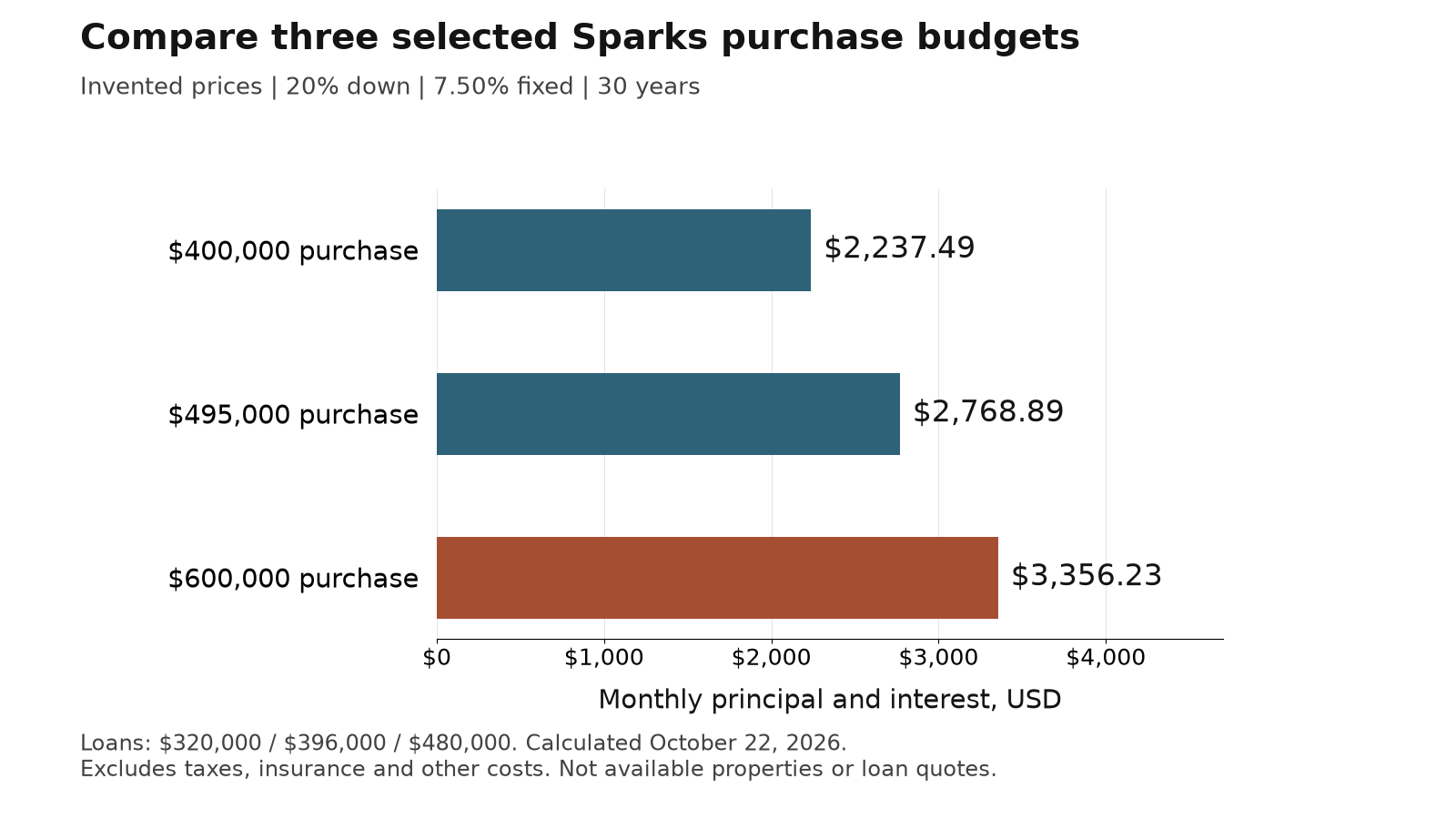
This guide compares chosen Sparks purchase budgets of $400,000, $495,000 and $600,000 without promising specific home sizes or neighborhoods. At an assumed 7.50% fixed rate for 30 years with 20% down, the $495,000 example has $2,768.89 monthly principal and interest. Taxes, insurance, association charges and operating expenses are additional. Compare actual property features, service responsibilities, repair needs and retained cash before deciding which home provides useful value.
- A dated Sparks price statistic describes a selected market, not a guaranteed house.
- The $495,000 middle budget is an example, not a claim about today’s median.
- Compare useful rooms, property condition and location against your own requirements.
- Confirm service providers, association responsibilities and address-specific charges.
- Count both recurring expenses and immediate work before comparing two prices.
- Keep cash retained for repairs and household needs separate from closing charges.
How we know this: Across the 9,600+ closings Nevada Real Estate Group has represented statewide — more than $4.85B in closed volume — a meaningful share sit right around the Reno-Sparks median, so we see what that budget buys every week. In my experience, buyers who name their single top priority first — newest, biggest, or best location — get far more for $495,000 than buyers who try to maximize all three at once.
The dated public evidence and original worksheets below have separate methods. The worksheets use explicitly chosen assumptions; they are not a new study of company transactions, a current listing sample or a lender’s offer. The original budget choices remain useful for comparing costs even when the market’s published median changes.
What Does the Latest Sparks Price Actually Describe?
According to NREG’s Sparks city market report, the published August 2026 single-family selection had a $584,500 median sale price and 103 closings, as reviewed October 22, 2026. This is an affiliated NNRMLS/Repliers city summary. It is a dated closed-sale measure, not an October asking-price sample, a combined Reno–Sparks figure or a prediction of what an individual house will sell for.
We've represented buyers at this price point across all of Sparks, so treat the median as a starting budget, not a house. To use a market number well, keep its geography, month and property type attached. The middle transaction in a selected group cannot tell you whether an available home has a usable office, a particular yard, a sound roof or the association arrangements you want. Those are separate questions requiring evidence about the actual candidate.
This guide keeps $400,000, $495,000 and $600,000 as selected comparison budgets. It does not rename the middle example as the current median or promise a bedroom count at any tier. A property’s condition and obligations can change its value to you even when the asking price matches one of those figures exactly.
Start from the Sparks housing hub and compare relevant recent closed sales alongside the homes currently offered. Check whether each comparable shares the location, property type, size and material condition of the candidate. A seller’s list price is a proposal; a closed price describes a completed transaction. Neither becomes an individual valuation simply because it appears beside a citywide statistic.
How Should You Define What Your Sparks Budget Must Buy?
Write the requirements before sorting listings. A useful requirement is observable: a bedroom and full bathroom on the entry level, space for a particular vehicle, a separate work area, or a yard you can maintain. “Best value” becomes easier to assess when it means a home meeting those requirements within your own cost and cash limits. A large advertised floor area alone cannot establish that result.
Divide the list into essentials, preferences and features you would pay nothing extra to obtain. Then ask what evidence establishes each item. A floor plan can identify room relationships, while an actual visit can reveal how furniture, storage and circulation work. A listing photograph cannot verify a permit, the condition of an inaccessible system or a future maintenance expense. Keep those unanswered questions visible instead of assuming favorable answers.
Use the Northern Nevada communities directory to organize locations without treating a broad marketing label as a service boundary. A Sparks mailing address, a city boundary and a subdivision name are not interchangeable evidence about the responsible government, utilities or association. The parcel and its governing documents resolve questions that an attractive neighborhood description cannot.
Compare candidates using the same requirements. If one home lacks a needed room, estimate the practicality of changing it only after the appropriate professionals review the work; do not assume an inexpensive conversion. If another provides an amenity you will rarely use, recognize that its cost still affects the budget. This method lets you explain why one home fits better without making an unsupported claim that its entire neighborhood is superior.
| Requirement | Evidence to inspect | Tradeoff to consider | What could change the choice |
|---|---|---|---|
| Usable space | Actual layout, room dimensions and permitted use | More floor area may add upkeep without meeting the need | The essential room cannot work as intended |
| Manageable responsibilities | Property condition, association documents and service arrangements | Paid services may replace only part of the owner’s work | Important work remains outside the service contract |
| Practical location | Actual route and destination checks at relevant times | A preferred setting may add travel or access demands | The routine is inconvenient under realistic conditions |
| Sustainable cost | Loan Estimate, parcel tax record, insurance and association information | A lower price may accompany higher repairs or recurring charges | Cash reserves become inadequate for identified obligations |
What Should You Compare in Spanish Springs and Kiley Ranch?
Use Spanish Springs and Kiley Ranch as locations to investigate, rather than assigning every home there the same age, size or price. The practical question is whether a particular property gives you a useful layout and acceptable responsibilities. Verify the address, jurisdiction, construction stage and actual included features before describing it as the better use of a fixed budget.
For a new home, ask which lot and plan the advertised amount covers. Separate the base figure from lot premiums, selected finishes, required items and work that remains after delivery. Confirm whether photographs show the actual home, a furnished model or optional features. A model’s landscaping, storage and finishes can influence the impression of value even when they are not part of the proposed purchase.
For an existing home, review the actual condition and changes made since construction. A relatively recent build can still need repairs, have equipment approaching replacement, or contain alterations requiring further investigation. Conversely, a maintained older home may meet your needs without the work you initially expected. Age is a starting question, not a complete condition report.
Travel belongs in the comparison as well. Check the route to your own destination at the times you expect to use it, including the arrangements needed when conditions disrupt the usual trip. No drive was timed for this guide, and no universal commute advantage is assigned to either community. If a larger home requires a routine you would dislike, the extra space may not be useful value. Compare the complete proposal and the daily routine before choosing between new and resale options.
What Can Established Central Sparks Offer a Budget Buyer?
An established location may fit a buyer who values an existing street pattern, access to particular destinations or a property with features already in place. The value depends on the home itself. This guide does not assign a standard lot size, construction period or repair bill to central Sparks, and it does not claim that a chosen price reliably buys a particular house there.
I steer buyers here when they want to be close to the action — the Sparks Marina, Victorian Square events and farmers markets, and quick freeway access to the rest of the metro — and are comfortable trading brand-new construction for an established central location. Confirm the specific activities, current schedules and routes that matter to you; the location description is not a guarantee of year-round programming or a measured trip time.
The Sparks Marina area provides another place to compare actual candidates. Look at the relationship between the home and the destination you intend to use: parking, walking routes, crossings and access points may matter more than a straight-line distance on a map. Do not assume that proximity creates private access, membership or a maintenance obligation without checking the applicable documents.
For an older property, review the roof, heating equipment, electrical and plumbing systems, drainage, prior work and inspection findings. Ask for the records supporting a claimed improvement. A recently painted room is not evidence that an underlying problem has been resolved. Obtain appropriate specialist advice where findings warrant it, and account for work that may be inconvenient to complete after moving in. Location can be a strong reason to choose a home, but it does not eliminate the cost of maintaining it.
How Do Golf Settings and Association Obligations Change the Comparison?
Compare Wingfield Springs and D’Andrea on the actual property, its documents and the amenities you would use. A golf-oriented setting is not evidence that every owner receives a membership, that a view is protected or that a particular home will appreciate faster. The cost and practical value of an amenity depend on the arrangement attached to the address and your intended use.
I bring these communities into the conversation for buyers who prioritize setting and lifestyle over raw size, or who are downsizing. Translate that preference into specific questions. What can the owner use? Which charges are mandatory, which are optional, and which organization collects each one? Are there separate association layers or facilities with their own terms? A single monthly number in a listing may not answer the complete set of questions.
Read the actual maintenance responsibilities alongside the charges. Exterior work, landscaping, roads and common facilities may have different responsible parties. Ask about the current budget, relevant notices, planned work and obligations affecting the property. Do not assume an assessment is absent simply because the listing does not mention one, or that a higher recurring charge necessarily pays for more of your own maintenance.
Compare the outcome with a home in a different setting using the same requirements. A smaller property can be the better fit if it supplies the layout and routine you want, while a larger one can be preferable when the added rooms are useful and its responsibilities are manageable. Neither choice establishes a universal neighborhood ranking. Keep future resale separate from today’s enjoyment; this guide has not measured a neighborhood appreciation premium.
How Do the $400,000, $495,000 and $600,000 Examples Compare?
The three budgets illustrate financing differences while holding the assumptions constant. Each uses a chosen 20% down payment, a 30-year fully amortizing fixed loan and a 7.50% annual interest rate. Calculated October 22, 2026, the results below exclude property taxes, insurance, association charges, mortgage insurance where applicable and other expenses. They are not available properties or approved loan offers.
According to Freddie Mac’s Primary Mortgage Market Survey, the national 30-year fixed average reported October 22, 2026 was 7.32%. That published benchmark is separate from the deliberately chosen 7.50% worksheet rate. A borrower’s actual terms depend on the loan and lender proposal; the national average is not a Sparks quote and does not establish personal eligibility.
Holding the rate, term and down-payment share steady makes the price difference visible. It does not establish that the higher budget buys an extra bedroom, more land or a particular community. To answer that question, compare current candidates meeting your requirements and verify their features. A larger borrowing amount may purchase something you value, but it also creates a larger recurring obligation under these assumptions.
Use the figures as a method you can reproduce with actual terms. If the down payment or rate changes, recompute the payment rather than carrying over the table’s result. Compare the loan amount and cash needed as well as the monthly figure. An apparently lower payment can result from different financing assumptions, a different term or a temporary arrangement, so it cannot be judged fairly without reading what produced it.
| Purchase price | Down payment | Loan amount | Monthly principal and interest |
|---|---|---|---|
| $400,000 | $80,000 | $320,000 | $2,237.49 |
| $495,000 | $99,000 | $396,000 | $2,768.89 |
| $600,000 | $120,000 | $480,000 | $3,356.23 |
What Belongs in a Complete Monthly Ownership Budget?
Build the budget in layers so that a mortgage figure does not silently become a claim about every expense. Start with the loan’s principal and interest, then add verified taxes, insurance and required association charges. Add separate allowances for maintenance and utilities using the property and household’s circumstances. Transportation, food, debts and other ordinary spending still need their own place in the household plan.
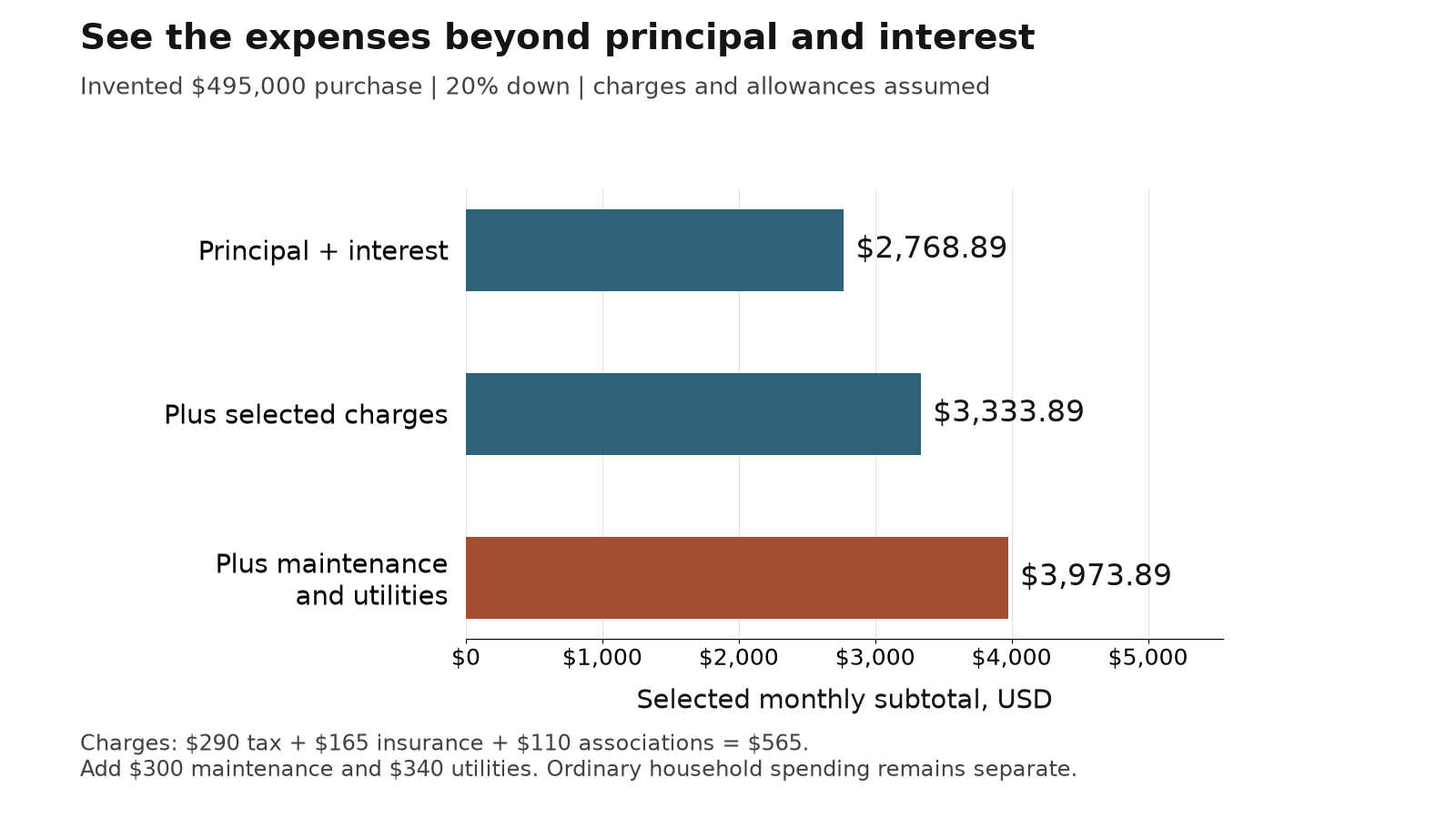
For an invented October 22, 2026 example, take the $495,000 purchase above and add $290 monthly taxes, $165 insurance and $110 association charges to $2,768.89 principal and interest. The selected subtotal is $3,333.89. Adding $300 for maintenance and $340 for utilities produces a broader owner budget of $3,973.89 monthly. Every charge and allowance here is assumed; none is a Sparks average, bill or quote.
The most expensive mistake I see is shopping on price alone and ignoring the all-in monthly cost. Replace each assumption with the actual document or a reasoned household estimate before relying on the total. Check whether a charge is billed monthly, quarterly or annually. Converting it to a monthly average helps comparison, but it does not change when the money must actually be paid.
Avoid double counting. A service included in association dues should not also appear as a separate contracted expense unless you will pay for additional work. Likewise, a repair already funded from a dedicated reserve should be tracked consistently rather than treated as both a new expense and an unexplained cash withdrawal. The Sparks cost-of-living guide provides broader household context; its dated examples also require their own current inputs.
How Should You Check the Actual Washoe County Tax Line?
Use the parcel’s own record and applicable tax year rather than multiplying the purchase price by a number remembered from another transaction. According to Washoe County’s tax-cap guidance, qualifying primary residences can receive a partial abatement limiting the increase in the property-tax bill to 3%, with qualifications and exceptions. This is a limit on bill growth under the described framework, not a tax rate equal to 3% of the home’s price.
The county guidance reviewed October 22, 2026 also discusses ownership information and the documentation used to establish the appropriate status. Do not assume a seller’s classification automatically resolves a buyer’s situation. A new property or an improvement added to the roll can raise questions different from those for an unchanged existing home. Confirm the relevant facts with the county or a qualified adviser for the actual transaction.
Keep a record of the parcel identifier, tax year, amount and any unresolved status question. Ask the lender how its estimated payment reflects the tax information available, and reconcile it with the documents used at closing. A convenient monthly allowance in this article is only a placeholder until that work is done.
This matters when comparing a completed resale with new construction. The documents available at the time of an initial proposal may not describe identical stages of assessment. It also matters when two homes have similar asking prices but different histories or improvements. Do not treat the difference as a permanent advantage without understanding its basis. No individual tax calculation, abatement eligibility or future bill has been verified for this guide.
How Can Water and Other Service Charges Change the Picture?
According to Truckee Meadows Water Authority’s customer FAQ, its water bill includes a monthly customer charge and usage charges structured in tiers. The customer guidance reviewed October 22, 2026 supports separating fixed and consumption-related parts of the bill. It does not mean that this article has verified a current tariff amount for your meter, the service provider for every Sparks-area address or the future cost of your own usage.
Ask which provider serves the parcel and what account arrangements apply when ownership changes. Review available bills with their dates, billing periods and usage rather than accepting an isolated dollar amount. A prior occupant’s household size, irrigation choices, equipment condition and time at home can differ from yours. An old bill can reveal questions to investigate without predicting your next bill exactly.
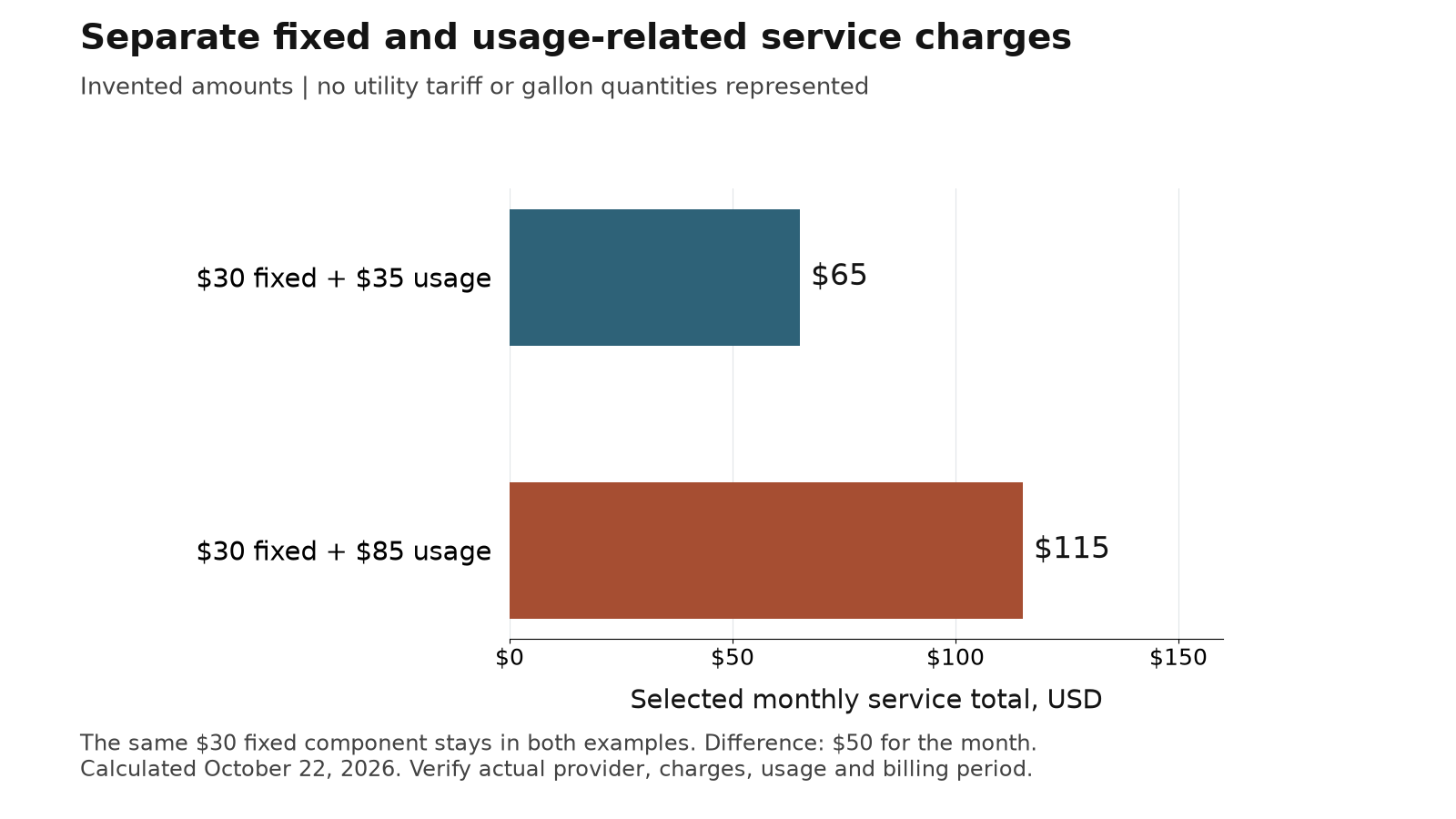
Consider an entirely invented service example calculated October 22, 2026: a $30 fixed component plus $35 usage totals $65, while the same fixed component plus $85 usage totals $115. The difference is $50 for that month. Those are explanatory inputs, not TMWA rates or charges for specified gallon amounts. The point is that reducing usage changes only the consumption-related portion in this simplified example.
Apply the same discipline to sewer, energy, trash and other services: verify the actual provider, included service, billing responsibility and current proposal. This guide did not verify a Sparks sewer tariff or combine several utilities into a claimed official rate. If you use a single utility allowance in the owner budget, make clear what it covers before adding any separate service estimate. Inspect leaks or equipment concerns through the appropriate review instead of assuming that a high bill is entirely a lifestyle choice.
What Property and Insurance Questions Belong Before an Offer?
According to the City of Sparks Engineering Services information, the division’s work includes parcel and subdivision maps and floodplain management. The page reviewed October 22, 2026 identifies an appropriate place to begin relevant questions. It does not establish that any property discussed here is in a particular flood zone, has approved improvements or has been cleared for a proposed use.
Check which jurisdiction is responsible for the actual address. Then identify the record needed: a map, permit history, drainage information or a specialist’s assessment may answer different parts of the problem. An apparent slope, nearby water feature or attractive landscape photograph is not a complete hazard assessment. No parcel-specific map review or property inspection was conducted for this guide.
According to the Nevada Division of Insurance’s wildfire recovery guidance, policy terms and coverage questions matter when assessing a loss and the arrangements for additional living expenses. Its recovery-focused information, reviewed October 22, 2026, is a reason to read an actual policy proposal carefully; it is not a buyer’s quote or a guarantee that a particular risk is covered.
For a purchase, obtain an address-specific insurance proposal early enough to understand its price, deductibles, exclusions and conditions. Ask the insurer to explain questions rather than assuming a standard policy covers every hazard or every rebuilding cost. Separate what has been confirmed from what remains pending, and reflect the actual proposal in the monthly budget. A home that appears affordable before this review may require a different plan once the obligations and coverage are understood.
How Should You Compare New Construction With a Resale Proposal?
Compare complete written proposals for actual homes, using the same financing assumptions where possible. In my experience, buyers who prioritize a move-in-ready modern home lean new, while buyers who want space, a central location, or golf amenities lean resale. I've toured both sides of this trade many times across Sparks, and the deciding factor is almost always which compromise you can live with daily and how your commute lines up.
For a builder proposal, identify what the purchase includes and what remains your responsibility after delivery. Review completion timing, selected features, warranty terms and the conditions attached to any incentive. A promotional monthly payment requires its own terms; it should not replace a review of the loan amount, permanent payment and cash requirements. Do not assume that an advertised plan is available on a suitable lot at the illustrated price.
For a resale, document the condition, included items, inspection findings and work you would need before occupying it as intended. According to EPA’s lead-disclosure guidance, many transactions involving housing built before 1978 have lead-disclosure requirements, with exceptions. The source reviewed October 22, 2026 supports asking the appropriate questions; age alone does not verify a lead hazard or provide legal clearance for a particular transaction.
Keep the different categories of evidence separate. A warranty is not an inspection, an inspection is not a promise that nothing will fail, and a seller’s repair description is not necessarily a specialist’s assessment. Compare the work you expect to undertake, its practicality and the funds available to handle it. The choice should survive those details rather than depending on a broad assumption that either new or resale is always cheaper to own.
When Can a Lower Price Require More Cash or More Work?
A lower price can still create an immediate work requirement that changes the comparison. Use actual findings and written proposals where available, and keep uncertain items visible. Cosmetic preferences can sometimes wait; work necessary for the intended occupancy, financing or safe use may not. The relevant question is how the purchase and identified work fit together, including timing and the household’s ability to manage the disruption.
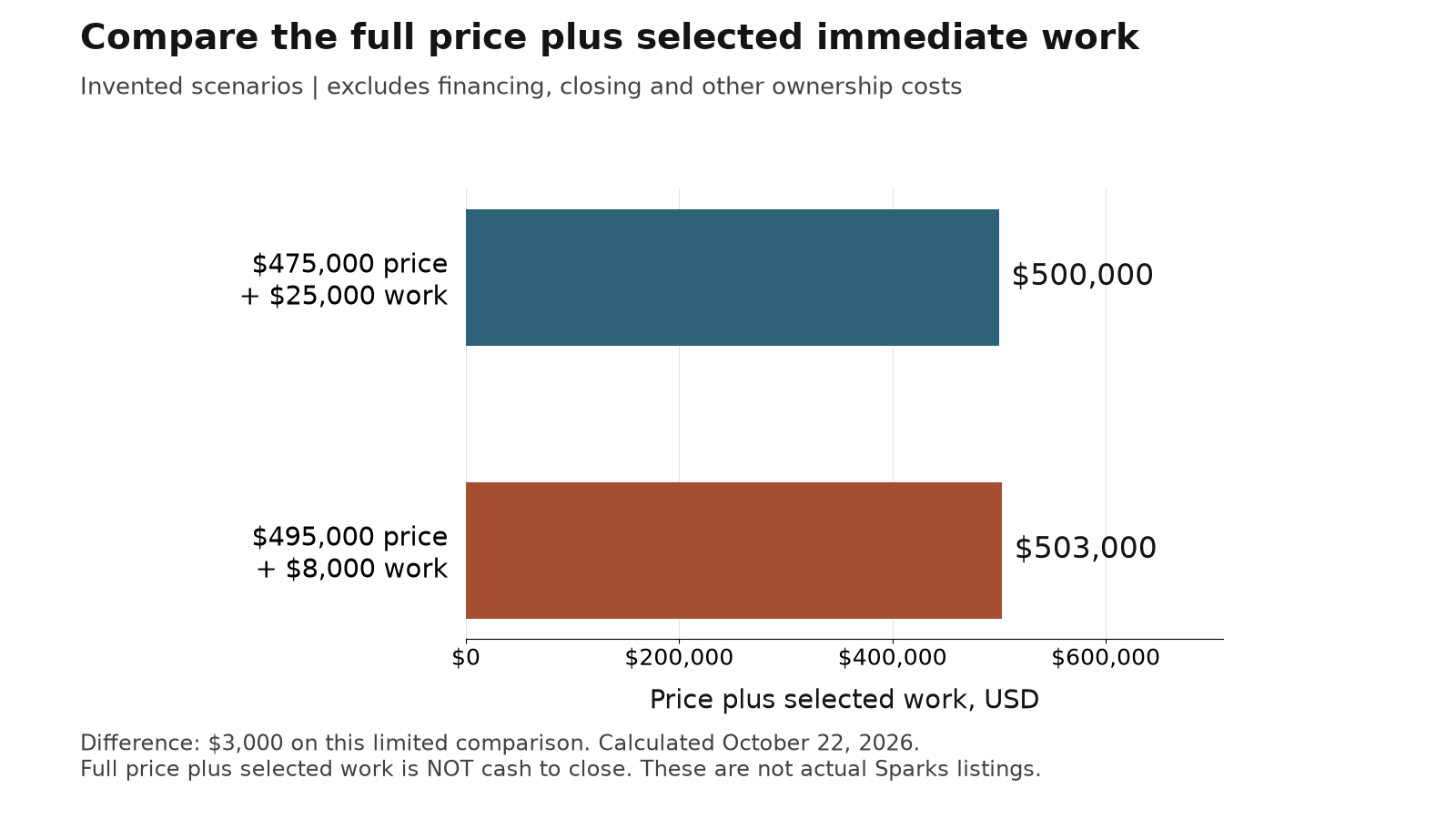
For an invented October 22, 2026 comparison, suppose one home costs $475,000 and requires $25,000 of selected immediate work. Its price-plus-work total is $500,000. Another costs $495,000 with $8,000 of selected work, totaling $503,000. The second is $3,000 higher on this limited comparison, even though its purchase price alone is $20,000 higher. These are assumed scenarios, not current Sparks listings or contractor estimates.
That calculation does not make the homes equivalent and is not a cash-to-close figure. Financing, closing costs, insurance, ongoing maintenance, the scope of the work and the finished result may differ. A repair allowance can also prove inadequate when additional findings emerge. Obtain the appropriate advice and quotes instead of assuming that the arithmetic resolves the property’s condition.
The worksheet is most useful when it makes the next question clear. If the lower-price home has an uncertain system problem, resolve that uncertainty before treating the apparent saving as money available for something else. If the higher-price home merely looks finished, verify what was done. A tidy presentation is not a substitute for records, and the ability to fund work matters separately from willingness to live through it.
| Selected scenario | Purchase price | Immediate work | Limited combined amount |
|---|---|---|---|
| Lower price, more work | $475,000 | $25,000 | $500,000 |
| Higher price, less work | $495,000 | $8,000 | $503,000 |
How Much Income and Retained Cash Should You Plan Around?
Loan approval and household comfort answer different questions. I always start buyers with a real pre-approval so we anchor the search to what you actually qualify for. The lender’s assessment does not replace your own review of take-home income, debt payments, transportation, care costs, savings goals and irregular expenses. A household can qualify for an amount that it does not want to commit to every month.
Using the invented $3,333.89 selected property-payment subtotal, a voluntarily chosen 30% of gross income screen implies $133,355.60 annual gross income. That is a calculation, not a Sparks salary requirement or lender rule. Using a different chosen share changes the result, and gross income does not describe the amount available after withholding and other deductions.
For a separate take-home test, assume $8,000 monthly take-home pay, the $3,973.89 owner budget above and $2,800 other spending. The remainder is $1,226.11. If another $600 expense arrives, it falls to $626.11. These October 22, 2026 examples are invented and do not establish what a particular family should spend. They expose the room available under the stated assumptions.
Cash planning needs similar clarity. In the $495,000 example, $99,000 down, $15,000 closing and prepaid costs, $8,000 immediate work, $7,000 moving and setup, and $25,000 retained reserve account for $154,000. The reserve stays with the household; it is not a closing charge. Replace these amounts with actual terms and identified needs, and avoid allocating the same savings twice. The Sparks salary guide offers a related income-planning framework with its own dated assumptions.
What Should You Verify in Loan Estimates and Down-Payment Choices?
According to the Consumer Financial Protection Bureau’s Loan Estimate guide, the form organizes loan terms, projected payments and closing-cost information for review. Use that structure to compare actual proposals rather than relying on a quoted interest rate or a promotional payment alone. Check the assumptions, timing and conditions that make each proposal applicable to your transaction.
A lower down payment may preserve cash but increase borrowing or create other financing costs. A larger down payment reduces the amount borrowed while leaving less cash available for work and reserves. Neither direction is automatically right for every household. Ask the lender which programs are available for the actual borrower and property, what insurance or other charges apply, and how the payment and cash requirements change.
Do not infer universal eligibility or automatic mortgage-insurance cancellation from the 20%-down worksheet. It is a deliberately simple comparison, not a program guide. The Nevada FHA explanation and VA explanation provide separate program context where relevant; an individual approval still requires the lender’s current review. Compare all applicable costs, not just the down-payment percentage.
Keep enough detail to understand a lender or seller credit. What cost does it cover, what conditions attach, and does taking it change another part of the proposal? Ask for the payment that applies after any temporary benefit ends. A future refinance is not assured and should not be necessary to make an unaffordable purchase appear workable. The Reno purchase-cash guide addresses the separate upfront-funding decision in more detail. Its dated examples require current inputs; this Sparks comparison focuses on what the chosen property provides and the obligations it creates.
How Should You Prepare Without Assuming Every Home Sells at the Same Speed?
Prepare before a promising home appears, while judging each opportunity on its actual circumstances. In my experience, buyers who are pre-approved and clear on their priorities can act within a day or two of the right home hitting the market, which is often the difference between winning and losing a well-priced Sparks house in the busy season. That is why I front-load the preparation before we ever tour.
Keep your financing information current, identify the documents still needed and know which requirements are essential. Review the particular listing’s status, relevant comparable sales, condition and proposal deadlines. An overall market statistic cannot tell you whether that seller will negotiate, whether other offers exist or which contractual protection you should accept. This guide makes no universal days-to-contract promise or seasonal discount forecast.
Location and operating responsibilities also deserve early attention. Sparks, like the rest of Northern Nevada, carries real winter operating costs a warmer market does not, so I fold heating and snow-season upkeep into the conversation. Identify who handles the actual road, driveway and other work affecting the property, and budget for your own responsibilities. No street-service schedule, snowfall amount or winter route time was measured here.
Use the Sparks relocation guide for broader move planning and confirm changeable details when needed. If the purchase depends on selling another home, coordinate the actual financing and possession arrangements with the appropriate professionals. Read the contract and inspection timelines rather than relying on a general market description. Preparation should improve the quality of the decision, including the ability to decline a property whose unresolved obligations do not fit the plan.
How Do You Turn These Comparisons Into a Useful Sparks Shortlist?
Build the shortlist from actual homes that meet the essential requirements, then compare the remaining choices consistently. I keep a live read on which area is offering the most at any given time. For each candidate, keep the source and date beside the facts: listing details, parcel records, financing terms, inspection findings, insurance proposal and association information should not blur into a single unsupported impression of value.
The two markets are closely linked, so I shop both for value depending on your priorities. If Reno also fits the search, compare Reno homes using the same requirements and cost categories. Keep each property’s location and responsibilities clear. A citywide median difference cannot prove that one specific Sparks home is a better purchase than one specific Reno home, and future appreciation remains uncertain.
Return to the preference list after reviewing the costs. Does the home provide the room, access or setting you actually need? Can you handle the identified work and recurring responsibilities? What important answer is still missing? A property that wins on only one headline feature may fall behind once the full evidence is assembled. It is reasonable to revise the shortlist when a material fact changes.
Use current Sparks homes for sale with your actual price ceiling and requirements rather than treating the illustrated budgets as a promise of inventory. As the lead brokerage serving Northern Nevada, Nevada Real Estate Group does this every week for buyers at exactly this price point. Call our Reno–Sparks team at (775) 277-2120 or contact us to compare candidates against the features, costs and responsibilities that matter to your purchase.
Frequently Asked Questions
What is the median Sparks home price in 2026?
The reviewed NREG city report publishes an August 2026 single-family median of $584,500 from 103 closings. Keep that month, city and property selection attached. It is not an all-year figure, a current asking-price sample or a valuation of a particular home. The $495,000 example in this guide is a chosen budget.
What does $495,000 buy in Sparks?
The answer depends on the actual available homes, their features, condition, location and obligations. This guide does not guarantee a size, age, bedroom count or community at that amount. Compare candidates against your requirements and confirm their documents and costs before treating the price as proof of useful value.
How much is the mortgage payment in the middle example?
At a chosen $495,000 purchase price with 20% down, the loan is $396,000. At an assumed 7.50% fixed rate over 30 years, monthly principal and interest are $2,768.89. Taxes, insurance, association charges and other ownership expenses are additional. Actual financing terms require a lender’s proposal.
Does buying in Sparks always give more space than Reno?
No universal size advantage is established here. Compare equivalent current candidates and the rooms you can actually use, alongside condition, cost and the locations that fit your routine. A citywide median does not control the price or features of every property, and more square footage does not automatically meet your needs better.
Are the water-bill examples actual TMWA rates?
No. The $30 fixed component and the $35 or $85 usage components are invented inputs illustrating why fixed and consumption-related charges should be separated. Confirm the provider, current applicable charges, usage and billing arrangements for the address. No gallon quantities or current tariff amounts are represented by that worksheet.
Is the 3% property-tax cap a purchase-price tax rate?
No. Washoe County describes a partial abatement that limits tax-bill increases for qualifying properties, with qualifications and exceptions. Review the actual parcel, tax year and status. The rule does not mean that a buyer can determine the annual bill by multiplying the purchase price by 3%.
Is a less expensive home with repairs always the better deal?
No. Compare the actual scope, cost, timing and practicality of the work, alongside financing and ongoing expenses. The invented price-plus-work example excludes many costs and does not make the homes equivalent. Unresolved condition questions can change the decision, so obtain the appropriate inspections, records and written proposals.
Does the $154,000 cash example all go to closing?
No. It includes the assumed down payment, closing and prepaid costs, immediate work, moving and setup, and a $25,000 reserve retained by the household. It is a planning total, not a settlement quote. Replace every assumption with actual transaction terms and household needs, and avoid counting the same cash twice.
Which Sources Inform This Sparks Budget Guide?
Sources were reviewed as of October 22, 2026. NREG’s Sparks city report supplies an affiliated, dated single-family summary. It was not independently recomputed from individual transactions. No current listing or home-size sample was collected, and the original company statements are separate from the published market selection and invented worksheets.
Washoe County tax-cap guidance, TMWA’s customer FAQ and Sparks Engineering Services inform property-specific questions. No individual tax eligibility, current utility tariff, sewer fee or parcel flood-map result was verified. The service example deliberately uses invented amounts.
Nevada Division of Insurance wildfire recovery guidance and EPA lead-disclosure guidance identify matters for appropriate review; they do not provide an individual policy, hazard determination or legal clearance. Freddie Mac PMMS supplies national rate context, and the CFPB Loan Estimate guide supports comparing written financing terms.
The mortgage, owner-cost, service, work and cash examples are original calculations with disclosed assumptions. They are not client results, available listings, contractor quotes or forecasts. The cover is conceptual, and the four charts visualize those examples. Companion guides have their own dated scope; confirm their changeable details when applying them to an actual decision.
Nevada Real Estate Group · Chris Nevada · License S.181401 · (775) 277-2120.