
Published June 3, 2026 · Updated June 3, 2026 · By Chris Nevada, Nevada Real Estate Group · NV License S.181401
For years, Reno was the place people drove through on the way to Lake Tahoe — "the Biggest Little City," the casino town with the old arch over Virginia Street. That Reno still exists, but it's no longer the whole story. Over the last decade Reno has reinvented itself into one of the most compelling relocation values in the West: a high-desert university city with no state income tax, four real seasons, a deep-blue alpine lake 45 minutes up the hill, and a job market powered by Tesla, hyperscale data centers, and advanced manufacturing instead of just slot machines.
At Nevada Real Estate Group — the #1 real estate team in Nevada, with more than 9,600 closings over 16-plus years across the state — a growing share of the buyers we work with are leaving California and the Pacific Northwest for Reno specifically. They want what Reno offers and what the coast no longer does: space, sunshine, lower taxes, and a four-season outdoor lifestyle they can actually afford. Here are the ten reasons that come up again and again, with the 2026 numbers behind each one.
People move to Reno, Nevada for advantages California can't match: no state income tax, a median home price near $600,000 versus about $1.4 million in the Bay Area, Lake Tahoe 45 minutes away, four real seasons at 4,505 feet, and a job market anchored by Tesla's $6 billion-plus Gigafactory. With 3.9% unemployment and a 3.5-hour drive to San Francisco, Reno is one of the West's best relocation values.
- No state income tax and no retirement-income tax — saving a $100,000 household roughly $5,000–$8,000 a year.
- Reno's median home runs about $600,000 versus roughly $1.4 million in the Bay Area.
- Lake Tahoe is 23 miles away; Mt. Rose Ski Tahoe is the closest resort at about 25 minutes.
- Reno's economy now runs on Tesla, Panasonic, Switch, Google, and Apple — 3.9% unemployment in April 2026.
- At 4,505 feet, Reno gets four real seasons and about 21 inches of snow a year.
If you're weighing Nevada's two big metros against each other, our Las Vegas vs Phoenix comparison covers the southern side of the state; this guide is about why the north keeps winning relocations.
See what's on the market: Reno homes for sale shows every active MLS listing with current prices and photos.
How Does Reno Stack Up as a Place to Live in 2026?
Before the ten reasons in detail, here's the whole picture in one view — the numbers relocating buyers ask me about first:
| Metric | Reno / Washoe County |
|---|---|
| State income tax | None (constitutionally banned) |
| Median single-family home | ~ $600,000 (Reno city ~ $660K, Sparks ~ $564K) |
| City population (2024 est.) | 275,000 (metro 575,000) |
| Elevation | 4,505 ft (high desert) |
| Unemployment (Apr 2026) | 3.9% |
| Distance to Lake Tahoe | 23 miles (45 min) |
| Distance to San Francisco | 218 miles (3.5–4 hrs) |
| Combined sales tax | 8.265% (Washoe County) |
Source: U.S. Census Bureau, U.S. Bureau of Labor Statistics, Nevada Department of Taxation, Northern Nevada Regional MLS, and Nevada Real Estate Group analysis, 2026.
Why Does Nevada's Lack of a State Income Tax Make Reno So Attractive?
This is the reason that starts most of my Reno conversations, and it's not a loophole — it's the state constitution. According to the Tax Foundation, Nevada is one of only nine states with no individual income tax, and that status is locked into Article 10 of the Nevada Constitution, which makes it extraordinarily hard to repeal. Nevada funds itself through sales and gaming taxes rather than taxing your paycheck, your capital gains, or your retirement income.
For someone moving from California, the math is dramatic. California's top marginal income-tax rate runs past 13%, and even a middle-income household pays several thousand dollars a year. According to the Nevada Department of Taxation, a household earning around $100,000 typically keeps an extra $5,000 to $8,000 every year simply by establishing genuine Nevada residency — and that gap widens fast for high earners and anyone selling appreciated stock or a business. Over a decade, that's $50,000 to $80,000 that stays in your pocket instead of Sacramento's.
It's not only wages. According to Kiplinger, Nevada taxes no retirement income at all — Social Security, pensions, military retirement, and 401(k), IRA, and Roth distributions are all free from state tax. Nevada also levies no estate tax, no inheritance tax, and no state capital-gains tax. For retirees drawing $80,000 or $120,000 a year in income, that's the difference between Nevada and almost every neighboring state. (One caveat I always give: to claim the savings you have to actually move your domicile — spend the days, get the Nevada license, register to vote — because California audits departing high earners aggressively.) We walk through the full mechanics in our Nevada state income tax explainer and our Nevada tax advantages guide.
| Household income | Reno (Nevada) tax | Approx. saved vs California |
|---|---|---|
| $75,000 | $0 | ~ $2,500–$3,500 |
| $100,000 | $0 | ~ $5,000–$8,000 |
| $150,000 | $0 | ~ $9,000–$13,000 |
| $250,000 | $0 | ~ $18,000–$25,000 |
| $120,000 retirement income | $0 | ~ $3,000–$9,000 |
Source: Nevada Department of Taxation and Tax Foundation, 2026. Simplified illustration; California liability varies by deductions and filing status.
How Much Further Does Your Housing Budget Stretch in Reno Than in California?
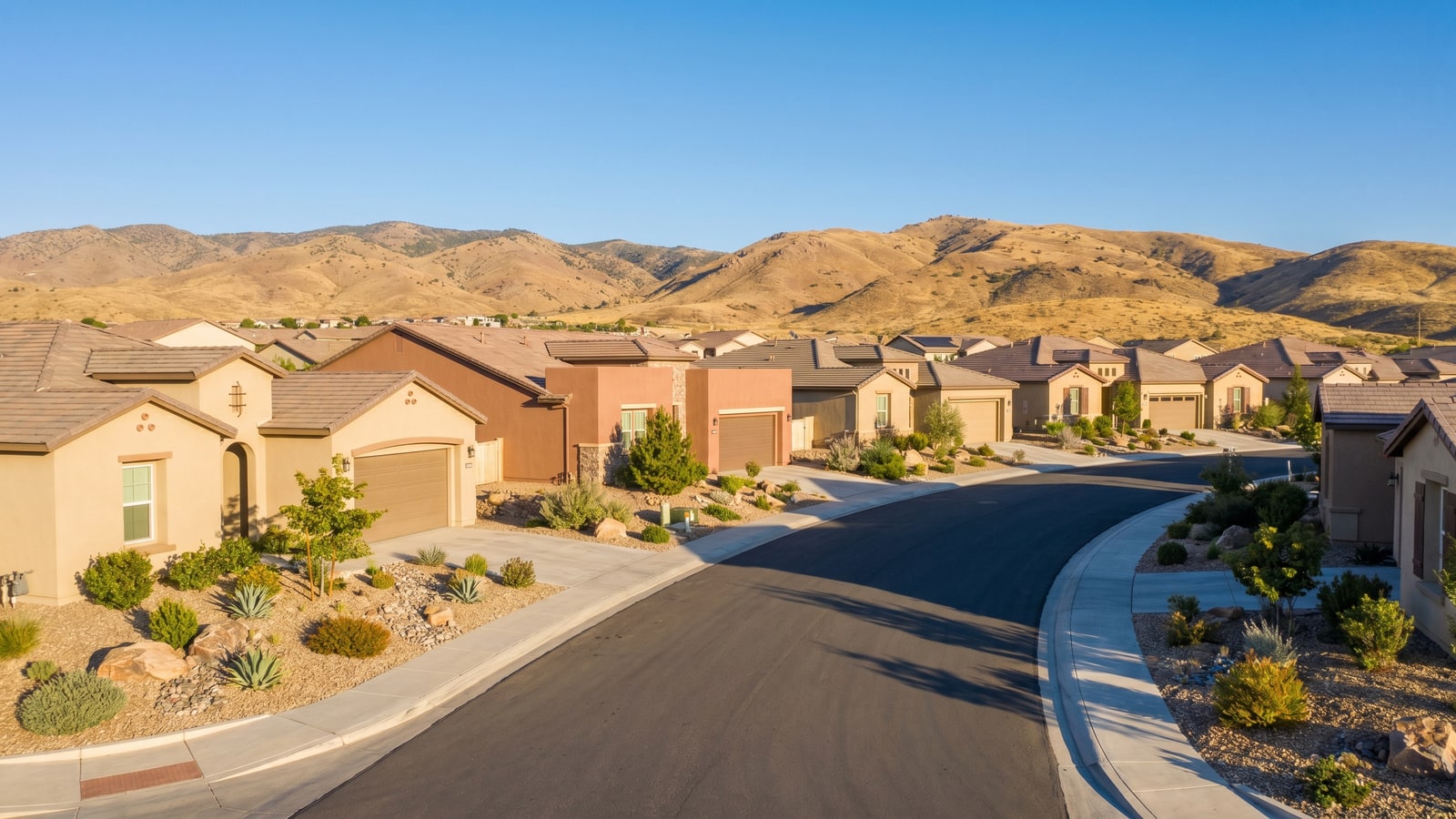
If the tax advantage gets people interested, the housing math is what closes the deal. According to Northern Nevada Regional MLS data compiled by the Reno/Sparks Association of REALTORS, the Reno-Sparks median single-family home price sits in the low $600,000s in 2026 — roughly $660,000 inside the city of Reno and about $564,000 in neighboring Sparks, with the metro median near $600,000 and up modestly year over year. Prices vary by submarket: newer South Reno areas like Damonte Ranch, Double Diamond, and Montrêux command a premium, while Sparks, Spanish Springs, and Sun Valley run lower. That is real money — but look at what it's being compared to.
According to the California Association of REALTORS, the San Francisco Bay Area median sat near $1.4 million in 2026, San Francisco County above $2.1 million, and the statewide California median hit a record around $915,000. Even the Los Angeles metro runs near $860,000. A Bay Area family selling a modest $1.4 million home can buy a comparable — often larger and newer — Reno home for $600,000, pocket the difference, and erase their mortgage or fund retirement. That single trade is the engine behind much of Reno's in-migration.
Day-to-day costs are reasonable too. According to cost-of-living indexes, Reno runs roughly 4% to 9% above the U.S. average depending on the methodology — driven mostly by housing — while utilities run about 15% below the national average. Median rent is around $1,800 a month (about $1,460 for a one-bedroom and $1,710 for a two-bedroom), a fraction of coastal-California rents. And once you own, Nevada's property-tax structure protects you: the effective residential rate in Washoe County is roughly 0.6% of market value, and according to the Washoe County Assessor, state law caps annual tax increases at 3% on owner-occupied primary residences — so your bill can't spike even when values climb.
Is Reno Really Just Forty-Five Minutes From Lake Tahoe and a Dozen Ski Resorts?
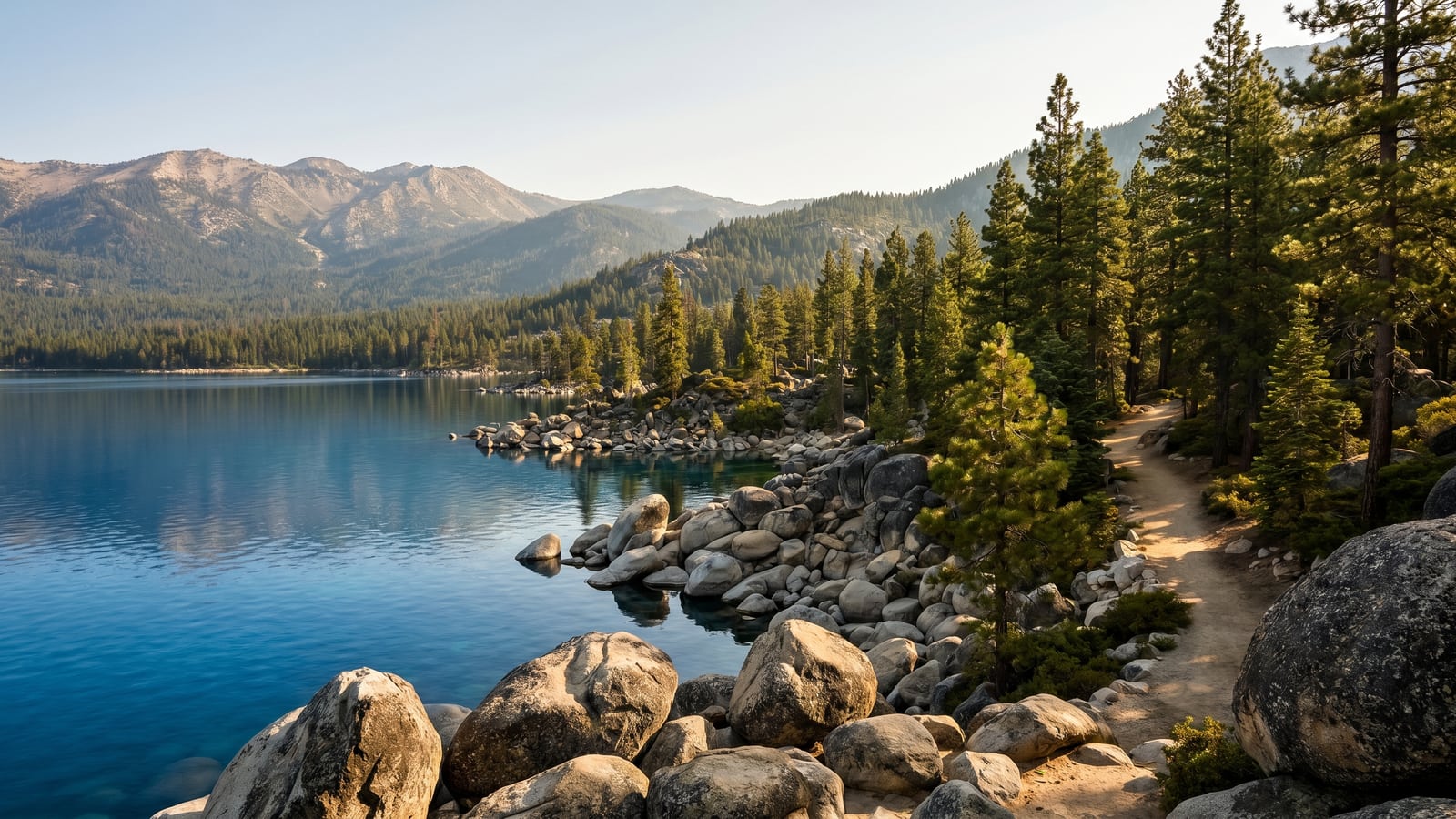
Yes — and for a lot of transplants, this is the reason. Lake Tahoe, one of the largest and clearest alpine lakes in North America, lies about 23 miles from Reno, an easy 45-to-60-minute drive depending on which shore you're aiming for. That means Tahoe isn't a once-a-year vacation; it's a Saturday. You can paddleboard a turquoise cove in the morning and be back in town for dinner. Tahoe's Nevada shore towns — Incline Village on the north end and Stateline at the south — even put lakefront living within reach for buyers who want it.
The skiing is just as close. According to Mt. Rose Ski Tahoe, the closest resort to Reno is about 24 miles / 25 minutes away and has Lake Tahoe's highest base elevation at 8,260 feet (summit 9,700), which means a long, reliable season. From there, the options fan out: Palisades Tahoe is roughly 45 minutes, Northstar about 40 minutes from the airport, and Heavenly around an hour. According to Visit Reno Tahoe, the region puts a dozen-plus ski areas — Palisades Tahoe, Northstar, Heavenly, Diamond Peak, Sugar Bowl — within about an hour of the city, one of the highest concentrations of resorts in the country. Buy a season pass and Reno becomes a four-season basecamp: Mt. Rose one direction, the Truckee River the other.
This proximity is a genuine quality-of-life multiplier you can't buy in Las Vegas, Phoenix, or most of California's interior. It's also why Reno real estate holds value: people don't just move here for a job, they move for the lifestyle the geography makes possible. If a four-season mountain-town life within reach of Lake Tahoe is the dream, Reno delivers it at a price the lake's California shoreline never could.
What Is Reno's High-Desert Climate Actually Like Across Four Seasons?
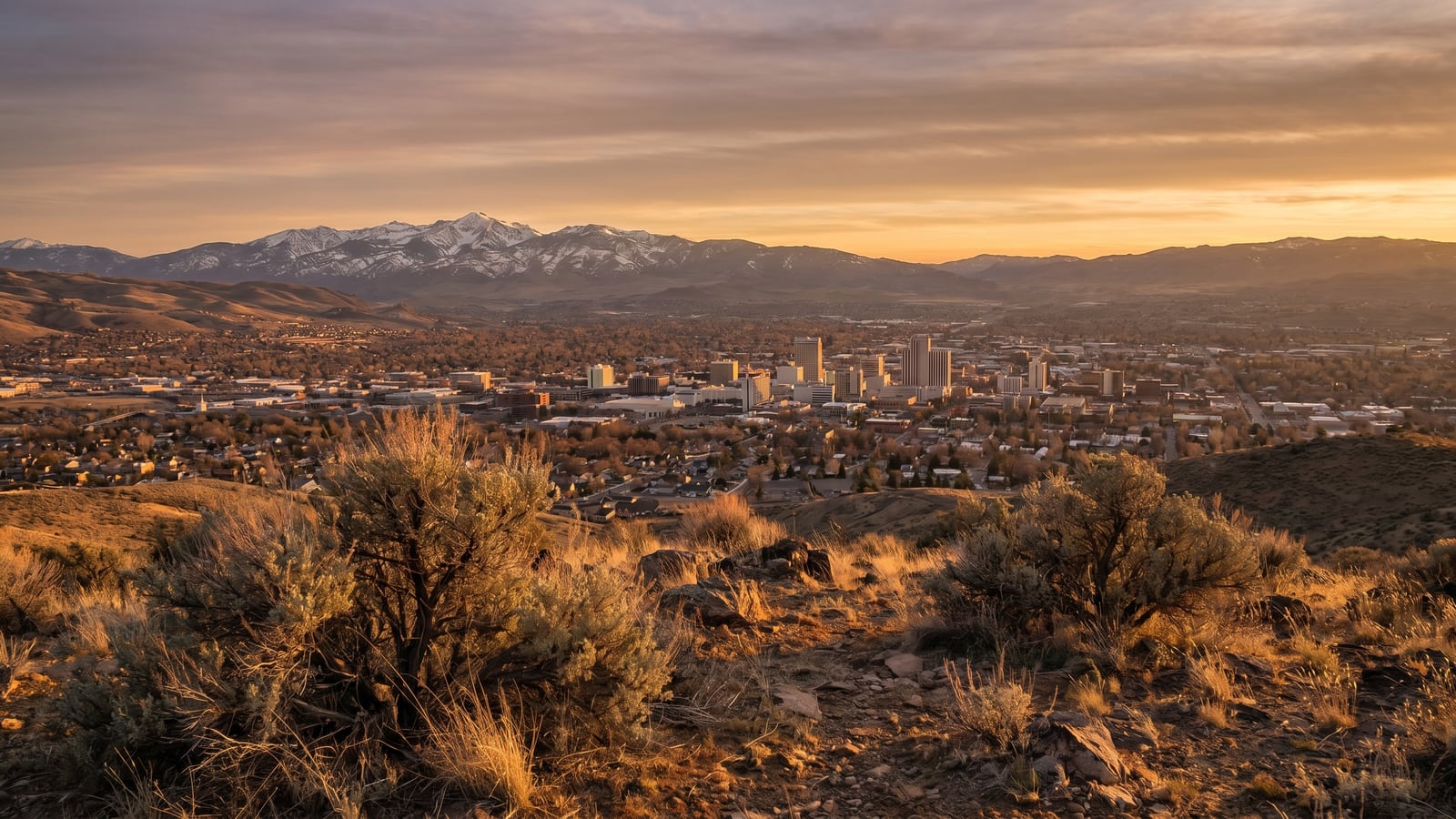
This surprises people who assume Nevada means relentless heat. Reno sits at 4,505 feet in the Truckee Meadows on the western edge of the Great Basin — with the Carson Range, Slide Mountain, and Peavine Peak framing the valley — and according to the Western Regional Climate Center, it has a cold semi-arid, high-desert climate — which means four genuine seasons, not the year-round furnace of the southern desert. Summers are hot and dry, with highs in the 90s, but low humidity and cool evenings; winters are crisp with overnight lows below freezing and real snow.
And there is snow — about 21 inches a year in the valley, with far more piling up in the surrounding Sierra and at Tahoe. That's the sweet spot a lot of relocators want: enough winter to ski and see the seasons change, but not the brutal, months-long lockdown of the Northeast or Midwest. The snow in town typically melts within days while the mountains stay loaded for skiing into spring.
Crucially, Reno stays sunny through all of it. According to climate data summarized by the regional tourism board, Reno enjoys roughly 82% of possible sunshine annually — marketed locally as "more than 300 days of sunshine a year." You get bluebird winter days, dry warm summers, and genuine spring and fall, all with very little of the gray, damp gloom that drives people out of the Pacific Northwest. For buyers fleeing both California wildfire-smoke summers and Seattle's nine months of overcast, Reno's high-desert four-season climate is a genuine relief — and in my experience it's the feature transplants underestimate most before they visit.
Why Is Reno's Job Market Booming Far Beyond the Casinos?
The old knock on Reno was a one-note, gaming-dependent economy. That's simply out of date. According to the U.S. Bureau of Labor Statistics, the Reno-Sparks metro unemployment rate was just 3.9% in April 2026, and according to Nevada's labor department, the metro added about 6,200 jobs (+2.2%) over the prior year, pushing nonfarm payrolls into the high-280,000s. The growth engine is the Tahoe-Reno Industrial Center (TRIC) just east of town — by land area, one of the largest industrial parks in the country, bigger than the city of Detroit.
Tesla anchors it. The company has invested roughly $6.2 billion in Gigafactory Nevada since 2014, and in this cycle announced a further expansion in the $3.5 billion range — a 4680 battery-cell plant and its first high-volume Semi truck factory — expected to add about 3,000 jobs. Tesla isn't alone: Panasonic Energy builds batteries on-site (around 38 GWh of capacity and roughly 4,500 regional workers), Switch runs a 2,000-acre, 100%-renewable data-center campus, Apple has invested more than $1 billion locally, and Google announced a $400 million expansion. According to the Economic Development Authority of Western Nevada, employers from Microsoft and Amazon to Patagonia and Chewy now run major Northern Nevada operations.
The diversification is deliberate and deep. According to EDAWN, Northern Nevada has roughly $26 billion in planned or under-construction projects, with advanced manufacturing, clean energy (Redwood Materials, Lyten, and Ioneer), and hyperscale data centers (Switch, Novva, and Vantage) leading the way and new-job salaries averaging above $76,000. For relocating professionals — especially in tech, manufacturing, logistics, and clean energy — Reno is no longer a gamble. It's one of the fastest-diversifying small economies in the West, and the business-friendly tax climate (no corporate income tax, just a low gross-receipts Commerce Tax that only applies above $4 million in revenue) keeps employers — and their workers — moving to Reno and neighboring Sparks.
Where Can You Play Outside in Reno When You're Not at Tahoe?
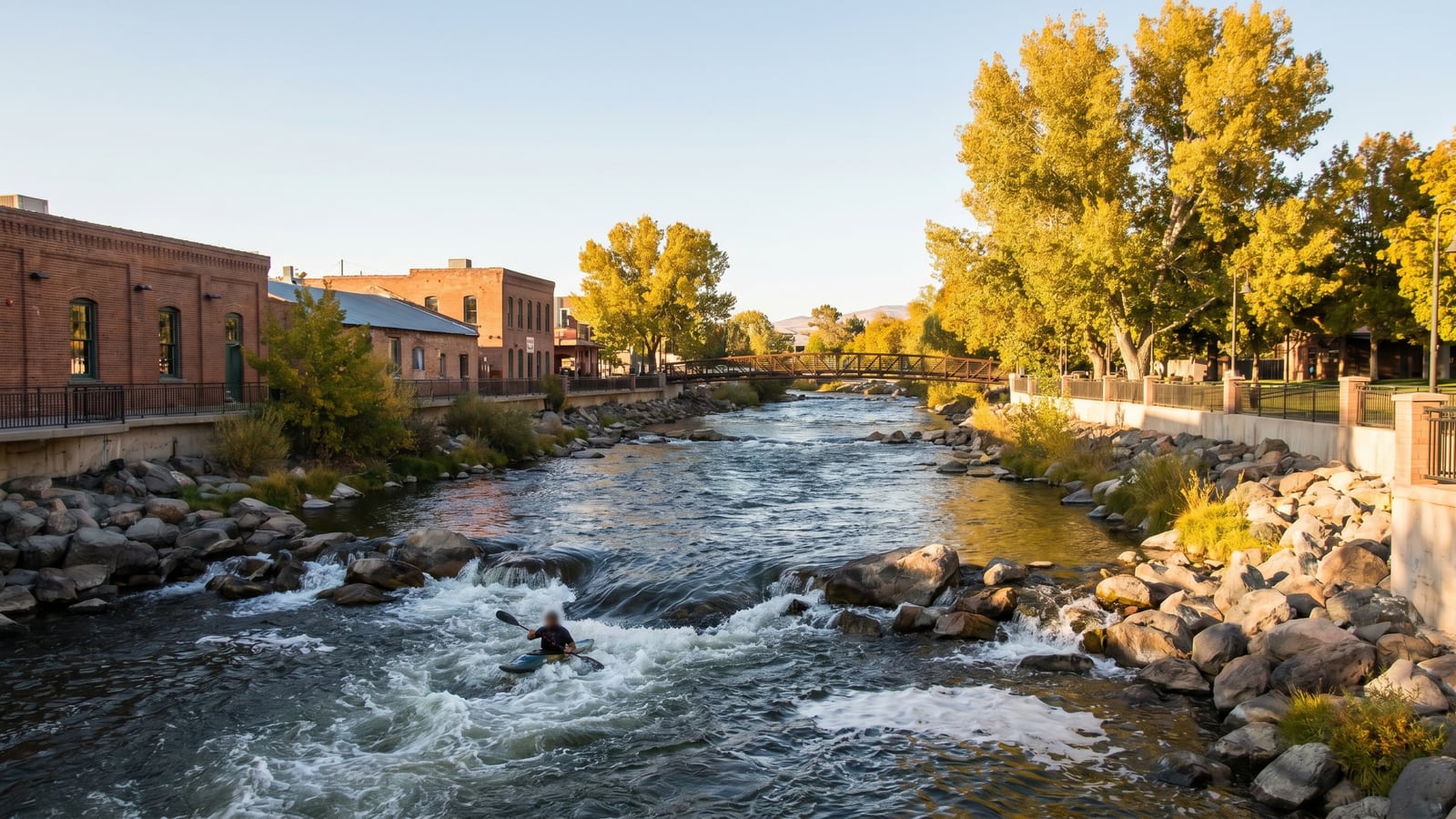
Tahoe gets the headlines, but Reno's everyday outdoor access is the part transplants rave about most. The Truckee River runs straight through downtown, and according to the City of Reno, the Truckee River Whitewater Park at Wingfield Park is a 2,600-foot, 11-drop-pool course with Class 2–3 rapids — free, open year-round, and a five-minute walk from the casinos. On a summer afternoon you'll see office workers kayaking and tubing on their lunch break.
Beyond the river, the high desert and the Sierra Nevada foothills are an open playground: hundreds of miles of hiking and mountain-biking trails climb straight out of neighborhoods like Somersett, ArrowCreek, and Caughlin Ranch, and the Tahoe-Pyramid Trail follows the river for 100-plus miles. Galena Creek, the Mt. Rose Wilderness, and the Carson Range deliver alpine hiking 20 minutes from your driveway. To the north, Pyramid Lake — a desert lake on the Pyramid Lake Paiute reservation — draws anglers for its Lahontan cutthroat trout, while Carson City, the state capital a half-hour south, opens still more Sierra trailheads.
This is what I mean when I tell clients Reno is a "do-stuff" town. The 300-ish days of sunshine, the elevation, and the geography combine so that an active outdoor life isn't a weekend project requiring hours in the car — it's woven into ordinary days. I've helped mountain bikers, trail runners, anglers, and paddlers relocate here, and that everyday access is consistently what made the decision for them. For families especially, raising kids who can ski, hike, and kayak within minutes of home is a lifestyle that coastal California now reserves for the wealthy.
How Connected Is Reno to California and the Rest of the Country?
One of Reno's underrated advantages is that you don't have to fully leave California behind to escape its costs and taxes. According to Visit Reno Tahoe, the drive from Reno to the San Francisco Bay Area is about 218 miles via I-80 — roughly 3.5 to 4 hours. That's close enough to keep Bay Area clients, see family, or run a hybrid work arrangement, while living somewhere your dollar goes twice as far. Sacramento is even closer, under two hours down the hill.
Air travel is easy, too. According to Reno-Tahoe International Airport, RNO serves roughly 4.7 million passengers a year with 20-plus nonstop destinations on about 11 carriers — Southwest, United, Delta, American, and Alaska among them — with nonstop service to Los Angeles, San Diego, Seattle, Portland, Denver, Phoenix, Salt Lake City, Dallas, and Chicago, from a compact airport ten minutes from downtown. No two-hour security lines, no hour-long drive to the terminal. Reno is also the primary gateway to Burning Man, about 135 miles (three hours) north in the Black Rock Desert, which fills the city with energy and visitors each summer.
That blend — close enough to California to stay connected, far enough to live under a completely different tax and cost structure — is exactly what a lot of remote workers and hybrid professionals are after. You get the no-income-tax paycheck and the $600,000 house, and you're still a half-day drive or a one-hour flight from the coast. For relocating buyers who can't or don't want to cut every California tie, that proximity is the feature that makes Reno work where a move to Texas or Florida wouldn't.
What Do the University of Nevada and Local Schools Add to Reno?
A university changes the character of a city, and the University of Nevada, Reno anchors the north end of town. According to UNR's own reporting, the university retained its R1 "very high research" Carnegie designation in 2025 — the top national research tier — on the strength of a record $194 million in research spending in fiscal 2024, a 124% jump since 2013. With around 21,800 students, UNR brings the cultural amenities, talent pipeline, Division I athletics (the Wolf Pack), medical school, and intellectual energy that help explain why Reno feels younger and more dynamic than its size suggests.
For families, the public-school picture is solid and large. According to the Washoe County School District, WCSD serves roughly 64,000 students across about 115 schools, making it Nevada's second-largest district, with a range of traditional, magnet, and signature programs plus growing school choice. As with any metro, quality varies by neighborhood — which is exactly the kind of street-level guidance a local Reno agent provides when you're choosing where to buy.
The university also feeds the economic story above: a steady supply of engineering, computing, business, and nursing graduates is part of what keeps Tesla, the data centers, and the healthcare systems expanding here. A research university, a major medical center, and a fast-diversifying private sector in a city of this size is an unusually strong combination — and it's a big reason Reno reads as a place on the way up rather than a place coasting. For young professionals and families alike, that trajectory matters as much as today's snapshot.
What Is Reno's Arts, Food, and Culture Scene Like?
This is the part long-time skeptics underestimate. Reno's MidTown district has become a genuinely walkable hub of independent restaurants, coffee roasters, vintage shops, murals, and craft breweries — Great Basin, Lead Dog, and Revision among them — and the downtown Riverwalk has reinvented the area around the Truckee with patios, galleries, and festivals. The "Biggest Little City" nickname, by the way, was chosen in a 1929 slogan contest, and the iconic Reno Arch over Virginia Street dates to 1926; according to Travel Nevada, it was recolored silver and blue in 2018 to honor UNR's Wolf Pack.
The events calendar far outpaces the city's size. Artown takes over the entire month of July — according to the festival, that's 600-plus events at 100-plus venues, most of them free, spread across the Riverwalk, Wingfield Park, and Rancho San Rafael Regional Park, with 2026 marking its 31st year. Hot August Nights turns Reno into one of the country's largest classic-car celebrations; the Great Reno Balloon Race, the Reno Rodeo, and Street Vibrations fill out the calendar; and the Reno Aces (Triple-A baseball) plus the UNR Wolf Pack give the city real spectator sports. Reno also sits at the doorstep of Burning Man in the Black Rock Desert, which infuses the local arts scene with a distinctly creative, maker-driven energy.
Add a real food-and-drink culture, a revitalized downtown, and a population just young enough (median age about 37) to keep it lively, and Reno offers far more "city" than a metro of its size usually does — without the congestion, parking nightmares, or price tags of a big coastal market. For buyers who feared moving to Reno meant trading culture for affordability, the honest answer in 2026 is that you no longer have to choose.
Why Are Retirees and Business Owners Choosing Reno?
Two groups have quietly turbocharged Reno's growth, and they're moving for overlapping reasons. Retirees get a near-perfect tax setup: no tax on Social Security, pensions, military retirement, or IRA and 401(k) withdrawals, plus no estate or inheritance tax, all wrapped in a four-season climate that's gentler than the southern desert and a healthcare base anchored by Renown Health, Northern Nevada Sierra Medical Center, and the UNR School of Medicine. A retiree drawing $100,000 a year keeps thousands annually that a California or Oregon move would tax — money that compounds across a 20-or-30-year retirement.
Business owners and entrepreneurs get the same no-personal-income-tax benefit plus a genuinely pro-business structure. According to EDAWN, Nevada imposes no corporate income tax, no franchise tax, no inventory tax, and no unitary or capital-gains tax; the only state-level business levy of note is the Commerce Tax, which applies just to gross revenue above $4 million. From Reno-Sparks, businesses can reach roughly 60 million customers within one day's truck drive, and commercial utility rates run less than half of California's. Nevada ranks 20th nationally on the Tax Foundation's 2026 State Tax Competitiveness Index — and far higher on the specific measures (no income tax) that owner-operators care about most.
Put those together and you understand the migration. Reno offers the retiree a tax-free, four-season, outdoor-rich place to enjoy their savings, and offers the founder a low-tax, low-cost, logistically central place to build a company — often the same household doing both. It's why the city keeps growing without overheating, and why so many of our Northern Nevada clients describe the move not as a downgrade from California, but as an upgrade in nearly every category that matters.
How Does Reno Compare to Las Vegas for 2026 Buyers?
Plenty of relocators consider both of Nevada's metros, so here's the honest side-by-side. Both share Nevada's powerful tax advantages — no state income tax, no retirement-income tax, the 3% property-tax cap — but they feel like different worlds. Las Vegas is a bigger, warmer, 24/7 entertainment-and-sports metropolis of roughly 2.3 million; Reno is a smaller, four-season, outdoor-and-university city of about 575,000 with Tahoe at its back.
| Dimension | Reno (Northern NV) | Las Vegas (Southern NV) |
|---|---|---|
| State income tax | None | None |
| Median home price | ~ $600,000 | Mid-$400,000s |
| Metro population | 575,000 | 2.3 million |
| Climate | Four seasons; real snow | Hot desert; mild winters |
| Signature lifestyle | Lake Tahoe, skiing, university town | Strip, dining, pro sports |
| California proximity | 3.5 hrs to Bay Area | 4 hrs to Los Angeles |
Source: U.S. Census Bureau, Las Vegas REALTORS, Northern Nevada Regional MLS, and Nevada Real Estate Group analysis, 2026.
The short version: choose Las Vegas if you want a bigger, warmer, entertainment-driven metro with the lowest home prices, and choose Reno if you want four seasons, mountain-and-lake recreation, a university-town feel, and easy California access. Many of our clients are surprised to learn homes run noticeably higher in Reno than Las Vegas — that's the premium for the Tahoe lifestyle and tighter Sierra-constrained supply. Because Nevada Real Estate Group works statewide, we help buyers compare both honestly; if the south wins, our full moving-to-Las-Vegas guide takes it from there, and you can browse every market on our statewide community directory.
Frequently Asked Questions
Is Reno, Nevada a good place to live in 2026?
For a lot of relocating buyers, yes. Reno combines no state income tax, a median home price around $600,000 (roughly half the Bay Area), four real seasons at 4,505 feet, Lake Tahoe 45 minutes away, and a booming, diversified job market with 3.9% unemployment. The trade-offs are real winter snow and home prices higher than Las Vegas, but for buyers who want a four-season, outdoor-oriented Western city at a reasonable cost, Reno is one of the best values in the region.
How much does it cost to live in Reno compared to California?
Far less, mostly because of housing and taxes. Reno's median single-family home is in the low $600,000s versus roughly $1.4 million in the Bay Area and about $915,000 statewide in California, and Nevada has no state income tax versus California's top rate above 13%. Day-to-day costs run only modestly above the U.S. average (utilities actually run about 15% below), so a household relocating from coastal California typically sees a large net improvement in take-home pay and housing affordability.
Does Reno get snow and have four seasons?
Yes. At 4,505 feet, Reno has a high-desert four-season climate — hot, dry summers in the 90s, crisp winters with overnight lows below freezing, and about 21 inches of snow a year in the valley (with much more in the nearby Sierra and at Tahoe). Snow in town usually melts within days while the mountains stay loaded for skiing into spring. Reno still gets roughly 82% of possible sunshine, so the seasons come with plenty of blue-sky days.
What is the job market like in Reno, Nevada?
Strong and increasingly diversified. Metro unemployment was 3.9% in April 2026, and the economy has shifted from gaming toward advanced manufacturing, clean energy, logistics, and data centers at the Tahoe-Reno Industrial Center — home to Tesla's $6 billion-plus Gigafactory, Panasonic, Switch, Google, and Apple. The region added roughly 6,200 jobs over the past year with new-job salaries averaging above $76,000, and Northern Nevada has about $26 billion in projects planned or under construction.
How far is Reno from Lake Tahoe and the ski resorts?
Lake Tahoe is about 23 miles from Reno — roughly a 45-to-60-minute drive depending on which shore. The closest ski resort, Mt. Rose Ski Tahoe, is about 25 minutes away with Tahoe's highest base elevation (8,260 feet), and a dozen-plus resorts including Palisades Tahoe, Northstar, and Heavenly sit within about an hour. That proximity makes Reno a true four-season basecamp rather than a place you visit the mountains from occasionally.
Is it better to move to Reno or Las Vegas?
It depends on what you want, and both share Nevada's no-income-tax advantages. Reno offers four seasons, Lake Tahoe and skiing, a university-town feel, and a 3.5-hour drive to the Bay Area, with homes around $600,000. Las Vegas is a much larger, warmer, entertainment-and-sports metro with lower median home prices in the mid-$400,000s. Choose Reno for mountains, seasons, and California access; choose Las Vegas for scale, warmth, and the lowest prices.
Which Sources Inform This Reno Relocation Guide?
This guide pairs Nevada Real Estate Group's statewide experience across 9,600-plus closings with primary public sources. Population data comes from the U.S. Census Bureau; employment and unemployment from the U.S. Bureau of Labor Statistics; tax structure from the Tax Foundation, the Nevada Department of Taxation, the Nevada Constitution, and Kiplinger; property-tax rules from the Washoe County Assessor; economic-development and employer data from EDAWN; university data from the University of Nevada, Reno and school data from the Washoe County School District; climate from the Western Regional Climate Center; recreation from Mt. Rose Ski Tahoe, the City of Reno, and Visit Reno Tahoe; connectivity from Reno-Tahoe International Airport; culture from Artown and Travel Nevada; and California price context from the California Association of REALTORS. Thinking about a move north? Call our Northern Nevada team at (775) 277-2120 or explore our Reno community page. Prices, taxes, and job conditions change — verify current figures before relocating.
Information deemed reliable but not guaranteed. This article is educational and is not financial, tax, or legal advice — tax rules and market conditions change and vary by individual situation. Confirm current details with a qualified professional before relocating. Nevada Real Estate Group · (702) 637-1759 · NV License S.181401.