

Sparks can be a useful place to compare homes, but a city label does not establish what your household will spend. The cost depends on the property, financing or lease, daily destinations, services and the income you will actually receive after moving. This October 22, 2026 review replaces a blanket savings promise with dated local evidence and calculations you can adapt to real proposals.
The guide keeps three kinds of numbers separate: historical housing measures, posted public charges and hypothetical household examples. It does not establish a current citywide asking-rent average, a representative family budget or a guaranteed saving over Reno. Use the examples to find missing questions, then replace the inputs with documents for your own move.
Sparks's Census median gross rent was $1,716 and median owner-occupied home value was $483,800 for 2020–2024. Those historical measures are not current offers. For a 2026 move, add the actual housing payment, utilities, insurance, transport, care costs and savings needs. Compare complete property budgets rather than assuming a Sparks address guarantees a fixed discount from Reno or California.
- Census figures for 2020–2024 describe occupied housing, not today's available homes.
- A loan payment is only one part of an ownership budget.
- Check utility providers, public charges and association responsibilities by address.
- Compare actual travel needs and take-home income before claiming savings.
- Keep proposed future rate changes separate from currently adopted charges.
What should a Sparks cost-of-living comparison measure?
Start with the decision you need to make: whether a particular home and daily routine fit the household's dependable income and available cash. A citywide index can provide background, but it cannot tell you the cost of an association, the condition of the home's systems, the terms of a lease or the transport needed for your work schedule. Those are the inputs that determine whether the move works.
According to Census QuickFacts for Sparks, the city's median gross rent was $1,716 and median owner-occupied home value was $483,800 for 2020–2024. Keep the period and definitions with those figures. They describe historical occupied housing, including homes acquired under different market and financing conditions. They do not establish that an appropriate home is currently available at either amount or that a new buyer's payment will match an existing owner's.
Build three connected lists: recurring spending, irregular annual obligations and cash needed for the move. Then identify which items are documented and which are still assumptions. A missing insurance quote should remain an open question. An expense paid annually should have both a monthly allocation and a payment date. Money you intend to keep in reserve should be distinguished from money paid to complete the transaction.
The Sparks home search helps identify specific ownership options. The Reno cost guide covers the neighboring city, while this article focuses on a Sparks household comparison. Use consistent categories when moving between them; different source periods and types of housing cannot be treated as identical simply because the cities share a regional economy.
How do you turn a home price into a useful monthly ownership budget?
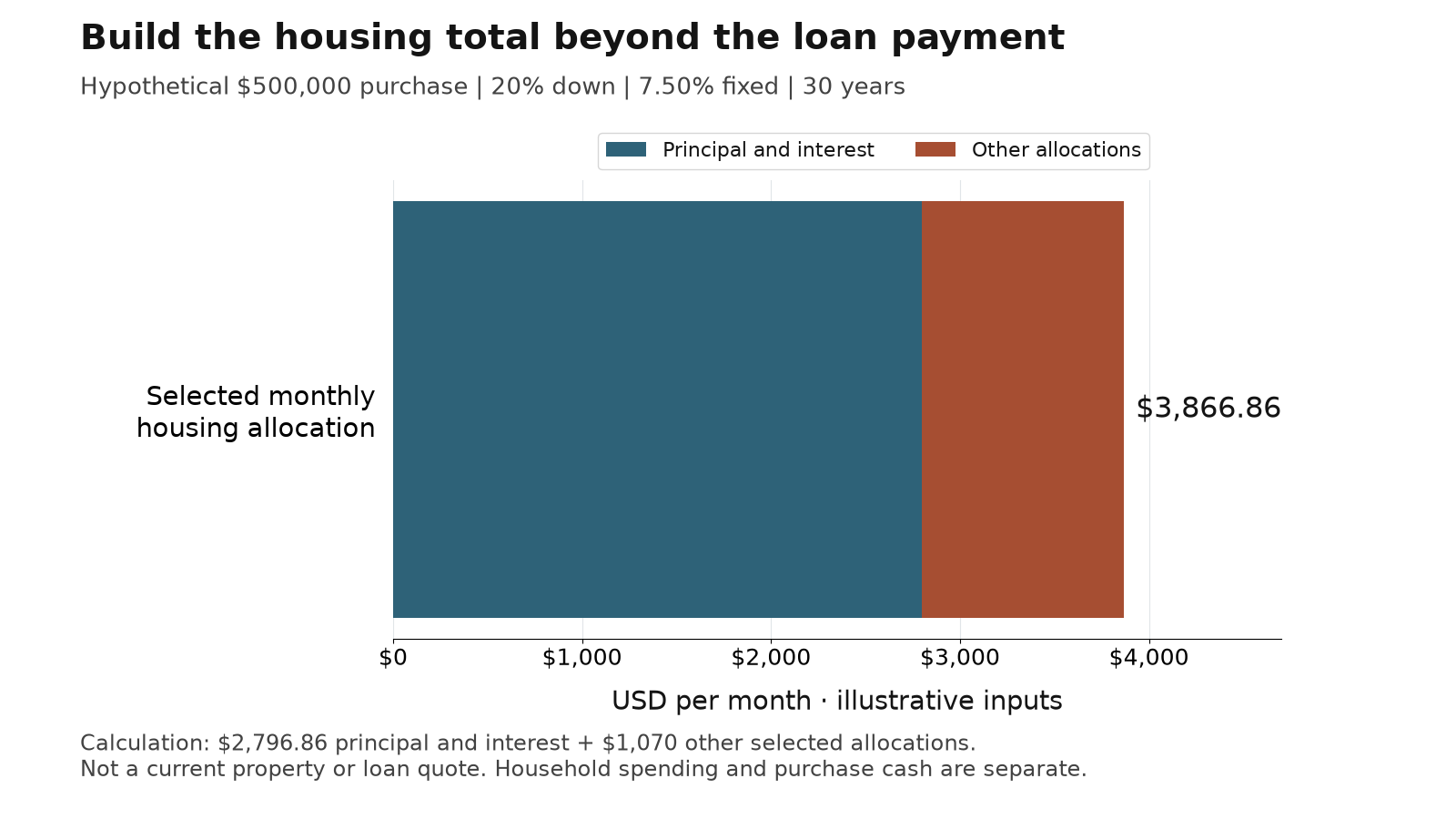
Specify the financing before calculating the payment. Consider an invented $500,000 purchase with 20% down, leaving a $400,000 loan. At an assumed fixed annual rate of 7.50% for 30 years, monthly principal and interest would be $2,796.86. This is a mathematical example, not a current Sparks listing, a typical sale or an offer of financing. It does not include mortgage insurance, loan fees or any expense outside principal and interest.
According to Freddie Mac's Primary Mortgage Market Survey, the national 30-year fixed average was 7.32% as of October 22, 2026. Our 7.50% assumption is 0.18 percentage points higher. The survey describes a defined conventional conforming application sample. It is a benchmark, not a quote for your credit profile, property, occupancy or loan size. Obtain a written proposal and update the calculation when its inputs change.
Add the operating obligations to the payment. The worksheet below uses invented amounts for every non-loan item. A tax estimate should come from the parcel and applicable treatment, insurance from the coverage proposed, and association dues from current documents. Some services may already be included in dues or the lease on an alternative property. Resolve those overlaps before comparing totals.
| Monthly allocation | Amount | Basis |
|---|---|---|
| Principal and interest | $2,796.86 | $400,000 loan, 7.50%, 30 years |
| Property tax | $285 | Assumption; replace with parcel estimate |
| Insurance | $150 | Assumption; obtain suitable coverage quote |
| Association dues | $85 | Assumption; verify obligations and inclusions |
| Utilities and communications | $350 | Assumption; use actual service and usage |
| Maintenance reserve | $200 | Assumed savings allocation, not a repair guarantee |
| Selected housing total | $3,866.86 | Excludes ordinary household spending and purchase cash |
The non-loan allocation totals $1,070. A debt-free version of this same invented property would still have those allocations and would commit the purchase capital. It would not make ownership costless. Our buyer resources can help organize the documents, but an actual affordability decision needs the complete household spending plan as well as the property's carrying costs.
What should renters count beyond the advertised amount?
Read a written proposal for the actual apartment or house, with the intended lease dates, before treating an advertised rent as your monthly cost. Identify which utilities, parking arrangements and services are included. Ask about recurring charges, insurance requirements, deposits, concessions and responsibilities for the property. A low headline can be less useful than a complete schedule that makes every payment and due date clear.
According to the Census explanation of gross rent, gross rent combines contract rent with estimated renter-paid utility and fuel costs. That historical definition explains why the $1,716 Sparks measure for 2020–2024 is not directly comparable to a current base-rent advertisement. Do not add a full utility allowance to the Census figure and call the result a new asking-rent estimate; some of that cost is already represented.
For an illustration, assume a lease proposal has $2,100 rent, $220 separately paid utilities, $30 renter's insurance and $50 parking. The selected housing total is $2,400 monthly. Every input is invented. It excludes transport, food, care, debt, savings and moving cash, and it is not evidence that an appropriate Sparks rental is available on those terms. Replace all four inputs with an actual proposal before comparing it with the ownership example.
Many of my relocating clients rent for six to twelve months first to confirm a neighborhood and experience a Northern Nevada winter, then buy — a smart, low-risk approach I recommend rather than rushing. The lease still needs review: renting first can involve two moves, uncertain renewal terms and costs that depend on the household. Use the Sparks living guide to plan the area questions; keep the eventual purchase search separate from evidence of rental availability.
Why do the service address and provider matter to utility costs?
A community name or postal address does not establish every service provider or billing responsibility. According to Washoe County's Quick Maps resources, the county provides maps covering jurisdiction and services including water, sewer, roads and snow removal. Use those resources to identify the right questions, then confirm the actual parcel and accounts with the relevant providers. Do not infer that every Sparks-area listing receives an identical package.
Ask for available utility history covering a full year and the occupancy behind it. A bill from a lightly occupied home may not describe full-time use. A home with different heating equipment, landscaping, insulation or household habits can produce a different result even when the provider is the same. Separate consumption from fixed charges, and keep electricity, gas, water, sewer, waste service and communications visible rather than burying them in an unexplained total.
For renters and condominium buyers, resolve inclusions first. If a lease or association pays a service, find out whether the cost is already reflected in rent or dues and whether an additional allocation applies. If the resident pays it separately, obtain the rate information and an estimate based on the intended use. Setup fees, deposits, equipment and installation can belong in the transition budget even when they are not recurring monthly charges.
The Spanish Springs and Wingfield Springs pages can help organize a location search, but they do not certify utilities for a particular home. For remote work, confirm the exact communications service and installation timeline before committing to a work arrangement. No general neighborhood description establishes a guaranteed connection, a specific monthly bill or uninterrupted service.
What does TMWA's proposed rate plan mean for a future budget?
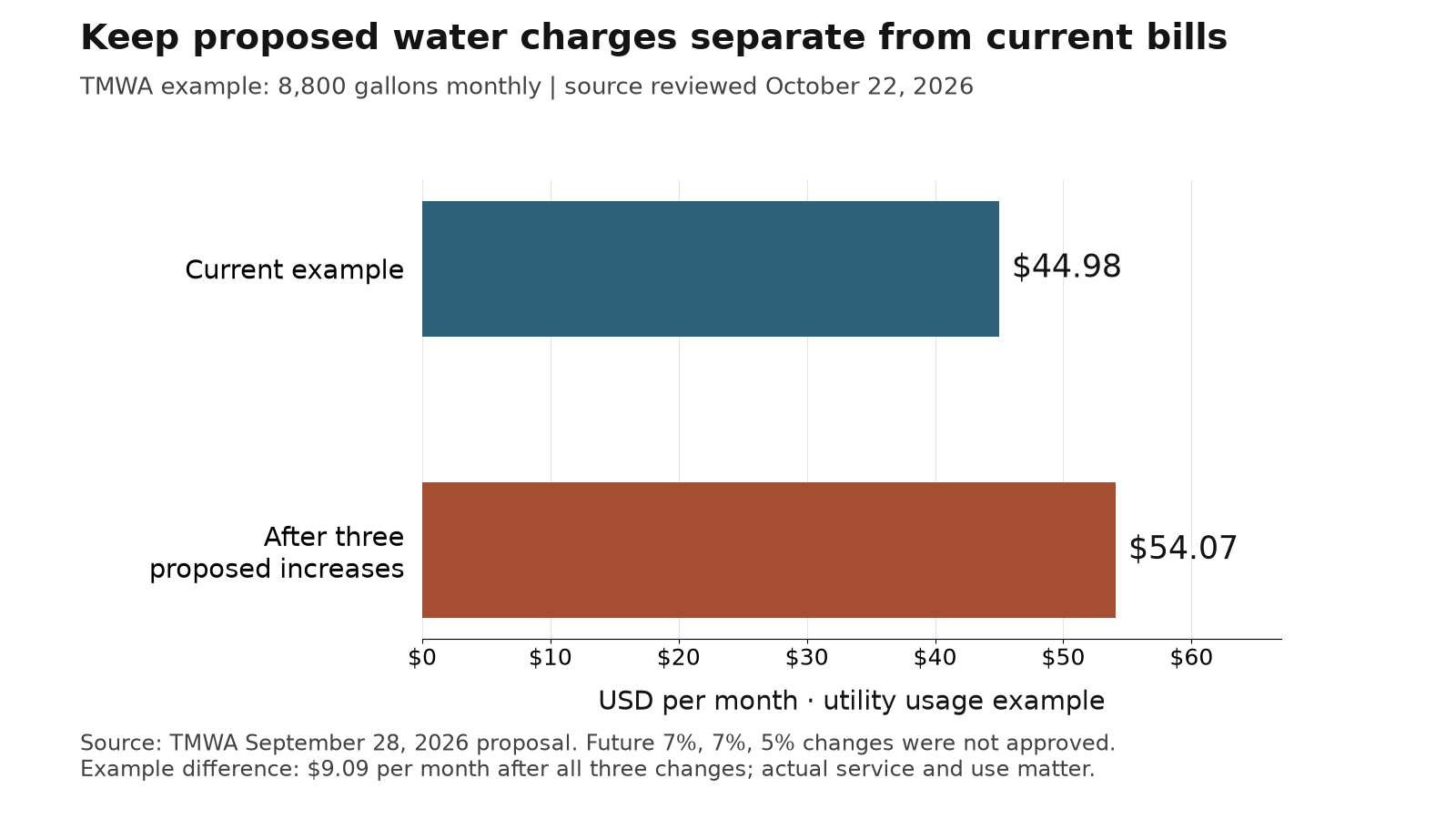
Separate an adopted charge from a proposal. According to TMWA's September 28, 2026 rate-plan explanation, the proposed increases had not been approved as of October 22, 2026 in the reviewed material. The plan described 7%, 7% and 5% adjustments for 2027, 2028 and 2029, with a March 2027 decision and the first change in May 2027 if adopted. Those are future proposal terms, not three charges already added to a current bill.
TMWA's example uses 8,800 gallons monthly and shows $44.98 currently versus $54.07 after the three proposed increases. That is the utility's usage illustration, not every Sparks household's bill. The difference is $9.09 monthly for that example after all three changes, equivalent to $109.08 over twelve months at that endpoint. It does not represent the total paid during the transition years or establish the cost of sewer, electricity or other services.
For your worksheet, retain the current documented amount and place a clearly labeled future scenario beside it. That makes the possible change visible without pretending the proposal is final. When the board acts, replace the scenario with the adopted terms and effective dates. If your usage or service category differs, ask the utility how to calculate the applicable bill instead of multiplying a citywide household allowance by the proposal percentages.
This is also a useful way to handle other uncertain expenses. Keep known current costs, documented future commitments and possible changes separate. A lender payment, association assessment or insurance renewal may have a different certainty and start date from a public proposal. Combining them into one supposedly current number conceals information that matters to the decision. Preserve the source and review date so the comparison can be updated when the underlying decision changes.
How should you budget for transport without promising a commute time?
List the actual destinations and times you expect to travel. A job at a regional industrial site, a downtown office, a school or a healthcare appointment can produce different routes and schedules. Include the trips that repeat during the week rather than comparing only distance to a city center. The cost of parking, fuel or charging, insurance, maintenance and vehicle financing depends on the household's arrangements; a city label does not determine the total.
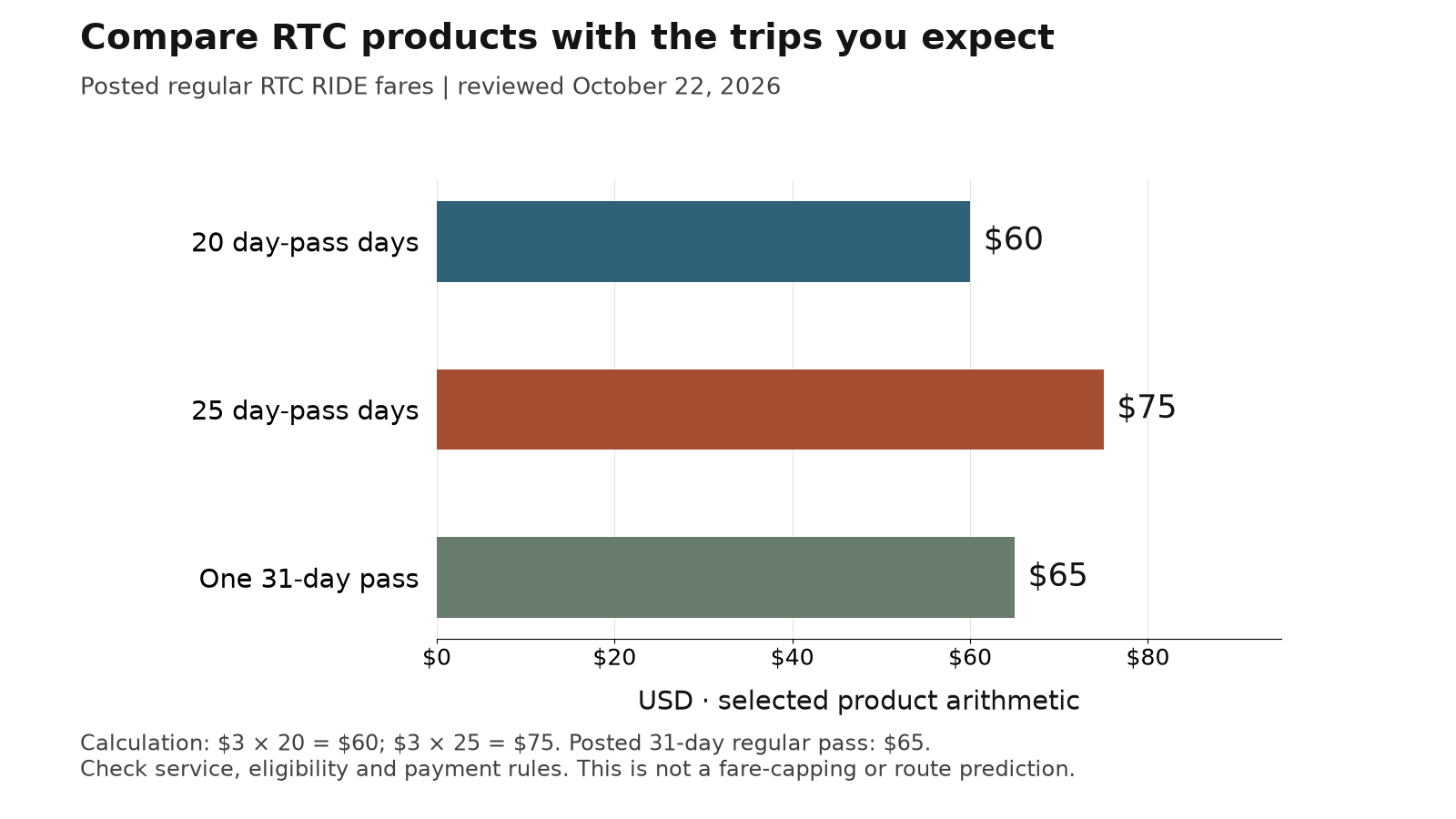
Public transport deserves an address-and-schedule check as well. According to RTC Washoe's fares page, reviewed October 22, 2026, regular RTC RIDE fares include $2 for a single ride, $3 for a day pass, $14.50 for seven days and $65 for a 31-day pass. Reduced categories have their own eligibility and documentation. A pass price alone does not prove that the route, service span or connection works for a particular shift.
RTC's Tap to Pay explanation describes transfers within two hours and fare capping when the same payment method is used. Confirm the applicable service and payment rules before calculating a travel budget. For a simple comparison, twenty separate $3 day-pass days total $60, while twenty-five total $75. A $65 31-day product is a different purchase decision; the arithmetic does not replace the operator's automatic-cap rules or guarantee that every trip is covered.
Test the complete journey: reaching the stop, waiting, transferring and arriving at the required time. Compare that with an actual driving plan, including parking and the trip home. Our Reno employment guide helps separate worksite questions from regional statistics. Neither this guide nor a home search has timed your route, confirmed an employer shuttle or established an emergency-response time.
How do property taxes and association charges affect the comparison?
Use the parcel's documents rather than a fixed percentage of the purchase price. According to the Washoe County partial-abatement explanation, eligible tax-bill increases are limited under the applicable abatement rules. That is a limit on the change in the bill, not a universal tax rate. The county's review guidance identifies value newly added to the roll as a separate issue. Confirm the actual property's treatment and required filings.
The $285 monthly tax allocation in the ownership worksheet is an invented input, not a formula for a $500,000 Sparks purchase. Obtain the relevant bill and a transaction-specific estimate. Check whether any separately listed public assessments or charges are already included before adding them again. A seller's historical payment can provide context, but it does not answer every question about the buyer's use, changed improvements or future obligations.
Association dues need a similar document review. Identify the services and building components covered, current reserve information, known assessments and the owner's remaining responsibilities. A low monthly amount does not prove that future work is funded. A higher amount may include an expense otherwise budgeted separately. Compare the obligations, not just the dues shown on a listing card.
Our Sparks property-tax guide is a related explanation to review alongside current official records. If a location such as Sparks Marina appeals to you, request documents for the specific ownership form and association. Proximity to recreation or shopping does not establish an amenity right, an insurance arrangement or the amount you will owe each month.
How can you estimate groceries and everyday spending without a citywide guess?
Use a recent record of your own purchases and adjust it for the routine you expect after moving. A household that cooks most meals, a household that travels frequently and one with substantial dietary or care requirements will not have the same spending. A broad regional consumer survey cannot turn those differences into one reliable Sparks grocery allowance. The original guide's unsupported citywide ranges should not determine an actual household decision.
If the comparison matters, price a consistent basket at the stores you would use, on a stated date. Keep quantities, product choices and delivery charges comparable. Promotions and loyalty pricing can change the result, so record what the estimate assumes. Include household supplies separately if they are part of the same shopping bill. Dining and takeout should reflect a realistic weekly pattern rather than being omitted because the housing calculation already looks tight.
Consider the travel associated with the shopping routine as well. A lower price at a distant store is not automatically a saving after additional travel and time. If you expect to consolidate trips, test whether that works with work, school or care schedules. The Sparks Marina area and other location pages can help identify areas to investigate, but a neighborhood description is not a verified grocery-price survey.
In the complete household illustration later in this guide, food and household goods receive an assumed $800 monthly allocation. That is a chosen calculation input, not an observed Sparks average or a recommended amount for a particular household size. Replace it with your own records, identify what it includes and add expenses outside the category. A useful budget makes its assumptions easy to challenge before you rely on the result.
What belongs in healthcare, insurance and care-related spending?
Separate premiums from the costs of using services. An employer benefit, an individual plan and a retirement coverage arrangement can have different premiums, deductibles, networks and out-of-pocket obligations. Confirm the coverage available to the household after moving, including any change in employment or eligibility. A facility's proximity does not establish that your clinician, appointment type or treatment is available under the proposed plan.
For ongoing care, ask the relevant providers about availability, hours, location and cost before relying on a general city description. The same principle applies to childcare or other regular support: a published service list does not establish an opening that fits your schedule. Keep any waiting period, deposit or transition arrangement in the plan. Do not treat an unavailable answer as zero spending simply to finish the worksheet.
Property insurance is a separate decision. According to the Nevada Division of Insurance's homeowners guidance, replacement and risk considerations affect coverage, and standard policies do not cover every type of loss. Get an address- and occupancy-specific quote, review deductibles and exclusions, and coordinate condominium coverage with association responsibilities. The $150 monthly insurance assumption in this guide is not an obtainable premium or a local average.
The household example uses a hypothetical $350 monthly allocation for selected health costs. It does not claim to cover every premium, treatment, care arrangement or future need. Replace that number with your actual coverage and obligations, and keep emergency planning separate from a routine monthly average. The home search can help identify a location; qualified providers and professionals supply the individual coverage and service answers.
How should winter and irregular expenses change the annual plan?
A budget needs a calendar as well as a monthly total. Heating demand, seasonal travel, equipment purchases and repairs do not necessarily arrive in equal installments. Review a full year of available utility history, identify known maintenance needs and decide which costs will be paid from an accumulating reserve. If a bill comes due before the reserve has built up, the annual arithmetic alone will not prevent a cash shortfall.
According to the City of Sparks snow-service guidance, major roads and school-bus routes receive priority, while residential streets generally are not plowed or sanded. Residents are responsible for their driveways and sidewalks. Verify the actual road's jurisdiction or private maintenance arrangement before assuming the city's policy applies. The point for budgeting is to establish responsibilities and service needs, not to promise that a particular trip will be clear.
Ask an inspector and relevant contractors about the home's equipment, condition and anticipated work. A generic reserve does not establish the remaining life of a roof, furnace or driveway. Separate known work from money held for uncertain future needs. If an association handles a component, review its documents rather than assuming the obligation has disappeared or that every future expense is already funded.
Our Reno-area snow guide provides related regional context, and the Lake Tahoe guide can help plan a separate recreation search. Valley living and mountain travel can require different preparations. Before a trip, use current conditions and appropriate professional guidance; this household worksheet is not a route forecast, a vehicle-equipment requirement or an emergency plan.
Is a lower Sparks purchase price enough to prove savings over Reno?
No. Compare the actual homes, financing and daily routines. A difference between two city medians does not establish the discount on equivalent properties: their size, condition, ownership form, location and transaction mix may differ. It also does not reveal which home creates additional driving, services or maintenance. An affordable choice is the one supported by the household's complete evidence, not the one attached to a citywide value label.
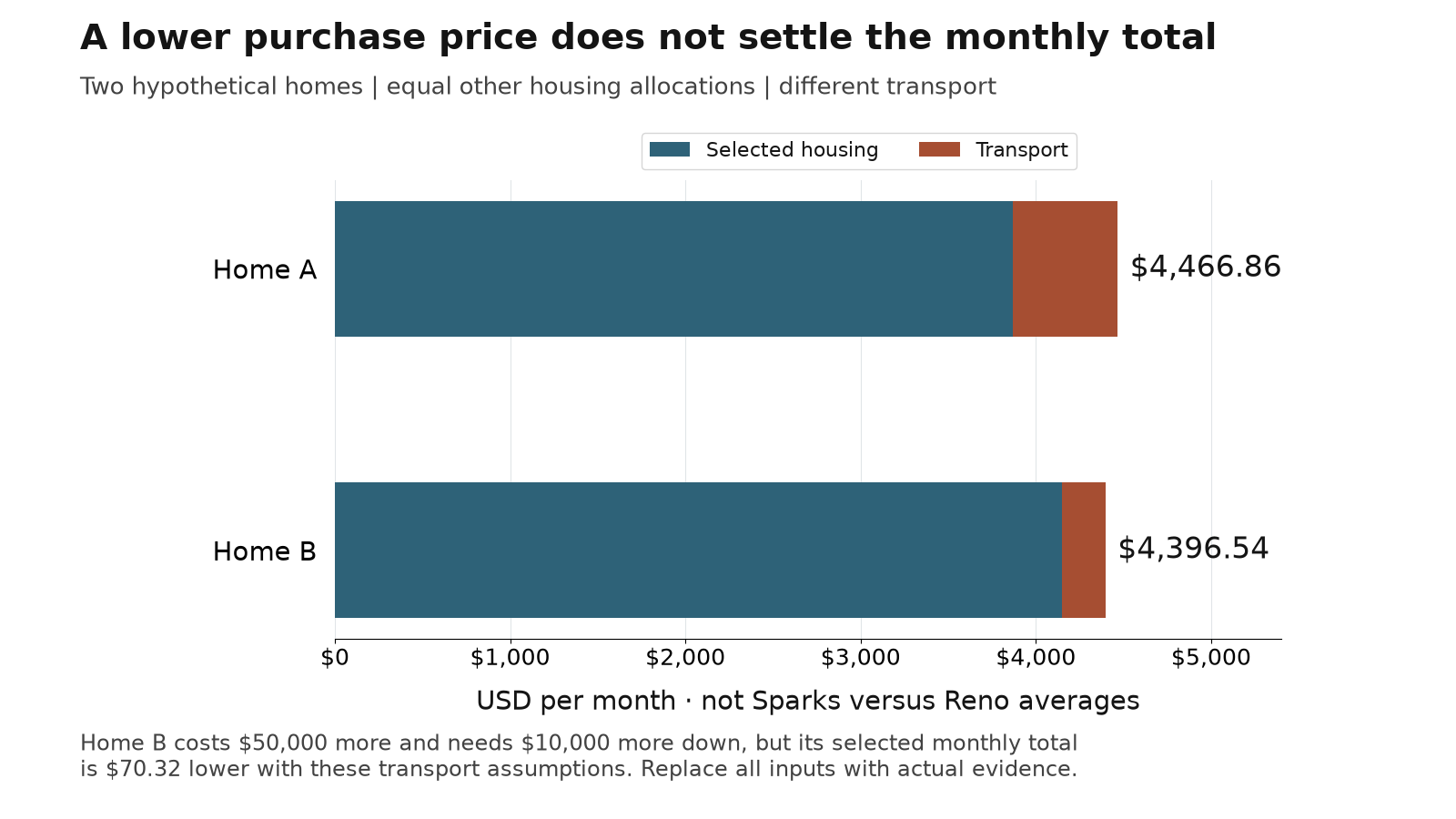
Here is a deliberately simplified illustration. Home A costs $500,000; Home B costs $550,000. With 20% down and the same assumed 7.50% fixed rate over 30 years, their $400,000 and $440,000 loans produce principal-and-interest payments of $2,796.86 and $3,076.54. If selected other housing allocations are $1,070 for each, the totals become $3,866.86 and $4,146.54. These are invented homes, not representative Sparks and Reno listings.
Now assume Home A requires $600 monthly transport spending while Home B requires $250. The selected housing-plus-transport totals become $4,466.86 and $4,396.54. The more expensive purchase has a $70.32 lower selected monthly total under those assumptions. That does not make Home B universally better: it requires $10,000 more down payment, and the properties, transaction charges and actual operating costs still need comparison.
| Input or result | Home A | Home B |
|---|---|---|
| Purchase assumption | $500,000 | $550,000 |
| 20% down payment | $100,000 | $110,000 |
| Loan principal and interest | $2,796.86 | $3,076.54 |
| Other selected housing allocations | $1,070 | $1,070 |
| Transport assumption | $600 | $250 |
| Selected monthly total | $4,466.86 | $4,396.54 |
Use the Reno and Sparks comparison guide for location questions, then attach real proposals to the same categories. A favorable example is a method to test, not a forecast. Keep the extra purchase cash, commute time, condition and features in the decision rather than allowing one monthly difference to decide everything.
How should a California-to-Sparks move be compared financially?
Use the income and expenses you will actually have after moving. Keeping a previous salary, receiving a location adjustment, changing employers and starting a business create different comparisons. Obtain written employment and benefit terms where applicable. A higher previous-city housing price does not establish that your next property will cost less after financing, transaction expenses and the features you require are included.
According to the Nevada Department of Taxation, Nevada does not impose an individual income tax. Federal taxes and other obligations remain. According to the California Franchise Tax Board's part-year and nonresident guidance, California-source income can remain relevant after a move, and the resident portion of a year has its own treatment. An address change is not a complete tax analysis.
Ask a qualified tax professional to evaluate the household's residency, income sources, work arrangements and moving date. Do not multiply all income by the highest marginal rate and call the result annual savings. Separate a one-time event from recurring income, and keep the projection distinct from actual tax paid. A planning estimate can change when work location, investment income or other facts change.
Then compare full household cash flow, including travel back to California if it will continue. Our Reno relocation guide raises related logistics that can be useful for a Sparks move, while seller resources can organize the sale side. No state-level generalization proves that every household's pay adjustment will be more than offset by lower costs. The comparison needs your actual alternatives and dates.
What income would support your own Sparks budget?
Work backward from the actual obligations and desired margin rather than accepting a universal comfortable salary. Gross income is not take-home pay. Benefits, retirement contributions, withholding, debt, household support and irregular income affect the money available each month. A lender's qualification calculation also serves a different purpose from the household's decision about spending, savings and flexibility.
For an invented complete-budget example, take the $3,866.86 ownership allocation, then add $800 for food and household goods, $600 for transport, $350 for selected health costs and $600 for savings or other planned allocations. The selected total is $6,216.86 monthly. Those amounts are not a family-of-four survey, an income recommendation or proof of what a single adult needs. Childcare, debt, travel or other obligations may materially change the result.
At hypothetical dependable take-home income of $6,800, that plan leaves $583.14. If combined expenses rise by an assumed $350 monthly, the remainder falls to $233.14. Those results show why the margin deserves attention; they do not certify that either remainder is sufficient for your situation. Keep known omitted expenses visible and test income interruptions or changes relevant to the household.
Before comparing jobs, review actual offers and benefits alongside the Reno-area employment guide. Regional wage statistics describe a defined population and period, not a promise of your compensation. When the budget is complete, decide whether it supports both the home and the commitments you intend to maintain. If it works only after excluding predictable expenses, revise the property, financing or timing rather than relabeling the result comfortable.
How much cash should be available for the move itself?
Separate the recurring budget from the funds needed to enter the transaction. A purchase can require a down payment, closing and prepaid charges, moving costs and immediate work. A lease can require deposits, initial rent and setup costs. A reserve is money you intend to retain, not another fee paid to the seller or landlord. Identify each category and its due date so the household understands the actual cash sequence.
For Home A's hypothetical $500,000 purchase, the 20% down payment is $100,000. Add assumed closing and prepaid costs of $14,000, moving and setup of $5,000, and a separately retained reserve of $12,000. The available-cash target in that illustration is $131,000. Only the down payment follows directly from the chosen purchase assumption; the other figures are invented placeholders rather than local vendor quotes or a lender estimate.
Do not count prepaid items twice when reconciling the first-year plan. Likewise, do not assume a general reserve covers a known repair or association assessment unless you have deliberately included it. If selling another home funds the move, estimate net proceeds after the obligations associated with that sale. The prior home's advertised value is not the same as money available for the next closing.
Review the dates with the professionals handling the actual transaction, including any gap between selling and buying. Temporary accommodation, storage and a second move can change the comparison. The Northern Nevada new-construction guide is relevant if a new home fits your search, but completion timing and incentives need written project-specific confirmation. No example here assumes that a future price reduction, refinance or on-time completion will solve a cash shortage.
How do you turn the comparison into a property shortlist?
Choose a few requirements that can be checked: a maximum complete recurring allocation, an acceptable route to a stated destination, required property features and enough cash remaining after the move. Then connect each requirement to documents or an actual test. A listing's price, attractive photograph or broad community reputation cannot establish all those answers. Keep the unresolved items attached to the property so they remain visible as the search progresses.
| Requirement | Evidence | Condition that could change the choice |
|---|---|---|
| Complete budget fits | Loan or lease, tax, insurance, service and association documents | A missing obligation removes the household margin |
| Routine is practical | Actual worksite, schedule, routes and service availability | Travel or care arrangements do not fit the required times |
| Property responsibilities are manageable | Inspection, maintenance scope and association records | Known work exceeds available time or cash |
| Transition remains funded | Closing or lease cash schedule and retained reserve | Timing, temporary housing or repair costs change |
I build this exact budget with relocating clients constantly. Across the more than 9,600 transactions Nevada Real Estate Group — the #1 real estate team in the state — has closed, Sparks is where value-focused buyers consistently land when Reno feels like a stretch. This guide breaks down the cost of living category by category — housing, rent, utilities, groceries, transportation, healthcare, and taxes — then covers the salary you need and how Sparks compares to Reno and California. For a personalized budget-to-home match, call our Northern Nevada team at (775) 277-2120 or browse Sparks homes for sale.
Use the Sparks neighborhood guide to organize areas, then compare them against your own requirements. Reno and Carson City remain alternatives to investigate on the same basis. No area label determines who should live there. Bring the documented costs and unanswered questions to the next discussion so the decision stays grounded in the actual property and household.
What questions do people ask about Sparks living costs?
What is the cost of living in Sparks in 2026?
There is no single verified total for every household. The Census's $1,716 gross rent and $483,800 owner-occupied value describe 2020–2024, not current offers. Build a total from the actual home, financing or lease, services, transport, care and savings needs. The worked examples here explain the method; they are not representative city budgets.
Is Sparks always cheaper than Reno?
No. Compare actual homes with the same cost categories and realistic daily destinations. Citywide medians can differ because of property mix, and a lower purchase price can come with higher travel or maintenance costs. The guide's two-home calculation deliberately shows how another expense can change the monthly result without establishing a citywide winner.
Does the Census rent figure show what a new lease will cost?
No. It is a historical occupied-housing measure that includes specified utility costs. Obtain a current written proposal for the apartment or house, with the intended dates and included charges. Keep base rent, other recurring payments, deposits and moving cash separate. A for-sale search does not verify rental availability.
Are TMWA's proposed increases already on the bill?
The September 2026 proposal reviewed for this guide had not been approved. Keep its possible future effects separate from current documented charges, and check the utility's decision and effective dates before updating the budget. The published usage example is not a quote for every Sparks home or a complete utility allowance.
Can a transit pass replace the transport budget?
Only if the actual service, schedule and access work for the trips you need, and other transport costs are accounted for. Check the operator's current product, eligibility, transfer and payment rules. The fare calculations here compare selected products; they do not establish route coverage, journey time or savings for a particular household.
What salary is enough to buy a home in Sparks?
The answer depends on the home, financing, other obligations and dependable take-home income. A lender determines qualification; the household should separately test its complete spending and reserve plan. The illustrative $6,216.86 monthly allocation is not a salary recommendation or a promise that every obligation has been included.
Will a California move automatically reduce total costs?
No. Compare actual post-move compensation, benefits, housing, travel and other spending. Nevada's individual income-tax policy does not resolve every California residency or source-income question. A qualified tax professional can evaluate those facts. Use the resulting projection rather than applying a top marginal rate to all income or assuming every pay adjustment is offset.
What should be checked before relying on the examples?
Replace every hypothetical input with current documents where available. Confirm the property, ownership responsibilities, financing or lease, coverage, service providers and cash dates. Keep missing information explicit and test a higher-cost month. Recheck public charges when their effective dates change, and retain the original period beside historical statistics.
Which facts should be reviewed again before a move?
This substantive review used primary Census, Freddie Mac, RTC Washoe, TMWA, Washoe County, City of Sparks, Nevada tax and insurance, and California FTB evidence on October 22, 2026. The Census period remains 2020–2024; the mortgage benchmark has its weekly date; public fares and the water proposal have their review dates and distinct status. A source for one category does not verify every other figure in the worksheet.
Recheck the actual property's price, financing, lease terms, insurance, association records and services before a commitment. Review TMWA's proposal when a decision is made, and use RTC's current rules for the intended service. Keep property maintenance and route checks separate from public statistics. No citywide current rental survey, measured commute, local grocery study or individual tax calculation was performed for this guide.
Record who supplied each quote, the property it covers and when its terms expire. If a financing or coverage proposal changes, recalculate the affected lines instead of carrying the earlier total into a later decision.
The original publication date remains July 1, 2026. This update improves the evidence and decision process without relabeling historical housing figures as current market offers. Its original calculations are transparent examples, not observed client outcomes. Preserve the documents, assumptions and dates with your own worksheet so a changed quote or requirement prompts a real revision before the household commits.