

A Carson City home budget has to answer three different questions: what comparable homes have sold for, what the chosen property will cost each month, and how much cash remains after closing and repairs. A citywide median answers only part of the first question. Start with dated market evidence, then compare actual addresses on condition, usable space, services and your daily routine.
Carson City’s September 2026 report shows a $515,000 median sale price across the residential property types selected by Sierra Nevada REALTORS. That does not promise a particular house size or neighborhood at a fixed budget. Use $390,000, $480,000 and $580,000 as planning examples, then compare current listings and similar closed sales. Your usable budget must also cover financing, property charges, repairs and cash reserves.
- A dated sold-price median is different from a listing price or a valuation of one home.
- The $480,000 example below is a chosen budget, not the current median or a guaranteed inventory category.
- Compare actual condition and usable rooms instead of assuming a fixed amount of space at each price.
- Historic features, private utilities and drainage can change the work and cash a purchase requires.
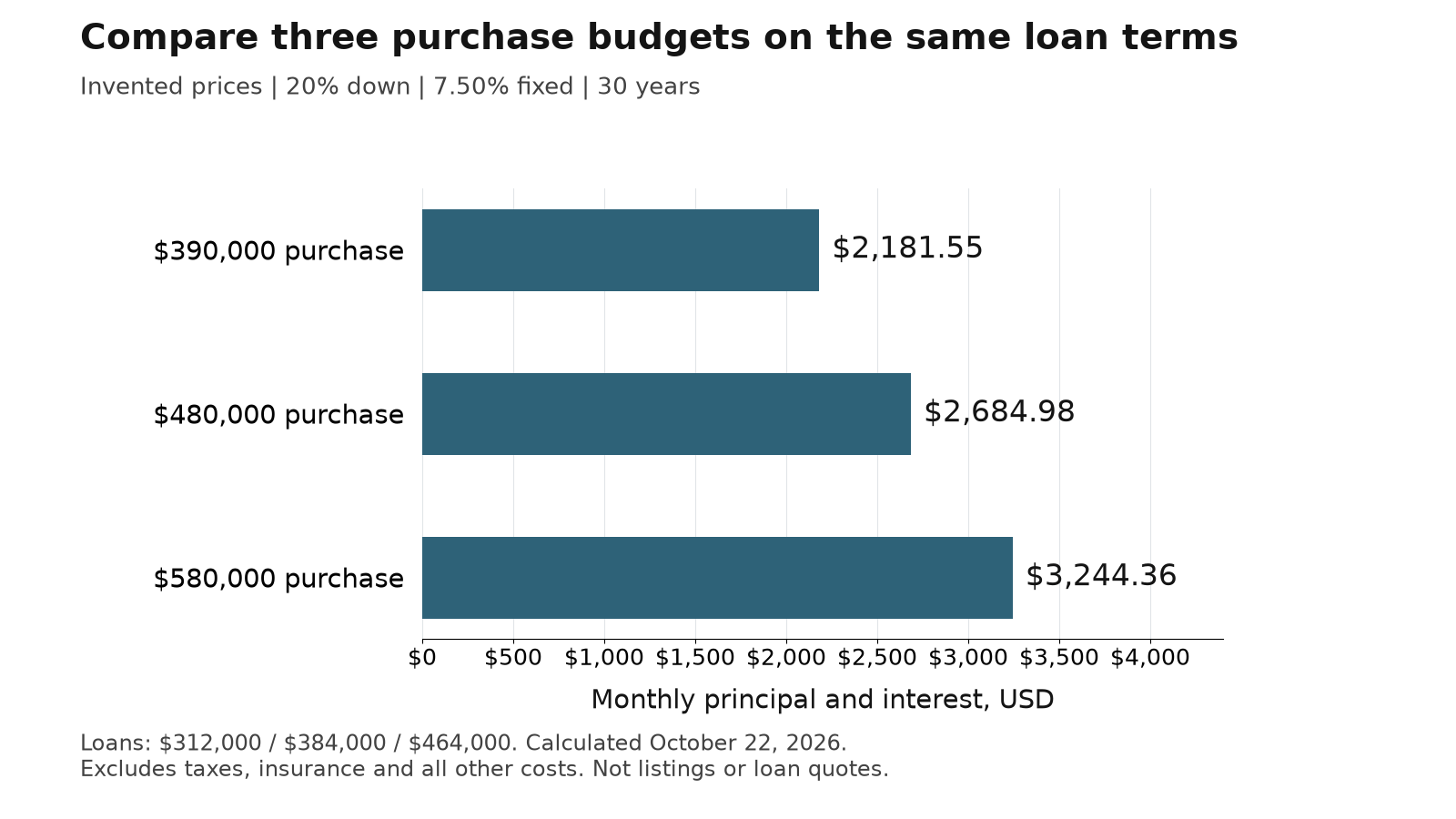
- At an illustrative $480,000 price with 20% down and a 7.50% fixed 30-year loan, principal and interest are $2,684.98 monthly; other costs are additional.
How we know this: Across the 9,600+ closings Nevada Real Estate Group has represented statewide — more than $4.85B in closed volume — we work the Northern Nevada market including the capital region every week, so we see what a Carson City budget actually buys. In my experience, buyers who name their single top priority first — newest, biggest lot, or historic character — get far more for $480,000 than buyers who try to maximize everything at once. The dated public evidence and explicitly assumed calculations below are separate from those existing company statements; they are not a study of company transactions.
What Do the Latest Carson City Prices Actually Measure?
According to Sierra Nevada REALTORS’ September 2026 market report, the Carson City panel shows a $515,000 median sold price and 75 closed sales. The report was updated October 4; its cover identifies all residential property types, and its Carson panel displays property-type selections. Read it as that published selection, not as a detached-house-only statistic or a live appraisal of your target property. The source was reviewed as of October 22, 2026.
The $480,000 budget used in this guide is a chosen amount for comparing purchases, separate from the dated median. A median marks the middle reported sale. It says nothing by itself about whether one particular home needs a roof, has an unusual floor plan or includes a buildable parcel. Nor does it establish a square-footage entitlement for buyers spending that amount. The condition and suitability of the property still need their own evidence.
We've worked buyers through this price point across the capital region, so treat the median as a starting budget, not a house. For an offer decision, request similar recent closings, the differences between those homes and the subject, and the reason for each proposed adjustment. Keep property type and geographic boundaries consistent. A nearby townhouse or a property outside Carson City may be relevant context, but label the difference instead of silently treating it as an equivalent sale.
Use the Carson City home search to identify candidates and the Northern Nevada communities directory to understand the wider area. Search inventory still needs property-level verification before it supports a price conclusion.
What Should You Prioritize at $390,000, $480,000 or $580,000?
These three amounts are selected shopping budgets, not verified tiers with a guaranteed bedroom count, building age or lot size. At each amount, ask which requirement has to survive every compromise: a particular room arrangement, a manageable payment, a work location, a usable yard or a historic setting. Then identify the features you can change after purchase and those you cannot.
A dated kitchen may be adaptable; the parcel’s location is fixed. A large bedroom count may be less useful than a smaller home with the right ground-floor layout. A distant house with more interior area can lose its advantage if the household needs another vehicle or spends substantially more time traveling. Those are individual trade-offs rather than a ranking of neighborhoods or residents.
| Comparison | $390,000 budget | $480,000 budget | $580,000 budget |
|---|---|---|---|
| First constraint | Identify essential layout and acceptable property types | Choose between condition, space and setting | Ask what the extra price actually improves |
| Condition review | Separate affordable repairs from work that needs immediate cash | Compare maintenance needs across similarly priced homes | Do not assume a higher price eliminates defects |
| Monthly comparison | Include association charges and service costs | Compare the full household budget | Retest savings and cash reserves after the higher payment |
| Evidence needed | Actual listing, disclosures and relevant closed sales | Same evidence, with documented differences | Same evidence, including support for any claimed premium |
The comparison is useful even if you ultimately spend a different amount. Put the same questions beside each candidate instead of changing the standard because one house photographs well. The buyer resources explain the broader purchase process; this guide concentrates on the price, condition and cash choices within it. A clear search brief makes it easier to reject an unsuitable property while remaining ready for a genuinely useful one.
How Do You Compare Foothill, South, East and Central Locations?
Treat these labels as starting points for a map conversation, not as standardized price bands. Two homes described as being in the foothills can differ in access, exposure, lot usability and distance from your destinations. Two established homes may share a general location while having very different systems, additions and maintenance histories. Listing descriptions are an introduction to that work, not its conclusion.
For each address, record the actual jurisdiction, parcel boundary, property type, parking arrangement and services. Confirm that a mailing address and a listing’s area label match the geography you intend to compare. That matters especially when a search stretches toward neighboring communities: a nearby property can be a valid alternative without being a Carson City sale.
I steer value-focused buyers here when they want maximum space for the money and are comfortable trading brand-new construction for an established neighborhood, with a sensible plan to update the home gradually over time. That existing approach to established areas still requires a specific inspection and renovation budget. It does not establish that every east-side home is larger or cheaper than every south-side home.
Run an ordinary weekday from each candidate: work, groceries, appointments and any recurring activities. If you are considering Reno, Sparks or Lake Tahoe as alternatives, use actual destinations and travel conditions rather than a universal half-hour promise. Separate preferences from necessities. A scenic route may be enjoyable on a free afternoon and unsuitable for a tightly timed workday. The strongest location choice is the one that continues to work under the household’s real schedule.
What Should You Check Before Buying an Older or Historic Home?
I bring the west side into the conversation for buyers who prioritize character, walkability, and a true sense of place over size or modern finishes. Those preferences can make an older property attractive, but they do not remove the need to understand its systems, previous work and potential restrictions. A listing’s use of “historic” does not tell you which rules apply to a particular alteration.
Ask the relevant local office to confirm the property’s designation and the review needed for your proposed project. Supply a specific description: replacement windows, an exterior addition, a roof change or work visible from the street. Get the answer for that address before relying on a contractor’s generic assumption. This review did not establish the current Carson City approval rules or a guaranteed permit timeline, so neither is promised here.
According to EPA’s guidance on real-estate lead disclosures, federal requirements apply to many transactions involving housing built before 1978. Review the applicable disclosures and inspection opportunity with the people handling your transaction. A disclosure is not a finding that the property has no hazard, and a cosmetic renovation is not proof that earlier risks were assessed.
For the budget, separate urgent work from improvements you can defer. Request qualified estimates for significant systems and ask what the estimate excludes. Keep an allowance for uncertainty that is proportionate to the actual findings. Historic character is a purchase preference; a future appreciation premium is not guaranteed. If the work needed to keep the property usable exceeds the cash you can retain, reconsider the purchase even when the asking price initially looks attractive.
How Should You Compare New Construction with Resale?
A new home and a resale can compete for the same household without offering the same bundle of costs. For a new property, obtain the written price for the specific lot and configuration, the included finishes, any selected upgrades, the expected completion conditions and the actual warranty documents. A model’s appearance is not a list of everything included in the advertised base price.
For resale, compare what you can inspect now, the disclosed repair history, the systems’ condition and any work needed before occupancy. Avoid assuming that age alone determines efficiency, reliability or maintenance expense. A well-documented older system and an undocumented newer installation require different questions, not an automatic ranking based on a year field.
In my experience, buyers who prioritize a move-in-ready modern home lean new, while buyers who want space, character, or a central location lean resale. Carson City's smaller inventory means the right home in your target area may not appear every week, so I keep buyers ready to move when it does. That existing observation is a search strategy, not evidence that a specific builder currently has a home at the $480,000 example budget.
According to the Consumer Financial Protection Bureau’s Loan Estimate guide, loan terms, projected payments and closing costs deserve separate attention. Use actual lender documents to examine a builder incentive: compare the rate, points, lender charges, required choices and duration of any payment reduction. A credit with conditions can still be useful, but the headline amount alone does not show which offer costs less. Keep financing and property comparisons in the same worksheet without treating them as interchangeable discounts.
Does More Square Footage Give You More Useful Home?
Measured area is an input to the search, not a complete description of what you can use. Check how rooms connect, whether the required bedroom or workspace is private enough, and whether stairs or narrow circulation create problems for your intended use. Ask which spaces are included in the reported area and how additions, conversions and unfinished rooms are treated in the records supporting the listing.
Do not infer that another $100,000 automatically buys a specified number of square feet. The money could be associated with condition, lot features, finishes or a different property type; it may also reflect an asking price that has not been supported by a sale. Compare the specific alternatives instead of assigning a universal exchange rate to space.
A practical tour sheet has three columns: needed now, useful later and unnecessary. Mark the actual room or feature that satisfies each need. Include outdoor space only if its slope, access and maintenance fit the use you have in mind. A large parcel is not equivalent to a large usable yard, and extra interior area can increase the space you have to furnish, maintain and condition.
Ask for documentation when a feature is central to the decision. If a converted room creates the value for you, confirm its status and suitability before giving it the same weight as documented living space. If an outbuilding makes the property work, investigate its permitted use and condition. These steps turn a broad size comparison into a defensible explanation of why one home serves the household better. They also help you avoid paying for impressive totals that do little for daily life.
How Do Private Wells and Septic Systems Change the Purchase Review?
First establish which systems the property actually uses. Do not infer service from its general location, rural appearance or a nearby home’s arrangement. Request the relevant records and identify who maintains each component. Where a private system is involved, its condition and ongoing obligations belong in the purchase decision alongside the house itself.
According to EPA’s new-homebuyer septic guidance, a buyer should arrange an inspection of a septic system before purchasing a home that uses one. EPA’s septic-system questions also explain the role of local authorities and system records. Ask a qualified inspector what the inspection covers, what records are missing and whether additional evaluation is needed for the proposed household use. Do not substitute a seller’s general assurance for the findings.
According to EPA’s private-well guidance, owners should test well water regularly, including annual testing for specified common indicators, and consider additional testing after relevant changes or events. Use a certified laboratory and local guidance to select appropriate testing. This does not establish the quality, quantity or legal status of water at any individual property.
Keep evaluation costs separate from potential repair or replacement work. A favorable result on one question does not answer every other question: water testing, equipment condition, records and intended use are distinct. Ask for address-specific professional advice where the findings affect your ability to occupy or finance the home. The aim is a purchase budget based on known systems and realistic remaining uncertainty, rather than treating private utilities as either automatically desirable or automatically disqualifying.
What Should You Check About Drainage and Winter Access?
According to the Nevada Division of Water Resources floodplain guidance, flood-hazard mapping helps communities understand risk and make land-use decisions. Reviewed October 23, 2026, that guidance supports checking current flood information before choosing a property. Request the address-specific flood determination and an insurance quote. Separately, ask the seller, association and appropriate local office who owns and maintains the drainage features serving the home; confirm the answer in the relevant property documents. A regional map does not establish a particular home’s drainage condition or insurance cost.
Request available drainage records and ask the relevant professionals about the property’s specific circumstances. Look beyond the interior: where does water go, which facilities serve more than one parcel, and what access is needed to maintain them? If an association has responsibility, examine the relevant documents and financial information rather than assuming the dues cover every possible expense.
Winter planning is similarly specific. Consider driveway grade, parking, access to equipment, exterior surfaces and the destinations you must reach. Obtain actual service options and costs where you expect to need help. This guide does not claim that a route was driven in snow or that a general area has a particular closure frequency. Use current official conditions when planning travel and verify what works for the address under consideration.
Make unresolved questions visible before an offer becomes an emotional commitment. A property might still fit after a drainage review, an insurance quote and a maintenance allowance. It may also require more money or work than your budget supports. The useful result is an informed comparison of obligations, including who performs the work and what happens if the cost is higher than expected. Do not allow an attractive view to replace that review.
What Are the Payments at the Three Example Purchase Prices?
According to Freddie Mac’s Primary Mortgage Market Survey, the national 30-year fixed average released October 22, 2026 was 7.32%. That survey observation is not a Carson City offer or a personal approval. The calculations here deliberately use a separate 7.50% fixed rate, 30-year term and 20% down payment so the examples remain reproducible. They exclude points and fees from the payment calculation.
| Input or result | $390,000 purchase | $480,000 purchase | $580,000 purchase |
|---|---|---|---|
| 20% down payment | $78,000 | $96,000 | $116,000 |
| Loan amount | $312,000 | $384,000 | $464,000 |
| Fixed rate and term | 7.50%; 30 years | 7.50%; 30 years | 7.50%; 30 years |
| Monthly principal and interest | $2,181.55 | $2,684.98 | $3,244.36 |
All three calculations use the same assumptions to isolate the effect of loan size. Taxes, insurance, association charges, maintenance, utilities and any other obligations are additional. A lower advertised payment may use different cash down, a different term, temporary assistance or omitted charges. Identify those changes before deciding that it is a better offer.
For an actual purchase, obtain quotes close enough in time to compare and record the lock status. Keep the cash needed for each quote beside the payment: paying more upfront can change the monthly result. Ask the lender to explain how the proposed terms work throughout the loan, not just during an initial period. Recalculate when any material input changes instead of carrying an old payment into a new price negotiation.
What Does the $480,000 Example Cost Beyond the Mortgage?
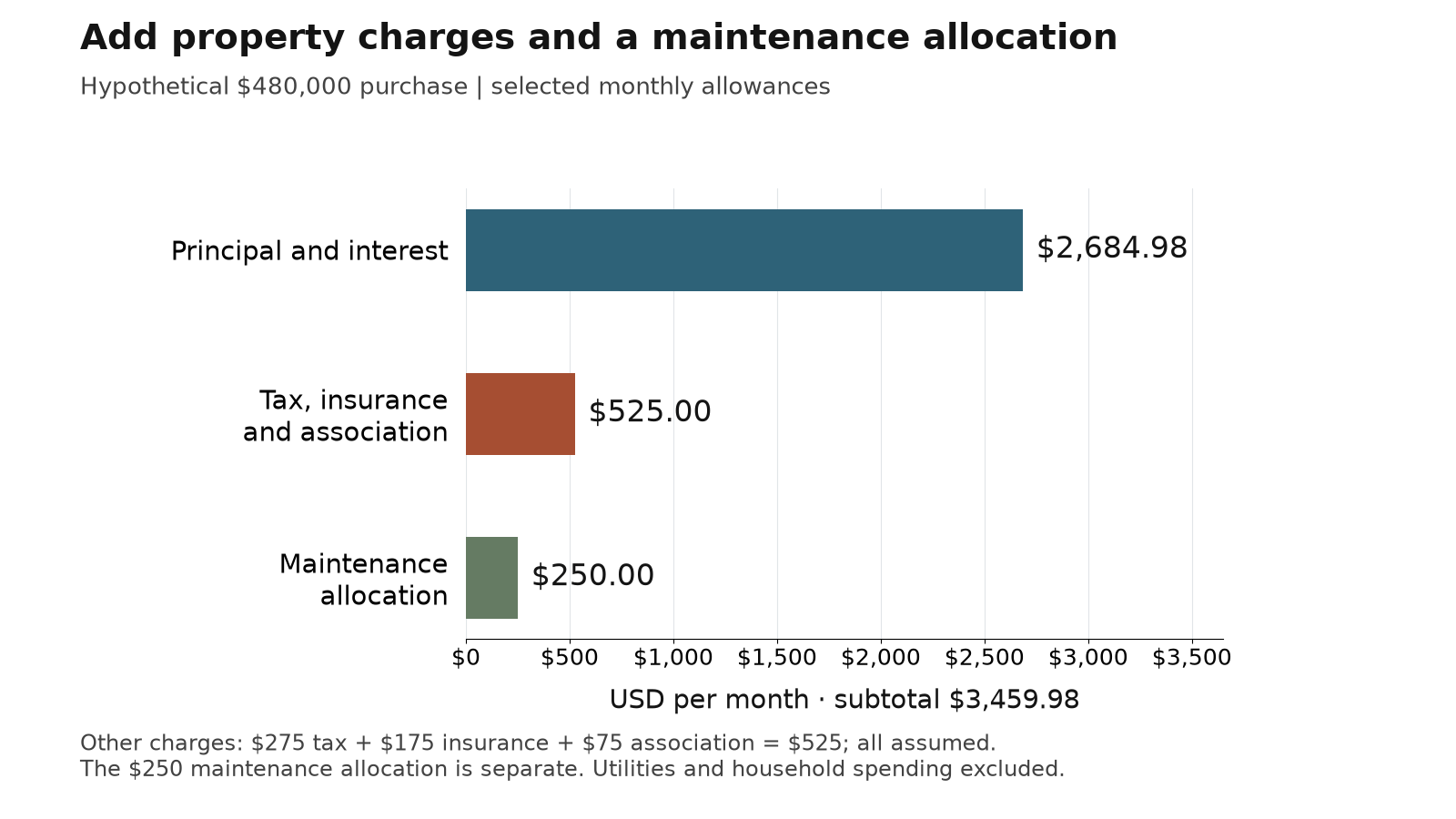
Start with the example’s $2,684.98 principal-and-interest payment. Add assumed monthly amounts of $275 for property tax, $175 for homeowners insurance and $75 for association charges. The selected payment components total $3,209.98. Add a separate $250 maintenance allocation and the selected owner budget becomes $3,459.98, before utilities and other household spending.
Those tax, insurance and association inputs are invented planning amounts as of October 22, 2026, not local averages, actual bills or quotes. A property with no association may still have maintenance obligations. An insurance estimate must fit the address and coverage sought. Obtain current documents and ask how the tax amount is established rather than calculating it from a neighbor’s bill or a simple percentage of the asking price.
According to the CFPB Loan Estimate explanation, the payment presentation distinguishes loan charges and estimated property-related amounts. Check what will be collected through escrow and what you must pay separately. Keeping those categories clear helps prevent an expense from disappearing or being counted twice when you move between a lender worksheet and a household budget.
The maintenance allocation is money you retain for future work; it is not an invoice or a prediction of evenly spaced repairs. Known work needs its own schedule and estimate. Add utilities, transport, food, healthcare, debt payments and savings separately. This produces a useful comparison between homes with the same price but different operating needs. It also makes clear why a principal-and-interest advertisement is an incomplete answer to the question of what you can comfortably own.
How Much Income Supports That Example Comfortably?
A percentage screen can organize a comparison, but it does not establish lender approval or household comfort. If you choose a 30% gross-income screen for the $3,209.98 selected payment, the calculation is $3,209.98 × 12 ÷ 0.30, or $128,399.20 in annual gross income. That chosen rule is an illustration as of October 22, 2026, not a lender threshold or an estimate of what every Carson City buyer earns.
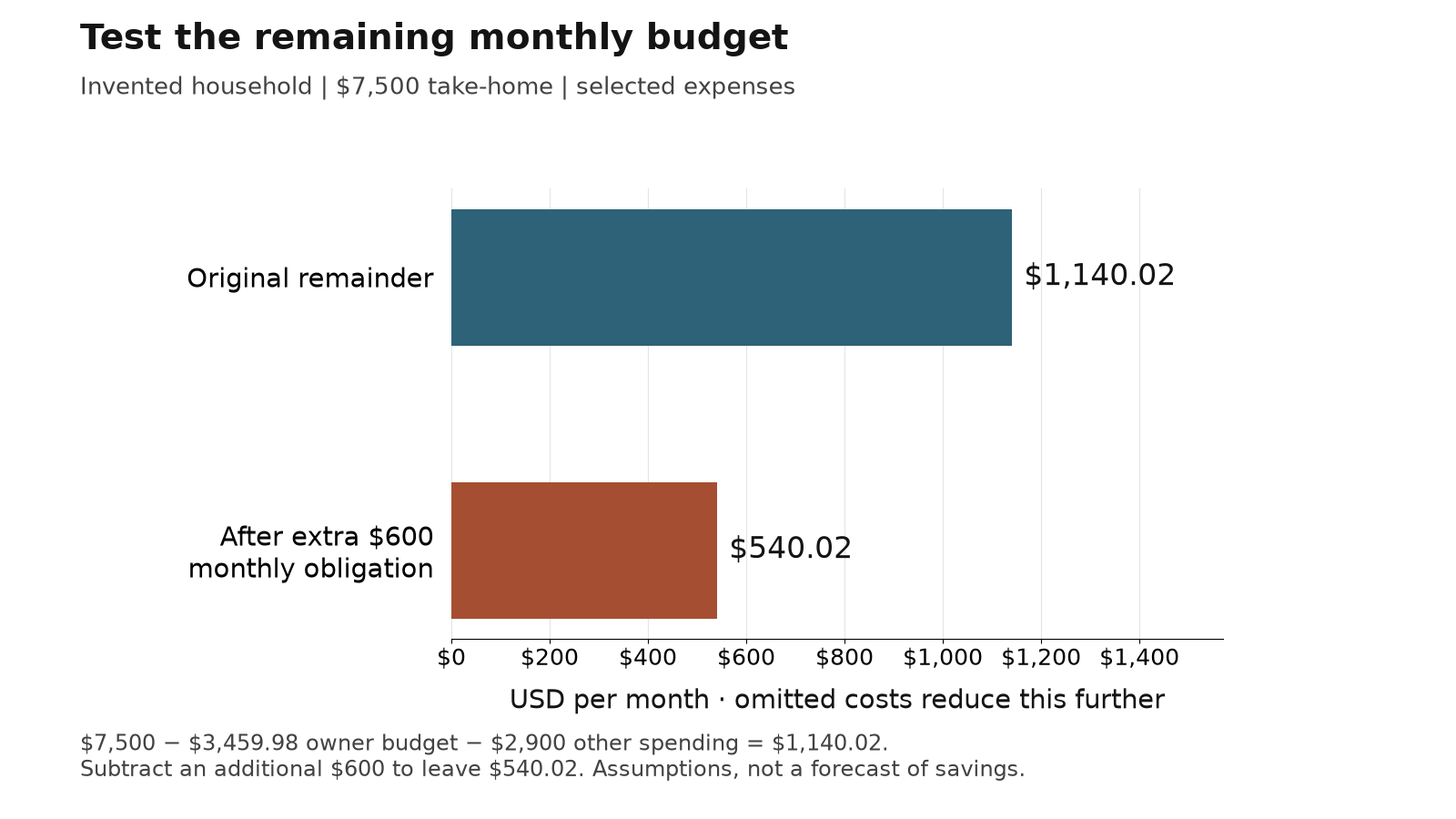
Then run the decision using reliable take-home income and actual spending. Suppose the household receives $7,500 monthly, allocates $3,459.98 to the owner budget and spends another $2,900 on its other obligations. The selected remainder is $1,140.02. An additional $600 monthly obligation reduces it to $540.02. Costs omitted from the worksheet reduce it further; do not call the remainder disposable until all necessary spending and saving are represented.
Income quality matters as much as the annual headline. Ask how stable hours, variable pay, retirement income or a pending job change affect the household’s own planning and the lender’s documentation. Do not include hoped-for overtime or a future raise as if it were already dependable cash. A pre-approval can be useful without defining the amount you ought to spend.
Use the Carson City cost-of-living guide as a broader checklist, then replace its examples with your own records. Keep the purpose of each number clear: gross income for a chosen screen, verified documents for financing, and take-home cash for daily life. Passing one calculation does not make the others unnecessary.
Can a Cheaper House Require More Cash Upfront?
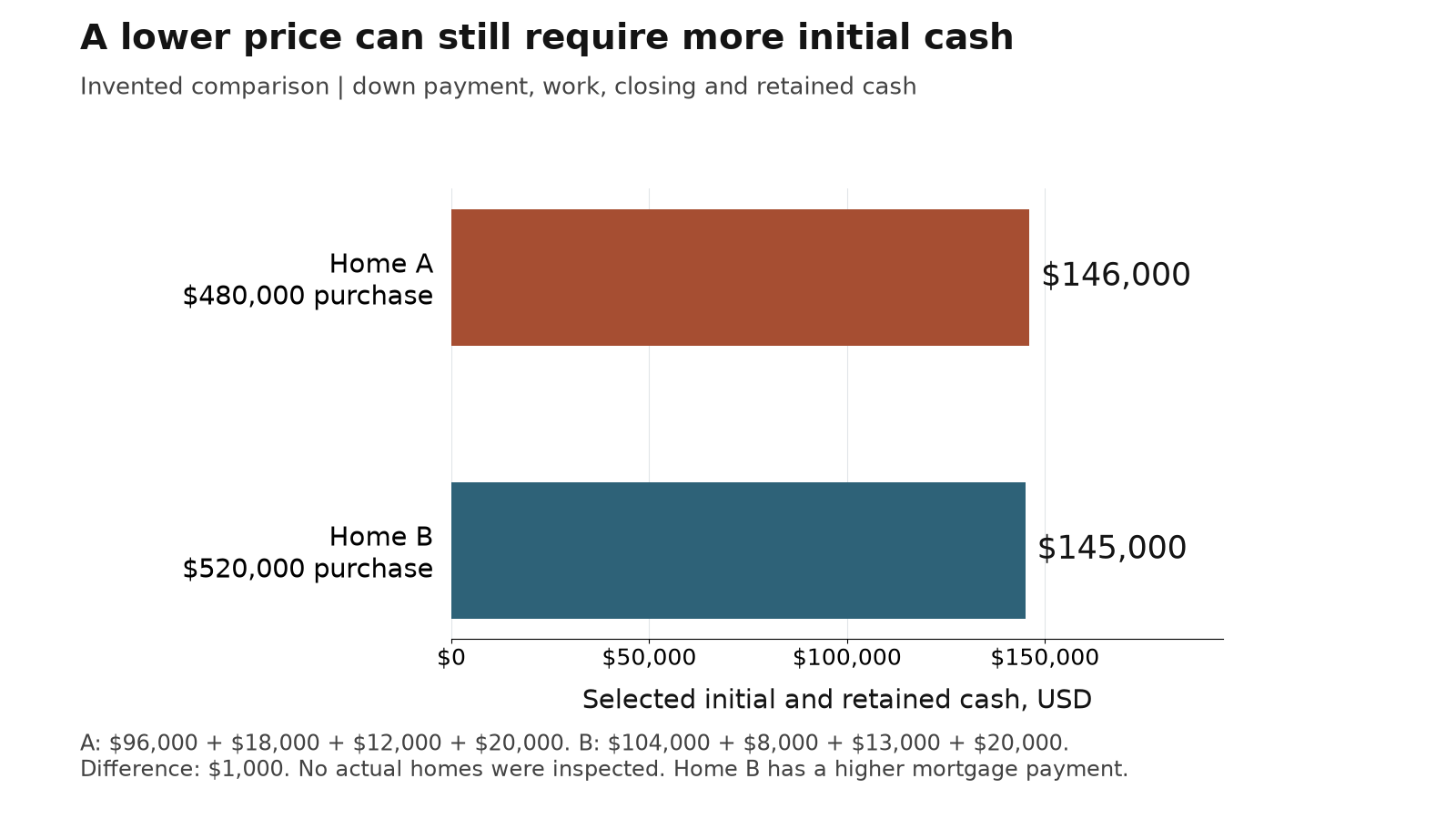
Yes. Compare two invented purchases as of October 22, 2026. Home A costs $480,000 and requires $18,000 of selected work. Home B costs $520,000 and has an $8,000 setup allowance. Both examples use 20% down and retain $20,000 after the planned spending. The remaining assumptions are shown separately so you can replace them with actual estimates.
| Cash category | Home A: $480,000 | Home B: $520,000 |
|---|---|---|
| 20% down payment | $96,000 | $104,000 |
| Selected work or setup | $18,000 | $8,000 |
| Closing costs and prepaids | $12,000 | $13,000 |
| Retained reserve | $20,000 | $20,000 |
| Cash accounted for | $146,000 | $145,000 |
Home A has the lower price but uses $1,000 more cash under these assumptions. Home B has the larger loan: $416,000 at the same 7.50% fixed 30-year terms produces $2,908.73 principal and interest, $223.75 more monthly than Home A. Neither calculation alone identifies a better purchase. You must consider both the initial cash and the continuing expense.
Keep repair timing visible. Some work may be required before occupancy; other improvements may be optional. A lender or insurer may also have requirements that differ from your preferred schedule. The retained reserve is not a closing fee, and it cannot simultaneously pay for work already listed elsewhere. This exercise exposes a common budget error: celebrating a lower contract price while ignoring the cash needed to make the property usable and maintain a realistic cushion afterward.
How Does a Smaller Down Payment Change the Trade-off?
Compare 20% and 10% down on the same assumed $480,000 purchase. With 20% down, the down payment is $96,000 and the loan is $384,000. With 10% down, the down payment is $48,000 and the loan is $432,000. The smaller down payment preserves $48,000 of initial cash before differences in fees and other transaction requirements.
At the illustrative 7.50% fixed 30-year terms, the larger loan’s principal and interest are $3,020.61, an increase of $335.63 monthly over the 20%-down example. Mortgage insurance or other program charges may change the comparison further. This calculation does not promise eligibility, a particular insurance charge or a universal cancellation rule. Obtain the terms for the actual program and borrower.
Cash retained can have an important purpose: known repairs, relocation, an emergency cushion or obligations that continue after closing. But preserving cash by borrowing more also creates a larger payment. Decide how much reserve you need based on the household and property, then compare actual loan offers that leave that reserve intact. Avoid treating the largest possible down payment as automatically best or the smallest possible down payment as automatically affordable.
Ask for the full initial-cash figure, not merely the percentage down. Closing costs, prepaid items, deposits already made and any credits need to be reconciled in the transaction documents. Compare the outcomes using the same purchase assumptions and date. If the home requires work that lenders or insurers will not allow you to postpone, a generous paper reserve is not enough; the financing and work plan must fit together in practice.
How Fast Are Homes Selling, and What Does That Mean for an Offer?
According to the September Sierra Nevada REALTORS report, the Carson City selection recorded a 24-day median time to contract and 99.2% of list price received. Those published measures concern the report’s defined sales group. The 24-day figure is not a promise about the time from an accepted offer to closing, and the percentage does not justify applying one standard discount to every asking price.
In my experience, the bigger challenge in Carson City is inventory, not competition — the right home in your target area may not appear every week, so I keep pre-approved buyers ready to act when it does. Use that existing search approach with current property evidence: listing history, relevant comparable sales, disclosed condition and your own limits. A citywide statistic cannot reveal whether the particular seller has flexibility or whether other offers exist.
Separate readiness from pressure. Have financing documents and your priority list organized, identify the inspections you need, and understand the proposed contractual dates before submitting an offer. Discuss contingencies and consequences with the professionals handling the transaction. Do not discard a material investigation simply because a general market summary suggests speed.
For a property that has been listed longer than others, investigate the explanation rather than assuming it is a bargain. Condition, price, access, financing suitability or a complicated seller situation can require different responses. For a newly listed property, ask the same questions within the available timetable. A disciplined offer explains why the home fits and what remains to be verified; it does not depend on a promise that the capital’s economy prevents price declines.
What Should Be Ready Before You Commit to a Carson City Purchase?
The most expensive mistake I see is shopping on price alone and ignoring the all-in monthly cost and condition. Keep a single decision sheet with the proposed price, documented property charges, lender terms, inspection questions, necessary work, initial cash and reserve remaining. Mark each entry as verified, assumed or outstanding. That makes an attractive estimate easier to distinguish from a decision you can actually support.
For the $480,000 example, $96,000 down plus $12,000 closing and prepaid costs, $18,000 selected work and $20,000 retained reserves accounts for $146,000. As of October 22, 2026, those are only the assumptions of the earlier illustration. Replace them before making a real commitment. If the required work grows, show the extra cash or the corresponding reduction in the reserve rather than leaving both figures unchanged.
If a current home must sell to fund the move, coordinate the cash timing with the seller resources and your transaction team. Do not assume proceeds arrive before the new purchase needs funds. Also plan any overlap in housing, storage or temporary accommodation. Those practical costs can influence which completion date or property condition is workable. Use the Nevada escrow guide to organize the funding, recording and possession questions with your transaction team.
Use $480,000 here as a chosen example, then set the search to your actual limits. As the lead brokerage serving Northern Nevada, Nevada Real Estate Group works the capital region for buyers at exactly this price point. For help comparing current addresses, call (775) 277-2120 or contact our team. Bring the priorities and budget you want to protect; the next step is a property-specific comparison, not a guarantee of a particular home at the median.
Frequently Asked Questions
What is the median Carson City home price in 2026?
The reviewed Sierra Nevada REALTORS September report gives $515,000 for its Carson City residential selection. Keep the period and property-type scope attached to that figure. It is a reported median, not an individual valuation or a promise about current asking prices.
What does $480,000 buy in Carson City?
That depends on actual available properties, their condition, layout, lot and location. This guide uses $480,000 as a planning amount rather than a guaranteed inventory tier. Compare relevant closed sales and inspect the specific home before assuming a bedroom count, size or age at that price.
Can I find a home for $390,000 or $580,000?
Check current inventory for your requirements and acceptable property types. These figures are examples, not confirmed listings. A higher price does not automatically deliver a specified amount of extra space, and a lower price does not establish that repairs or association costs will be manageable.
What is the monthly mortgage payment on the $480,000 example?
With 20% down, a $384,000 loan at an assumed 7.50% fixed rate for 30 years has $2,684.98 monthly principal and interest. Taxes, insurance, association charges and other costs are additional. The article’s broader owner-budget example is also assumed, not a lender or property quote.
Is a new home automatically better value than resale?
No. Compare the actual property, included features, financing, completion conditions and future work. A lower initial repair allowance can accompany a higher payment or larger down payment. Use written builder and lender documents, then compare them with verified resale condition and costs.
What makes a historic or rural property different to evaluate?
Historic features may require address-specific planning questions and specialist assessment. Private water, septic, drainage or access arrangements require their own records and inspections. Confirm which issues actually apply. A property’s appearance or neighborhood label does not establish its legal status, utility condition or maintenance responsibilities.
Does time to contract tell me when I can move in?
No. Marketing time and the period after an accepted offer are different. Financing, inspections, agreed repairs, title work and contract terms can affect the transaction schedule. Plan a move around verified milestones and the actual agreement, with an appropriate contingency for changes.
Is Carson City necessarily a better financial choice than Reno or Tahoe?
No single comparison answers that for every household. Match actual properties, financing, operating expenses and travel needs. Citywide medians drawn from different property mixes or periods are incomplete comparisons. Choose the home that fits the full budget and daily routine without assuming future appreciation.
Which Sources Inform This Carson City Home-Price Guide?
This guide’s market and consumer-source review was completed as of October 22, 2026. The Sierra Nevada REALTORS September report supplies the dated Carson City aggregate measures. Its published summary was reviewed; individual transaction records were not independently recomputed. Its selected residential scope must stay attached to the figures. No live listing was used to promise a particular home configuration at one of the example prices.
Freddie Mac’s PMMS supplies the dated national rate context. The article’s financing examples use their own disclosed 7.50% assumption. CFPB’s Loan Estimate guide supports the distinction between loan terms, projected charges and closing costs. Neither source validates the invented property-tax, insurance, association, repair or household-spending inputs used for the worksheets.
Nevada Division of Water Resources floodplain guidance, reviewed October 23, 2026, supports the flood-mapping discussion. Property-specific drainage responsibilities still require document review. EPA supplies separate guidance on older-home disclosures, septic purchase review, system records and oversight and private wells. The current local historic-review page was unavailable during this review, so specific approval rules and timelines are not stated. No property inspection, commute measurement or client study is implied. Obtain address-specific evidence for consequential decisions.
Keep the dates and assumptions attached when using these comparisons. The charts illustrate the stated calculations; the cover is conceptual. Market conditions, availability and quotes can change after review. For a purchase decision, replace the examples with current documents for the chosen home, then check that the payment, initial cash and retained reserve still fit together.
Nevada Real Estate Group · Chris Nevada · License S.181401 · (775) 277-2120.