

Published May 3, 2026 · Last updated September 4, 2026
The right professional can be worth real money in negotiated price, credits and terms. Licensees across greater Las Vegas range from full-time producers to part-timers. Before you sign a representation agreement, vetting your advisor against 12 critical questions determines whether you work with a producing expert or a part-timer. With the Southern Nevada median at $480,000 in July 2026 and 8,605 active listings inside the city of Las Vegas alone over the 90 days ending September 4, 2026, the difference between the two shows up in your closing statement.
Before signing with a Las Vegas real estate agent in 2026, verify the license on red.nv.gov, demand closed deals in your ZIP and price band from the past 90 days, and get compensation and dual-agency terms in writing. A strong agent can quote the current market unprompted: a $480,000 Southern Nevada median in July 2026 and a 28-day median days on market citywide. Interview at least three before you commit.
- Verify license status on red.nv.gov and confirm firm, transaction history, and any disciplinary record first.
- Ask for closed deals in your neighborhood and price band from the past 90 days, with MLS numbers.
- Nevada does not mandate a commission rate; every compensation term is negotiable and must be in writing.
- A current agent cites the latest Las Vegas REALTORS median and Freddie Mac rate without looking them up.
- Red flags: pressure to sign immediately, vague deal history, or evasion of dual-representation questions.
-
Verify license status on NRED's License Lookup and confirm firm, transaction history, and any disciplinary record before proceeding.
-
Request proof of closed deals in YOUR specific neighborhood and price range from the past 90 days: not breadth, but production in your market segment.
-
Clarify representation terms, including compensation structure and any dual-representation arrangements; nearly every point is negotiable under Nevada law.
-
Verify continuing education, access to real-time market data, and tech capability (video tours, digital marketing, MLS integration).
-
Red flags: pressure to sign immediately, vague deal history, inability to name comparable sales, or evasion of conflict-of-interest questions.
Question 1: Can You Show Me Your Nevada Professional License and Verify It On red.nv.gov?
Every licensed professional in Nevada carries a license number issued by the Nevada Real Estate Division. This first vetting step takes 90 seconds. According to the Division's License Lookup page, you enter a name or license number in the License Lookup to check the professional's licensing status, and its compliance FAQ says a Request for Records of Complaints form shows whether a licensee has had disciplinary problems. A legitimate professional will supply their license number immediately and often have it memorized or listed in their email signature.
What to confirm before you sign:
-
Active status. Any status other than "Active" is disqualifying. Inactive, expired, or surrendered licenses mean the professional cannot legally represent you.
-
Broker firm match. Verify the broker matches what the professional told you and what appears on the Duties Owed form (Form 525) you are given. Rogue operators sometimes claim affiliation with larger firms without actual sponsorship.
-
Clean disciplinary record. Request the licensee's complaint record from the Division on its Request for Records of Complaints form. A clean record is baseline; one or two old complaints may be defensible, but a pattern suggests carelessness.
-
License inception date. New licenses (less than 6 months old) are acceptable for experienced professionals switching firms, but combined with zero deal history is a warning sign.
Pro tip: Check status on the License Lookup and discipline through the Division's Request for Records of Complaints form, then test production claims separately. Recorded deeds name the buyer and seller, not the agents, so ask for a list of the professional's own recent closings with addresses and MLS numbers. You can confirm each sale's price and month on the Clark County Assessor's real property records search, which shows a parcel's last sale price, month and year; that confirms the sale, and the MLS numbers tie it to the agent.

Question 2: How Many Homes Have You Closed in the Past 12 Months, and in What Price Range?
Transaction count is the most honest metric of production capability. When someone tells you they've closed "hundreds of deals," ask them to break it down by year, price band, and neighborhood. The vague answer ("I've sold all over Vegas") signals lack of deep market knowledge and suggests they're generalists without neighborhood expertise. Depth of knowledge matters far more than geographic breadth. A professional who knows 3 neighborhoods intimately will serve you better than one who claims mastery across all 600 square miles of the Las Vegas valley without proving it.
Specifically, you need:
-
Recorded, closed transactions only. Pending deals may fall through. Only closed, recorded sales prove execution capability.
-
Your specific price band. If you're buying a $350,000 condo in Summerlin, a professional with 30 closings all in the $800,000+ segment lacks expertise in your segment. Price bands differ in buyer profiles, negotiation leverage, and financing challenges.
-
Activity from the past 90 days. This reveals active, current producers. If nothing closed in the past 3 months, they're likely part-time or losing market share.
-
Their role in each deal. Did they list it, represent the buyer, or co-broker it? Different deal roles require different skill levels.
Request a written transaction history with MLS numbers. Real producers maintain this in their CRM and can email it within minutes. Anyone who hedges, says "my broker has that," or claims to forget deal numbers is signaling weakness. For context, Nevada Real Estate Group closed 789 transactions in 2025; across the 9,600+ closings we've represented, every agent on the team can produce their own list on request.
Question 3: What Neighborhoods and Price Points Are You an Expert In?
Las Vegas spans over 600 square miles with vastly different market dynamics, from guard-gated communities to first-time-buyer tracts. The North Las Vegas investor-friendly market (high-cap-rate rentals, fast turnover) differs completely from Summerlin luxury (longer closings, custom-home negotiations) or Henderson Green Valley resale (family-focused, HOA-heavy, school-zone dependent). A professional strong in one segment may be weak in another.
A real expert will tell you: "I specialize in single-family homes from $300K to $500K in Henderson and Summerlin, with deep knowledge of CCSD school zoning and CC&R restrictions." A weak professional will say: "I work everywhere; I know the whole market."
Proof points:
-
Can they name 3–5 competing properties and recent sale prices without looking them up?
-
Do they know school zoning, HOA fees, and resale restrictions in your target ZIP (for example 89135 in Summerlin, 89052 in Henderson, or 89128 near North Las Vegas)?
-
Can they explain the difference between distressed properties, short sales, and standard arm's-length sales in your area?
-
Have they worked with the listing professionals currently active in your neighborhood? Personal relationships matter in local markets.
Request a 1–2 page market summary for your target area. If they can't produce one in 24 hours, they're not invested in expertise. The table below is the kind of ZIP-level detail I expect any agent on my team to know cold.
| Area | Active listings | 90-day closings | Median sold price | Median DOM | Sold $/sq ft |
|---|---|---|---|---|---|
| Las Vegas (city) | 8,605 | 3,025 | $437,111 | 28 | $252 |
| Henderson | 2,453 | 968 | $489,890 | 34 | $258 |
| North Las Vegas | 1,021 | 496 | $415,000 | 20 | $232 |
| Summerlin South 89135 | 304 | 112 | $832,500 | 37 | $365 |
| Henderson 89052 (Anthem, Seven Hills) | 380 | 135 | $640,000 | 34 | $288 |
| Las Vegas condos and townhomes | 1,342 | 345 | $215,000 | 37 | $211 |
Question 4: How Do You Stay Current on Market Data, Trends, and Financing Changes?
The Las Vegas real estate market moves fast. Las Vegas REALTORS publishes monthly market reports tracking inventory, median sale price, how quickly homes sell, and months of supply. Federal interest rates, Nevada tax law, and lending guidelines shift constantly. A professional in 2026 subscribes to market feeds, attends continuing education, and reviews competitive intelligence weekly.
Red flags:
-
Claims a median sale price but can't cite the source or report date.
-
Doesn't mention MLS data, LVR reports, or third-party market analytics.
-
Can't explain how recent mortgage rate changes affect buyer purchasing power.
-
Hasn't taken a class on Nevada law, tax implications, or Fair Housing in the past 12 months.
Ask: "Which market data sources do you use daily, and what's the current median sale price in this ZIP code?" A knowledgeable professional will cite the latest published figures. According to Las Vegas REALTORS' July 2026 report, the Southern Nevada median existing single-family price was $480,000 in July 2026, down 1% from July 2025 and 2% below the $490,000 all-time high set in May and June 2026; condos and townhomes ran a $290,000 median, and 2,587 existing homes, condos and townhomes sold in July on nearly four months of supply. According to Freddie Mac, the 30-year fixed averaged 6.71% for the week of September 3, 2026, up from 6.66% the prior week and 6.50% a year earlier. An agent who cannot get within a few percent of those numbers is not reading the reports.
Question 5: Who Is on Your Team, and How Do You Delegate Paperwork, Showings, and Follow-Up?
Real estate is a team sport. A solo operator trying to handle inspections, appraisals, title work, and lender coordination alone will drop balls. Successful professionals employ transaction coordinators, buyer advisors, or partner with larger teams within their brokerage. Understanding team structure reveals whether you get direct attention or get handed off to an intern.
Smart questions:
-
Solo or team-based? Team professionals close deals faster through division of labor. Solopreneurs must be exceptionally organized.
-
Who handles contract review, inspection scheduling, and title coordination? If one person does all of it, they're stretched thin. If delegated, ask for the coordinator's background and availability.
-
Your professional's role post-contract? Some disappear during loan processing. Great professionals check in weekly, proactively flag appraisal risks, and coordinate inspections.
-
How many concurrent transactions? If a professional has 8 active deals and yours hits a snag, how quickly will they respond?
Call one past client directly. Ask: "Did you have direct access to your professional, or did they hand you off to an assistant?" "How responsive were they at appraisal time or when inspection issues surfaced?" "Would you hire them again?" That conversation is worth an hour of formal vetting and reveals personality fit, communication style, and actual capability in ways an interview cannot.
| What to check | Part-time solo agent | Full-time solo agent | Team-based agent |
|---|---|---|---|
| Closed deals to ask for | Any in the past 12 months, with MLS numbers | 5+ in your ZIP and price band in 90 days | Agent's own closings, not the team total |
| Who handles paperwork | The agent, between other obligations | The agent, or a paid transaction coordinator | Named coordinator; ask for their availability |
| Response time to confirm | Same day at best | Under 4 hours during active deals | Under 4 hours, with backup coverage |
| Biggest risk | Unavailable at appraisal or inspection crunch | Overloaded with 8+ concurrent files | Handed off to an assistant without notice |
| Question that exposes it | "What did you close last quarter?" | "How many active files right now?" | "Who calls me when the appraisal is short?" |
Question 6: What Is Your Exact Compensation Structure, and Is It Negotiable?
Nevada law does NOT set a compensation rate. According to the NAR settlement FAQs, broker commissions are not set by law and are fully negotiable, and listing and buyer agreements must say so conspicuously. Since the practice changes took effect on August 17, 2024, buyer-side compensation is set in a written buyer agreement before you tour, as a defined amount or rate, and your agent cannot collect more than that from any source. A seller can still pay a buyer's agent, but only with the seller's written approval of the amount or rate in advance, and offers of compensation can no longer appear in the MLS. No public source I know of reports an average Las Vegas commission rate, so judge a quote by what it buys, whether you are shopping a condo or one of the valley's luxury homes; our commissions guide works through the arithmetic. A professional who calls one percentage "standard" and won't discuss it is telling you something; strong professionals are comfortable negotiating because they can explain what the fee pays for.
Key points:
-
Listing-side and buyer-side pay are set separately. The listing agreement states what the seller pays the listing broker; your buyer agreement states what your agent earns. Confirm who pays what, in writing.
-
Your purchase price directly affects dollar amounts. A 1% reduction on a $400,000 purchase is $4,000 in your pocket or loan balance; on the $475,000 Las Vegas REALTORS single-family median for August 2026 it is $4,750. It's worth discussing.
-
Listing professionals sometimes offer reduced rates to attract buyer-side professionals. If you're buying, negotiation may be possible. If you're selling, you may need incentive to attract top buyer professionals.
-
Rush closings and multiple offers sometimes justify higher rates. Negotiation should still be the default assumption.
Ask: "What is your fee for this transaction, how is it written in the agreement, and what does it include?" A good answer names a specific amount or rate, lists the services it covers, and treats every term as negotiable.
Question 7: Can You Explain Your Representation Agreement and What It Means for Me?
A representation agreement is a contract between you and your professional. It obligates you to work exclusively with that professional for a defined period (often 60–90 days, but negotiable). Nevada law permits one professional to represent both buyer and seller in the same transaction only with the written consent of each party, obtained before the professional acts for both. Under NRS 645.252, that consent must state the conflict of interest and that you are not required to consent, and the Division's Consent to Act form (Form 524) is that consent. This is called dual agency or dual representation, and it's a critical point many buyers don't understand until closing.
Before you sign, clarify:
-
Duration. Is it 30 days, 60 days, or 90 days? Shorter is better; it protects you if the relationship isn't working.
-
Termination clause. Can you end it with written notice? Is there a penalty? (The answer should be: you can terminate anytime with a written request.)
-
Exclusions. If you're already in contract with a for-sale-by-owner, can you work with them without triggering your representation agreement? (The answer should be: yes, FSBOs and prior leads are typically excluded.)
-
Dual representation. Does the professional represent both sides? If so, can they advocate equally for you? (Nevada law allows dual representation if both sides consent, but it's a risk.)
-
Your payment obligation. Does the agreement obligate you to pay if you buy without your professional finding the property? (The answer should be: no, you only owe compensation if you buy through a home listed on MLS.)
Read the full agreement before signing, and never sign something you don't understand.
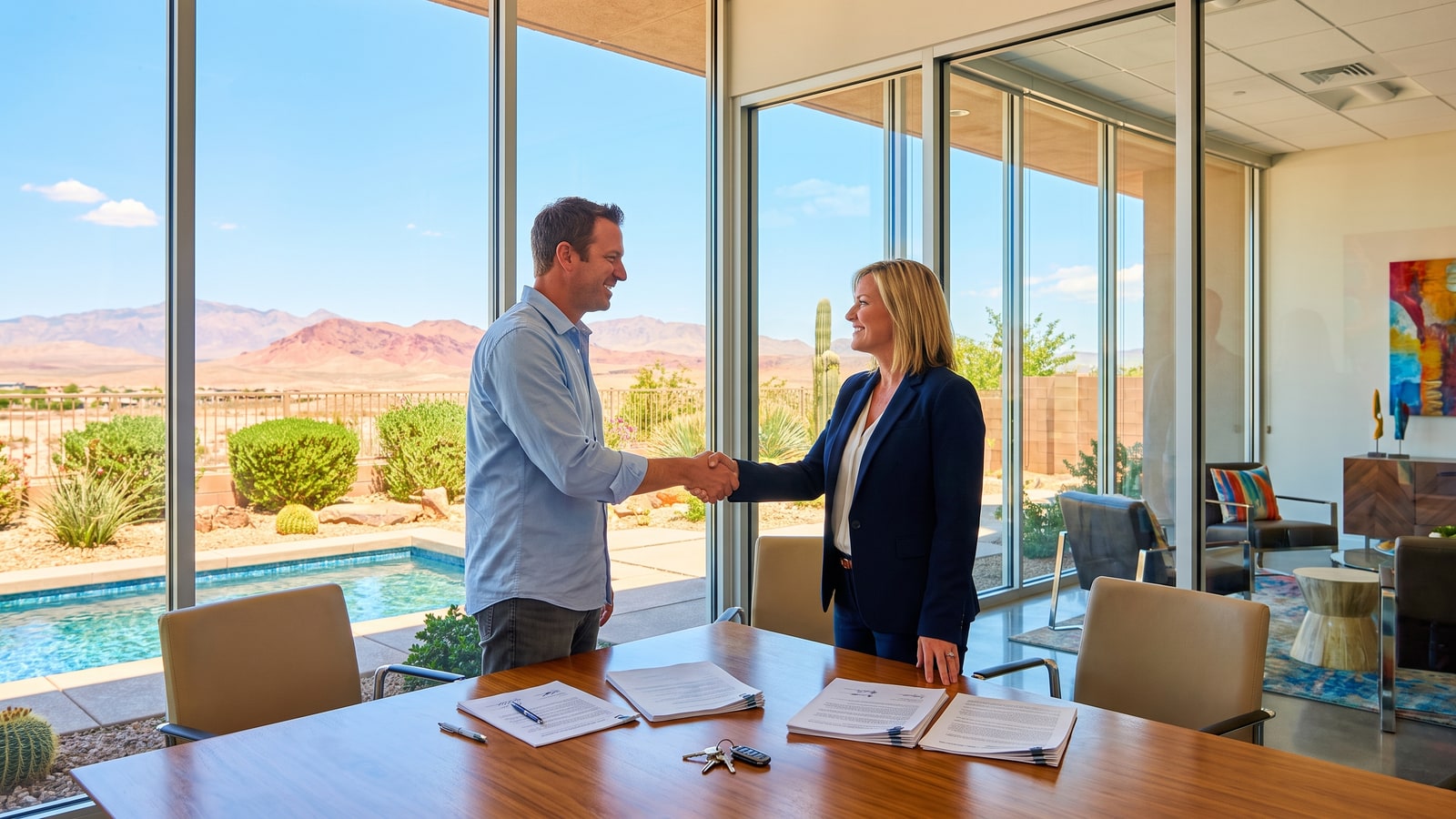
Question 8: How Do You Handle Conflicts of Interest, Especially Dual Representation?
Dual representation (professional represents both buyer and seller) is legal in Nevada if both sides consent, but it's a structural conflict. The professional can't fully advocate for you against the other side. Many sophisticated buyers avoid dual-representation professionals because the professional profits the same regardless of whether you negotiate down the price, creating less incentive to fight for your benefit.
Ask directly: "If I want to buy a listed property, will you also represent the seller, or can you represent just me?" A transparent professional will explain their brokerage policy and let you choose. If they hedge, that's a warning.
Also ask: "Have you represented the listing professional or seller before?" If they have history with the listing side, relationship pressure exists to close fast rather than fight hard for your benefit.
Question 9: What Happens If There's an Appraisal Gap, Inspection Issue, or Financing Snag?
Most transactions face at least one hiccup: an appraisal below purchase price, a home inspection revealing a $10,000 HVAC problem, or a lender requesting last-minute documentation. How your professional handles crisis is the real test. A weak professional disappears or defers to the lender. A strong professional negotiates, coordinates, and keeps all parties moving toward closing.
Ask for an example: "Tell me about a time when an appraisal came in below purchase price and how you resolved it." Listen for:
-
Did they research comparable sales and request an appraisal challenge?
-
Did they negotiate the seller down to match the appraisal?
-
Did they explain your options (renegotiate, bring more cash, walk away)?
-
Or did they say, "Sorry, nothing I can do"?
Request a written contingency plan for your specific deal once you're under contract. That plan should include timelines for inspections, appraisal, loan approval, and title review. In my experience, the appraisal gap is where the good agents earn their fee: on a $480,000 purchase that appraises at $465,000, the $15,000 gap is either negotiated, split, or paid in cash, and the agent's job is to know which one the seller will accept before the buyer has to guess.
Question 10: How Do You Market Homes When Listing? What's Your Digital Strategy?
If you're selling, your professional's marketing reach directly impacts sale price and days on market. Ask exactly what photography, video and online syndication the professional provides, and when the listing will reach the MLS; under NAR's Clear Cooperation Policy, a publicly marketed listing must be submitted within one business day. Top professionals use drone video, 3D walkthroughs, targeted digital ads, and syndication to national platforms.
For seller candidates, ask:
-
Photography and video. Do you hire professional photographers and videographers? (Answer should be: yes, always.)
-
Listing syndication. Which platforms beyond MLS? (Answer should include: national platforms, professional website, email blast, social media.)
-
Average days on market. What's your typical time-to-sale for homes in this price range and neighborhood? (Benchmark: 28 days citywide, 34 in Henderson, and 20 in North Las Vegas over the 90 days ending September 4, 2026, according to our analysis of Las Vegas REALTORS MLS data via Repliers.)
-
Price adjustments. Do you monitor comparable sales daily? When do you recommend a price correction? (Answer should be: within 14 days if showing traffic is low.)
-
Open houses and previews. Do you hold open houses? How many professional previews? (A busy professional will have had 30–50 other professionals view the home preemptively.)
Ask for a market analysis showing comparable sales, average days on market by neighborhood, and seasonal trends. Our seller resources and home value estimator show what a complete listing plan starts with.
Question 11: Can You Help Me Understand Financing, Contingencies, and Timing in Las Vegas?
Real estate professionals are not loan officers, but they need to understand lending timelines. Ask how long underwriting, the appraisal and clear-to-close usually take with the lenders they work with, and check those answers against the deadlines written into your purchase agreement. If a professional doesn't explain these timelines upfront, you can reach closing day with an appraisal still pending, so coordination is essential.
Ask: "Walk me through the timeline from offer to closing, step by step." Their answer reveals sophistication. Topics:
-
Inspection period. Standard is 7–10 days; 5-day periods are tight and risk missing major repairs.
-
Appraisal timeline. 7–10 days after order. If you waive the appraisal contingency (risky), you're on the hook for the full price even if the home appraises $20,000 less.
-
Financing contingency. Most lenders require one with a clear deadline (usually 17–21 days). Waiving it means you buy even if financing falls through.
-
Title work. Nevada title companies usually clear in 5–7 days. Title issues (liens, easements, encroachments) must resolve before closing.
-
HOA review. Many Summerlin, Henderson, and North Las Vegas properties are HOA. You should review CC&Rs, financials, and resale disclosures. This takes 5–7 days and uncovers deferred maintenance or special assessments.
A strong professional provides a written timeline and contingency checklist. Weak professionals wing it and create chaos. A good agent also runs the payment math with you: at the 7.28% rate Freddie Mac reported for the week of October 1, 2026, a home at the $475,000 August 2026 Las Vegas REALTORS single-family median with 20% down carries about $2,600 a month in principal and interest, and one at the $489,890 Henderson 90-day median in the table above carries about $2,682.
Question 12: What Are Your References, and Can I Speak to Recent Clients Directly?
Ask for 3–5 past client references from the past 6–12 months (both buyers and sellers). A confident professional will provide them immediately. Ask each reference:
-
How responsive was your professional during the transaction?
-
Did they understand your local market?
-
Did they negotiate effectively on your behalf?
-
Would you hire them again and recommend them?
-
What surprised you negatively about the process?
One or two lukewarm references is normal; half a dozen rave reviews is standard for top professionals. Public review platforms are a second check: Nevada Real Estate Group carries 9,146+ verified five-star reviews across Google, FastExpert, and other platforms, and I tell every prospective client to read the three-star ones first.

What Red Flags Should You Watch For During Your Interview?
Some warning signs emerge immediately:
| Red flag behavior | What it signals | Action |
|---|---|---|
| Rushes you to sign a representation agreement before discussing terms | Lack of professionalism; prioritizes paperwork over relationship-building | Walk away. A real professional wants you informed and comfortable before signing anything. |
| Claims "I know everyone" or "I can get you a deal no one else knows about" | Overconfidence or lack of market data; off-market deals are rare and usually listed on MLS within 48 hours | Ask for specifics: names of off-market deals closed in the past 6 months with dates and prices. If vague, skip them. |
| Can't cite recent closed deals or MLS numbers | Part-time operator or overstated production claims | Request written transaction history. Real producers have it ready in seconds. |
| Doesn't know the neighborhood where you want to buy or vaguely generalizes | Not an expert; will be less effective negotiating or forecasting value | Choose a professional with deep roots in your target area (Summerlin, Green Valley Henderson, CCSD-zoned neighborhoods). |
| Avoids questions about compensation, dual representation, or conflict of interest | Hiding something; likely to create surprises later | A good professional is upfront. If they dodge, keep interviewing. |
| No smartphone, no MLS app, no real-time listing access | Outdated tech stack; slow responsiveness; inefficient showing coordination | Modern professionals live on their MLS app and CRM. Absence is a major red flag. |
What Should You Include in Your Vetting Checklist Before Signing?
Use this 12-point checklist before signing any representation agreement:
-
License verified on NRED's License Lookup, active status, no violations
-
Closed 5+ deals in your target neighborhood in the past 90 days (proof: MLS numbers or recorded deal list)
-
Can name 3+ competing homes and recent sales prices without looking them up
-
Current on market data (cites LVR reports and third-party analytics)
-
Clear team structure: solo or team-based, with named coordinator or support staff
-
Negotiable compensation, stated as a specific amount or rate in writing
-
Representation agreement is clear on duration, termination, and exclusions
-
Transparent about dual representation (if applicable) and conflict of interest
-
Provided contingency plan or timeline for your specific deal
-
References from past 6–12 months available immediately
-
No pressure to sign; willing to answer follow-up questions
-
Professional communication (timely email/text, organized, courteous)
Why Does Hiring the Wrong Professional Cost You Thousands?
A poor professional choice costs real money. If they don't negotiate effectively, you overpay on purchase or undersell on listing. If they miss inspection deadlines or fail to coordinate appraisals, you lose deals or extend closing timelines. If they don't understand HOA restrictions in Summerlin or school-zone implications in Henderson, you inherit surprises after closing. Top professionals, those who close consistent volume in your neighborhood, maintain deep market data, and advocate fiercely, net you tens of thousands in negotiated value, faster sales, and peace of mind.
Put numbers on it. On the $480,000 Southern Nevada median, a 2% negotiation miss is $9,600. An unchallenged low appraisal that forces $15,000 of extra cash to close is $15,000 you did not plan for. A seller paying 6% on a $350,000 loan (an example rate, not a market figure) carries about $1,750 a month in interest, so a listing that sits 60 days instead of 28 costs about $1,840 more in interest alone, before any price reduction. On these example numbers, those three items together come to about $26,400.

How Should You Interview Multiple Professionals and Compare?
Never hire the first professional you meet. Interview at least three, preferably in your target neighborhoods. Use the 12 questions above verbatim. Take notes and follow up on references. Request their market analysis and transaction history in writing before the final interview. Once you've narrowed to a top candidate, negotiate the representation agreement terms before signing. Confirm duration, termination clause, compensation, and exclusions.
If you work with the Nevada Real Estate Group in Las Vegas, Henderson, Summerlin, North Las Vegas, or Reno, you can search active listings on our MLS-powered home search. The team will walk you through every one of these vetting questions and provide full transparency on team structure, market expertise, and past client references.
What Terms Should You Negotiate in Your Representation Agreement?
Once you've selected a professional, don't just sign the form they hand you. Negotiate:
-
Duration. Request 30 days to start. If the relationship is working at day 30, renew or extend. Don't lock in 90 days upfront.
-
Termination. Insist on: "Either party may terminate this agreement with written notice. No penalties for early termination."
-
Exclusions. List any homes or sellers you're already in contract with or have open discussions with. Those are excluded.
-
Compensation (if selling). Negotiate lower if you're a cash seller, if the home is easy to sell, or if you're listing during a seller's market.
-
Dual representation consent. If the agreement allows the professional to represent both sides, request: "In the event of dual representation, I retain the right to hire separate counsel or terminate without penalty."
A true professional will negotiate these terms without pushback. If they resist, keep interviewing.
What Legal and Ethical Standards Should Every Professional Meet?
Every professional in Nevada must adhere to the Nevada Real Estate Commission rules and the National Association of Realtors Code of Ethics (if they hold membership, which most do). Nevada law requires professionals to disclose material facts, avoid conflicts of interest, and provide honest representation. The Code of Ethics goes further, requiring good faith negotiation, transparency in all dealings, and protection of client confidentiality. If a professional violates these standards, you have recourse: file a complaint with the Nevada Real Estate Division (see the Division's File a Complaint page, which uses the Statement of Fact Form 514), or pursue damages through arbitration or court. However, prevention is better than remedy; vetting thoroughly upfront avoids needing legal recourse entirely.
Key ethical standards to know:
-
Fiduciary duty. Your professional must act in your best interest, not their own or the other side's. This is non-negotiable.
-
Disclosure of conflicts. If a professional represents both buyer and seller, or has a financial interest in the outcome, they must disclose it in writing.
-
Fair dealing. No deception, hidden fees, or misrepresentation of property condition, market value, or deal terms.
-
Confidentiality. Information you share with your professional (your maximum offer, your closing timeline, your financial situation) must not be disclosed to the other side without permission.
-
Competence. Professionals must maintain knowledge of Nevada law, local markets, and current lending practices.
When interviewing, ask: "What's your approach to fiduciary duty, especially in dual-representation deals?" A strong professional will explain how they advocate for you despite any conflicts, or proactively recommend a non-conflicted colleague. If they dodge the question or claim "it's not an issue," take it seriously; the best professionals often steer clear of dual agency altogether for buyer-side work.
When Should You Ask These 12 Questions, Early or Late in Your Search?
Start asking these 12 questions early, ideally before your first showing. Under the NAR settlement practice changes in effect since August 2024, a buyer's agent needs a written agreement with you before touring homes, so the vetting has to happen before the first showing, not after. If you're in a multiple-offer situation or a fast-moving market, you'll want a trusted professional already vetted and ready. Las Vegas markets cycle: in 2024, inventory tightened significantly, creating 14-day closing windows on hot properties. In September 2026, conditions have stabilized, with a 28-day citywide median days on market and roughly four months of supply. Your professional needs to understand these cycles and position you accordingly.
Also, don't be afraid to walk away mid-process if the professional isn't meeting expectations. If they miss a callback within 24 hours, fail to prepare your paperwork on time, or pressure you on major decisions, that's a signal to interview someone else. You haven't signed anything binding until the representation agreement is executed, so use your interview process as a test drive. Top-tier professionals maintain response times under 4 hours during active transactions.
What Changed for Las Vegas Buyers and Sellers Since Spring 2026?
When this guide first ran in May, the valley was at a price peak. According to Las Vegas REALTORS' July 2026 report, the median existing single-family price set an all-time high of $490,000 in May and June 2026 and then eased to $480,000 in July. Sales were roughly flat, with home sales up 1.2% and condo and townhome sales down 1.1% from July 2025, and supply sits near four months. That combination, flat-to-slightly-lower prices with steady volume, rewards agents who price precisely and punishes the ones who list high and "test the market."
Rates moved against buyers. According to Freddie Mac, the 30-year fixed rose from 6.50% a year earlier to 6.71% on September 3, 2026. That is about $60 a month more on a $350,000 loan, which is not decisive on its own, but it means Question 11 matters more: an agent who can steer you toward seller credits, a builder buydown on new construction, or a lender who prices competitively is worth more than one who simply forwards a pre-approval letter.
The data also shows how much neighborhood expertise matters right now. Over the 90 days ending September 4, 2026, according to our analysis of Las Vegas REALTORS MLS data via Repliers, North Las Vegas homes closed in a median 20 days while Summerlin South took 37, and Henderson's $1M+ tier took 41 days against 28 for Las Vegas $1M+. An agent who quotes you a single "Vegas average" for days on market is not reading the ZIP-level data, and the 12 questions in this guide are how you find that out before you sign.
Why Should You Vet Nevada Real Estate Group With These Same Questions?
I built this checklist because I expect clients to run it on my own team. Nevada Real Estate Group is the #1 real estate team in Nevada and #44 in the nation, with 9,600+ closings, $4.85 billion+ in total sales volume, 150+ agents, and 9,146+ verified five-star reviews; in 2025 alone we closed 789 transactions and $361.5 million+ in volume. I am a 16-year U.S. Navy veteran, licensed in Nevada (S.181401), and every agent on the team can produce a transaction history, a ZIP-level market summary, and references on request.
If you're buying or selling in Las Vegas, Henderson, Summerlin, North Las Vegas, or relocating from out of state, call the team at (702) 637-1759, use our contact page, or start with our buyer resources and seller resources. We will answer all 12 questions in the first meeting, in writing if you prefer, and you can browse current inventory on our home search before we talk. The Nevada Real Estate Group office is located at 8945 W Russell Rd, Suite 170, Las Vegas, NV 89148; you can also reach us at info@nevadagroup.com or read more about the team.
Frequently Asked Questions
How do I verify a Las Vegas real estate agent's license?
Go to the Nevada Real Estate Division's License Lookup and search by name or license number to check the licensing status. For disciplinary history, the Division's compliance FAQ points to its Request for Records of Complaints form. The lookup takes about 90 seconds, and any status other than "Active" means the person cannot legally represent you.
Do I have to sign a buyer representation agreement before touring homes in Nevada?
Since the NAR settlement practice changes took effect in August 2024, an agent who is a REALTOR must have a written agreement with you before touring a home with you. That makes the vetting in this guide a pre-showing step. Negotiate the duration (30 days to start), a no-penalty termination clause, exclusions for homes you already found, and the compensation terms before you sign.
Is real estate commission negotiable in Las Vegas?
Yes. According to NAR's settlement FAQs, commissions are not set by law and are fully negotiable, and Nevada law sets no rate either. Buyer-side compensation is set in your written buyer agreement as a defined amount or rate, and a seller can pay a buyer's agent only with the seller's written approval of the amount. No public source reports an average Las Vegas rate; on the $475,000 August 2026 single-family median, each 1% is $4,750. Ask what the fee covers and whether it flexes with price or property type.
What market numbers should a good Las Vegas agent know without looking them up?
At minimum, the latest Las Vegas REALTORS monthly median ($475,000 for existing single-family homes in August 2026), the current Freddie Mac 30-year fixed rate (7.28% for the week of October 1, 2026), and the days-on-market and price-per-square-foot figures for your target ZIP. An agent who cannot get within a few percent of those numbers is not reading the reports.
How many closed deals should an agent have in my neighborhood?
Ask for 5 or more closed, recorded transactions in your target neighborhood and price band within the past 90 days, with MLS numbers. Pending deals do not count, and team totals do not count as the individual agent's production. A producer can email the list within minutes.
What is dual agency in Nevada, and should I allow it?
Dual agency is when one professional represents both the buyer and the seller in the same transaction. Nevada permits it with written consent from both sides, but the agent cannot fully advocate for either party. Many buyers decline it and ask for a separate agent from the same brokerage or a different brokerage; at minimum, retain the right to terminate without penalty if dual representation arises.
How many agents should I interview before choosing one?
Interview at least three, ideally agents who have closed recently in your target neighborhood. Use the 12 questions verbatim, request the transaction history and market summary in writing, call at least one reference each, and only then negotiate the representation agreement with your top choice.
Which Sources Inform This Las Vegas Agent Vetting Guide?
License verification references the Nevada Real Estate Division's License Lookup, and complaint records its compliance FAQ. Market figures come from Las Vegas REALTORS monthly reports through August 2026 (the August figures as reported by VEGAS INC on September 9, 2026) and from Las Vegas REALTORS MLS data accessed via the Repliers API on September 4, 2026, covering the 90 days ending that date. Mortgage rates reference the Freddie Mac Primary Mortgage Market Survey for the weeks of September 3 and October 1, 2026.
Professional-conduct standards and buyer-agreement practice changes reference the National Association of REALTORS Code of Ethics and its settlement FAQs. Property records reference the Clark County Assessor's real property records search. School-zone context references the Clark County School District's zoning page. Licensee duties reference Nevada Revised Statutes Chapter 645, which governs real estate licensees.
This article is for informational purposes only and is not legal, tax, or financial advice; real estate transactions vary by property and circumstance, and Chris Nevada is a licensed Nevada real estate professional (S.181401) with Nevada Real Estate Group, verifiable at red.nv.gov, last reviewed September 4, 2026.