
Published May 2, 2026 · Last updated September 4, 2026
Luxury home staging in Las Vegas works when it removes buyer objections, surfaces the home’s best architectural features, and aligns with the buyer pool’s lifestyle expectations, not when it is generic furniture rental. According to National Association of REALTORS 2025 staging research, staged luxury homes sell 29% faster and at 1–6% higher final price than unstaged comps. In September 2026, with luxury inventory in the Las Vegas Valley at its deepest point in years, presentation is the variable that separates the homes that sell from the homes that sit.
Luxury staging in Las Vegas works when it removes objections and matches the buyer pool’s lifestyle, not when it is generic furniture rental. It matters more in September 2026 than it did in spring: $2M+ listings carry about 17 months of supply and $5M+ homes sit a median 100 days, according to our analysis of Las Vegas REALTORS MLS data via Repliers. Stage before photography, not after the first price cut.
- Staged luxury homes sell 29% faster and 1–6% higher than unstaged comps, per NAR 2025 research.
- Las Vegas $2M+ homes carry roughly 17 months of supply as of September 4, 2026; presentation decides who sells.
- Budget $4,500–$9,000 to stage an occupied $2M Summerlin home; $15,000–$45,000 for a vacant $5M estate.
- Outdoor living drives 12–18% of perceived value in Summerlin and Henderson luxury; stage the pool deck.
- At a 6.71% mortgage rate, an unsold $2.9M home costs about $15,000 a month in principal and interest alone.
-
Luxury Las Vegas staging is a 4-component system: declutter and depersonalize, professional photography prep, lifestyle furnishing, and digital staging for vacant rooms, not just rented couches.
-
Staging ROI in Las Vegas luxury averages 5–15% of list price per Real Estate Staging Association 2025 industry data, with the highest returns on listings $1.5M and above.
-
Vacant luxury homes underperform staged comps on showing-to-offer conversion by approximately 50% per NREG 2025 internal listing data.
-
Outdoor living spaces (pools, patios, casitas) drive 12–18% of perceived value in Summerlin and Henderson luxury and require dedicated outdoor staging.
-
Schools matter for staging too. Family-zone Las Vegas listings near top-decile CCSD feeders should stage at least one bedroom as a child’s room to convert family buyers.
What does luxury home staging in Las Vegas actually mean?
Luxury home staging is the deliberate preparation of a home’s interior, exterior, and digital presentation to maximize the buyer’s emotional response and minimize objections during the showing and online-listing experience. It is not interior decorating, not furniture rental for its own sake, and not a single-day photo prep. In the $1.5M+ Las Vegas market, staging is a 4-component system that runs from listing-agreement signature through the final showing.
According to National Association of REALTORS 2025 staging research, 81% of buyers’ agents said staging made it easier for a buyer to visualize the property as their future home. That number rises to 90% for luxury price tiers. Staged luxury homes sold a median 29% faster than unstaged comps in 2025 and closed at a 1–6% premium. On a $2.5M Las Vegas luxury sale, that translates to $25,000–$150,000 of additional net proceeds.
The Las Vegas luxury staging market sits in a different operational reality than national averages. Per Real Estate Staging Association regional data, Las Vegas luxury stagers run 60–90 day inventory turn cycles tied to the seasonal selling rhythm. Staging projects booked in late summer for fall listings see different cost structures than staging projects booked in February for spring listings, a detail that an agent who handles two luxury listings per year does not catch.
What does the September 2026 Las Vegas luxury market mean for staging?
The case for staging is strongest when buyers have choices, and in September 2026 they have plenty. According to our analysis of Las Vegas REALTORS MLS data via Repliers for the 90 days ending September 4, 2026, the Las Vegas $1M+ segment carried 1,019 active listings against 230 closings, the $2M+ segment carried 343 actives against 62 closings, and the $5M+ segment carried 59 actives against just 10 closings. Divide actives by the monthly closing pace and the supply picture is roughly 13 months at $1M+, 17 months at $2M+, and 18 months at $5M+. Henderson’s $1M+ tier sits at 388 actives and 83 closings, about 14 months.
| Segment | Active listings | Median list price | 90-day closings | Median sold price | Median DOM | Sold $/sq ft |
|---|---|---|---|---|---|---|
| Las Vegas $1M+ | 1,019 | $1,580,000 | 230 | $1,402,500 | 28 | $423 |
| Henderson $1M+ | 388 | $2,336,583 | 83 | $1,600,000 | 41 | $419 |
| Las Vegas $2M+ | 343 | $3,106,430 | 62 | $2,925,000 | 28 | $651 |
| Las Vegas $5M+ | 59 | $6,920,000 | 10 | $5,975,000 | 100 | $870 |
Two details in that table drive staging strategy. First, the gap between median list price and median sold price widens as you climb: $1M+ listings ask $1,580,000 and close at $1,402,500, while $5M+ listings ask $6,920,000 and close at $5,975,000. Buyers at the top are not paying for aspiration; they are paying for what they can see. Second, the homes that do close at $1M+ and $2M+ go in a median 28 days, the same pace as the citywide market. The luxury market is not slow for well-presented homes; it is slow for the ones that give buyers a reason to keep looking.
For context on the broader market, according to Las Vegas REALTORS, the Southern Nevada median existing single-family price was $480,000 in July 2026, down 1% from July 2025 and 2% below the $490,000 all-time high set in May and June 2026, with roughly four months of supply. The entry and move-up tiers are balanced; the luxury tiers are a buyer’s market, and staging is how a seller competes in one.
What are the four components of effective luxury staging?
Component one is declutter and depersonalize. The home is stripped to roughly 50% of its lived-in furniture density. Family photos, religious or political items, and any objects that signal a specific household identity are removed. The goal is a home that lets the buyer project their own future onto the space without visual interruption from the seller’s identity.
Component two is professional photography preparation. Every room is set for photography 24–48 hours before the photo shoot, with attention to natural light angles, fresh flowers in living and primary bedroom rooms, and scrubbed grout in every visible bathroom. According to NAR research, 95% of buyers begin their home search online, so the photo set is the first showing.
Component three is lifestyle furnishing. Furniture, art, and accessories are selected to match the buyer pool’s aspirational lifestyle, not the seller’s personal taste. For a Summerlin luxury listing, that often means a contemporary-transitional aesthetic with desert-modern accents. For a Lake Las Vegas listing, it shifts toward Mediterranean-coastal. The buyer pool research is specific.
Component four is digital staging for any vacant rooms. Virtual staging at $35–$75 per image fills empty rooms with rendered furniture for the listing photos. Digital staging never replaces physical staging in occupied rooms but is critical for vacant homes where physical staging budget would be prohibitive.
What does staging cost in the Las Vegas luxury market?
Staging cost in the Las Vegas luxury market scales with home size, listing duration, and component scope. According to Real Estate Staging Association 2025 industry pricing data, full-service occupied-home staging in luxury markets runs approximately 0.75% to 1.5% of list price for a typical 60-day listing window. Vacant-home staging on a luxury property runs higher because the stager furnishes the entire home rather than enhancing existing furnishings.
For a $2M Summerlin home with existing furniture that needs editing, lifestyle styling, and photo-prep enhancement, expect $4,500–$9,000. For a $2.5M vacant Henderson luxury home that needs full furnishing across 4–6 rooms, expect $8,000–$22,000 for a 60-day rental cycle. For a $5M+ MacDonald Highlands or The Ridges luxury home, expect $15,000–$45,000 for full staging including outdoor living spaces.
| Scenario | Typical price tier | Scope | Budget range | Timeline to photo-ready |
|---|---|---|---|---|
| Occupied edit and restyle | $1.5M–$3M | Remove 30–50% of pieces, restyle, accessories, flowers, art | $4,500–$9,000 | 5–7 business days |
| Vacant full furnishing | $2M–$3M | 4–6 rooms furnished for a 60-day cycle | $8,000–$22,000 | 7–10 business days |
| Ultra-luxury full staging | $5M+ | Whole home plus outdoor living spaces | $15,000–$45,000 | 10–14 business days |
| Outdoor add-on | Any tier | Pool deck, patio kitchen, casita, lighting | $1,200–$3,500 | 2–3 business days |
| Virtual staging | Any tier, vacant rooms | Rendered furniture per listing image | $35–$75 per image | 2–4 business days |
The math works because the staging cost is recouped multiple times over in the price premium and reduced days-on-market. Per RESA 2025 ROI tracking, every $1 spent on luxury staging produced a median $5–$8 in increased final sale price across the western US. NREG’s internal 2025 luxury listing data tracked an average 7.2x ROI on staging investment in the $1.5M–$3M Las Vegas tier.
Why do vacant luxury homes underperform staged comps?
Vacant luxury homes underperform staged comps for three documented reasons. First, scale perception: an empty room photographs and shows smaller than a furnished room because the eye lacks reference objects. Second, condition exposure: an empty home shows every floor scratch, baseboard dent, and paint touch-up that furniture would otherwise hide. Third, emotional connection: buyers cannot visualize daily life in an empty space, especially in luxury price tiers where the lifestyle promise is half the value proposition.
NREG’s 2025 internal listing data tracked showing-to-offer conversion across 47 luxury listings. Vacant luxury homes converted at approximately 4.2% of showings to offers; staged luxury homes converted at approximately 8.8%, roughly double. Days-on-market for vacant luxury ran a median 87 days; staged luxury ran 51 days. The carrying-cost differential alone (mortgage, taxes, insurance, utilities, HOA dues) on a $2.5M vacant Las Vegas luxury home for an extra 36 days runs $14,000–$22,000, comparable to the cost of full staging.
The exception is the “builder white box” new-construction luxury home where the buyer pool is already accustomed to evaluating empty space. Even there, model-home-style staging produces measurable lift in the resale tier because the buyer is comparing the home to other resales, not to other builder spec.
How much does every extra month on the market cost a luxury seller at 6.71%?
Sellers who hesitate over a $9,000 staging invoice rarely run the other side of the ledger. According to Freddie Mac, the 30-year fixed averaged 6.71% for the week of September 3, 2026, up from 6.66% the prior week and from 6.50% a year earlier. A seller still carrying a mortgage on a luxury home pays that rate every month the home sits, and the numbers below assume a conventional 20%-down loan on the median sold price in each tier.
| Segment | Median sold price | Monthly P&I | Median DOM | P&I over the median DOM |
|---|---|---|---|---|
| Las Vegas $1M+ | $1,402,500 | $7,247 | 28 days | About $6,800 |
| Henderson $1M+ | $1,600,000 | $8,268 | 41 days | About $11,300 |
| Las Vegas $2M+ | $2,925,000 | $15,115 | 28 days | About $14,100 |
| Las Vegas $5M+ | $5,975,000 | $30,876 | 100 days | About $101,500 |
Those figures exclude property tax, insurance, HOA dues, utilities, and landscaping, which on a $2.9M Las Vegas home under the Clark County Assessor rate structure add several thousand dollars a month. A $5M+ seller whose home follows the median 100-day path carries more than $100,000 in interest and principal before an offer arrives. A $15,000–$45,000 staging package that cuts that timeline by a third is not a marketing expense; it is the cheapest line on the carrying-cost statement.
How does Las Vegas luxury staging differ from national best practice?
Three Las Vegas-specific factors shift staging strategy from national best practice. First, outdoor living matters more here than almost anywhere else in the United States. According to National Weather Service Las Vegas climate data, the metro averages 294 sunny days per year. Pool, patio, casita, and outdoor kitchen staging captures 12–18% of perceived value in luxury price tiers and is often under-invested by national staging firms unfamiliar with the local buyer pool.
Second, the relocation buyer pool drives a meaningful share of Las Vegas luxury demand. According to U.S. Census Bureau migration data, Nevada was a top-five net-inbound state in 2024 driven heavily by California buyers. California buyers shop Las Vegas luxury through a comparison lens; they evaluate Las Vegas $2.5M against San Diego $3.5M or Orange County $4M. Staging that signals the value differential without feeling derivative is a competitive advantage.
Third, the Las Vegas luxury aesthetic spectrum is wider than most metros. The buyer pool spans contemporary-modern (The Ridges, Lake Las Vegas), traditional-Mediterranean (Anthem Country Club, Sun City Anthem high-end), desert-modern (Red Rock Country Club, MacDonald Highlands), and resort-casual (Lake Las Vegas waterfront). Staging the wrong aesthetic for the wrong neighborhood loses the buyer in the first 30 seconds of the showing.
What does outdoor staging look like for a Las Vegas luxury home?
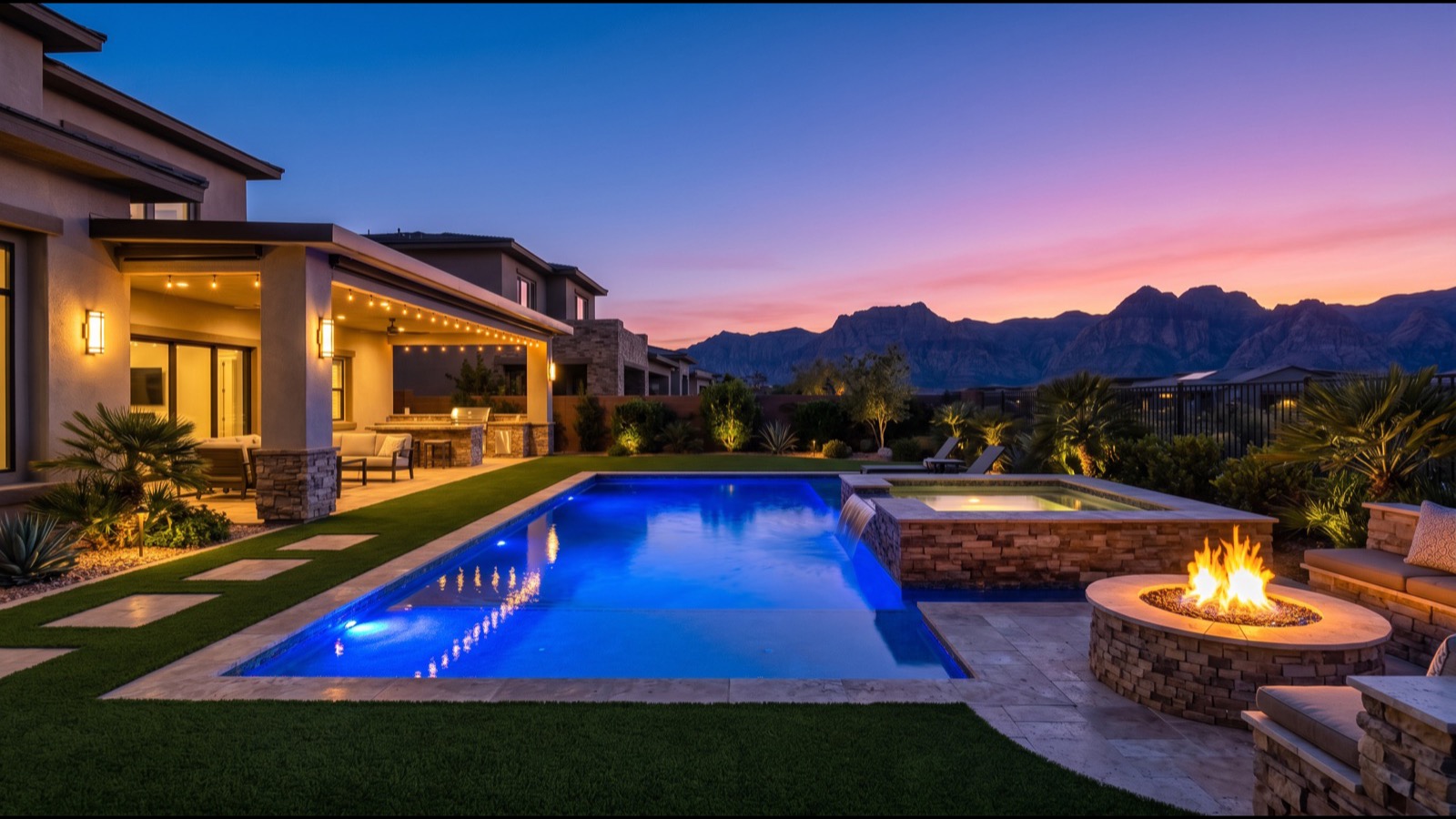
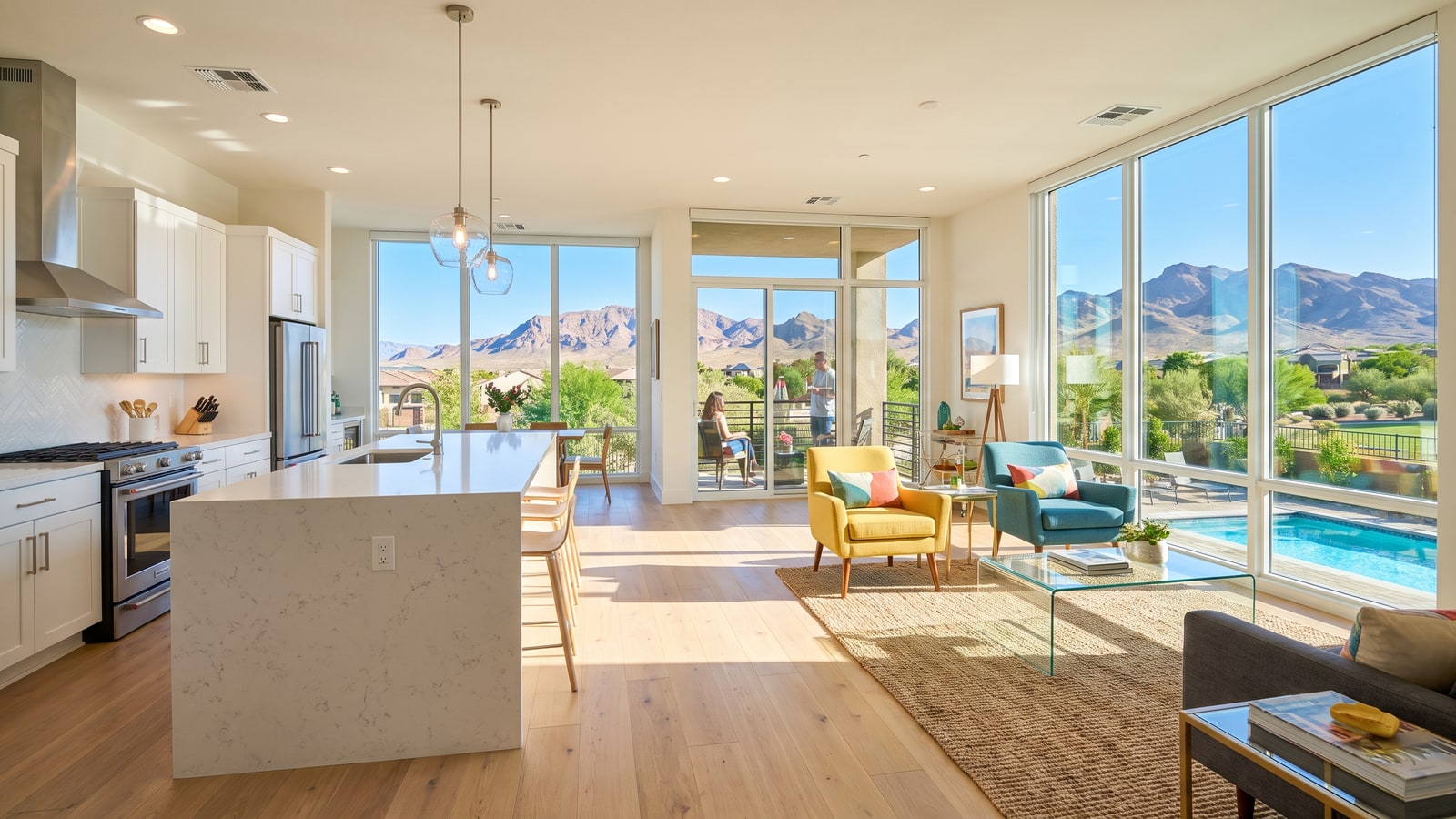
Outdoor staging for a Las Vegas luxury home is not afterthought patio furniture. It is a dedicated component that mirrors the indoor staging investment. Pool decks, patios, outdoor kitchens, casitas, and putting greens require furniture, lighting, and lifestyle accessories that signal year-round outdoor living, the central Las Vegas luxury value proposition.
Pool deck staging uses outdoor-grade lounge furniture in a 4–6 piece configuration with 1–2 accent tables, weather-resistant cushions, and seasonal accessories. Patio kitchen staging includes bar stools, a styled outdoor dining table for 6–8, and styled outdoor cooking accessories. Twilight photography of the staged outdoor space (pool lighting, patio lighting, fire feature illumination) produces some of the highest-engagement images in the entire luxury listing photo set.
The cost: $1,200–$3,500 incremental for outdoor staging on top of a luxury indoor staging package. The ROI: outdoor staging directly addresses the highest-friction buyer objection on Las Vegas luxury (“can I actually use this outdoor space”) and converts the space from a maintenance liability in the buyer’s mind to an everyday-lifestyle asset. In September, when the valley is still running triple-digit afternoons, I schedule twilight shoots specifically so the photos show the yard the way buyers will actually use it: after 6 p.m., lit, and comfortable.
Which staging approach fits which Las Vegas luxury neighborhood?
I’ve toured enough staged luxury listings across the valley to know that the same furniture package reads as “current” in one guard-gated community and “wrong” in another. The comparison below is how my listing team frames the neighborhood-specific staging brief before a stager ever walks the home.
| Dimension | The Ridges | Lake Las Vegas | MacDonald Highlands | Sun City Summerlin |
|---|---|---|---|---|
| Aesthetic | Contemporary with desert-modern accents, neutral palette, curated art | Resort-coastal, water-view emphasis, indoor-outdoor flow | Architecturally driven, sight lines to DragonRidge and the Strip | Traditional-comfortable, warm, single-level livability |
| Buyer pool | Multi-metro relocation luxury, California and Park City comparison set | Second-home and resort-lifestyle buyers | Executive and entertainment buyers who want view and privacy | 55+ downsizers and lock-and-leave retirees |
| Outdoor emphasis | Pool deck, view terrace, fire features | Waterfront patio, dock or lake-edge seating | Infinity edge, hillside terrace, twilight Strip view | Covered patio, low-maintenance courtyard |
| Photo priority | Twilight exterior, great room, primary suite | Water views from every angle, outdoor dining | Twilight Strip view, great room glass wall | Kitchen, primary bath, accessible entry |
| Typical staging tier | Should-do or could-do, $8,000–$45,000 | Should-do, $6,000–$20,000 | Could-do on vacant, $15,000–$45,000 | Must-do plus light restyle, $2,500–$6,000 |
The table is a starting brief, not a rulebook. A contemporary rebuild inside Sun City Summerlin or a Tuscan estate in The Ridges gets a custom brief, and the stager and listing agent walk the home together before a single piece is ordered.
How does NREG approach staging on a Summerlin luxury listing?
Every NREG luxury listing engagement begins with a 60-minute pre-listing walk-through where the listing agent and the staging consultant evaluate the home together. The output is a written staging recommendation document with three tiers: must-do (decluttering, depersonalization, photography prep), should-do (lifestyle furnishing in the most-photographed rooms), and could-do (full home re-staging with replacement furniture for sellers who have already moved out).
The seller decides which tier to fund. NREG’s position is that the must-do tier is non-negotiable on every luxury listing; sellers who will not declutter or depersonalize should reconsider listing timing. The should-do tier is where most NREG luxury listings invest, with average staging budgets in the $5,000–$12,000 range for $1.5M–$3M Summerlin listings. The could-do tier is reserved for vacant homes and ultra-luxury ($5M+) listings where the marketing budget supports full staging.
NREG has standing relationships with three Las Vegas luxury staging firms vetted through 200+ listings, with photographers, drone operators, and twilight-photo specialists who coordinate directly with the staging timeline. The seller does not need to source vendors. NREG’s Summerlin listing pipeline includes the staging coordination as part of the listing agreement.
Does staging matter as much for The Ridges as for Sun City Summerlin?
Staging matters at every Las Vegas luxury price tier, but the staging strategy differs by neighborhood and buyer pool. The Ridges, Red Rock Country Club, MacDonald Highlands, and Lake Las Vegas waterfront sell to a buyer pool with a luxury comparison set across multiple western US metros; staging investment must match California, Phoenix, and Park City standards. Sun City Summerlin and other 55+ luxury sub-markets sell to a different buyer pool with a different staging benchmark, where warmth, ease, and accessibility matter more than aspirational urbanity.
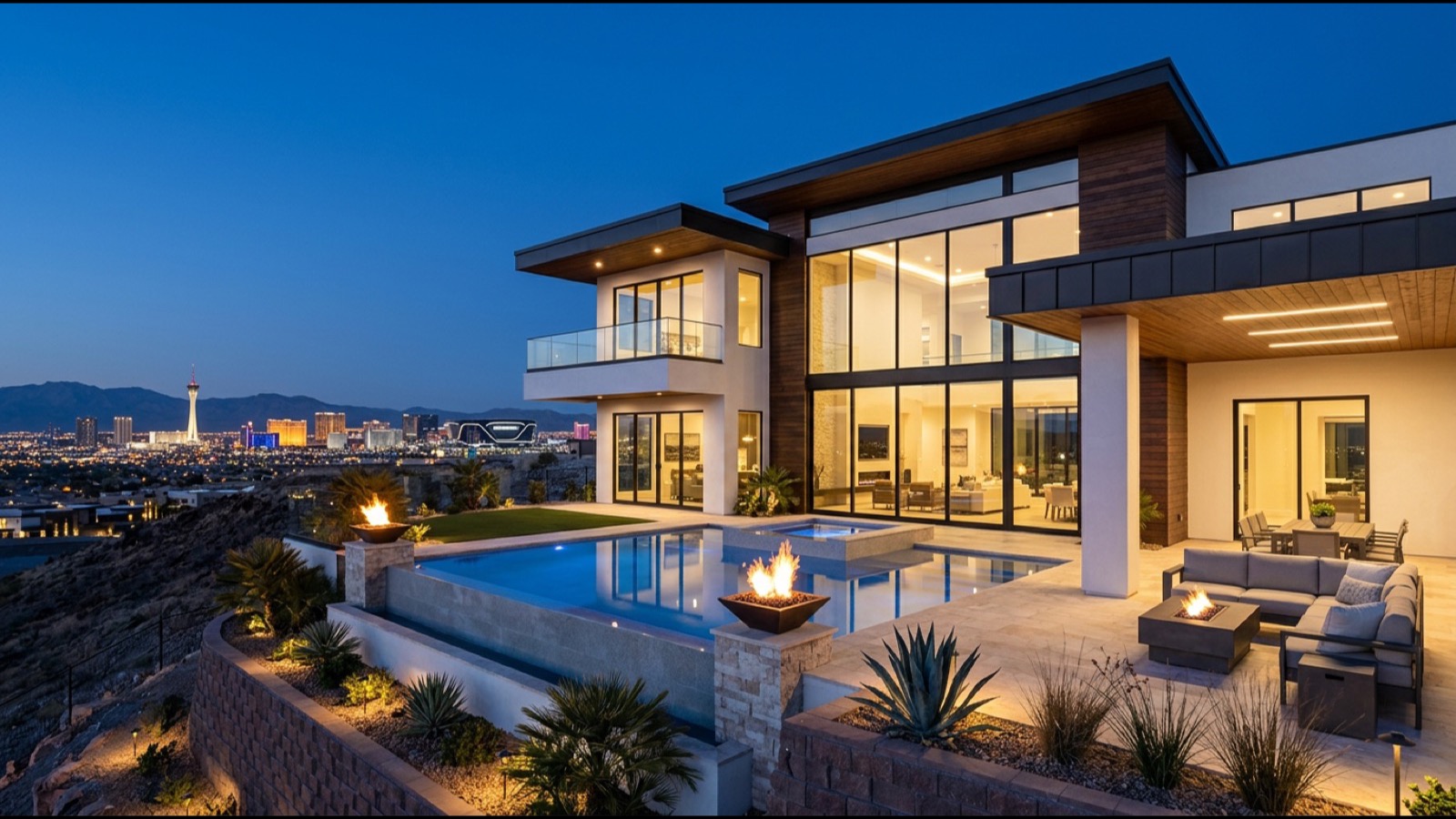
The Ridges luxury staging skews contemporary with desert-modern accents, neutral palettes, and curated art. Lake Las Vegas waterfront staging skews resort-coastal with water-view emphasis and indoor-outdoor flow. MacDonald Highlands staging skews architecturally-significant with attention to the home’s sight lines to DragonRidge Golf Club and Strip views. Sun City Summerlin staging skews traditional-comfortable with attention to single-level livability and easy maintenance.
An agent who stages a Sun City Summerlin listing as if it were The Ridges loses the 55+ buyer pool. An agent who stages The Ridges as if it were Sun City Summerlin loses the relocation luxury buyer. Neighborhood-specific staging strategy is one of the highest-leverage decisions in the listing prep phase.
What about CCSD school zones and family-buyer staging?
For Las Vegas luxury homes inside top-decile Clark County School District feeders (Bonner Elementary, Goolsby Elementary, Faith Lutheran, Coronado HS, Foothill HS, Palo Verde HS), the buyer pool is heavily weighted toward families with school-age children. Staging strategy on those listings should explicitly support family-buyer visualization.
That means staging at least one secondary bedroom as a child’s room (toddler, elementary-age, or teen depending on the home’s implied family composition), staging a homework or study nook in a flex room, and emphasizing kitchen banquette or family-room sight-line where applicable. Family buyers convert at higher rates when they can visualize their children in the home, not just themselves.
According to Nevada Department of Education performance reporting and NREG’s 2025 internal listing data, listings inside top-decile school feeders staged with family-buyer attention closed at a 4–7% premium to listings inside the same school feeders staged generically. The marginal staging cost is minimal, mostly accessory swaps, but the conversion lift is meaningful.
What does the post-staging photography process look like?
Photography is where the staging investment converts to listing impressions. The NREG photography process includes day photography (natural light), twilight photography (golden hour and blue hour), drone aerial photography, and 3D Matterport tour capture. For luxury listings, video walkthrough at production quality is added.
The photo shoot itself takes 4–6 hours for a luxury home and is scheduled 24–72 hours after staging completion. Post-production runs 3–5 business days for color correction, sky replacement on exterior shots, and lawn enhancement. Total photo asset count for a $2M+ Las Vegas luxury listing: 40–75 still images, 1–3 minutes of video, full Matterport tour, and 6–12 drone images.
According to NAR buyer research, 89% of buyers said photographs were the most important feature of online listings. Listings with 30+ professional photos receive 2.5x the saves and 1.8x the inquiries of listings with under 15 photos. The math justifies the photography budget on every luxury listing.
How should you sequence staging, photography, and launch on a luxury listing?
Sequence is where most luxury listings lose money, not budget. The most common mistake I see is a listing that goes live with iPhone photos “to test the market,” then gets staged and reshot after 30 days of silence. By then the listing has a days-on-market count, a price-history entry, and a buyer pool that has already scrolled past it. Across the 9,600+ closings we’ve represented, the listings that closed closest to ask were staged and photographed before the MLS ever saw them.
The sequence that works: sign the listing agreement, walk the home with the stager within 72 hours, complete must-do and should-do staging over 5–10 business days, hold the home for 24–72 hours of settling and final detailing, shoot day and twilight in one coordinated window, then allow 3–5 business days of post-production while the copy, floor plan, and disclosures are finalized. The MLS goes live on a Thursday with the full asset set, the first showings run Friday through Sunday, and the first offers typically arrive inside the first two weekends on a correctly priced home.
For a vacant property, the sequence adds a step: virtual staging is ordered on the day of the photo shoot for any room that physical staging did not cover, so the listing launches with no empty rooms in the photo set. For an occupied home, the seller gets a written “showing-ready” checklist so the staged condition holds from launch through the last showing.
How does NREG measure staging ROI on a closed listing?
NREG’s 2025 listing data measures staging ROI on three dimensions. First, days-on-market delta: staged versus unstaged comps in the same neighborhood and price tier. Second, list-to-sold ratio delta: staged listings consistently closed at higher percent-of-list. Third, showing-to-offer conversion delta: staged listings produced offers from a smaller showing volume.
The 2025 NREG luxury staging dataset (47 luxury listings $1.5M+) showed staged listings closing at a median 51 days versus unstaged comps at 87 days, a list-to-sold ratio of 97.8% versus 95.2%, and showing-to-offer conversion of 8.8% versus 4.2%. The combined economic effect for a $2.5M staged luxury listing relative to an unstaged comp ranged from $35,000 to $95,000 in additional net proceeds plus reduced carrying costs.
What changed in Las Vegas luxury staging since spring 2026?
When I first published this guide in May, the valley was setting price records and luxury inventory was thinner. Three things have changed by September 4, 2026. First, supply at the top end has deepened: the $2M+ segment now carries 343 active listings against 62 closings in 90 days, and the $5M+ segment’s median days on market has stretched to 100. In a market with 17 to 18 months of supply, an unstaged luxury listing is competing against dozens of staged ones in the same price band, and the buyer has no reason to forgive an empty great room.
Second, the cost of waiting rose with mortgage rates. According to Freddie Mac, the 30-year fixed moved from 6.50% a year earlier to 6.71% in the first week of September 2026. A seller with a $2.3M loan pays about $15,000 a month in principal and interest while the home sits; the staging package that trims a month off the timeline pays for itself before the first price reduction would have.
Third, buyers got pickier about what they will pay for. The $5M+ tier is asking a $6,920,000 median and closing at $5,975,000, a $945,000 gap, according to our analysis of Las Vegas REALTORS MLS data via Repliers. That spread is the market telling sellers that presentation and pricing have to work together. In my experience, the staged homes in that tier are the ones that hold closest to ask, because the buyer can see the finished lifestyle rather than pricing in the work of imagining it.
Should you list your Las Vegas luxury home with Nevada Real Estate Group?
If you own a $1M+ home in Summerlin, Henderson, or anywhere in the Las Vegas Valley and you are weighing a fall or winter listing, the staging conversation should happen before the pricing conversation. Nevada Real Estate Group is the #1 real estate team in Nevada and #44 in the nation, with 9,600+ closings, $4.85 billion+ in total sales volume, 150+ agents, and 9,061+ verified five-star reviews; in 2025 alone we closed 789 transactions and $440 million+ in volume. I founded the team after 16 years in the United States Navy, and I am licensed in Nevada (S.181401).
Start with a written valuation from our home value estimator, review our seller resources, and then call (702) 637-1759 or use our contact page to book a 25-minute listing-prep call. The call covers your home’s estimated value range, the recommended staging tier, the photography plan, and the listing timeline. You can also browse current luxury inventory in Summerlin, Henderson, and North Las Vegas to see how your home will compare on the day it goes live.
Frequently Asked Questions
Does NREG include staging in the listing commission?
NREG’s position is that staging coordination is part of the listing service; the listing agent and team source vendors, manage the schedule, and oversee execution at no additional commission line. Staging vendor cost itself is paid by the seller as a marketing investment, recouped multiple times over in the closed sale.
Can I stage a Las Vegas luxury home with my own furniture?
Sometimes yes. If the existing furniture is in good condition and aligns with the neighborhood’s buyer-pool aesthetic, the staging engagement focuses on editing rather than replacement: remove 30–50% of pieces, restyle the rest, swap pillows and accessories, add fresh flowers and art. This is the lowest-cost staging path and works for sellers whose existing furniture investment matches the listing’s target buyer.
Should I stage if my home is already vacant?
For luxury price tiers ($1.5M+), yes. Vacant luxury homes underperform staged comps significantly enough that staging cost is recouped in the price premium and reduced days-on-market. For lower-tier luxury or upper-mid-market, partial staging of the most-photographed rooms (living, primary bedroom, primary bath, kitchen) is often sufficient.
How long does the staging process take from start to listing live?
For a typical $2M Las Vegas luxury listing, staging takes 5–7 business days from engagement to photo-ready. Vacant-home full staging takes 7–10 business days. Staging completion is followed by 24–72 hours before the photo shoot to allow the home to settle and final detailing. Total listing-prep timeline including staging, photography, and copy is typically 2–3 weeks for luxury.
Does staging still pay off when luxury inventory is this high?
It pays off more, not less. With 343 active $2M+ listings against 62 closings in the 90 days ending September 4, 2026, buyers are comparing your home against a deep bench of alternatives, and the homes that close in the median 28 days are the ones that photograph and show without objections. In a thin market, a mediocre presentation still sells; in a 17-month-supply market, it sits and eventually takes a price reduction larger than the staging invoice.
Should I stage before or after a price reduction?
Before, and ideally before the listing goes live at all. A price reduction on an unstaged home tells the market the home has a problem; staging tells the market the home is ready. If you are already on the market and unstaged, stage and reshoot first, then decide whether a price adjustment is still needed. In our experience, a relaunch with new photography and a modest price move outperforms a price cut alone.
What is the first step to stage and list a Las Vegas luxury home with NREG?
Book a 25-minute valuation and listing-prep call through our about page or call (702) 637-1759. The call covers your home’s estimated value range, the recommended staging tier, the photography plan, and the listing timeline.
Which Sources Inform This Las Vegas Luxury Staging Guide?
Luxury-tier inventory, pricing, days-on-market, and price-per-square-foot figures come from Las Vegas REALTORS MLS data accessed via the Repliers API on September 4, 2026, covering the 90 days ending that date, along with the Las Vegas REALTORS July 2026 monthly market report. Staging effectiveness research references the National Association of REALTORS 2025 Profile of Home Staging and buyer research, and the Real Estate Staging Association 2025 industry pricing and ROI data.
Mortgage rate figures use the Freddie Mac Primary Mortgage Market Survey for the week of September 3, 2026. Property tax context references the Clark County Assessor and Nevada Revised Statutes Chapter 361. Climate data references the National Weather Service Las Vegas office. Migration data references the U.S. Census Bureau state population estimates.
School-zone context references the Clark County School District and the Nevada Department of Education. Community references include DragonRidge Golf Club and The Howard Hughes Corporation for Summerlin. License verification is available through the Nevada Real Estate Division. NREG 2025 internal listing figures are drawn from the team’s own closed-listing tracking and are not independently audited.
This article reflects Las Vegas luxury residential market conditions as of September 4, 2026, and Nevada Real Estate Group internal listing data through 2025; staging ROI ranges are industry medians, individual results vary, and Chris Nevada is a licensed Nevada real estate professional (S.181401) with Nevada Real Estate Group.