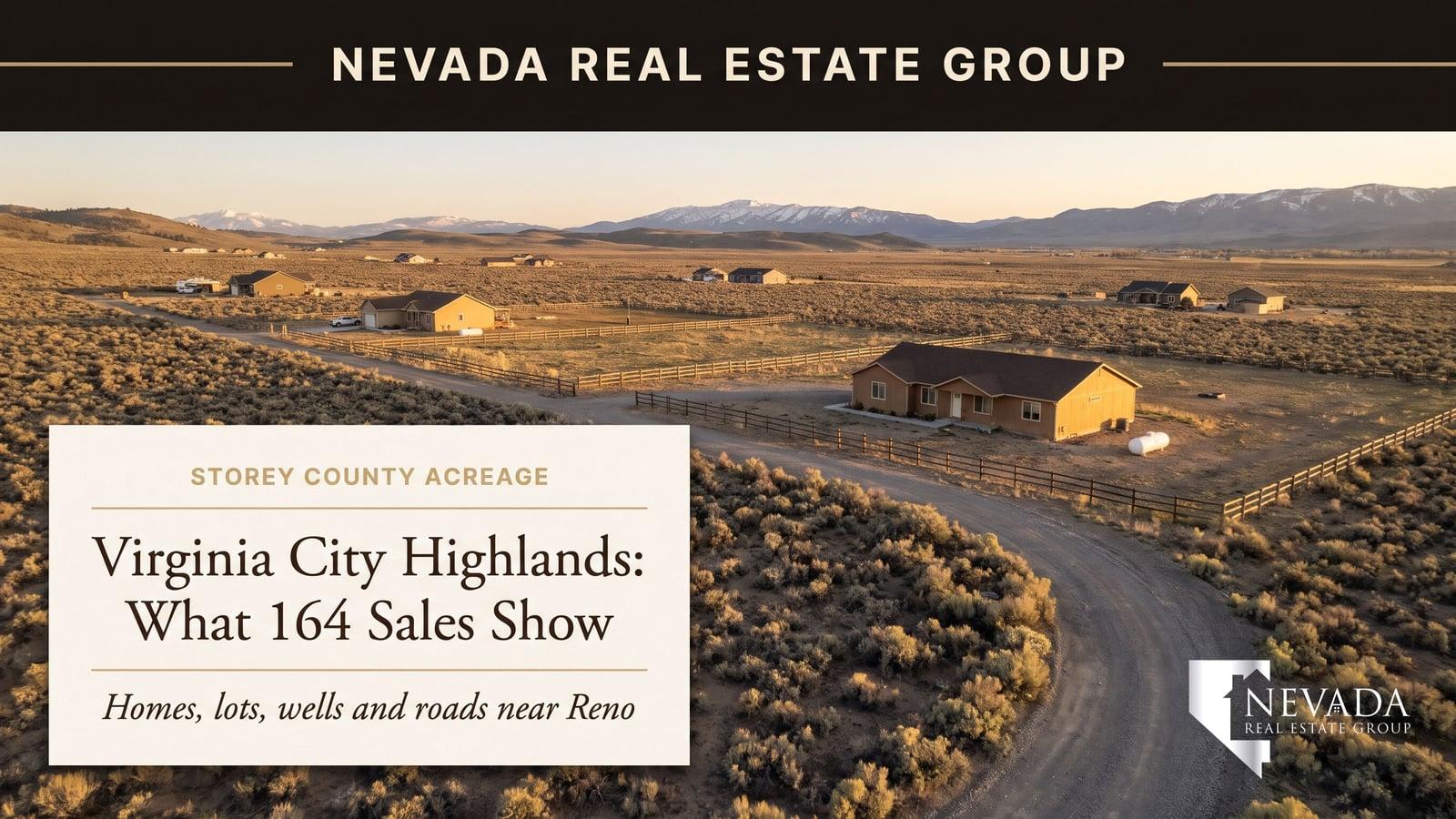

Virginia City Highlands is where a Reno-area buyer can still get a house on acreage, with horses allowed, for under $700,000: the 74 homes that sold there from October 2023 through September 2026 closed at a $685,000 median on a median 2.4 acres. It is also easy to misread. Most Highlands homes carry a "Reno, NV 89521" mailing address, yet they sit in Storey County, on private wells and septic systems, on roads that are not all maintained the same way, and up the Geiger Grade from the Truckee Meadows.
So we pulled every Highlands sale recorded in the Northern Nevada Regional MLS from October 1, 2023 through September 30, 2026, sorted the homes and lots by the zoning written on each listing, and set them beside Washoe County acreage homes that share the same 89521 ZIP. That gave us 74 house sales and 90 vacant-land sales on the Highlands plateau, plus 48 Washoe County comparison sales. Below is what they cost, how fast they sold, and what the listings say about water, heat, roads and dues.
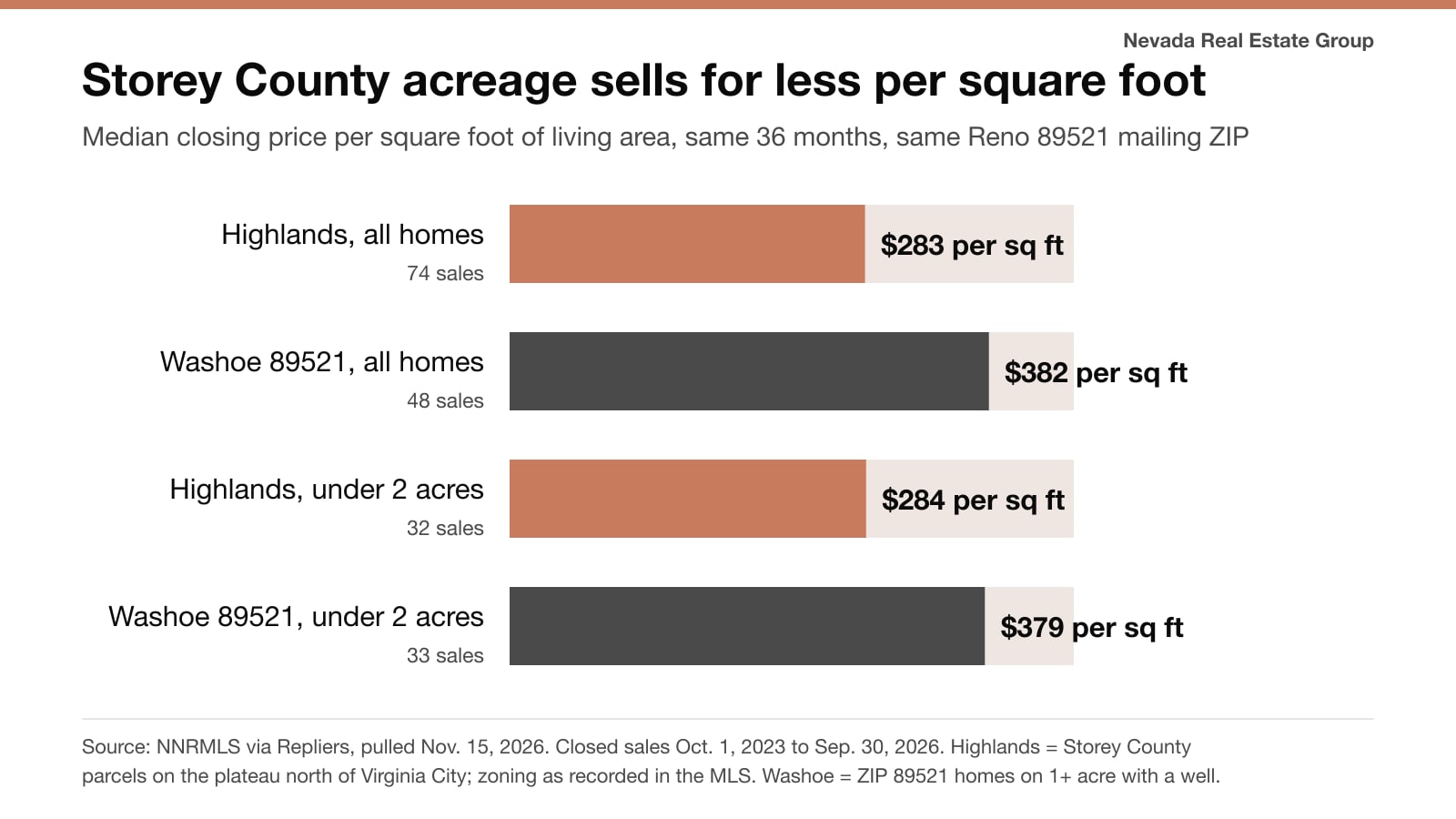
Virginia City Highlands homes sold for a median $685,000 from October 2023 through September 2026, across 74 MLS sales on this Storey County plateau north of Virginia City. Homes on the 1-acre E-1 VCH lots closed at a $649,000 median and homes on 10-acre E-10 HR parcels at $767,500. Vacant lots sold for a $69,500 median, and most still needed a well and septic system.
- 74 Highlands homes closed at a $685,000 median, $283 per square foot, October 2023 to September 2026.
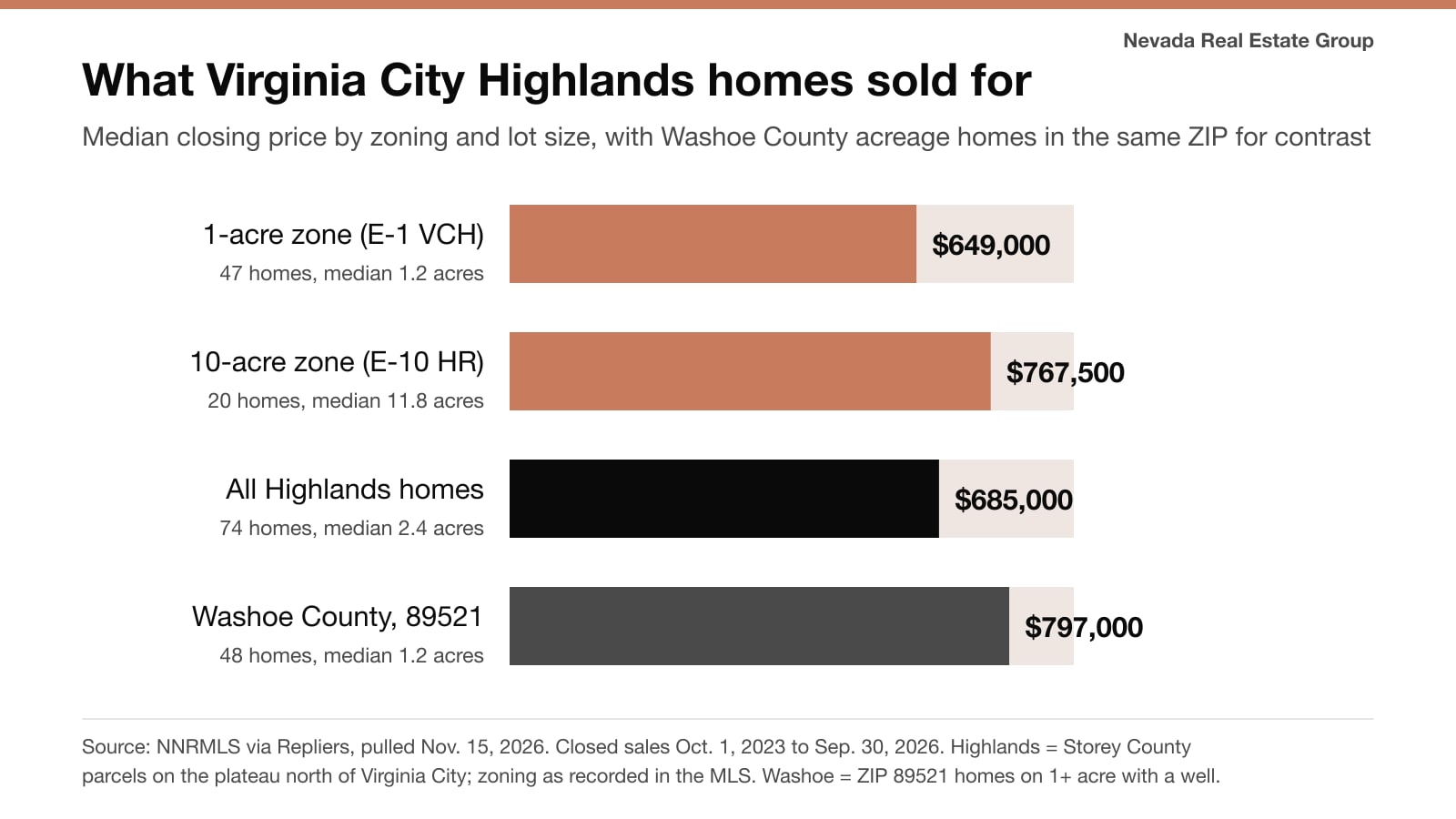
- Washoe County acreage homes in the same 89521 ZIP sold for $382 per square foot over those months.
- Lots closed at a $69,500 median in the same window; 62% recorded "well needed."
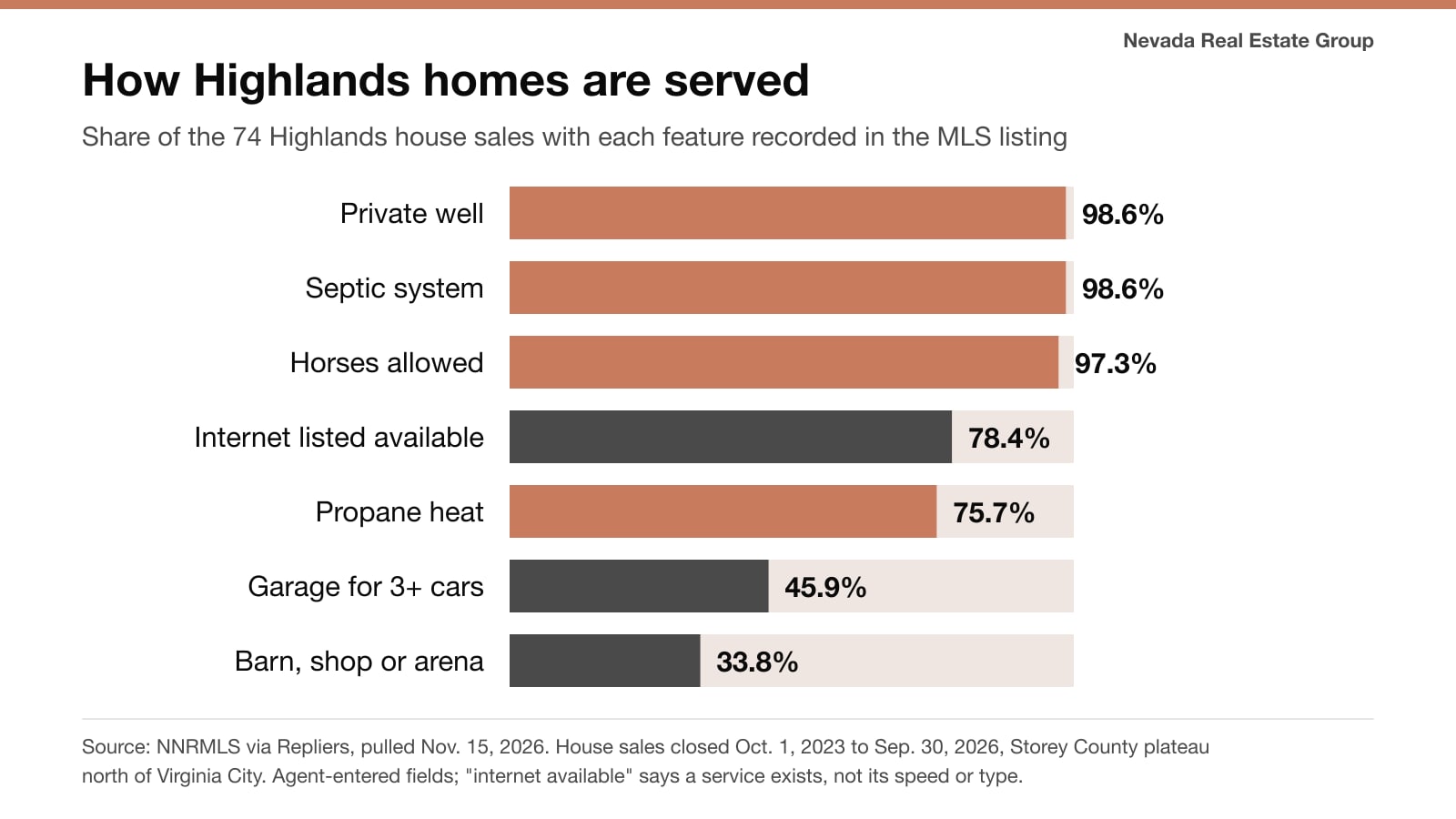
- 72 of the 74 homes ran on both a private well and septic system; 56 heated with propane.
- The 1-acre association's dirt roads are private; the county plows Cartwright and Lousetown roads.
| Measure | 1-acre zone (E-1 VCH) | 10-acre zone (E-10 HR) | All Highlands homes |
|---|---|---|---|
| House sales | 47 | 20 | 74 |
| Median sale price | $649,000 | $767,500 | $685,000 |
| Middle half of prices | $545,000 to $717,000 | $735,000 to $1,240,000 | $545,000 to $760,000 |
| Median price per square foot | $281 | $293 | $283 |
| Median living area | 2,370 sq ft | 2,983 sq ft | 2,388 sq ft |
| Median lot | 1.2 acres | 11.8 acres | 2.4 acres |
| Median days to an accepted offer | 32 | 78 | 38 |
| Barn, shop, arena or corral recorded | 14 of 47 | 10 of 20 | 25 of 74 |
| Recorded association dues (median) | $100 a year | $200 a year | $100 a year |
What did Virginia City Highlands homes sell for from 2023 to 2026?
The 74 Highlands house sales that closed between October 1, 2023 and September 30, 2026 had a median price of $685,000 and a median of $283 per square foot of living space. The middle half sold between $545,000 and $760,000. The cheapest closed at $280,000 and the most expensive at $1,675,000. Most buyers spent between half a million and three-quarters of a million: 42 sales landed between $500,000 and $749,999, 14 between $750,000 and $999,999, 8 at $1 million or more, and 10 below $500,000.
These are not small houses. The median home had 2,388 square feet, three bedrooms (45 of the 74) or four (23), and sat on 2.4 acres. The median year built is 1997, and the stock is mostly from the 1980s through the 2000s; only four of the 74 were built in 2020 or later, so a Highlands buyer is usually buying a house that has been lived in for decades on its own well and septic system.
Prices rose over the window, though the sample is small enough that one year can swing. In the 12 months ending September 2024, 29 homes closed at a $640,000 median. In the next 12 months, 22 closed at $708,500. In the 12 months ending September 30, 2026, 23 closed at $700,000, and the median price per square foot rose from $281 to $320. Sales also got faster: the median time from listing to an accepted offer fell from 56 days to 36 and then to 29.
For a sense of the monthly cost, at Freddie Mac's 7.11% average 30-year fixed rate for the week of November 12, 2026, a $685,000 home with 20% down carries principal and interest of about $3,686 a month, before property tax, insurance, dues, propane and well and septic upkeep.
The Highlands averages roughly two home sales a month, so a single unusual property moves the numbers. As of November 15, 2026, seven Highlands houses were listed in the MLS, one of them under contract, at asking prices from $520,000 to $1,050,000 and a $729,000 median. Search them on our Virginia City Highlands homes for sale page, which shows the live listings.
Why does a Storey County home have a Reno 89521 address?
Because the mailing address and the county are two different things. Of the 74 Highlands homes in our study, 72 were listed with the city "Reno" and ZIP 89521, the same ZIP as Damonte Ranch and the Geiger Grade foothills in Washoe County. Only two carried a Virginia City address. Every one of them sits in Storey County.
That matters more than it sounds. The county decides who assesses and taxes the property, which building department issues permits for a garage or a new septic system, which sheriff and fire district respond, and which school district the children attend. In the MLS, all 74 Highlands homes were assigned to Hugh Gallagher Elementary and Virginia City High School, two of the four schools on the Storey County School District's schools page, and the district's transportation page lists a Highlands elementary bus route with stops along Cartwright Road. It is a small county: the state's certified population estimate put Storey County at 4,462 residents on July 1, 2025. The 48 Washoe County acreage homes in the same ZIP were assigned to Washoe County schools: Pleasant Valley or Brown elementary, and mostly Galena High.
It also affects how you search. A buyer who filters for Reno 89521 on a portal sees Highlands homes mixed in with Washoe County acreage that sold for about a third more per square foot from October 2023 through September 2026, and may not notice the county line until the tax bill or the school assignment arrives. A buyer who searches "Virginia City" may miss most of the Highlands, because so few listings use that city name.
Before you write an offer, confirm the county on the listing and on the county assessor's parcel record, and read the preliminary title report with the county in mind. Our Reno 89521 homes for sale page covers the Washoe County side of the ZIP, and the Virginia City page covers the historic town to the south. The comparison below shows what the county line is worth in price.
How do Highlands prices compare with Washoe County acreage in 89521?
Highlands homes sell for about a quarter less per square foot than Washoe County acreage homes in the same ZIP. Across the 36 months, the 74 Highlands homes closed at a median $283 per square foot, against $382 for the 48 Washoe County homes in 89521 on at least an acre with a well. Holding lot size roughly constant barely changes the gap: on lots under two acres, 32 Highlands homes sold for $284 per square foot and 33 Washoe County homes for $379.
The Washoe group is the closest like-for-like we could build: all on wells and septic systems, at a median 1.2 acres, and mostly zoned to Pleasant Valley Elementary. Its most common streets were Virginia Street, Ravazza Road, Cheyenne Drive and Toll Road. Those homes are older (median year built 1978), smaller (2,229 square feet), and sit closer to south Reno. Location and the Washoe County school district likely explain part of the price gap, though sales data alone can't say how much. The Highlands homes are newer, larger and on bigger lots, and they ask you to drive farther and higher.
| Measure | Highlands (Storey County) | Washoe County, 89521, 1+ acre on a well |
|---|---|---|
| House sales | 74 | 48 |
| Median sale price | $685,000 | $797,000 |
| Median price per square foot | $283 | $382 |
| Price per square foot, lots under 2 acres | $284 (32 sales) | $379 (33 sales) |
| Median living area | 2,388 sq ft | 2,229 sq ft |
| Median lot | 2.4 acres | 1.2 acres |
| Median year built | 1997 | 1978 |
| Median days to an accepted offer | 38 | 30 |
| Median sale price as share of original asking price | 96.4% | 94.1% |
| Propane heat recorded | 56 of 74 | 24 of 48 |
| School district | Storey County | Washoe County |
Washoe County acreage prices also rose faster, on a small sample: its latest 12 months, to September 30, 2026, closed 19 homes at a $970,000 median, up from $722,500 a year earlier, while the Highlands median held near $700,000. At about that price, the median Highlands home over the three years had roughly 2,400 square feet on 2.4 acres. Our guide to Northern Nevada homes with acreage compares the other acreage areas around Reno.
What separates the 1-acre Highlands lots from the 10-acre Highland Ranches?
Storey County's master plan describes the Highlands as "a mountainous residential subdivision of 1, 10, and 40 acre parcels," and the zoning written on each listing follows that split. Of the 74 homes that sold from October 2023 through September 2026, most (47) were recorded as E-1 VCH, the roughly one-acre estate lots of Virginia City Highlands, whose property owners association dates to July 1972. Twenty were E-10 HR, the roughly ten-acre parcels of Highland Ranches, which has its own association. One was E-40 VR, a forty-acre parcel in Virginia Ranches, and six carried other zoning text.
The 1-acre homes are the Highlands most buyers picture: a median 1.2 acres, 2,370 square feet, $649,000, and an accepted offer in a median 32 days. Most of their listings (28 of 47) describe the road as publicly maintained, though the association's own account of its roads differs (see the roads section below), and their recorded association dues run from $50 to $425 a year, most often $100 (18 of 47) or $50 (15). About three in ten (14 of 47) list a barn, shop, arena or corral.
The 10-acre homes are a different purchase. They sold for a median $767,500, but the middle half ran from $735,000 to $1,240,000, because ten acres holds both modest ranch houses and large custom homes; the median home had 2,983 square feet. Half (10 of 20) list a barn, shop, arena or corral, and 13 of 20 have garage space for three or more vehicles. They also took longer to sell, a median 78 days to an accepted offer, and only 5 of the 20 front a publicly maintained road: 9 rely on a road maintenance agreement and 6 on a private road. Most (15 of 20) recorded dues of about $200 a year.
Per acre, the 10-acre homes are far cheaper ($73,490 of sale price per acre against $452,000 for 1-acre homes), but that is not the useful comparison. Most of the price of a Highlands home is the house, the well, the septic system and the driveway, not the dirt. The real choice is whether you need the extra land for horses, shops or privacy, and whether you will drive a private road in winter to get it. For horse plans, our Carson Valley horse property guide walks through barns, water and fencing questions that apply here too.
How long does a Highlands home take to sell, and how much do sellers give up?
The median Highlands home went under contract 38 days after it was listed, but the spread is wide. Of the 74 sales, 14 accepted an offer within a week and 17 more within 30 days, while 25 took more than 90 days and 13 of those took more than six months. A well-priced home can sell in days; one that misses the market can sit through a winter.
Most sellers came down before they sold. Seventy-two percent of the homes (53 of 74) closed below their original asking price, and the median sale closed at 96.4% of it. The 10-acre homes gave up more, closing at a median 93.8% of the original price after 78 days; the 1-acre homes closed at 97.1% after 32 days. Two of the 74 sales were bank-owned or HUD-owned homes, so distressed sales did not drive the numbers.
The market has quickened. Over the 12 months ending September 30, 2026, the median Highlands home went under contract in 29 days, down from 56 in the 12 months ending September 2024. But the homes still listed on November 15, 2026 show the other side: the six that were not under contract had been listed a median 153 days, and three of them asked more than $350 a square foot on lots of about an acre, against a $281 median for 1-acre homes sold over the three years.
For a seller, the lesson in these numbers is to price to the Highlands sales, not to the Washoe County homes that share your ZIP. Those Washoe homes closed at $382 a square foot with a Washoe County address and school district; the closest substitutes for a Highlands home are other Highlands homes, which closed at $283. Our guide to selling a Reno home covers the closing costs and timeline that apply on either side of the county line.
What does a vacant Highlands lot cost, and what does it still need?
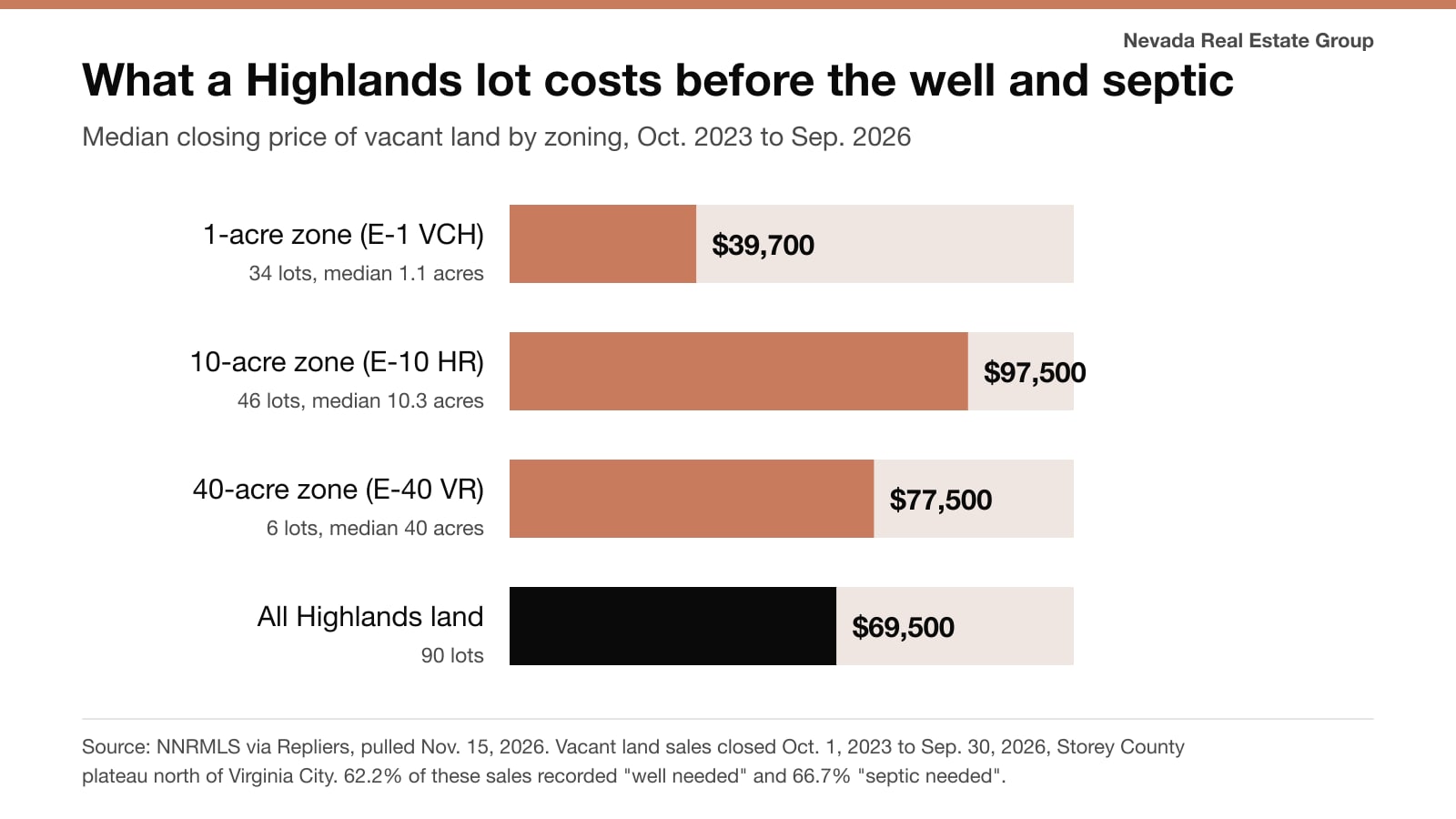
Land is where most of the Highlands' MLS activity happens. The 90 vacant-land sales that closed from October 2023 through September 2026 outnumbered the house sales, at a median $69,500 for a median 10.1 acres. The cheapest closed at $20,000 and the most expensive at $358,000. On November 15, 2026, 47 of the 54 Highlands listings in the MLS were land.
| Zoning | Lot sales | Median price | Middle half | Median lot | Median days to an offer | Median share of original price |
|---|---|---|---|---|---|---|
| E-1 VCH (about 1 acre) | 34 | $39,700 | $33,000 to $45,500 | 1.1 acres | 87 | 90.0% |
| E-10 HR (about 10 acres) | 46 | $97,500 | $70,000 to $149,900 | 10.3 acres | 101 | 90.0% |
| E-40 VR (about 40 acres) | 6 | $77,500 | $55,000 to $140,000 | 40 acres | 85 | 96.4% |
| Other zoning text | 4 | $146,750 | $115,000 to $269,500 | 10.1 acres | 45 | 90.1% |
| All Highlands land | 90 | $69,500 | $40,000 to $125,000 | 10.1 acres | 90 | 90.5% |
The price of the lot is the small part. Of the 90 land sales, 56 recorded the water source as "well needed" and 60 recorded the sewer as "septic needed." Only 16 listed an existing well and 9 an existing septic tank. A lot without either is raw land: before anyone can live there, the buyer has to drill a well, design and permit a septic system, bring in power and build a driveway, all on top of building the house.
Land also sold slowly and at a discount. The median lot took 90 days to reach an accepted offer and closed at 90.5% of its original asking price, and 72 of the 90 sold below it. The forty-acre parcels sold for less than the ten-acre ones, a reminder that remote access, slope and the distance to power matter more than the acreage on the listing. As of November 15, 2026, the 22 one-acre lots for sale had a median asking price of $47,987 and the 14 ten-acre lots a median of $104,000. See current lots on our Reno-area land for sale page, and read our guide to buying land around Reno and Sparks for the water and permit steps.
Is it cheaper to buy a built Highlands home or a lot and build?
The sale prices frame the decision but don't settle it. On the 10-acre parcels, the median home sold for $767,500 and the median lot for $97,500, a gap of $670,000. On the 1-acre lots, the gap between the $649,000 median home and the $39,700 median lot was $609,300. Whatever you build has to fit inside that gap to beat buying a finished home, and the gap has to cover far more than the house.
On a raw Highlands lot, the buyer pays for the well and the septic system the land doesn't have yet, a power connection, a driveway graded to handle snow, plans, permits and inspections, and then the house, garage and any barn or shop. The work also takes time: until the house is finished, you are carrying a lot, a construction loan or both, while paying for housing somewhere else. We don't publish construction or well-drilling costs here, because they depend on the parcel and the contractor; get written bids before you buy the land.
What the data does show is how rarely buyers get a new home here any other way. Only four of the 74 homes that sold were built in 2020 or later, and only one was marked new construction. If you want a new house in the Highlands, building it yourself is the main route, and the lot you choose decides much of the cost: road access, slope, the distance to power and what the neighbours' wells have produced.
The permit path runs through the state as well as the county. Storey County's residential construction packet says a septic permit from the Nevada Department of Public and Behavioral Health is required before the county will issue its permit, and it lists association approval among the requirements for building on the 1-acre and 10-acre lots. Before you buy land to build, confirm what a permit requires on that parcel, and read the well logs filed for nearby lots. Our guide to building a custom home covers the steps around Reno, though it is written for Washoe County, so the permit office and fees will differ in Storey County. If you'd rather start from a finished house, compare current listings on our Reno-area homes with land page, which covers acreage across the region.
Storey County's 2024 building and design requirements sheet shows what a Highlands build has to plan for. It lists the Highlands estate zones as E-1-VCH, E-10-HR and E-40-VR, with setbacks of 30 feet in front, 15 on the sides and 40 in back. Roofs are designed for snow by elevation: in the sheet's Risk Category II column, the design ground snow load climbs from 50 pounds per square foot at 5,500 to 5,999 feet to 70 at 6,000 to 6,499 feet, 90 at 6,500 to 6,999 feet and 129 at 7,000 to 8,500 feet. The same sheet calls for a 24-inch frost line and ice-shield underlayment at 5,000 feet and above. Ask any builder to show how the roof and foundation design meet those figures on your parcel's elevation before you compare bids.
What should you know about a Highlands well before you buy?
Nearly every Highlands home depends on one. Of the 74 homes that sold from October 2023 through September 2026, 73 listed a private well as the water source; the Washoe County comparison homes were all on wells too, by design of that group. Only 2 of the 74 Highlands listings marked water rights as included, and that is normal for a house lot: a domestic well serving a single home works under a different set of rules from an irrigation or commercial water right.
Nevada law explains why. Under NRS 534.180, the state's water-permit chapter doesn't apply to a well for domestic purposes that draws no more than 2 acre-feet a year, so a house lot can carry its own well without a separate water right. A new well still involves the state: the Nevada Division of Water Resources' guide to water wells in Nevada says the well driller submits a notice of intent to the division, and Storey County's residential construction packet lists the well driller's log among the documents for a new home's building permit.
What matters most to a buyer is how much water the well produces and what is in it. Ask the seller for the well driller's log, which records the depth, the water level and the yield measured when the well was drilled. You can look up the logs for the parcel and its neighbours yourself in the division's well log search. Then compare that log with any later flow test, the pump's age and any repair records. A well that produced plenty in 1995 may produce less now, and the log for the house next door tells you something about the ground under yours.
Order your own tests during the inspection period: a flow or yield test, so you know the well can supply the household at the same time it fills a stock tank, and a water-quality test from a certified laboratory. Ask your lender whether it requires either. If you plan to keep horses or irrigate pasture, ask whether a domestic well can legally and physically supply that before you buy for it, not after. Our home inspection guide for Northern Nevada buyers lists the well and septic specialists to add, and our Northern Nevada acreage guide explains how water rights change the value of larger parcels.
How are Highlands homes heated, and what utilities are missing?
Expect propane, not natural gas. Of the 74 Highlands homes that sold from October 2023 through September 2026, 56 listed propane as a heat source, often forced-air propane with a fireplace or wood stove. Sixteen listed wood or pellet heat, 15 electric heat, four oil and two solar; several listed more than one. Only one listed natural gas, and 10 listings stated outright that natural gas was not available. In the Washoe County comparison group, propane was common too (24 of 48 homes), and none of those homes recorded natural gas heat either.
Propane changes the monthly budget and the closing checklist. A buyer should learn whether the tank is owned or leased, who supplies it, how full it will be at closing and whether the price of the fuel left in the tank is part of the deal. If the tank is leased, ask the supplier what a new owner has to sign. Ask the seller for the last year of fuel bills, too, since they show what that particular house used through a winter.
The other utilities are private too. Seventy-three of the 74 homes had a septic tank, and 73 of 74 a private well, so there is no water or sewer bill, but there is a well pump, a pressure tank and a septic system to maintain. Fifty-eight of the 74 listings recorded internet service as available and seven said cable was not available; "available" says a provider serves the address, not how fast it is, so check speed at the exact address if you work from home.
Our Northern Nevada utility setup guide covers who provides power and internet in the region, how to read a seller's utility history and what changes when a property runs on a well and septic system.
Who maintains Highlands roads, and what is winter like on the Geiger Grade?
It depends on the street, and the listing field doesn't always settle it. Of the 74 Highlands homes that sold from October 2023 through September 2026, 37 listings described the road as publicly maintained, 26 named a road maintenance agreement and 11 a privately maintained road (two of those also listed a public road). The split follows the zoning: 28 of the 47 one-acre homes had a publicly maintained road, but only 5 of the 20 ten-acre homes did, with 9 relying on a maintenance agreement and 6 on a private road. On vacant land, 32 of the 90 sales named a maintenance agreement and 41 recorded nothing about the road at all. Treat the field as a prompt to ask, not a fact: only 13 of the 37 homes listed with a publicly maintained road front Cartwright or Lousetown Road, the two roads the association says the county plows.
A road maintenance agreement means the owners along that road share the cost of grading, gravel and snow removal, under whatever terms the agreement sets. Before you buy, get a copy, find out who organises the work, what each owner paid in the last year or two and whether anything is owed. A private road with no written agreement is a bigger unknown, so ask the neighbours how grading and plowing are handled now and who pays.
The associations' own pages describe a different split from the MLS field. The Virginia City Highlands Property Owners Association, which covers the 1-acre lots, says on its roads page that the dirt roads are private property maintained by their associations, and its FAQ says Storey County Public Works plows all of Cartwright and Lousetown roads, the main routes across the plateau. The Highland Ranches association says on its road information page that it is responsible for about 35 miles of roads and usually starts plowing when 4 inches of snow has fallen. Storey County's residential construction packet notes that roads in the 40-acre Virginia Ranches are maintained by the property owners, not the county. Ask the association which body maintains and plows your specific road, and get the answer in writing.
Getting to Reno is part of the decision. The main route down is State Route 341, the Geiger Grade, a mountain highway that climbs from south Reno to the plateau. Check it on the state's NVroads road conditions page before you drive it in a storm; the site's definitions page explains each chain-control level, up to chains required on all vehicles except four-wheel drives with snow tires. Before you buy, drive it at the hour you would commute, and again after a storm if you can. Our Reno snow guide covers what winter looks like on the valley floor; the Highlands is higher, so judge winter by the Grade and your own road, not by south Reno.
What do association dues and property taxes cost in the Highlands?
Association dues here are small next to a suburban HOA, but the MLS figure may not be the whole bill. On sales from October 2023 through September 2026, the listings recorded a median $100 a year for 1-acre homes and about $200 for most 10-acre homes. The Virginia City Highlands Property Owners Association's buyer information page puts its annual dues and reserve assessment at $100 a lot and lists a $250 transfer fee, and its FAQ says dues pay for road expenses including salaries, snow removal, fuel and vehicles. The Highland Ranches association's 2026 dues page lists $200 in dues plus a $350 reserve, $550 in all for 2026. So the $200 that most 10-acre listings recorded matches the base dues, not the full 2026 amount. Ask for the current statement, any special assessment and the transfer fee before you remove contingencies.
Storey County's tax rate isn't the reason Highlands bills look modest. According to the Nevada Department of Taxation's fiscal 2026-27 tax rate book, unincorporated Storey County carries a combined rate of $3.4607 per $100 of assessed value, against $3.2402 for the Truckee Meadows Fire Protection District tax districts (4000 and others) in unincorporated Washoe County and $3.66 inside the City of Reno; some 89521 parcels sit inside the city, so check the district on each tax bill. Nevada assesses property at 35% of its taxable value under NRS 361.225, and taxable value is set by the assessor, not by your purchase price.
The listings show what owners were actually billed. The median tax amount on the 74 Highlands home listings that sold from October 2023 through September 2026 was $3,082 a year, about 0.44% of the sale price: $2,712 on 1-acre homes and $3,557 on 10-acre homes. The Washoe County comparison homes showed a $2,636 median, about 0.32% of price. These are the prior owners' bills, shaped by years of capped increases, so use them as a starting point, not a forecast of your own bill.
The cap is the part buyers miss. Nevada limits a primary residence's yearly tax increase to 3% under NRS 361.4723, and other property to a formula capped at 8% under NRS 361.4722. Because the cap is measured against the property's tax bill for the year before, a sale doesn't start the bill over, but the new owner has to claim the 3% cap: the Storey County Assessor's property tax cap page says the office mails a claim form to new owners, who must file it to establish their qualification. Until then, the higher cap can apply. Our Washoe County property tax guide walks through the same rules from the Washoe side of the ZIP.
Can you keep horses in the Highlands, and what about the wild horses?
The listings say yes almost everywhere. Seventy-two of the 74 Highlands homes that sold from October 2023 through September 2026 were marked as allowing horses, and a third of them (25 of 74) listed a barn, shop, arena or corral; on the 10-acre parcels half did. And those homes sold for less per square foot than the Washoe County acreage homes that share the 89521 ZIP. Confirm the specific rules for your parcel in the association's covenants and the county's zoning before you plan a barn or bring horses home, because the MLS field says only that horses are allowed, not how many or under what conditions. Search current horse properties across the region on our Reno-area horse property page.
The Highlands sits in the Virginia Range, which has its own free-roaming horses, and they are not BLM wild horses. The Nevada Department of Agriculture's Virginia Range feral horses FAQ (dated April 20, 2017, and posted by Washoe County) explains that BLM Nevada declared the range a "wild horse free area," so the horses are treated as estray or feral livestock under Nevada law. Under NRS 569.010, estrays and feral livestock in Nevada are deemed the property of the Department of Agriculture, and NRS 569.040 makes it unlawful to feed them. The same FAQ says the horses come down off the range in autumn and winter looking for food and water, and it advises owners to fence out private property because horses are attracted to green landscapes.
In practice, plan fencing, gates, hay storage and water troughs with loose horses in mind, and budget for fencing that works on rocky, sloped ground. If you keep your own horses, ask the association and a fencing contractor what has held up on neighbouring parcels before you build.
What should you check before making an offer in the Highlands?
In the Highlands, the systems and the access matter as much as the floor plan. Work through this list before your inspection period ends, and put anything you can't verify in writing into the contract as a condition.
County and parcel. Confirm the parcel is in Storey County on the assessor's record, not just the listing, and read the preliminary title report for road easements, the recorded covenants and any association liens.
The well. Ask for the well log, any past flow or yield test, the pump's age and recent water-quality results. Order your own water-quality test and, where the lender or your own comfort requires it, a flow test. A weak well is the one problem in a Highlands home that a remodel can't solve.
The septic system. Ask for the permit records and the last pumping date, and have the system inspected and pumped if the seller can't show recent service. Locate the tank and leach field before you plan a shop, a barn or a pool.
Propane, power and internet. Learn who owns the propane tank, who supplies it and how much fuel conveys. Check internet speed at the exact address if you work from home. Our home inspection guide for Northern Nevada buyers covers which specialists to add for wells, septic systems and roofs, and our radon testing guide explains that test.
Roads, association and winter. Read the road maintenance agreement if there is one and ask what each owner paid last year. Read the association's covenants for rules on outbuildings, livestock and rentals. Drive the route to work on a winter morning before you commit.
Fire and insurance. Ask for an insurance quote before you remove your contingency. Our guide to wildfire home insurance in Northern Nevada explains what changed in Nevada home insurance in 2026, which home features move a quote and when to shop during a purchase. The Living With Fire program's defensible space guide describes the managed buffer around a home in zones from 0 to 5 feet, 5 to 30 feet and 30 to 100 feet or more; walk the parcel with those zones in mind and price any clearing you would need.
When you're ready to look at Highlands homes or lots, reach our Northern Nevada team through our contact page or at (775) 277-2120. If you are moving from out of the area, our Reno relocation guide covers the wider region.
Frequently Asked Questions
Is Virginia City Highlands in Reno or Storey County?
It is in Storey County. Most Highlands homes use a Reno, NV 89521 mailing address, and 72 of the 74 homes that sold from October 2023 through September 2026 were listed that way, but the parcels are taxed, permitted and served by Storey County. Children are zoned to Storey County schools; all 74 listings named Hugh Gallagher Elementary and Virginia City High.
How much does a house in Virginia City Highlands cost?
The 74 Highlands homes that sold from October 2023 through September 2026 closed at a $685,000 median, or $283 per square foot. Homes on the 1-acre E-1 VCH lots sold for a $649,000 median and homes on the 10-acre E-10 HR parcels for $767,500. On November 15, 2026, seven homes were listed, from $520,000 to $1,050,000.
How much is land in Virginia City Highlands?
The 90 vacant lots that sold from October 2023 through September 2026 closed at a $69,500 median. One-acre lots sold for a $39,700 median, ten-acre parcels for $97,500 and forty-acre parcels for $77,500. Most lot listings recorded that a well (56 of 90) and a septic system (60 of 90) were still needed.
Do Virginia City Highlands homes have city water and sewer?
Almost never. Seventy-three of the 74 Highlands homes that sold ran on a private well and 73 on a septic tank. Most heat with propane: 56 of 74 listed it, and only one listed natural gas. Plan for well, septic and propane checks during your inspection period.
How long do homes take to sell in Virginia City Highlands?
The median Highlands home went under contract 38 days after listing from October 2023 through September 2026, and 29 days in the 12 months ending September 30, 2026. Ten-acre homes took longer, a median 78 days. Seventy-two percent of homes closed below their original asking price, at a median 96.4% of it.
Are Virginia City Highlands homes cheaper than other acreage near Reno?
Per square foot, yes. Highlands homes sold for a median $283 per square foot from October 2023 through September 2026, against $382 for Washoe County homes in the same 89521 ZIP on at least an acre with a well. The Washoe homes are older and smaller but closer to south Reno's services and schools.
What do HOA dues cost in Virginia City Highlands?
Very little next to a suburban HOA. The Virginia City Highlands Property Owners Association, which covers the 1-acre lots, lists $100 a lot a year in dues and reserve assessment, and the Highland Ranches association lists $550 for 2026 ($200 dues plus a $350 reserve). The MLS recorded a median $100 a year on Highlands home sales from October 2023 through September 2026. Road agreements on some streets are separate.
Which sources inform this Virginia City Highlands guide?
MLS study. Sales and listing data come from the Northern Nevada Regional MLS through Repliers, pulled November 15, 2026. We retrieved sold listings from a radius search centred on the Highlands plateau and every sold listing in ZIP 89521, and counted a record as a sale only when its raw MLS status was Closed and its MLS closing date fell between October 1, 2023 and September 30, 2026, the newest settled 36 months. The Highlands group is Storey County records whose map point lies on the plateau north of the town of Virginia City and south of Lockwood; it excludes the town of Virginia City and Gold Hill. Houses are residential single-family listings and land is the MLS land type. The Washoe County comparison group is ZIP 89521 houses in Washoe County on at least one acre whose water source includes a well. Zoning, acreage, utilities, road responsibility, association dues, tax amounts and horse permission are the agent-entered listing fields; days to an accepted offer run from the listing date to the purchase contract date. As a spot check, the most common street names among the Highlands house and land sales were Cartwright Road (16) and Lousetown Road (12), the plateau's two main roads. Active listings are those with an Active or Active Under Contract MLS status on November 15, 2026.
Limits. The MLS sees only agent-listed sales, so private and for-sale-by-owner deals are missing. Thirty-five more Highlands records returned for the window (19 recorded as land and 16 with no property details) carried no MLS status in the feed and were left out, so the counts here may miss some sales. The listing tax amount is the prior owner's bill, not a buyer's future bill, and a newly built home can show a land-only bill. Small groups, such as the 20 ten-acre homes, can move a lot with one sale. The analysis script, scripts/virginia-city-highlands-study.ts, and its output are kept with this post's records.
County records. Storey County's master plan page, its 2024 building and design requirements, its residential construction packet (revised February 3, 2026) and the Assessor's property tax cap page; the Storey County School District's schools and transportation pages. All read November 15, 2026.
Associations. The Virginia City Highlands Property Owners Association's buyer information, FAQ and roads pages, and the Highland Ranches association's road information and 2026 dues pages, read November 15, 2026. Dues change; confirm them with each association.
State law and agencies. Nevada Revised Statutes 534.180 (domestic wells), 361.225, 361.4722 and 361.4723 (property tax), and 569.010 and 569.040 (estray horses); the Nevada Division of Water Resources' guide to water wells and well log search; the Nevada Department of Taxation's fiscal 2026-27 tax rate book (Storey and Washoe County rates on page D-10) and 2025 certified population estimates; the Nevada Department of Agriculture's Virginia Range feral horses FAQ (document dated April 20, 2017, as posted by Washoe County); and NVroads' road conditions and definitions pages. All read November 15, 2026.
Other. Freddie Mac's Primary Mortgage Market Survey for the week of November 12, 2026, and the Living With Fire defensible space guide, both read November 15, 2026.
This guide is general information, not legal, tax or engineering advice. Confirm well, septic, road and zoning details for a specific parcel with the county, the state and your own inspectors.