

If you are shopping in Reno or Sparks with an FHA or VA loan, you have probably heard some version of the same warning: sellers want cash, and a government-backed loan puts you at the back of the line. It is a reasonable worry. It is also a claim you can test, because the Northern Nevada Regional MLS records how every buyer paid when a sale closes.
So we tested it. We pulled every residential sale in the MLS cities of Reno and Sparks that closed between July 1 and September 30, 2026, 1,482 homes, and sorted them by the financing the listing agent recorded at closing: cash, conventional, FHA, VA or something else. Then we compared what each group paid against the asking price, how quickly each one closed, and which price ranges each one bought in. We also checked the financing terms printed on all 1,608 active Reno and Sparks listings on November 12, 2026. Here is what the record shows, and what it means for the offer you are about to write.
Yes, Reno and Sparks sellers regularly accept FHA and VA offers. Of 1,482 residential closings from July to September 2026, 192 used FHA and 96 used VA. Those buyers paid a median 100% of the final asking price, while 400 cash buyers paid 98.3% and closed in 26 days instead of 31 to 33.5. A government-backed buyer usually wins on price, not speed.
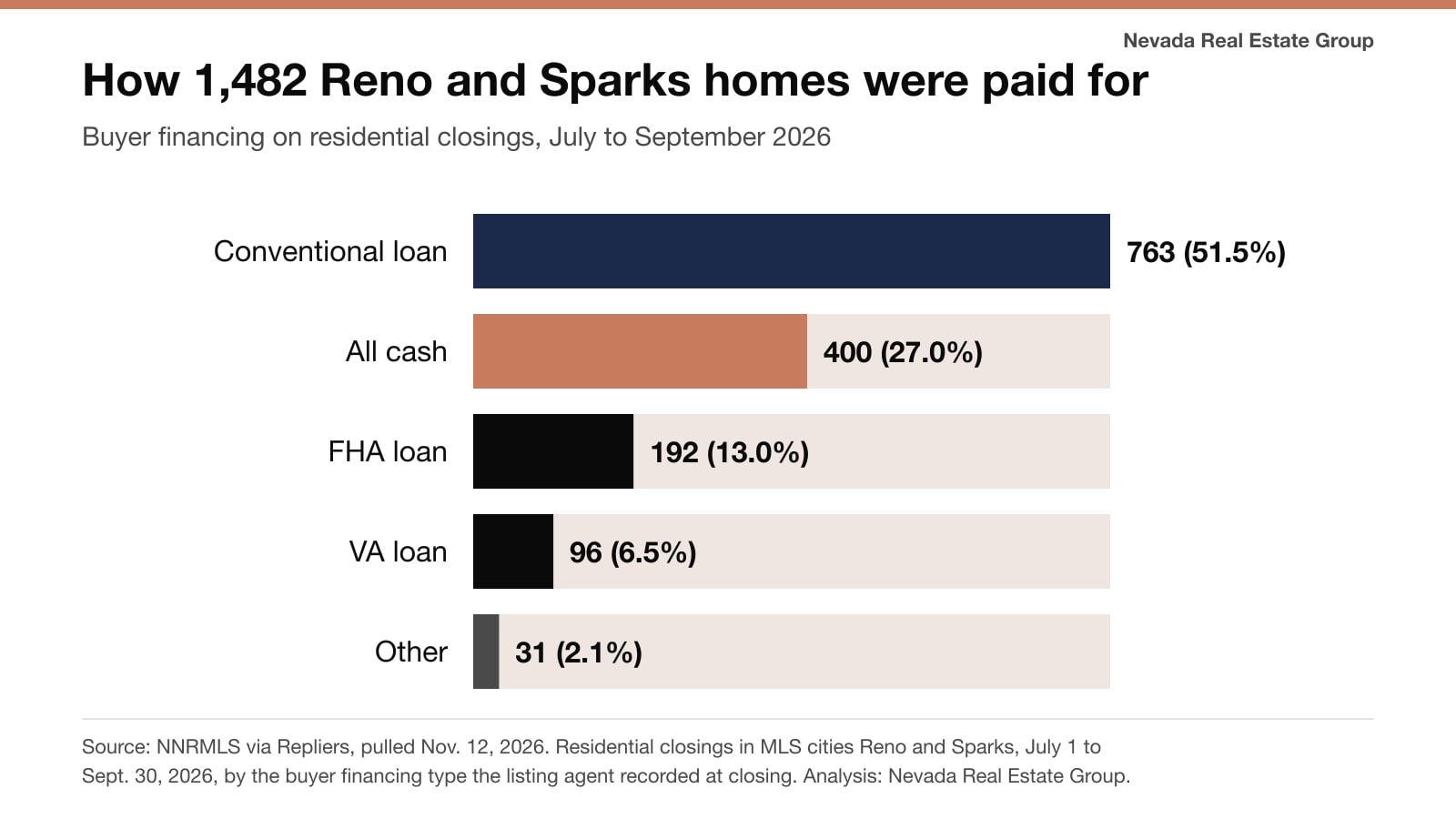
- Cash paid for 27.0% of Reno and Sparks closings, July to September 2026.
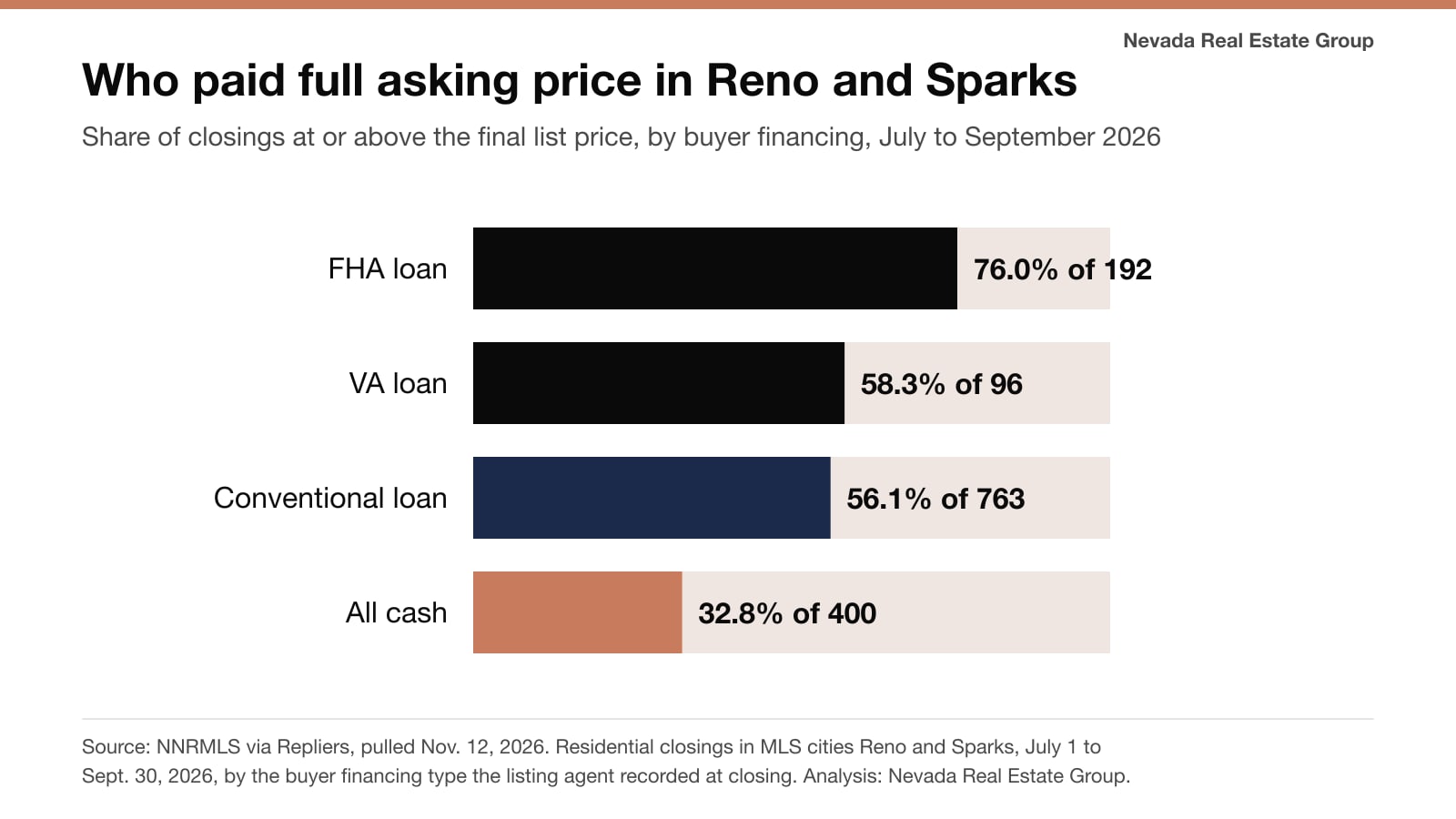
- In that quarter, 76.0% of FHA buyers paid full asking price or more, against 32.8% of cash buyers.
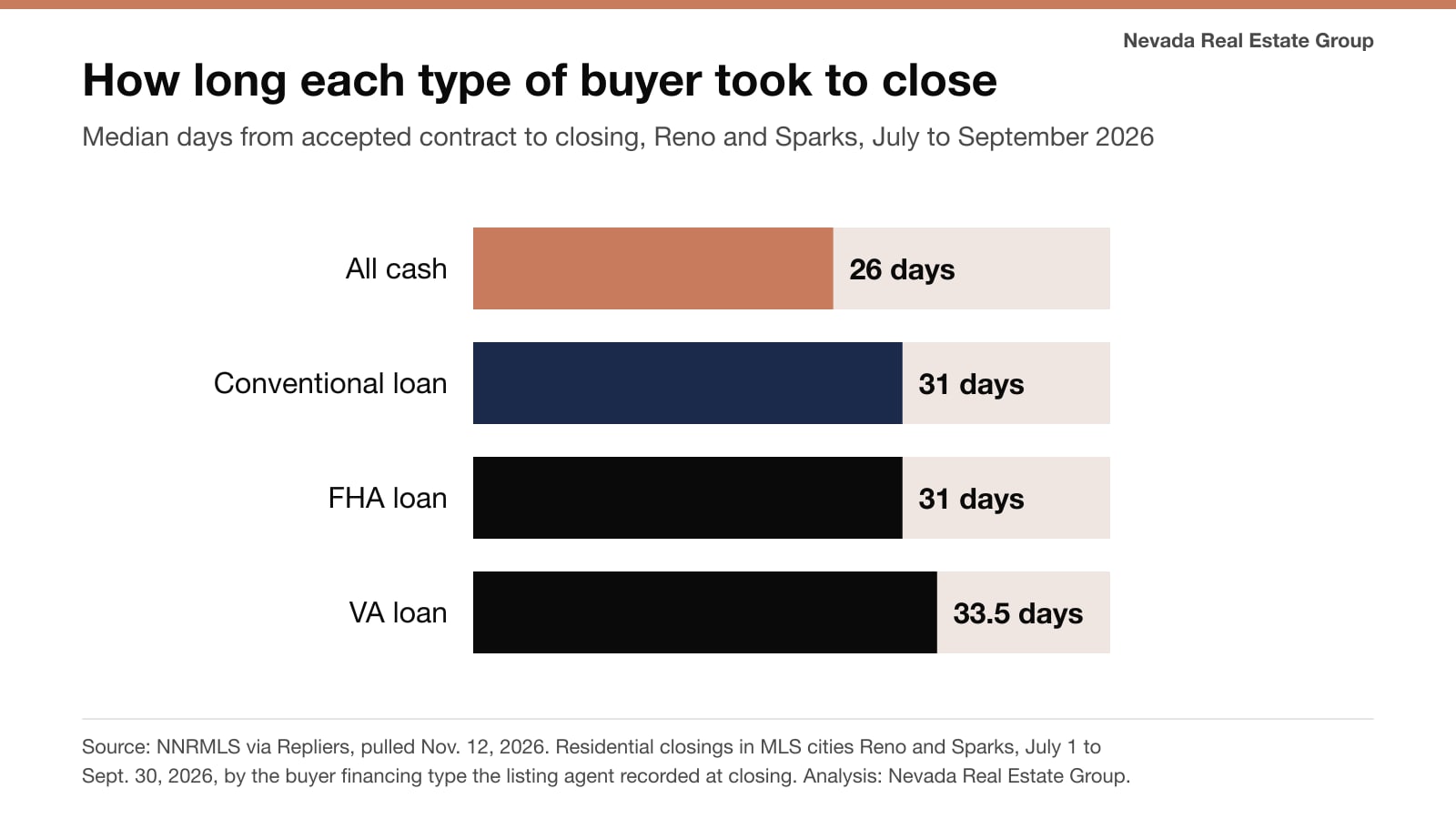
- Cash buyers closed a median 26 days after contract that quarter; FHA took 31, VA 33.5.
- FHA financed 22.3% of Sparks closings but 9.2% of Reno closings, July to September 2026.
- 74.2% of active listings on November 12, 2026 named FHA in their terms.
| Measure | Cash | Conventional | FHA | VA |
|---|---|---|---|---|
| Closings (share of 1,482) | 400 (27.0%) | 763 (51.5%) | 192 (13.0%) | 96 (6.5%) |
| Median sale price | $640,000 | $605,000 | $459,500 | $581,750 |
| Median sale price as a share of final list price | 98.3% | 100.0% | 100.0% | 100.0% |
| Closed at or above final list price | 32.8% | 56.1% | 76.0% | 58.3% |
| Median days from listing to accepted offer | 23 | 20 | 18.5 | 13 |
| Median days from accepted offer to closing | 26 | 31 | 31 | 33.5 |
How were Reno and Sparks homes paid for from July to September 2026?
Conventional loans paid for just over half of the market. Of the 1,482 residential closings in Reno and Sparks between July 1 and September 30, 2026, 763 (51.5%) used a conventional mortgage, 400 (27.0%) were all cash, 192 (13.0%) used FHA, 96 (6.5%) used VA, and 31 (2.1%) used something else: 16 recorded only as "other", nine private loans, four seller-financed sales and two assumed loans. Not one closing in either city used a USDA loan; USDA's guaranteed loan requires the home to sit in an eligible rural area, which you can check address by address.
The mix held steady month to month. Cash was 28.8% of July closings, 25.2% of August and 26.8% of September, and FHA ran between 12.1% and 13.9%. VA climbed from 4.5% in July to 8.4% in September, the one share that moved, though on small monthly counts (24 to 39 sales). We used July through September because that is when the field became complete: every one of the 1,482 closings in this window carries a buyer financing value, while only 85 of roughly 1,440 April-to-June closings did.
That makes the first answer simple. More than a quarter of the homes you are competing for will go to someone who does not need an appraisal or a loan approval, and about one in five will go to an FHA or VA buyer. Nationally, the National Association of REALTORS reported that all-cash sales were 27% of existing-home sales in September 2026 and 29% in October, so Reno and Sparks were in the same range, though the national figures cover different months than our July-to-September window. The useful question is not whether government-backed buyers win homes in Reno and Sparks, because they plainly do, but which homes they win and what they pay to win them. The rest of this guide answers that, using the same 1,482 sales. For a broader view of where prices and inventory stand this fall, our Reno real estate market report for November 2026 covers the full market.
Do cash buyers really pay less than buyers with a loan?
They do, and the gap shows up in every price range. Across all 1,482 sales, cash buyers paid a median 98.3% of the final asking price. Conventional, FHA and VA buyers each paid a median 100%. In dollars, the median cash buyer closed $10,000 under the last list price, while the median financed buyer closed right at it.
A single overall median can mislead, because cash buyers are heavily concentrated at the top and bottom of the market. So the table below compares buyers inside the same price band. The pattern does not change: cash buyers paid between 97.1% and 98.9% of list in every band, conventional buyers paid 100% in every band below $1 million, and FHA and VA buyers paid 100% in every band below $1 million except two thin cells: VA buyers under $400,000 (99.3% on 10 sales) and the single FHA sale between $750,000 and $999,999.
| Sale price band | Cash | Conventional | FHA | VA | Median cash discount from list |
|---|---|---|---|---|---|
| Under $400,000 (240 sales) | 97.6% (79) | 100.0% (91) | 100.0% (53) | 99.3% (10) | $5,000 |
| $400,000 to $549,999 (415) | 98.9% (69) | 100.0% (209) | 100.0% (100) | 100.0% (30) | $5,000 |
| $550,000 to $749,999 (424) | 98.5% (104) | 100.0% (242) | 100.0% (38) | 100.0% (34) | $9,450 |
| $750,000 to $999,999 (205) | 98.9% (62) | 100.0% (123) | one sale | 100.0% (14) | about $10,000 |
| $1 million and up (198) | 97.1% (86) | 98.2% (98) | none | 98.6% (8) | $43,500 |
The discount is real but modest below $1 million: about $5,000 on a home under $550,000 and about $9,500 to $10,000 between $550,000 and $1 million. That is far smaller than a 10% cut. And a median hides a wide spread. Plenty of cash buyers paid full price, and plenty of financed buyers negotiated well below it. What the numbers show is a tendency: when a seller accepted cash in the third quarter of 2026, the seller usually took a little less money to get it.
Why did FHA buyers pay full asking price most often?
FHA buyers were the most likely group to pay the full final asking price or more: 146 of 192, or 76.0%. Conventional buyers did so 56.1% of the time, VA buyers 58.3% and cash buyers 32.8%. Looking closer, 41.1% of FHA buyers paid exactly the list price and 34.9% paid more than it, with a median overage of $7,500 among those who went over. Conventional buyers who went over list paid a similar median $8,000 above it, but far fewer of them did.
Two things in the data explain much of this, and one thing we cannot measure. First, FHA buyers shop where competition is heaviest. Their median purchase was $459,500, and 100 of the 192 FHA sales fell between $400,000 and $549,999, the band where 63.6% of conventional buyers also paid list or more. Second, FHA buyers in this window moved quickly: the median FHA sale went under contract 18.5 days after listing, against 23 days for cash buyers. In this same study, 72.7% to 90.0% of loan-financed buyers who got an accepted offer within a week of listing paid the asking price or more, so fast sales and full-price sales go together.
The thing we cannot see is seller credits. The MLS fields for concessions are restricted in our data feed, so this study cannot tell how many full-price FHA offers also asked the seller to pay part of the buyer's closing costs. HUD treats seller and other interested-party contributions above 6 percent of the purchase price as an inducement that reduces the price the loan is based on, so FHA credits generally stay at or under 6%, and a price at list can still net the seller less than it looks. Treat the 76.0% as "paid the asking price on paper", not as proof that every FHA buyer left money on the table. The Reno buyer closing costs guide shows what those costs add up to in Washoe County.
Is the cash discount just a sign the home sat on the market longer?
Partly, but not entirely. Cash buyers did tend to buy homes that had been for sale longer. The median cash purchase went under contract 23 days after listing, compared with 20 days for conventional buyers, 18.5 for FHA and 13 for VA. Homes that sit usually sell for less, so some of the cash discount is really a stale-listing discount.
To separate the two, we grouped every sale by how long the home took to get an accepted offer, then compared buyers inside each group. The cash discount survived in every group except the fastest one.
| Days to an accepted offer | Cash | Conventional | FHA | VA |
|---|---|---|---|---|
| 0 to 7 days | 100.0%, 63.2% at or above (106) | 100.0%, 79.0% (257) | 100.0%, 90.0% (50) | 100.0%, 72.7% (33) |
| 8 to 30 days | 98.0%, 27.5% (120) | 100.0%, 53.5% (200) | 100.0%, 76.4% (72) | 99.9%, 50.0% (34) |
| 31 to 90 days | 97.8%, 22.8% (123) | 98.9%, 39.6% (217) | 100.0%, 71.4% (49) | 100.0%, 52.6% (19) |
| 91 days or more | 95.8%, 5.9% (51) | 98.5%, 36.0% (89) | 100.0%, 52.4% (21) | 99.6%, 50.0% (10) |
Read across any row and the order barely changes. On a home that took one to four weeks to get an offer, cash buyers paid a median 98.0% of list and only 27.5% of them paid full price, while FHA buyers paid 100% and 76.4% of them paid full price. On homes that sat more than 90 days, only three of 51 cash buyers paid list or more. FHA buyers held at 100% even on those homes.
Two lessons follow for a financed buyer. On a brand-new listing, you are on roughly level ground: in the first week every group paid a median 100% of list. On an older listing, a cash buyer is probably offering less than you are, which gives you room to compete on price alone. Our guide to whether now is a good time to buy in Reno covers how to read a listing's price history before you choose a number.
How much faster do cash buyers close in Reno and Sparks?
About five to eight days at the median. From July to September 2026, cash buyers closed a median 26 days after their offer was accepted. Conventional and FHA buyers both took 31 days, and VA buyers took 33.5. The difference is larger on lower-priced homes: under $550,000, cash buyers closed in a median 21 days, while FHA buyers took 30 to 34 and VA buyers 31.5 to 35.5.
The extra time on a loan comes from steps a cash sale skips. A lender orders an appraisal, underwrites the file, and has to deliver the final loan terms on time. The Consumer Financial Protection Bureau notes that, by law, a borrower must receive the Closing Disclosure three business days before closing. An FHA or VA appraisal can also call for repairs before the loan closes, which a cash buyer can simply choose to skip.
None of these gaps is large. A median of five days between a cash and an FHA closing is shorter than most people expect, and the loan buyers in this study were not slow to commit: the median VA buyer had an accepted offer 13 days after listing, the fastest of any group. When a listing agent says a seller "needs cash", ask what the seller actually needs. If it is a closing date, the medians in this study put a loan within about five to eight days of a cash closing.
Which price ranges do cash and FHA buyers compete in?
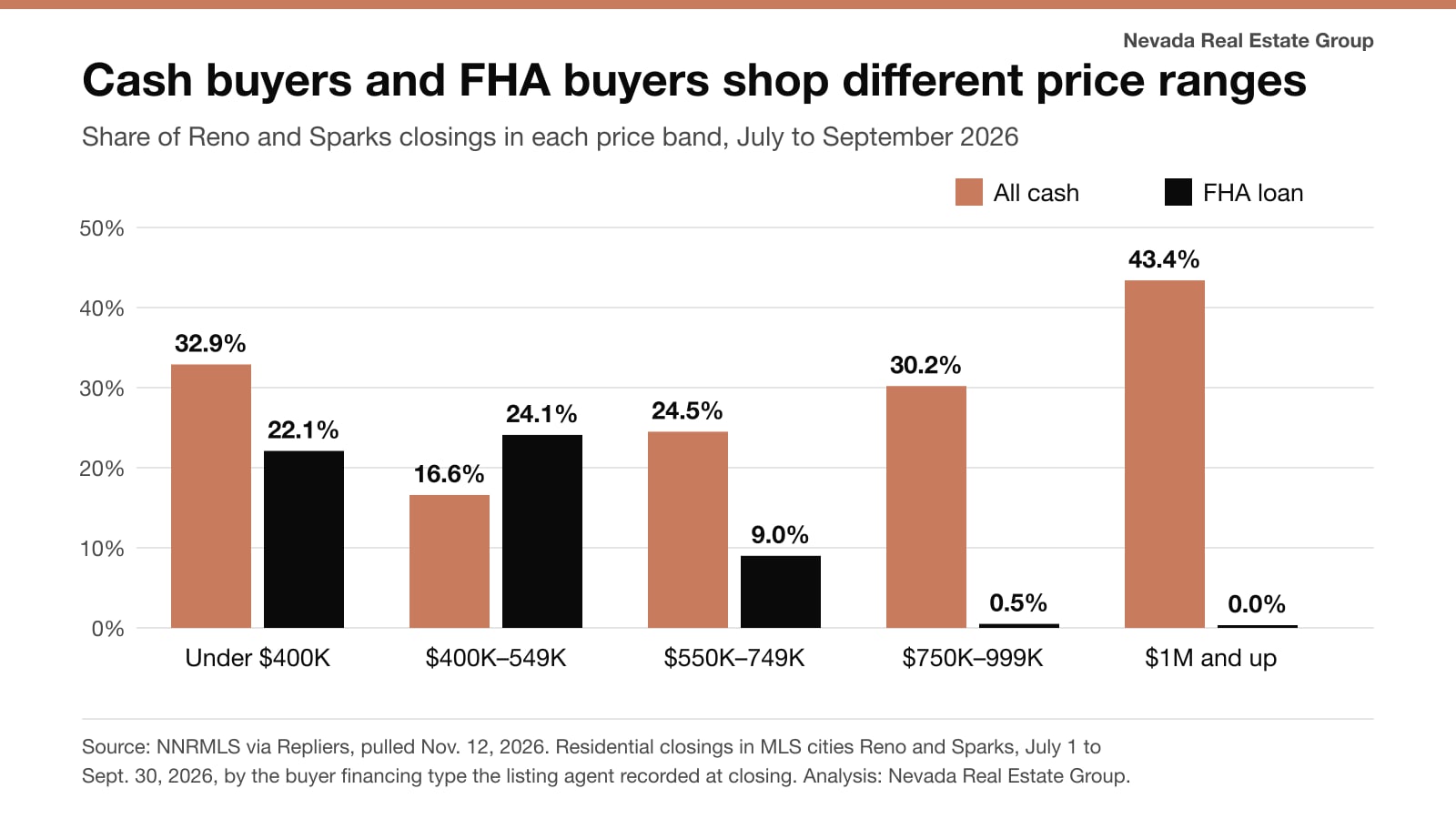
Mostly different ones, which is good news for FHA buyers. From July to September 2026, FHA was 22.1% of Reno and Sparks sales under $400,000 and 24.1% of sales from $400,000 to $549,999, then fell to 9.0% from $550,000 to $749,999 and almost nothing above that: one FHA sale between $750,000 and $999,999, none at $1 million or more. Cash followed the opposite curve. It was 32.9% of sales under $400,000, dropped to 16.6% in the $400,000 band, and climbed back to 24.5%, 30.2% and finally 43.4% of sales at $1 million and up.
So the band where FHA buyers are strongest, $400,000 to $549,999, is also the band where cash buyers are weakest. In that range, only 69 of 415 sales were cash, while 100 were FHA and 30 were VA. If you are an FHA buyer shopping between about $400,000 and $550,000, most of the competing offers you meet will be other financed buyers, not cash.
The FHA ceiling has a mechanical cause. FHA insures loans only up to a county limit, and for 2026 HUD's one-unit limit for Washoe County is $638,250, above the 2026 national floor of $541,287. With 3.5% down, that limit runs out at a price of about $661,000, so above that an FHA buyer needs a larger down payment or a different loan. VA works differently: the VA says a borrower with full entitlement does not have a loan limit, as long as the lender approves the loan and the appraisal supports the price, and VA buyers appeared in every band, including eight sales at $1 million or more. For the other end of the market, our list of Reno homes under $400,000 shows what that budget buys today.
Are Reno and Sparks different for FHA and VA buyers?
Very different. From July to September 2026, FHA paid for 95 of 426 residential closings in Sparks (22.3%) and VA for 43 (10.1%), so nearly a third of Sparks buyers used a government-backed loan. In Reno, FHA paid for 97 of 1,056 closings (9.2%) and VA for 53 (5.0%). Cash was the reverse: 30.0% of Reno closings against 19.5% of Sparks closings.
Price explains much of it. Reno's sales spread further up the price range, including 187 closings at $1 million or more against 11 in Sparks, and cash dominates that top end. But the split holds inside the same price bands too. Between $400,000 and $549,999, FHA was 34.4% of Sparks sales and 17.8% of Reno sales, while cash was 11.5% in Sparks and 19.8% in Reno. Under $400,000 the gap is wider: in Reno, cash bought 40.3% of homes in that band and FHA 17.7%. In Sparks, cash bought 10.2% and FHA 35.6%.
For a buyer, that changes the competition you should expect. An FHA or VA offer on a Sparks home in the $400,000s is ordinary: in that band, 42.7% of Sparks sales from July to September 2026 used one of the two loans. In Reno's condo market or above $750,000, you are more likely to be compared directly with a cash offer, and your preparation matters more. Our comparison of living in Reno vs Sparks and the Sparks home buying guide cover the neighborhoods behind those numbers, and you can browse current Sparks and Reno listings by area.
Why do so few Reno condo buyers use FHA?
Because many condo buildings are not set up for it. Of the 152 condominium closings in Reno and Sparks from July to September 2026, 73 (48.0%) were cash and only eight (5.3%) were FHA. Compare that with townhomes, where FHA paid for 25.0% of 124 closings, and manufactured homes, where FHA was 13 of 25 sales. Under $400,000, where most of these homes sell, condos alone accounted for 50 of the 79 cash purchases.
The listing terms show the same thing from the seller's side. Only 53.9% of the condos that sold in this window named FHA among their accepted financing terms, against 78.3% of all closed listings. An FHA loan on a condo generally needs the building to be an FHA-approved project, or the unit to qualify for the single-unit approval HUD created in 2019. When neither applies, an FHA buyer cannot use the loan on that unit, no matter what they offer.
The practical step is to check approval before you fall in love with a unit. HUD's FHA condominium search lets you look up a project's approval status, and a lender can tell you whether a single-unit approval is realistic for the unit you want. Conventional lenders review condo projects too, so ask about the building early whatever your loan. The Reno condos and townhomes buyer guide explains HOA reserves and warrantability, and you can filter current Reno condos for sale by price.
Will a seller whose listing doesn't mention FHA or VA still take your offer?
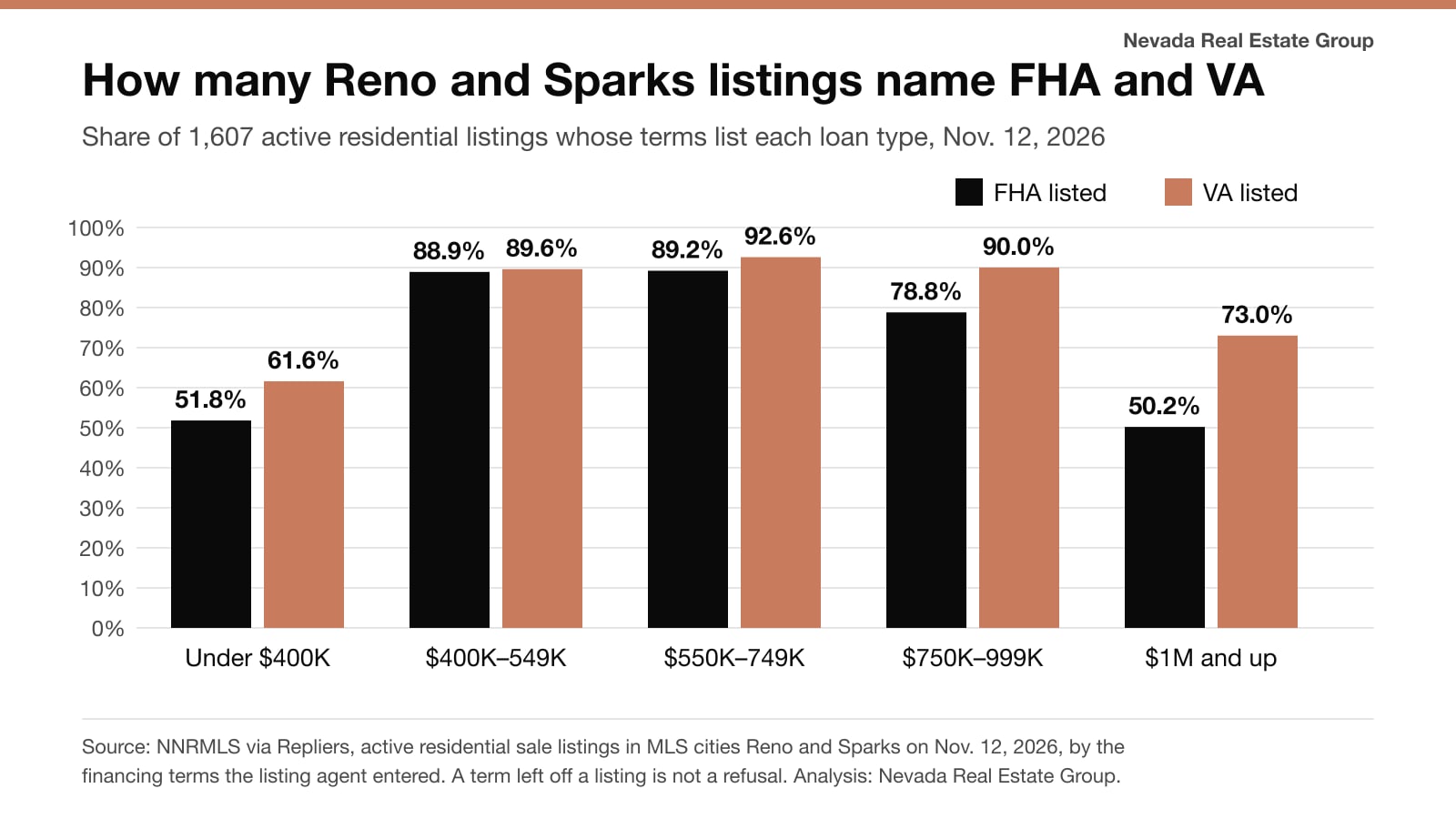
Often, yes. On November 12, 2026, we read the financing terms on all 1,608 active residential listings in Reno and Sparks. Of the 1,607 that listed any terms, 96.5% named conventional loans, 82.5% named VA, 74.2% named FHA and 8.8% named USDA. Only 2.5% listed cash alone or cash plus a 1031 exchange, and 2.6% said the owner may carry financing.
Those terms describe what the seller advertised, not a legal filter. In the closings, 13 of the 192 FHA sales (6.8%) and eight of the 96 VA sales (8.3%) were on listings whose terms did not name the buyer's loan type, so a missing term is not always a refusal. Some limits are real, though. A condo without FHA project or single-unit approval cannot close with FHA, and a home that needs major repairs may not pass an FHA or VA appraisal until they are made.
Price changes the picture. Under $400,000, only 51.8% of active listings named FHA and 61.6% named VA, and 10.8% were cash-only: 33 listings, of which 14 were stock cooperatives, seven condos, seven single-family homes and five manufactured homes. Between $400,000 and $749,999, close to nine in ten listings named both FHA and VA. Above $1 million, FHA appeared on half of listings, which matters less, since few buyers there use FHA. Before you write an offer on a listing that leaves your loan off, have your agent ask the listing agent one direct question: is there a reason this home can't close with FHA or VA?
Do Reno and Sparks builders take FHA and VA buyers on new homes?
Yes, at about the same rate as resale sellers. The MLS flagged 118 of the 1,482 closings as new construction. Of those, 18 (15.3%) used FHA and 10 (8.5%) used VA, slightly above the 12.8% FHA and 6.3% VA shares on the 1,364 resales. Cash was a bit less common on new homes, 23.7% against 27.3% on resales. Among the new homes that closed, FHA and VA together financed 28 of 118, about one in four.
That does not make every builder offer equal. If an incentive depends on using a particular lender, the program limits on seller-paid costs still apply to whatever the builder contributes, so a large incentive can run into the FHA or conventional limit, and any part the VA counts as a concession falls under its 4% limit. Ask the sales office to put the incentive, the lender requirement and the deadline in writing before you sign, and compare the builder lender's Loan Estimate with one from a lender you choose. New homes also carry their own timing risk: a contract on a home still under construction depends on the builder's completion date, so get the expected completion month in writing and ask your lender how the appraisal and rate lock will line up with it.
Our guides to new construction homes in Reno and the current Sparks new homes for sale list the active communities and what their builders publish. For a quick-move-in home that is already complete, the same price-history checks used on resales in this study apply.
How can an FHA or VA buyer compete with a cash offer?
By shrinking the risks a seller sees in a loan offer, since the data show sellers will accept the loan when the price and terms are right. Most of the advantage a cash buyer has comes from three things: certainty that the loan will fund, a short timeline, and no appraisal. You can narrow each of them.
Start with the approval. A full pre-approval, with income, assets and credit already reviewed by the lender, reads very differently from a basic prequalification letter. Ask your lender to call the listing agent the day you submit. Then match the timeline. From July to September 2026, conventional and FHA buyers closed in a median 31 days, so offering a 30-day close with a lender who has confirmed it can meet that date takes away much of the cash buyer's edge. Put real money down as earnest money too; our Nevada earnest money guide explains how it is held and when it is at risk.
The appraisal is the hardest piece. FHA requires an amendatory clause that releases the buyer, without losing earnest money, if the appraised value comes in below the price, and the same clause lets the buyer choose to go ahead anyway. VA requires a similar escape clause tied to the VA's reasonable value. You keep those protections, but you can tell the seller in writing how much of a low-appraisal gap you are able to cover from your own cash. Have your agent and lender confirm the wording fits the required clause, because it gives the seller certainty without removing your protection. Our full guide to making an offer on a house in Nevada covers each contract term in order.
Should you ask a Reno seller for closing-cost credits with an FHA or VA loan?
It can make sense, but it is a trade, and it has limits set by each loan program. A seller credit lowers the cash you need at closing, but the seller nets the same from a full-price offer with a $10,000 credit as from an offer $10,000 lower with no credit, so a credit competes directly with price. Since FHA buyers already paid full price 76.0% of the time from July to September 2026, a credit request on top of a full-price offer in a fast-moving price band can make your offer weaker, not stronger.
Each loan type sets its own rules. Under FHA, HUD treats interested-party contributions above 6 percent of the purchase price as an inducement that cuts the price the loan is based on, dollar for dollar. The VA limits seller concessions to 4% of the home's reasonable value, counting items such as paying the buyer's VA funding fee or debts, but says it does not limit credits for a loan's ordinary closing costs. The same VA page sets the first-use funding fee at 2.15% with less than 5% down and waives it for veterans receiving VA disability compensation. Fannie Mae's interested-party contribution limits for a conventional loan on a primary home are 3% with less than 10% down, 6% with at least 10% but less than 25% down, and 9% with 25% or more down. These limits are the maximum the program allows, not what a seller will agree to. With Freddie Mac's 30-year average at 7.11% on November 12, 2026, a seller credit can also go toward buying down the interest rate instead of paying closing costs. Our guide to rate buydowns versus rate locks shows how to compare the two.
When cash is the problem, a credit is not the only option. Nevada's Home Is Possible program offers up to 5% of the loan value toward the down payment or closing costs, with a 640 minimum credit score (660 for manufactured homes) and an income limit of $165,000, and its current rate sheet lists FHA, VA, USDA and conventional options and describes the 5% assistance as a no-interest, no-payment, non-forgivable second mortgage, so ask the lender when it must be repaid. Our Nevada down payment assistance guide compares the programs. A buyer who can cover closing costs without a seller credit can write a cleaner offer, and in a band where most competing offers are at list price, a clean offer often matters more than the last few thousand dollars.
What does the cash discount mean in dollars on a typical Reno home?
Less than many buyers fear, and it helps to see it next to the cost of the loan itself. Take a $480,000 home, close to the middle of the $400,000 to $549,999 band where most FHA and VA buyers shopped. In that band, the median cash buyer paid 98.9% of list, about $5,000 under asking, while the median FHA and VA buyer paid the full price.
Here is what the price difference does to an FHA payment. At $480,000 with 3.5% down, the down payment is $16,800 and the base loan is $463,200. HUD's 1.75% upfront mortgage insurance premium, $8,106, can be financed into the loan, as assumed here, for a total of $471,306. At 7.11%, the 30-year average Freddie Mac reported for November 12, 2026, principal and interest come to about $3,171 a month. FHA quotes can differ from that average, so ask your lender for the actual rate. Because the loan is above 95% of the home's value, the annual premium under the same HUD letter is 0.55%, roughly $210 to $215 a month in the first year depending on the balance it is applied to, before property taxes, insurance and any HOA dues.
Now give the cash buyer's $5,000 discount back. At $475,000, the same FHA buyer would put down $175 less and pay about $33 a month less in principal and interest, plus about $2 less in mortgage insurance. In other words, offering the full $480,000 instead of the price a typical cash buyer paid in this band costs an FHA buyer about $35 a month and $175 at closing.
So a cash buyer's typical edge on a $480,000 home is about $5,000 in price plus about nine to ten days of time, the gap between cash and loan closings in that price band. A financed buyer more than covers the price side of that gap by offering full price on a home that fits the budget, which is what most FHA buyers in this study did. The mortgage calculator lets you run your own price, down payment and rate. The bigger risk for an FHA or VA buyer is not losing to cash on price; it is a condo that cannot be financed, a home that needs repairs before it can pass a government appraisal, or a timeline the lender cannot meet.
Why would a Reno seller choose your FHA offer over cash?
Because, more often than not, the FHA offer was the higher price. From July to September 2026, the median FHA buyer paid 100% of list and the median cash buyer 98.3%. On a $600,000 home, that is roughly $10,000 more for the seller from the financed buyer, in exchange for about five more days and an appraisal. Many sellers take that trade, which is why 288 of the 1,482 sales in this window went to FHA or VA buyers.
A seller comparing offers is choosing among net proceeds, certainty, timing and the work the home needs before closing. The days-to-offer table above shows how that played out in this quarter. On homes that went under contract within a week, every buyer group paid a median 100% of list. On homes that took more than 90 days, cash buyers paid a median 95.8%, and those sellers accepted it, while the 21 FHA buyers in that group still paid a median 100%.
Your job as a financed buyer is to make the seller's choice easy. Lead with a price that fits the evidence, attach a strong pre-approval, offer a closing date your lender has confirmed, and keep requests for credits and repairs modest. On a home that has been on the market for months, you may be competing with a cash buyer who is offering less. On a new listing in the $400,000s in Sparks, you are most likely competing with another FHA or conventional buyer, and the cleaner offer wins.
Frequently Asked Questions
Do sellers in Reno accept FHA offers?
Yes. From July to September 2026, 192 of 1,482 residential closings in Reno and Sparks (13.0%) used FHA loans, and 74.2% of active listings on November 12, 2026 named FHA in their financing terms. FHA is less common on condos, where the building usually needs FHA approval, and above about $661,000, where the 2026 Washoe County limit of $638,250 runs out at 3.5% down.
Is a cash offer better than an FHA offer in Reno?
Not always. From July to September 2026, cash buyers in Reno and Sparks closed a median 26 days after contract, five days faster than FHA, but they paid a median 98.3% of the final list price while FHA buyers paid 100%. A seller choosing between them is usually trading a few thousand dollars against a few days and an appraisal.
How much less do cash buyers pay in Reno and Sparks?
In the third quarter of 2026, the median cash buyer closed $10,000 below the final list price. Inside price bands, the median discount was about $5,000 under $550,000, $9,450 to about $10,000 between $550,000 and $1 million, and $43,500 at $1 million and up.
How long does an FHA or VA loan take to close in Reno?
From July to September 2026, Reno and Sparks FHA buyers closed a median 31 days after their offer was accepted and VA buyers 33.5 days, against 26 days for cash and 31 for conventional loans. Your own timeline depends on the lender, the appraisal and any repairs the appraiser requires.
Can I use an FHA loan to buy a condo in Reno?
Sometimes. An FHA condo loan generally requires the building to be on HUD's approved project list, or the unit to qualify for a single-unit approval. Only eight of 152 Reno and Sparks condo sales from July to September 2026 used FHA, and 48.0% were cash. Check the building's status before making an offer.
Are VA loans common in Sparks?
More than in Reno. VA paid for 43 of 426 residential closings in Sparks from July to September 2026 (10.1%), double its 5.0% share in Reno. VA buyers appeared in every price band, including eight sales at $1 million or more across both cities.
Can you use a USDA loan in Reno or Sparks?
Only where the address falls inside an area USDA classifies as eligible rural, which you can check on USDA's eligibility site. None of the 1,482 Reno and Sparks closings from July to September 2026 used a USDA loan, though 8.8% of active listings named USDA in their terms on November 12, 2026. Our guide to USDA loans in rural Nevada covers where they apply.
How do you put these numbers to work on your Reno or Sparks offer?
Start with your price band and your loan. If you are an FHA or VA buyer between about $400,000 and $550,000, the data say you are shopping where your financing is most common and cash is least common, so a full-price offer with a strong approval is usually competitive. If you are looking at condos or homes under $400,000, check FHA condo approval and property condition first, because that is where cash buyers cluster and where some homes cannot close with a government-backed loan at all. Above about $661,000, the FHA limit runs out at 3.5% down, so plan on a conventional, jumbo or VA loan, and expect more cash competition: cash bought 30.2% to 43.4% of homes in each band from $750,000 up in that quarter.
Then use the listing's own history. From July to September 2026, cash buyers paid a median 100% of list on homes that went under contract within a week of listing and 95.8% on homes that took more than 90 days. A financed buyer who reads that history can offer full price where it is needed and negotiate where the seller has already waited. Our first-time homebuyer guide to Reno, along with the statewide guides to FHA loans in Nevada and VA loans in Nevada, cover the loan rules in more depth.
When you are ready to write an offer, a Reno real estate agent on our team can pull the price history and financing terms on any listing you are considering and help you decide how to structure the offer. Browse Reno homes for sale, start a mortgage pre-approval, call Nevada Real Estate Group at (775) 277-2120 or contact us online.
Which sources inform this guide?
MLS study. Closed-sale and listing data come from the Northern Nevada Regional MLS (NNRMLS) through Repliers, pulled November 12, 2026. The population is every sale listing with MLS city "Reno" or "Sparks", a residential property type, a raw MLS status of Closed and an MLS closing date between July 1 and September 30, 2026: 1,482 sales (147 records returned by the search were excluded: 78 land, income or commercial listings, 66 whose raw status was still under contract and three with no status). Buyer financing is the MLS BuyerFinancing value the listing agent records at closing; it is complete for all 1,482 sales in this window but for only 85 of roughly 1,440 April to June 2026 closings, so earlier months were left out. Sale-to-list ratios use the close price against the final list price. Days to an accepted offer run from the listing contract date to the purchase contract date, and days to close run from the purchase contract date to the closing date. (The MLS days-on-market count runs from listing to closing, so it was not used for either measure.) Price bands use the sale price; the active-listing chart uses the list price. Active listings are every residential sale listing in the same two cities on November 12, 2026 (1,608, of which 1,607 listed financing terms). Six records were spot-checked against the MLS by address and matched.
Limits. Seller concession fields are restricted in our feed, so credits are not measured. BuyerFinancing is entered by agents and not audited. Sales outside the MLS are not included. Comparisons between buyer groups show association, not cause, and September counts can still rise slightly as late closings post. The script, scripts/reno-buyer-financing-study.ts, and its output are kept with this post's records.
Loan program rules. HUD's FHA Resource Center answer on seller contributions treated as inducements to purchase (published March 16, 2026); HUD's model amendatory clause; Mortgagee Letter 2023-05 on FHA mortgage insurance premiums; Mortgagee Letter 2025-23 and HUD's 2026 forward mortgage limits file for the $541,287 floor and the $638,250 Washoe County limit; Mortgagee Letter 2019-13 on condominium single-unit approval and the FHA condominium search; the VA's pages on the escape clause, funding fee, closing costs and seller concessions and entitlement and loan limits; Fannie Mae Selling Guide B3-4.1-02, interested-party contributions; and USDA's property eligibility site. All read November 12, 2026.
Rates, closing rules and assistance. Freddie Mac's Primary Mortgage Market Survey for November 12, 2026 (30-year fixed 7.11%); the National Association of REALTORS' October 2026 existing-home sales release (all-cash share 29%); the Consumer Financial Protection Bureau's page on reviewing documents before closing; and the Nevada Housing Division's Home Is Possible program and rate sheet. All read November 12, 2026. The payment example uses the Freddie Mac average as a stand-in rate; it is not a loan quote.
This guide is general information, not legal, tax or lending advice. Loan program rules change, so confirm current terms with your lender.