

Dayton home searches can involve very different properties: a house in a subdivision, a golf-oriented setting or a larger parcel with separate buildings and equipment. A single townwide safety label is not enough to compare those choices. The relevant police records, drainage questions, utility arrangements and access responsibilities need to match the home under consideration.
Our September 25, 2026 source review verified 184 violent crimes and 366 property crimes for the Lyon County Sheriff's Office in calendar 2025. Those figures cover the reporting agency, not Dayton alone. This guide explains what that distinction means and gives buyers a practical process for reviewing the local and property-specific questions that the headline cannot answer.
Dayton cannot be responsibly rated safe or unsafe using Lyon County sheriff totals as if they were town-only statistics. Nevada's portal reports 184 violent crimes for that agency in 2025 across its broader reporting area. For a Dayton home, seek appropriately scoped records and examine drainage, road access, water systems and inspection findings. Golf frontage, acreage and a quiet showing do not establish a property's safety.
- Lyon County Sheriff's Office reported 184 violent crimes and 366 property crimes in 2025.
- These agency totals do not establish Dayton-only crime or a comparison with Fernley.
- Dayton drainage planning and current flood resources deserve a separate property review.
- Large lots require clear access, maintenance and utility information.
- Choose homes through consistent evidence, not neighborhood labels or demographics.
Why is a Dayton address different from a crime-reporting boundary?
According to Lyon County's sheriff information page, the Sheriff's Office lists a Dayton substation at 801 Overland Loop, along with locations in Fernley, Silver Springs and Yerington. The Nevada crime reports used here describe the Sheriff's Office as an agency. They do not isolate every offense occurring within a Dayton postal or community boundary.
This matters because a number can be accurate in its original report and misleading in a new headline. Calling the agency total “Dayton crime” removes the scope that makes the figure understandable. Dividing that total by a Dayton population estimate would not fix the problem; it would combine a numerator and denominator from different geographies.
For the exact property, ask which agency and public record source are appropriate. Confirm the address and parcel instead of relying only on the subdivision name. A community label used in listings can be useful for browsing while still differing from the boundaries used for public services, mapping or statistics.
When requesting information, specify the period and type of record that would help. Ask what can be released and what limitations apply. Do not assume a records office provides a custom safety certification, neighborhood ranking or prediction of future incidents. Keep the answer and its scope with your research so it is not exaggerated later.
Our Dayton relocation guide provides broader move-planning context. The jurisdiction check belongs before any safety comparison, whether the home is in an established subdivision or on a larger parcel. It is a way to make the evidence fit the question, rather than a technical detail to ignore once you have found a reassuring number.
What do the official 2025 sheriff crime categories mean?
According to Nevada's violent-crime report for Lyon County Sheriff's Office, the 2025 total is 184. According to the corresponding property-crime report, the property total is 366. The table retains the agency name so that the categories are not mistaken for a Dayton-only count.
| Violent category | Count | Property category | Count |
|---|---|---|---|
| Murder and nonnegligent manslaughter | 1 | Burglary | 88 |
| Rape | 35 | Larceny | 188 |
| Robbery | 9 | Motor vehicle theft | 79 |
| Aggravated assault | 139 | Arson | 11 |
| Violent theme total | 184 | Property theme total | 366 |
The category sums match the displayed totals. The portal counts murder, rape and aggravated assault by victim and robbery by incident. Property counting can include multiple offenses from one incident, while motor vehicle theft includes attempts and individual stolen vehicles. These figures are not the number of households affected, individual offenders or convictions.
The two themes also do not include every kind of crime or every request for assistance. If your concern is a category not shown, ask about the relevant source rather than treating the table as an exhaustive inventory. A missing category is a definition issue, not evidence that the event never occurs.
Keep the year visible. We reviewed these records in 2026, but the reported events belong to calendar 2025. The data can be revised, and this review does not certify completeness. A buyer making a decision now should ask what more recent, geographically suitable information is available.
Fernley's companion article correctly shows the same agency counts. That is not a finding that the two places have identical crime. It is a disclosure that the available agency-level source cannot distinguish their local totals. A more precise conclusion would require a different dataset, not more confident wording around the same one.
Can online rankings identify the safest part of Dayton?
This review does not produce a safest-neighborhood list. According to the FBI's caution against simplistic crime rankings, comparisons can become misleading when important local factors are omitted. A ranking that does not disclose geography, definitions and dates should not be presented as an official verdict about Dayton.
Look for the underlying source behind a color-coded map or letter grade. Does it use reported data, estimates or a commercial model? Is the displayed boundary a ZIP code, city, community or police agency? Are the figures current-year partial counts or a completed year? If those questions remain unanswered, the score has limited value for an address-level decision.
Keep housing preferences separate from safety claims. You may prefer more yard space, a particular floor plan, a shorter trip or a golf setting. Those preferences are valid search criteria without implying that nearby residents or a different neighborhood are less safe. Price, age restrictions and demographics should not become substitutes for evidence.
Use our Dayton lifestyle guide to organize broader questions, then inspect the actual homes. A useful observation identifies a condition: the entry lighting needs evaluation, the gate operation is unclear or a drainage question requires an answer. A broad label about an entire community does not provide the same actionable information.
For each property, apply the same review: appropriately scoped public information, a qualified inspection, a route visit and documented answers about material systems. If a comparison still lacks evidence, retain the uncertainty. It is better to identify a question that needs work than to create a numerical safety score whose precision cannot be defended.
What do Dayton's drainage-planning records tell a buyer?
According to Lyon County's archived announcement about Dayton storm-drainage plans, county commissioners addressed drainage plans and a Carson River bridge location in June 2022. This is historical evidence that drainage and access have been local planning subjects. It does not establish that every proposed project is complete today or that an individual parcel is protected from flooding.
For a purchase, use that history to ask better current questions. Which plan, map or engineering record applies to the property? What work has actually been completed? Who can explain an identified drainage feature or a planned improvement? Request the current status rather than assuming an old announcement describes present conditions.
A useful property inquiry distinguishes the house, the lot and the access road. A building may sit differently from another part of the parcel, and the route used to leave may have its own exposure. Ask for appropriate professional interpretation where needed. A listing's broad “not in a flood zone” statement should not substitute for examining the exact map and its limitations.
According to Lyon County's current flood-information resource, preparedness includes reviewing flood risk, household communications and evacuation planning. Use its links to current mapping and official contacts, checking details again when needed. This guide does not promise the availability of a particular emergency supply or the condition of a road during an event.
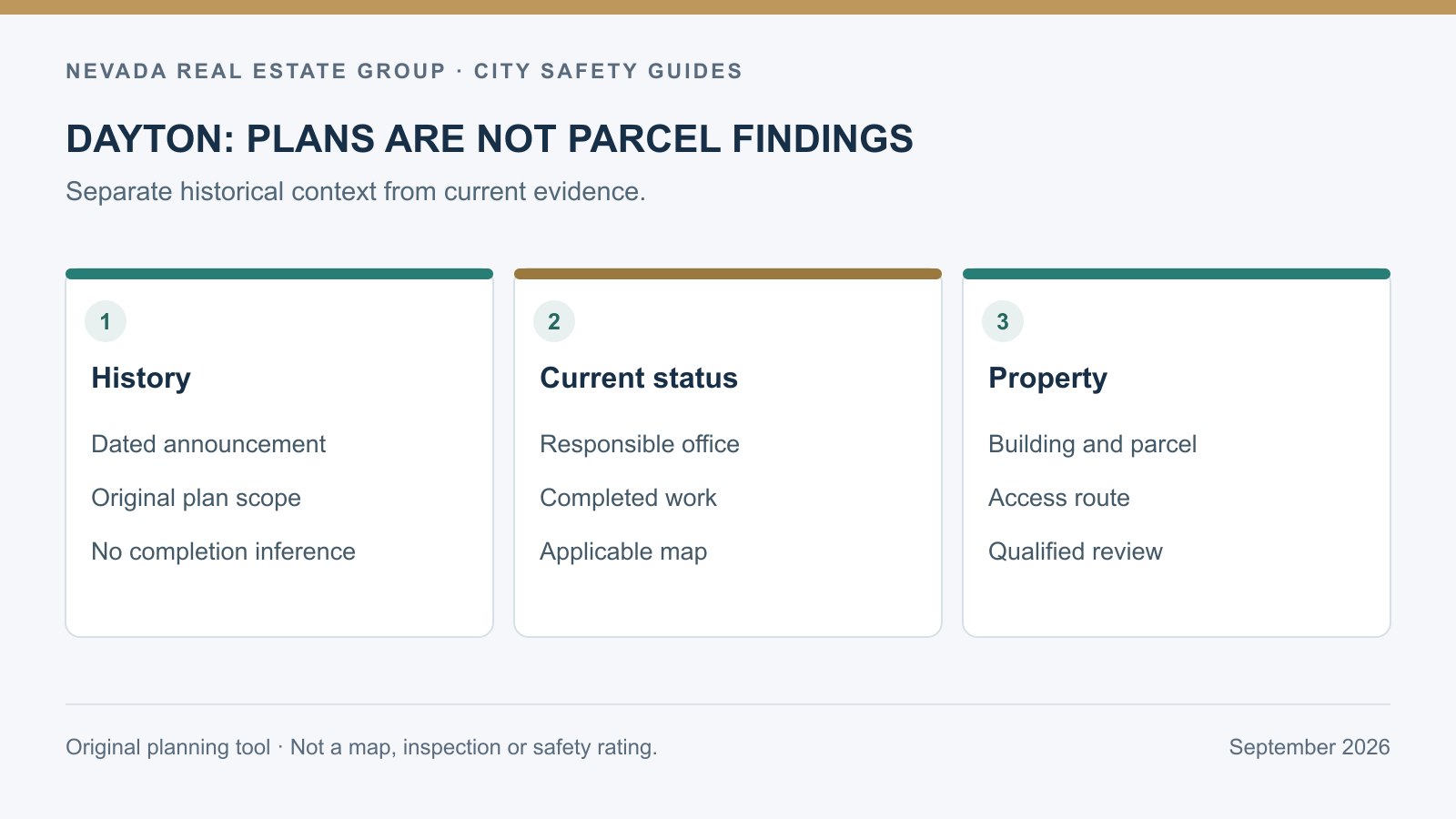
Retain the date of every answer. If a project status changes before your decision, revisit the part of the review that depended on it. The goal is not to turn regional flood history into a prediction, but to avoid treating an unresolved drainage question as settled.
How should you examine a river-area or low-lying property?
Begin with the parcel and the building location, not a view photograph or a neighborhood name. Obtain the relevant maps and ask a qualified source to explain what they show. A property that looks level or dry during a showing may still raise questions that cannot be answered by appearance alone. Conversely, a nearby river or drainage feature does not automatically establish the same exposure for every home.
Walk the accessible property with permission and note grading, retaining features, drainage outlets and signs that merit professional follow-up. Do not diagnose the cause of staining, settlement or soil changes from a casual tour. Bring the observations to the inspector or appropriate specialist, who can explain the limits of the evaluation and any further work needed.
Ask about prior drainage work and obtain the available documentation. Match invoices, plans or permits to the actual improvement. A statement that “the issue was fixed” is incomplete without understanding what was addressed, when and by whom. The same question applies to work completed by a prior owner and to work proposed during the transaction.
For insurance, request an explanation for the exact address and intended use. Ask about coverage, exclusions, limits and effective dates; do not assume a general homeowners discussion resolves every flood question. Our Nevada flood-zone and insurance guide is background for that conversation, not an insurer's determination.
When browsing Riverpark and Sutro properties or Santa Maria Ranch homes, apply the same parcel-level process. These links identify places to research, not a claim that either has a particular risk level. A sound comparison relies on the individual home's evidence and keeps unanswered drainage or access questions visible until the appropriate source resolves them.
What access questions become important with acreage and outbuildings?
More land can create more responsibilities to understand. For a Dayton home with land, trace the usable route from the public road to the house, any workshop and the areas where equipment or animals would be kept. Confirm which roads and drives are private, shared or publicly maintained using the relevant records and authority. Do not infer maintenance responsibility from the surface condition alone.
Ask how gates operate, how authorized visitors can enter and what happens if powered equipment is unavailable. Measure clearances for the vehicles you actually intend to use. A photograph showing a trailer parked on the property does not establish that every trailer can turn, fit or be stored under the applicable rules.
For outbuildings, identify utilities, access and the intended use. Ask which improvements have relevant documentation and which questions need a specialist. A workshop described in marketing is not automatically suitable for every electrical load, storage use or business activity. Keep your proposed use separate from what the structure has actually been evaluated to support.
| Feature | Question | Evidence to request |
|---|---|---|
| Drive or shared road | Who may use and maintain it? | Recorded access and responsibility documents |
| Gate | How does authorized entry work? | Operating instructions and tested access |
| Outbuilding | Does it support the intended use? | Records and qualified inspection |
| Equipment area | Can the actual vehicle move and park? | Measurements and a site check |
Do not let the appeal of extra space answer these questions by default. Record the condition and responsibility for each feature, especially when several people or parcels share an arrangement. If the planned use depends on a future change, investigate feasibility and cost before treating that change as an existing benefit of the home.
How do you verify a Dayton home's water and wastewater arrangements?
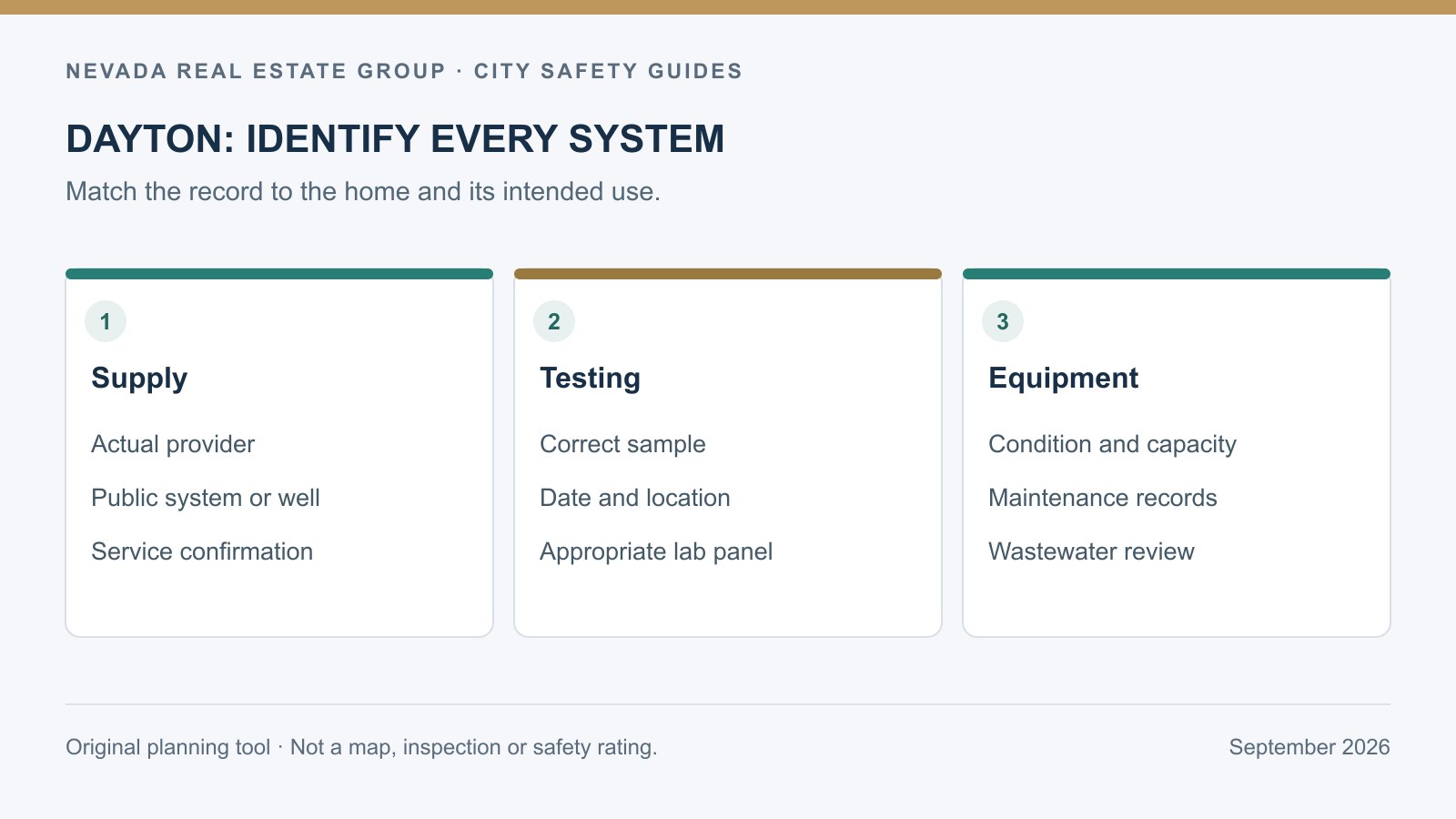
First identify what actually serves the address. A neighborhood name does not tell you whether a particular property uses a public system, a private well or a specific wastewater arrangement. Ask for provider confirmation and the relevant property records. Keep drinking water, irrigation and wastewater questions distinct; documentation for one does not necessarily describe the others.
According to EPA guidance on protecting a home's private-well water, annual testing should include total coliform bacteria, nitrates, total dissolved solids and pH, with additional testing when local conditions warrant. Use a certified drinking-water laboratory and ask the appropriate local resource which tests fit the property. A sample's date and location matter as much as an informal statement that the water tested well.
For a public system, obtain the report for the system actually supplying the home. For a private well, request the well's own records and testing rather than relying on a nearby utility's report. Ask a qualified professional about equipment condition, capacity questions and the implications of your intended use. Water-quality testing and equipment performance are related inquiries, but they are not identical.
For wastewater, ask about permits, system location, available maintenance records and appropriate inspection. Avoid building a future shop, driveway or landscaping plan around an area whose constraints have not been understood. This guide does not diagnose a system or assert that every Dayton property uses the same arrangement.
Our Nevada well and septic buyer guide can help prepare a document request. Bring the actual findings to qualified professionals and keep outstanding questions visible before relying on a property's water arrangements.
What should you test about the daily drive and essential services?
Use the actual home as the starting point for route research. Identify the destinations that matter to your household and drive the full route under reasonably representative conditions. A broad community-to-community estimate may omit the local road, turn, parking or final approach that affects daily use. Record your observations without converting one trip into a guaranteed commute time.
According to Nevada Department of Transportation travel information, Nevada 511 is a source for road-condition information. Check it when planning travel and consult the appropriate official source for any restriction affecting the route. A saved map or an old article should not be treated as a live road-status report.
Consider an ordinary disruption before a serious one. If a usual turn is blocked or an appointment runs late, what changes? Which contact needs notification? Does an essential destination have a practical alternative? The answers may differ between two homes with similar prices, which is why the route belongs in the property comparison rather than only in a general relocation discussion.
Do not infer emergency response times from distance to the sheriff substation or another facility. A map cannot establish dispatch conditions, resource availability or the circumstances of a future event. Ask the relevant service about coverage and access questions without turning an informal estimate into a promise.
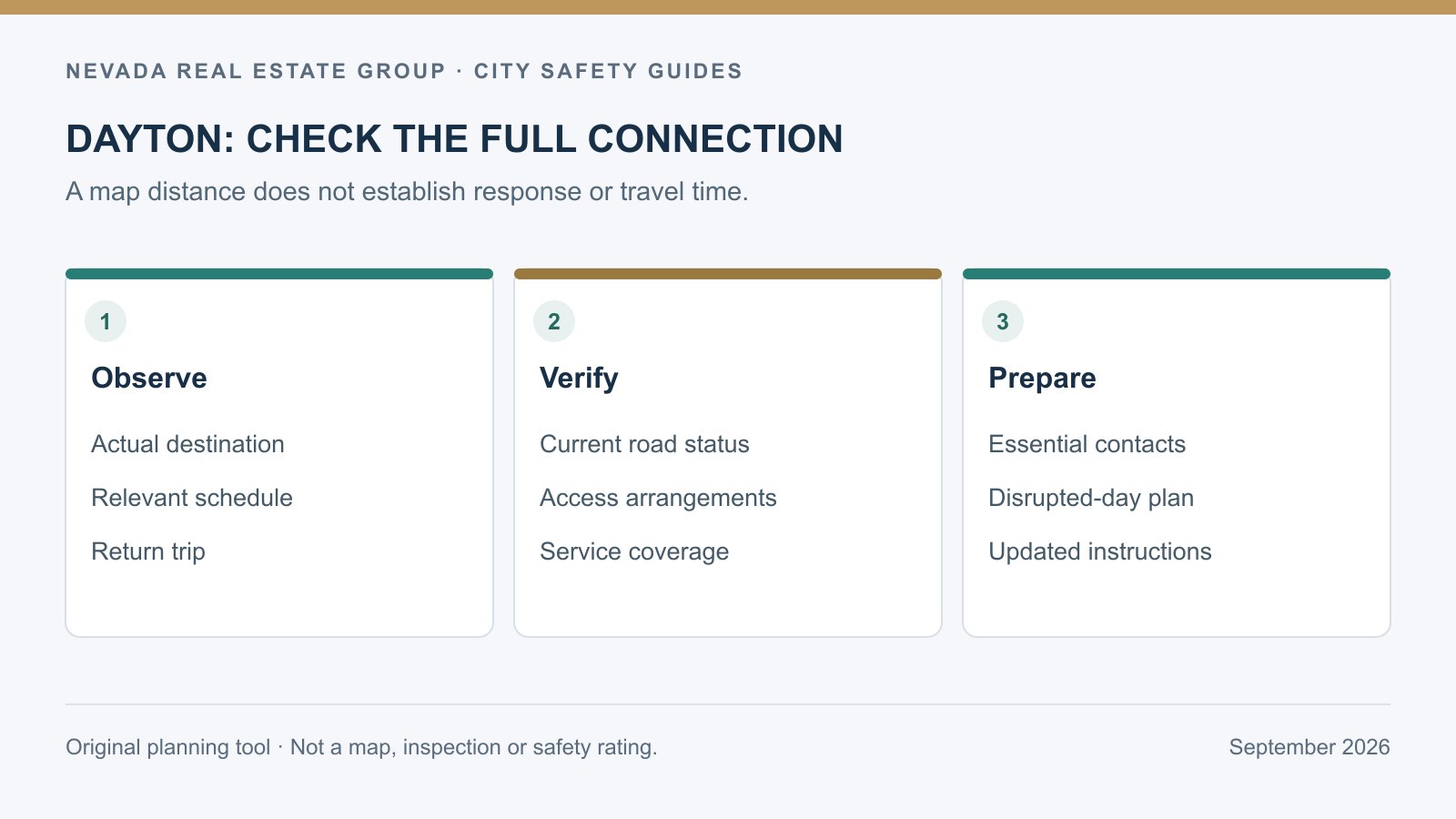
For Dayton Valley homes, a route check can clarify how a property fits the household's routine. It should not be used to imply that one area's residents are safer than another's. The useful result is a documented, workable connection to the services and activities you intend to use.
What does a golf or managed-community setting change about safety research?
A golf view or a managed entry can be a desirable feature without proving lower crime. If you are considering Dayton golf homes, ask what services and responsibilities actually apply to the property. The presence of maintained common areas does not establish that the association inspects a home's systems or provides a particular security service.
Read the current written documents for the community. If a gate, patrol, camera system or staffed service is advertised, verify its scope, operating arrangements and limitations. Confirm who maintains access equipment and how visitors or authorized responders enter. A sales description should not replace the governing documents or a direct explanation from the responsible provider.
Review the property's relationship to adjacent uses. Walk the accessible boundaries and consider how outdoor areas, parking and storage will work for your intended routine. Ask appropriate questions about maintenance access and any restrictions that affect proposed changes. Do not infer the legal boundary or an easement from a landscaped edge.
Treat dues, maintenance and safety as separate subjects. A payment can support specified services without purchasing a guarantee that no incident will occur. Likewise, a property without an association is not automatically less safe; it may simply place different responsibilities on the owner. Compare the actual arrangements rather than using the presence or absence of an HOA as a score.
Keep preferences clear in the decision file. One household may value a particular setting, while another needs more storage or a different daily route. Those are housing choices that can be made without ranking residents or making unsupported neighborhood claims. The safety inquiry still returns to appropriately scoped records, the condition of the home and the practical operation of its access and services.
How should smoke and household equipment figure into the review?
According to AirNow's smoke-readiness guidance, planning ahead includes reliable information and a cleaner indoor space. When evaluating a Dayton home, ask an HVAC professional about the installed system and suitable filtration. Do not assume a higher-rated filter, portable unit or advertised smart feature is appropriate without considering the actual equipment and household needs.
Ask the inspector to explain window, door and ventilation findings that may affect how the home operates. A casual showing cannot test every system under every condition. Document which items were evaluated and which require further work. Keep smoke preparation distinct from an assessment of property fire exposure, which calls for its own relevant information.
Insurance should also receive a property-specific review. Our Northern Nevada wildfire and insurance guide can help organize questions, but it does not establish coverage or availability for an individual address. Obtain the actual terms and any conditions that matter to your intended ownership or absence pattern.
For power or service interruptions, identify the installed equipment and the instructions needed to operate it. Consider powered gates, pumps, communications and any essential household device. Ask qualified professionals about a contingency plan instead of assuming one backup product supplies everything. Keep contact information accessible outside a single connected device.
Our Northern Nevada utility setup guide is useful for arranging the move. The safety review should add a practical question to each service: what does the household do if it is temporarily unavailable? A plan grounded in the actual property is more valuable than a generic promise that the neighborhood or equipment makes interruptions irrelevant.
How can you compare a subdivision home with a larger Dayton parcel?
Compare responsibilities as well as features. A smaller lot may have a simpler maintenance layout but still require careful inspection and drainage review. A larger parcel may offer useful space while adding gates, detached systems, access questions or more area to maintain. Neither property type is inherently the safer choice based on its category alone.
Use the same evidence headings for both homes, then add the questions specific to each. For the subdivision property, that may mean shared features or community documents. For the larger parcel, it may mean private systems and road responsibility. The comparison should make the differences visible without pretending that a single numerical score can resolve them.
| Question | Subdivision home | Larger parcel |
|---|---|---|
| What is maintained by others? | Verify shared services and documents | Verify any shared road or utility arrangement |
| What systems serve the home? | Confirm providers and installed equipment | Confirm providers or private-system records |
| How is access managed? | Test entry, parking and common access | Test drives, gates and vehicle clearance |
| What remains uncertain? | List property-specific open items | List property-specific open items |
Put costs beside defined work, not vague concern. Request relevant estimates for documented repairs or changes and understand their scope. Avoid using an unsupported average to make one option appear inexpensive. A proposal that depends on additional investigation or permission should remain conditional in the budget.
Discuss material unanswered questions before committing. Our Northern Nevada inspection guide helps prepare the inspection conversation, while transaction professionals can address the process and timing. The comparison succeeds when it identifies which home fits the household and which issues still require resolution, not when every box has been forced into a reassuring color.
What should a practical Dayton move-in plan contain?
Begin with the systems and access arrangements you are taking over. Collect operating instructions, service contacts, transferred controls and the documentation for agreed work. Confirm the condition of material items through the appropriate transaction process. A final walkthrough is useful for its intended purpose, but it does not replace a specialized inspection that was needed earlier.
For a property with multiple structures or a longer drive, make sure everyone who needs access understands the route and can identify the correct building. Securely share necessary instructions with authorized contacts. Keep gates, keys and account access organized without publishing private codes or an absence schedule in public channels.
If animals, trailers or equipment are part of the move, plan their placement and movement before arrival. Use the actual dimensions and available space. Maintain the household's ordinary entry and exit routes while unpacking, and obtain professional guidance for any system you do not know how to operate. A large lot can still require careful staging to avoid obstructing needed access.
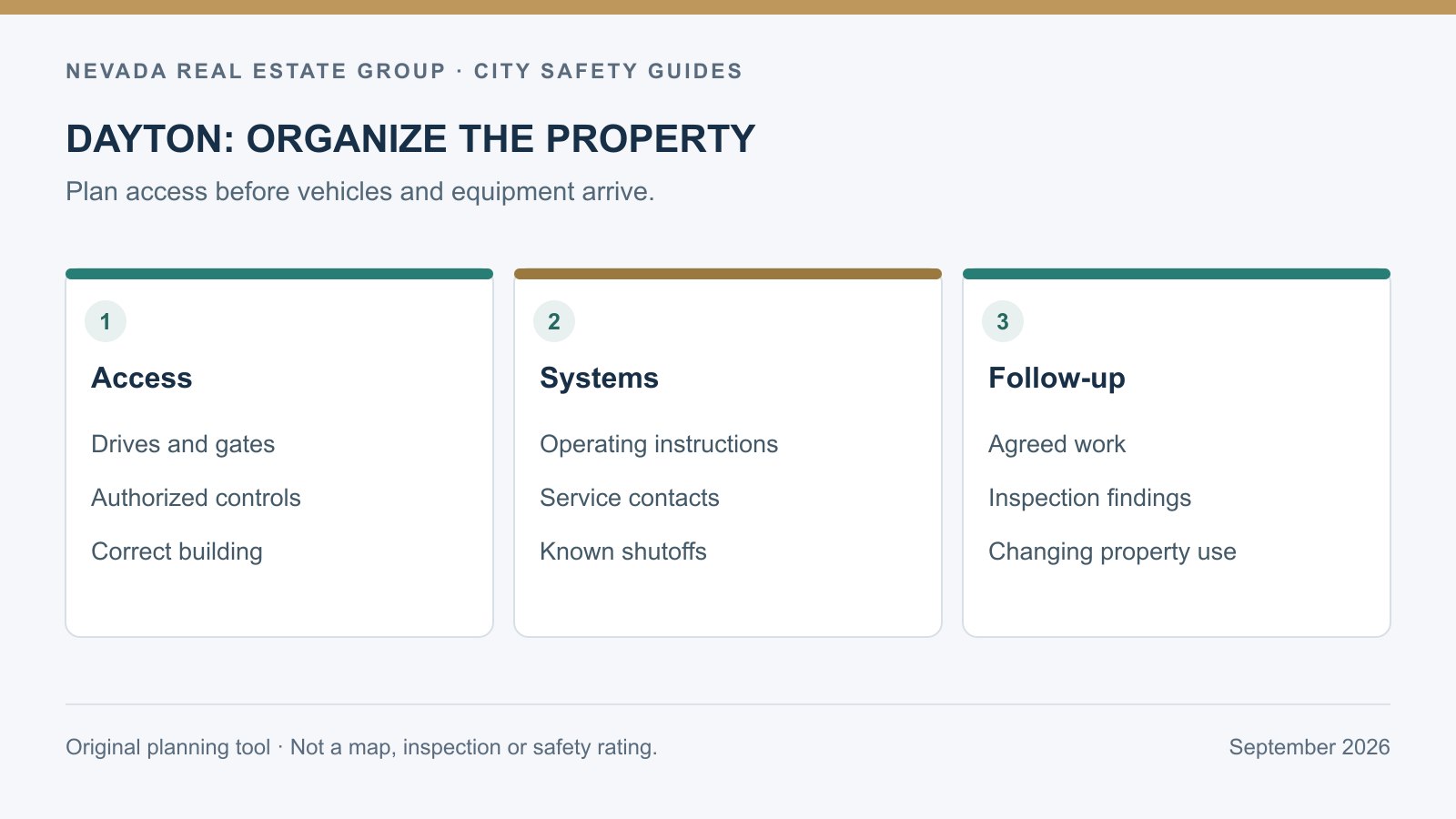
Set follow-up dates based on inspection findings and equipment guidance. Keep the official source links available for current roads, local records and relevant alerts. Revisit the plan if your use of the property changes, especially when adding structures or changing access arrangements.
For help comparing Dayton properties, contact Nevada Real Estate Group or call (775) 277-2120. We can organize the home search and questions for qualified specialists. We do not certify a neighborhood as safe, diagnose private systems or turn an agency crime total into a guarantee about an individual home.
Frequently Asked Questions
What are Dayton's official 2025 crime figures?
The verified source reports Lyon County Sheriff's Office totals: 184 violent crimes and 366 property crimes in its 2025 themes. Those are not Dayton-only figures. The reporting area extends beyond the community, and the totals should not be presented as a town crime rate or a measure of household risk.
Does the Lyon County sheriff have a Dayton location?
The county's official sheriff page lists a Dayton substation at 801 Overland Loop. Use the current page for service instructions and contact information. Its proximity to a home does not guarantee an emergency response time, and routine office hours should not be mistaken for all patrol or dispatch availability.
Is Dayton safer than Fernley based on these reports?
These reports cannot establish that comparison. Both communities are discussed using the same agency-level dataset, which does not separate their local totals here. A defensible comparison would need appropriately scoped local data, consistent definitions and dates, plus a clear account of what the records do and do not measure.
Do old drainage plans prove a Dayton property is protected?
No. A historical planning announcement establishes what was discussed or approved at that time, not the present condition of every project or parcel. Obtain current records, inspect the actual property and access route, and ask the responsible agency or qualified professional which information applies to the address.
What should I check when a Dayton home has a private well?
Obtain the well's records, appropriate current testing and a qualified review of equipment questions. EPA recommends annual testing for total coliform bacteria, nitrates, total dissolved solids and pH, with additional tests as warranted. A public utility's report or an old informal summary does not establish the condition of that well.
Is a golf-community home automatically safer than a home on acreage?
Neither setting proves safety. Review the actual access arrangements, inspection findings, applicable community documents and appropriately scoped incident information. Golf frontage and extra land describe features and responsibilities. They should not replace evidence or become proxies for the safety of the people who live in an area.
What is the most useful Dayton homebuyer safety checklist?
Start with jurisdiction, then review crime-source scope, drainage, access, water systems, inspection findings and daily routes. Record the source and date of each answer, along with material uncertainties. Use the same standards across candidate properties and bring unresolved technical questions to the qualified professional who can address them.
Which sources and methods support this Dayton guide?
Reviewed September 25, 2026. The primary crime sources are Lyon County Sheriff's Office 2025 violent and 2025 property reports. Category sums were checked; the dataset is agency-wide, not Dayton-only, and is also the agency source used in our Fernley guide.
Additional primary sources: Lyon sheriff locations, FBI ranking caution, June 2022 Dayton drainage announcement, current Lyon flood resources, EPA private-well guidance, NDOT travel information and AirNow smoke readiness. Diagrams are original planning tools, not flood maps or inspection findings. No neighborhood ranking, engineering assessment or firsthand property tour is claimed.