

A search for Fernley crime statistics can produce a precise-looking number that describes a much larger reporting area. That is the first problem to solve before deciding what the number means for a home. The second is practical: a buyer also needs to understand drainage, the daily drive, the condition of the house and how the household would handle an interruption.
We reviewed official sources on September 25, 2026. The Nevada Crime Statistics portal reports 184 violent crimes and 366 property crimes for the Lyon County Sheriff's Office in calendar 2025. Those are sheriff-agency totals, not a Fernley-only rate. This guide keeps that distinction visible and provides a property-review process that fits a Fernley search without pretending to rank individual neighborhoods.
Fernley's safety cannot be determined from a sheriff-agency total alone. Nevada's official portal reports 184 violent crimes for the Lyon County Sheriff's Office in 2025, covering more than Fernley. For a home decision, request geographically appropriate information and check the property's flood exposure, access, condition and daily travel routes. A new subdivision, golf setting or attractive listing does not establish a neighborhood safety rating.
- Lyon County Sheriff's Office totals are not Fernley-only crime figures.
- The agency reported 184 violent crimes and 366 property crimes in 2025.
- Fernley and Lyon County publish flood-preparation resources worth checking by address.
- Test the commute and access arrangements you will actually use.
- New construction, gates and home prices do not substitute for records and inspections.
Who provides police services in Fernley, and why does the boundary matter?
According to Lyon County's sheriff information page, the Sheriff's Office has a Fernley substation at 555 East Main Street, alongside locations serving other parts of the county. The state crime portal reports the agency as a whole. That reporting unit is the reason this article does not present the agency's totals as a standalone Fernley crime rate.
An agency boundary, a city boundary, a ZIP code and a subdivision label answer different questions. A website may use one while its headline sounds like another. Before repeating a statistic, identify the actual population or area represented, the reporting year and the measure being counted. Do not divide a sheriff-agency total by Fernley's population and call the result a local rate.
For a particular address, ask which official source can provide geographically appropriate information. A useful request identifies the location, time window and relevant categories. Availability may be limited, and the department may direct you to an existing report rather than creating a custom analysis. Preserve that limit rather than filling it with an estimate presented as fact.
The substation's location is useful contact information, but its distance from a home does not establish an emergency response time. Posted office hours also should not be interpreted as the schedule for all patrol or dispatch functions. Use the current department instructions for routine inquiries and the appropriate emergency channel for an active emergency.
Keep this jurisdiction check at the front of your Fernley relocation research. It makes the rest of the review more accurate and prevents a larger area's records from being used to label every street in the city. A clear boundary is more useful than a confident answer built on the wrong denominator.
What do the official Lyon County sheriff crime reports show?
According to the 2025 violent-crime report for Lyon County Sheriff's Office, the reported total is 184. According to the 2025 property-crime report, the total is 366. We checked the individual categories and reconciled them to both displayed sums.
| Violent category | Count | Property category | Count |
|---|---|---|---|
| Murder and nonnegligent manslaughter | 1 | Burglary | 88 |
| Rape | 35 | Larceny | 188 |
| Robbery | 9 | Motor vehicle theft | 79 |
| Aggravated assault | 139 | Arson | 11 |
| Violent theme total | 184 | Property theme total | 366 |
The portal's counting rules matter. Murder, rape and aggravated assault are counted by victim, while robbery is counted by incident. Property offenses can include multiple counts from an incident; motor vehicle theft includes attempts and individual stolen vehicles. These totals are not the number of affected Fernley households, arrested people or convictions.
They are also not a complete inventory of every offense or call for assistance. A question about a category outside these themes requires the appropriate separate record. The table should be read as a dated summary of what this particular portal reports, not a promise about completeness or current conditions at a prospective home.
Our Dayton safety guide uses this same agency dataset. It cannot logically be used to claim that Fernley has more or less crime than Dayton. A valid comparison would require suitable separate geography, consistent definitions and an appropriate time window. We have not manufactured those missing local totals.
For the buyer, the useful next step is narrower than another countywide search. Ask what can be learned about the area relevant to the address, keep the source and date, and connect that information to observed property conditions. A reported count supplies context; it does not replace investigation of the house you may actually occupy.
How should you assess a website's Fernley crime score?
Start by looking for the methodology, not the color of the map. According to the FBI's caution against simplistic crime rankings, important local factors can be lost in comparisons that reduce places to a rank. That is a methodological caution, not a new measurement of Fernley or a reason to ignore official records.
Ask what the score represents. Is it based on reported offenses, estimated values, calls for service or survey responses? Does it use the city, a postal area or a wider agency? What year is shown? A polished map can still obscure these basic questions. If the site does not explain them, do not repeat the score as an official local finding.
For map displays, examine filters and dates before interpreting blank spaces. Location points may be approximate, some categories may be suppressed and a selected period may be short. An empty screen is not necessarily evidence of zero incidents. Conversely, a single marker does not establish a continuing pattern or identify the people involved accurately.
Use public records responsibly. There is no need to collect victim names, publish a neighbor's personal information or circulate unverified accusations to make a housing decision. Request appropriate aggregate or releasable information and retain only what is relevant to the property review.
Our Fernley neighborhood overview can help identify housing options, but this safety guide does not endorse a safest-neighborhood list. Apply the same evidence standard whether the property is modest, expensive, newer or established. If a source cannot support a claim, label the uncertainty. That is more useful than averaging several unexplained scores into another number that looks authoritative but cannot be checked.
Why should a Fernley buyer investigate flood exposure separately?
According to the City of Fernley's flood and flood-insurance resource, flood coverage is a subject to discuss with an insurance provider. According to Lyon County's flood-preparation page, households should review flood risk, prepare communication and evacuation plans and use FEMA mapping resources. These official resources establish a sensible starting point; they do not decide the risk or coverage of a particular parcel for you.
Use the exact address and parcel, then check where the building sits within that parcel. Ask for help if a map boundary is unclear or the address search returns a nearby location. Review the road used to reach the home as well as the structure itself. The question is not limited to whether water has entered the living room in the past.
Request available drainage, grading and prior-work information. Walk the property with the appropriate professional and distinguish visible observations from conclusions requiring expertise. A dry driveway during a showing cannot demonstrate how runoff moves during a storm. New landscaping or fresh paving also should not be assumed to resolve a drainage question without supporting evidence.
For insurance, obtain an address-specific explanation of coverage, exclusions, limits, effective dates and any lender requirement. This article does not quote a premium or declare one universal policy rule. Our Nevada flood-zone and insurance guide can help prepare the conversation, but the actual policy and property records control your decision.
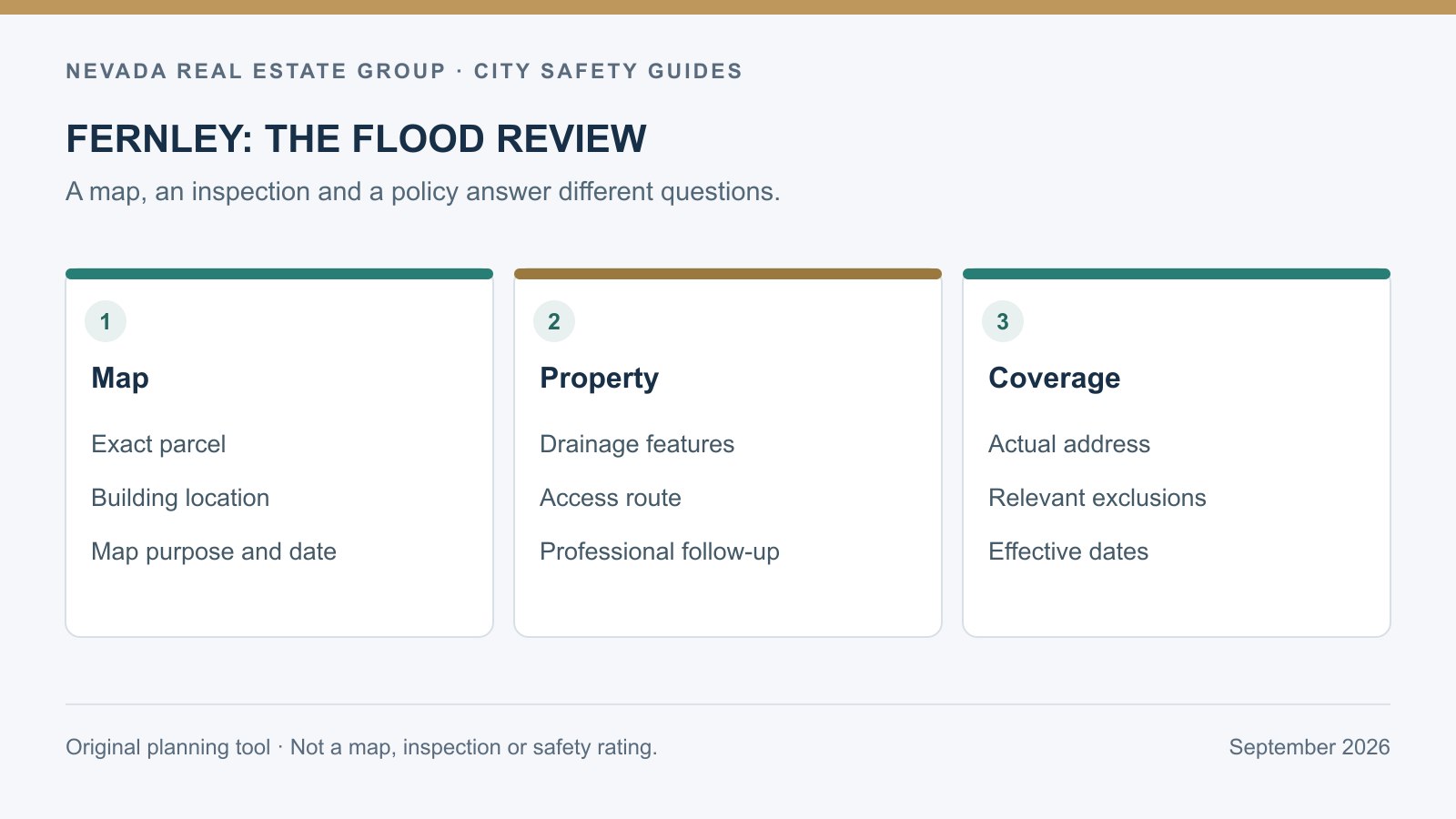
Keep the resulting answers together. A map screenshot, an inspection observation and an insurer's statement answer different questions. Completing one does not automatically complete the others, and a remaining question should stay visible before you commit to the property.
How should canals, drainage features and nearby land affect your review?
Fernley's landscape includes water infrastructure that deserves accurate context. According to the city's published history of the Newlands Project and canal, the project's history connects irrigation works and regional rivers. The hosted 1996 account is historical background, not a current engineering assessment or evidence that a particular home will flood. Do not turn a historical account into an address-level prediction.
At a candidate property, identify the features that actually matter: a ditch, drainage easement, retaining structure, watercourse or access crossing. Ask for the relevant maps and recorded documents. Confirm who maintains each feature and which office can explain its function. A fence line or listing photograph is not a substitute for a survey or an interpretation of recorded rights.
If a planned improvement would change grading, fencing or access near a drainage feature, investigate feasibility before building the improvement into your decision. Obtain the required professional and agency guidance. This guide does not assert that any specific project is permitted, prohibited or easy to approve.
For households with children, pets or outdoor equipment, consider the actual layout and how you will use the yard. Identify barriers, entry points and areas that require supervision or a different plan. Do not use the presence of infrastructure to label an entire neighborhood. The relevant question is whether the specific property's arrangement is understood and workable for your household.
Keep current evidence separate from historic context in the purchase file. A historical canal description may explain why a buyer asks a question; a current map, inspection or agency response is what helps answer it. If responsibility for a feature remains unclear, record the uncertainty and seek clarification rather than assuming it belongs to the city, an association or the adjacent owner.
What commuting and road checks matter for a Fernley household?
Test the drive you expect to make, from the actual house to the actual destination. A city-to-city estimate is not the same as the trip from a driveway to an employer, appointment or childcare location. Include the local approach, parking and the return trip. If a schedule matters, observe the route under conditions reasonably similar to that schedule.
According to Nevada Department of Transportation travel information, Nevada 511 provides road-condition information. Check the current service for the route before travel. Weather, restrictions and disruptions should be checked when relevant; a single clear-day test is not a guarantee that every future drive will take the same time.
Keep a simple route log. Record the date, departure time, destination and unusual conditions. Separate what you observed from what a navigation application predicted. That makes a comparison between two homes more useful and prevents one unusually easy or difficult trip from becoming a permanent commute claim.
Think through a disrupted day. If the usual route becomes unavailable, which official source will you check? Who needs to know about a delayed arrival? Does the household have a practical alternative for an essential appointment or pickup? You do not need to predict every event, but the plan should not depend on one untested assumption.
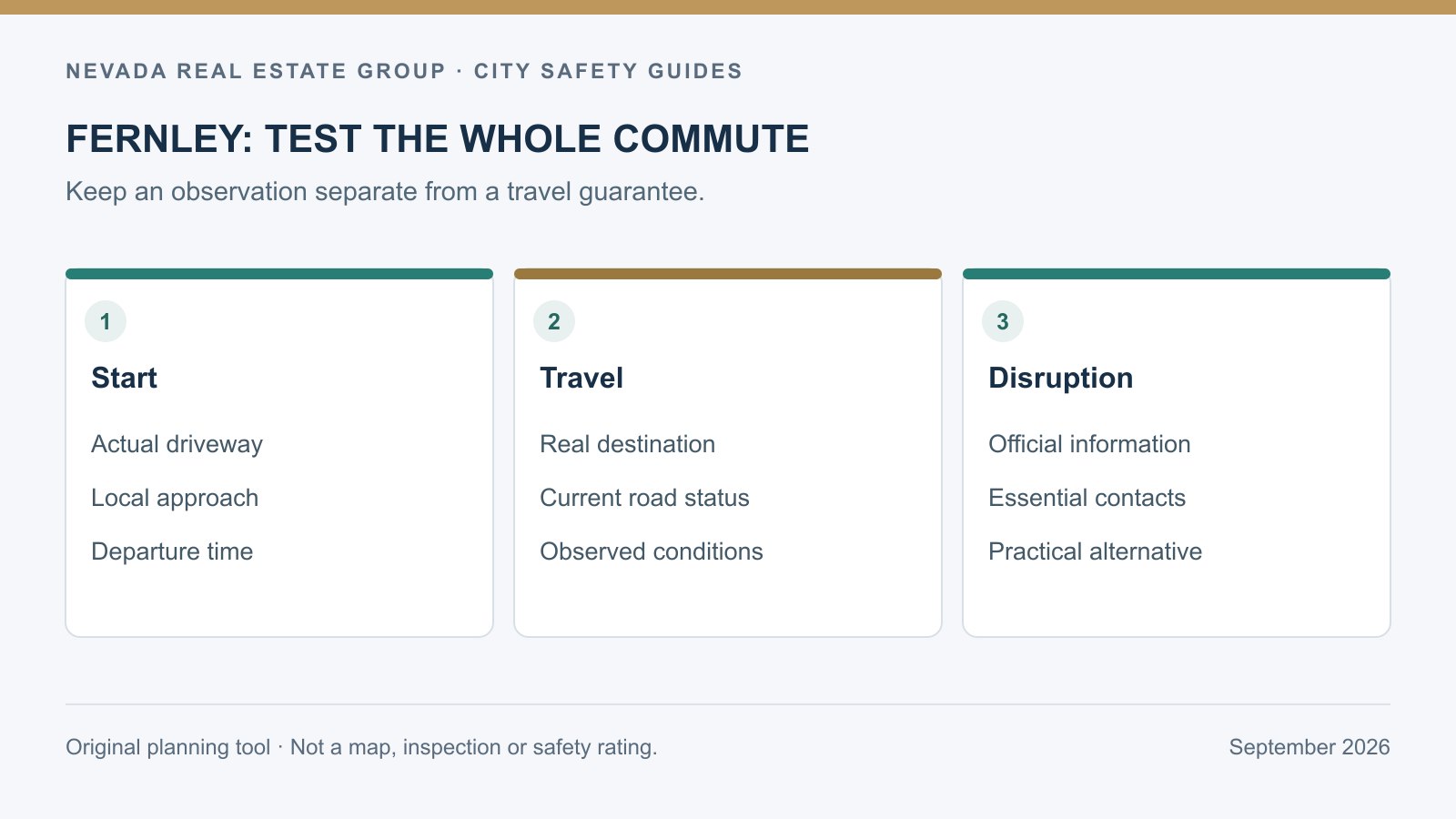
A commute is one part of the broader housing budget and routine. It should not be converted into a claim that one neighborhood is safer because it is closer to a destination. For Fernley homes for sale, compare the real routes and access arrangements that serve your own needs.
Does new construction remove the need for a safety inspection?
New construction changes the questions; it does not remove them. For a completed home, review the actual condition of installed systems, the status of unfinished work and the documentation available for the property. For a home still being built, distinguish promised future features from what is present now. A model home's landscaping or street lighting may not describe the delivery condition of your particular lot.
Ask the builder or seller to identify the property-specific documents and the process for independent inspections. Confirm access, timing and any limitations in writing. This article does not claim one inspection policy applies to every builder. The relevant agreement and professionals should explain how concerns are documented and resolved for your transaction.
Review the route around the house, not only the interior finishes. Check entries, steps, garage operation, drainage and the connection to the public street. If nearby construction is ongoing, ask about access arrangements and the status of shared improvements. Do not infer completion from marketing renderings or an anticipated schedule.
Our Fernley new-construction page and new homes search can help organize available options. Keep listing status, construction status and inspection findings separate. A home can be attractive and still have unresolved work that needs a clear scope and completion record.
The same principle applies to an established home with recent renovations. Obtain the applicable records and inspect the work rather than equating “updated” with verified condition. Our Northern Nevada buyer inspection guide provides questions to bring to a qualified inspector. Neither the year built nor a finish package establishes a safety ranking for the house or the subdivision around it.
What should you check about garages, yards and ordinary property security?
Begin with how the property will actually be used. Walk from the parking space to the entry while carrying the kinds of items you bring home. Look at lighting, visibility, door operation and storage arrangements. A garage full of boxes may have different usable capacity from its advertised vehicle count, so measure the space and plan the layout before depending on it.
Ask which locks, remotes, access accounts and installed devices transfer with the house. Arrange appropriate changes or resets after possession with the relevant professional. A camera or alarm is only useful if the household understands how it works, who receives alerts and what happens when power or internet service is unavailable. Do not assume an advertised device includes an active monitoring contract.
For the yard, identify gates, outbuildings and storage areas that need separate attention. Confirm which features are part of the property and which depend on shared or recorded arrangements. A fence can define a practical enclosure without necessarily establishing the legal boundary; use the right documents when that distinction matters.
| Feature | Question | Useful evidence |
|---|---|---|
| Doors and gates | Who can enter and how? | Controls, keys and operating instructions |
| Alarm or camera | Who receives and responds to alerts? | Service terms and tested settings |
| Garage | Does actual storage leave usable access? | Measurements and a layout check |
| Shared feature | Who maintains it? | Recorded or written responsibility |
Apply these checks consistently whether you are viewing Desert Lakes homes or Donner Trail Estates homes. Those links identify housing areas, not a comparative safety endorsement. Equipment and design features should be evaluated on their actual operation rather than used as a substitute for local evidence.
How should you prepare a Fernley home for smoke and service interruptions?
According to AirNow's smoke-readiness guidance, advance preparation includes knowing where to get information and planning a cleaner indoor space. For a homebuyer, ask an HVAC professional about the installed system, suitable filtration and the maintenance it requires. The guidance does not mean every filter fits every system or that a particular house is protected from all smoke exposure.
Check how windows and doors operate and ask the inspector to explain relevant findings. Identify the room and equipment you would use under the appropriate official guidance, then verify the plan with the professionals needed for your household. Avoid buying a device solely because a listing or advertisement uses a broad health claim.
Keep smoke preparation separate from property fire exposure and insurance. Those questions may involve different records, assessments and coverage terms. Our Northern Nevada wildfire and home-insurance guide can frame the inquiry, but it does not supply an insurance determination for an unreviewed Fernley address.
Service interruptions require an equally specific plan. Confirm the utility providers, shutoffs and instructions for the installed equipment. If a household member relies on powered equipment, discuss the contingency with the appropriate professional. Do not infer restoration times from a provider's office location or assume a battery-backed device keeps every connected system functioning.
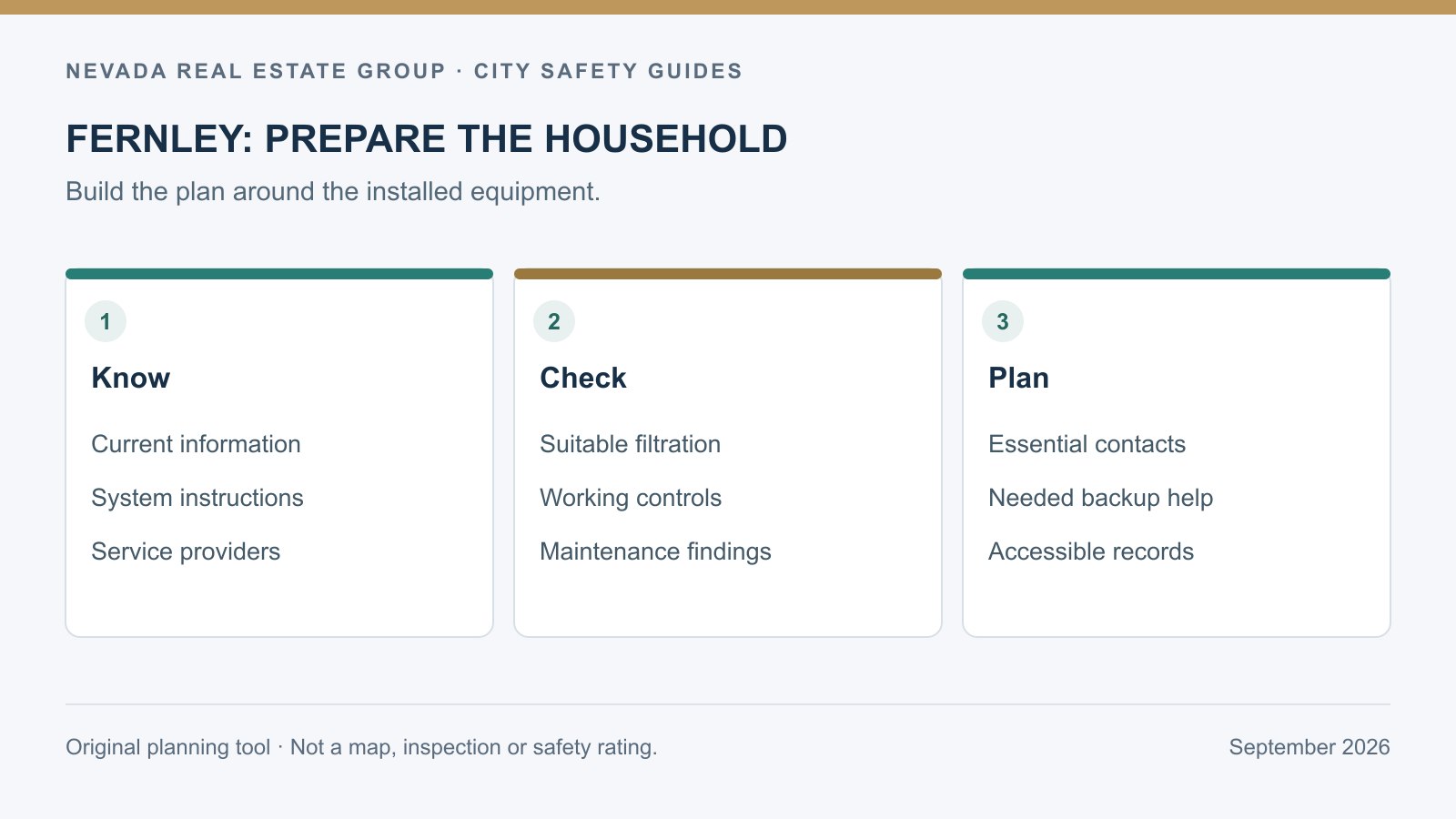
Keep instructions available outside a single app and review them with the household. Our Northern Nevada utility setup guide helps organize the move-in tasks. Preparation should resolve practical questions, without presenting a device purchase or a general neighborhood reputation as a guarantee.
How do school, shopping and recreation routes fit a safety review?
A daily route can matter as much as a home's interior. Identify the destinations your household will use and examine the actual path from the front door. Look at crossings, sidewalks, parking, visibility and access under the conditions that matter to you. A map's short distance does not necessarily show a convenient route for walking, cycling or a person with specific mobility needs.
For a school-related move, verify assignment and current transportation information with the relevant official source. Our Fernley school guide is a starting point for questions, not a guarantee of enrollment or a school-safety ranking. Educational preferences should not become assumptions about the demographics or safety of nearby residents.
Visit public areas respectfully and follow traffic rules. A property tour does not authorize entry onto neighboring land or private facilities. Record objective observations such as a missing connection or a difficult turn, then ask the appropriate authority about anything requiring clarification. Avoid photographing people or collecting personal information as part of a housing comparison.
If the household expects to reduce driving over time, test that possibility before treating it as a benefit of the location. Determine which trips still require a vehicle, what alternatives actually exist and how an interrupted routine would be handled. The Fernley retirement guide can help frame broader housing needs, while the route review remains specific to the address and person.
Repeat a critical visit if the first observation does not reflect intended use. The aim is not to declare a street universally safe or unsafe. It is to understand whether the home's connections work for the household and what adaptations, further information or different location would be needed.
What belongs in a Fernley purchase file before you decide?
Organize the file around questions rather than document volume. Begin with the property identity: address, parcel, intended use and the actual features being evaluated. Then attach the source that answers each question, noting its date and scope. A countywide report should remain labeled countywide or agency-wide; it should not become an address-level conclusion when copied into a spreadsheet.
Keep inspection findings, map interpretation, insurance information and route observations separate. They provide different kinds of evidence. Ask for professional clarification when a document is ambiguous, and record the answer in a form the household can revisit. Avoid relying on a verbal summary that loses the limitations of the underlying report.
| File section | Include | Still unresolved if missing |
|---|---|---|
| Jurisdiction | Agency and relevant records | Geographic fit of the data |
| Flood and drainage | Parcel maps and professional answers | Property and access exposure |
| Condition | Inspection, work scope and completion evidence | Material repair questions |
| Routine | Routes, equipment and service contacts | How the household will use the home |
For a known repair, obtain a defined scope and a relevant estimate rather than inserting an unsupported average cost. If a task depends on permission, access or additional investigation, include that dependency. A low quote with an incomplete scope is not directly comparable with a complete proposal.
Decide which unanswered items are material before enthusiasm for a property makes them easier to overlook. Discuss transaction options and timing with the appropriate professionals. A good file makes the decision understandable to someone who did not attend every showing and prevents a broad safety label from obscuring the specific issue that needs attention.
What should happen between the final walkthrough and move-in?
Use the final walkthrough to check the agreed transaction items and the home's observed condition, while recognizing that it is not a replacement for the inspections already needed. Confirm the status of agreed work, transferred equipment and access arrangements. Keep evidence of unresolved items and discuss them through the appropriate transaction process instead of assuming they will resolve after possession.
At move-in, learn the installed controls and shutoffs from reliable instructions or qualified help. Confirm who has access to the property, arrange appropriate resets and establish service accounts. Test household routines such as entry after dark, deliveries and storage without blocking the spaces you need for ordinary movement.
Review the official information sources you will use. Save the sheriff contact route for routine matters, current road information and relevant emergency notifications. Confirm any subscription or service enrollment rather than treating a submitted form as proof of activation. Update contact details when circumstances change.
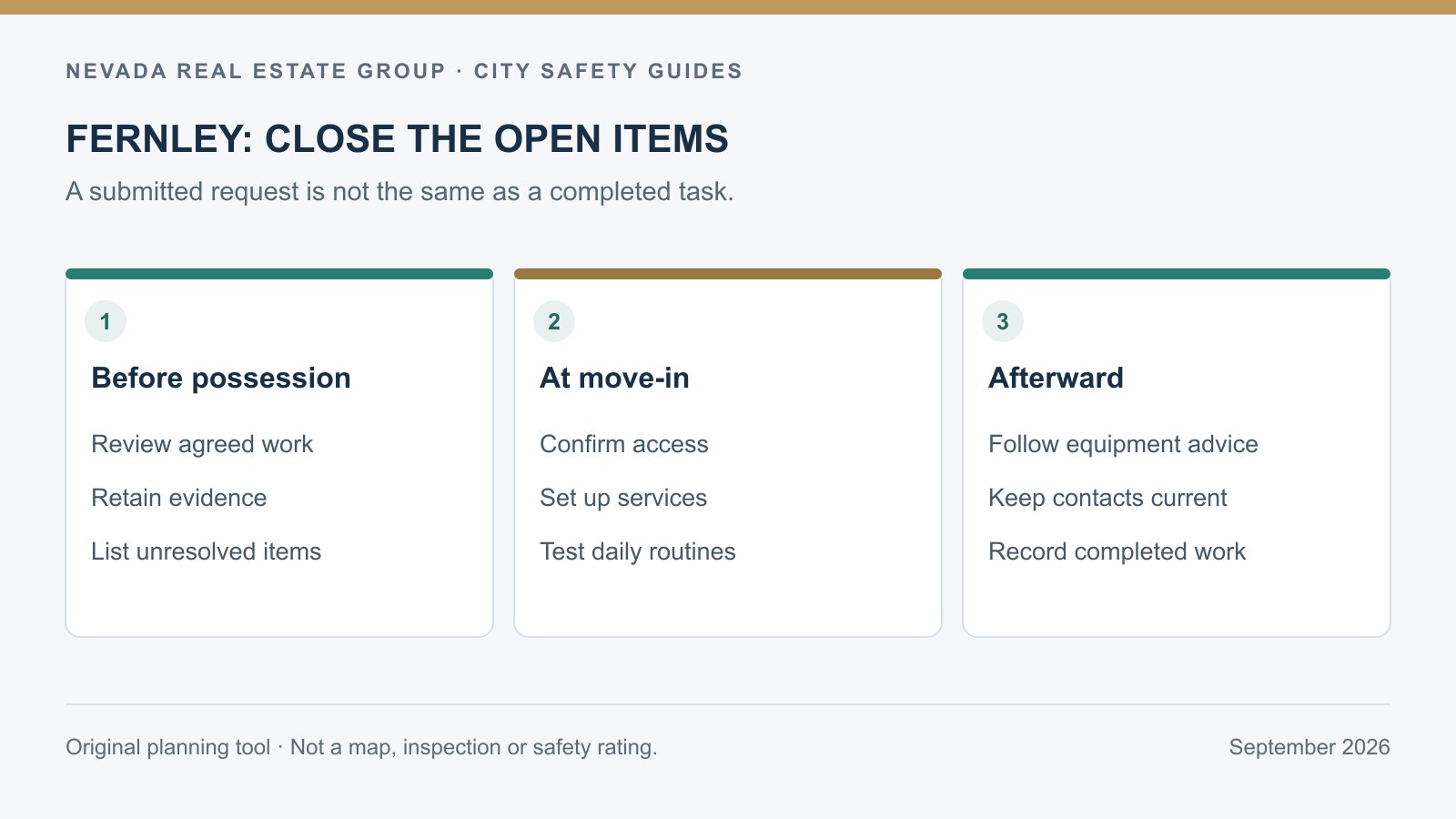
Make follow-up dates reflect the actual inspection findings and equipment guidance. This article does not prescribe an invented universal maintenance interval. The useful outcome is a home with understood systems, documented open items and a household that knows what to do next.
For help comparing Fernley properties, contact Nevada Real Estate Group or call (775) 277-2120. We can help organize the search and identify questions for qualified specialists. We do not certify a neighborhood as safe or convert a sheriff-agency count into a guarantee about a particular address.
Frequently Asked Questions
What is Fernley's official 2025 crime rate?
This review verified Lyon County Sheriff's Office counts, not a Fernley-only per-capita rate. The agency reported 184 violent crimes and 366 property crimes in the state's 2025 themes. Its reporting area extends beyond Fernley, so those totals should not be divided by Fernley's population or labeled city-only statistics.
Does Fernley have a sheriff substation?
Lyon County's official sheriff page lists a Fernley substation at 555 East Main Street. Use the current department information for contact details and service instructions. The location does not establish a response-time guarantee, and posted office hours should not be interpreted as the schedule of all patrol or dispatch functions.
Can these totals tell me whether Fernley is safer than Dayton?
No. Both guides reference the same Lyon County Sheriff's Office dataset. A comparison between the communities would need suitable separate geographic data, consistent categories and the same reporting period. Assigning the entire agency total to either community would produce a misleading result rather than a defensible ranking.
Should I investigate flood exposure in Fernley?
Yes. Use the exact address and parcel with current official resources, review drainage and access, and obtain property-specific insurance information. Fernley and Lyon County publish flood-preparation resources. A dry showing, a new house or a map viewed without understanding its scope does not complete the inquiry.
Is a new Fernley home automatically safer than an older one?
The construction date alone does not establish condition or safety. Inspect the actual systems, review documentation and distinguish completed work from promised improvements. An older home with documented maintenance and a newer home with unresolved work require different follow-up; neither should receive a blanket conclusion from age alone.
What should I check before commuting from a Fernley home?
Test the full route from the property to your actual destination under relevant conditions. Record the timing and circumstances, check current NDOT road information and consider a disrupted-day plan. A single navigation estimate or city-to-city distance does not guarantee the daily drive you will experience.
How can I compare Fernley neighborhoods responsibly?
Use consistent property and route checks, appropriately scoped incident information and qualified inspections. Keep preferences separate from evidence and do not use price, gates or demographics as a safety proxy. Record material unknowns rather than forcing each area into a numerical score that the available data cannot support.
Which sources and methods support this Fernley guide?
Reviewed September 25, 2026. Primary crime sources are the Lyon County Sheriff's Office 2025 violent and 2025 property reports. Category sums were checked. These are agency-level reported counts, not Fernley-only totals, per-capita rates or a completeness certification.
Additional sources: Lyon sheriff locations, FBI ranking caution, Fernley flood-insurance resource, Lyon flood preparation, historical canal account, NDOT travel information and AirNow smoke readiness. Worksheets and diagrams are original editorial planning tools. No firsthand property inspection, engineering analysis or neighborhood crime ranking is claimed.