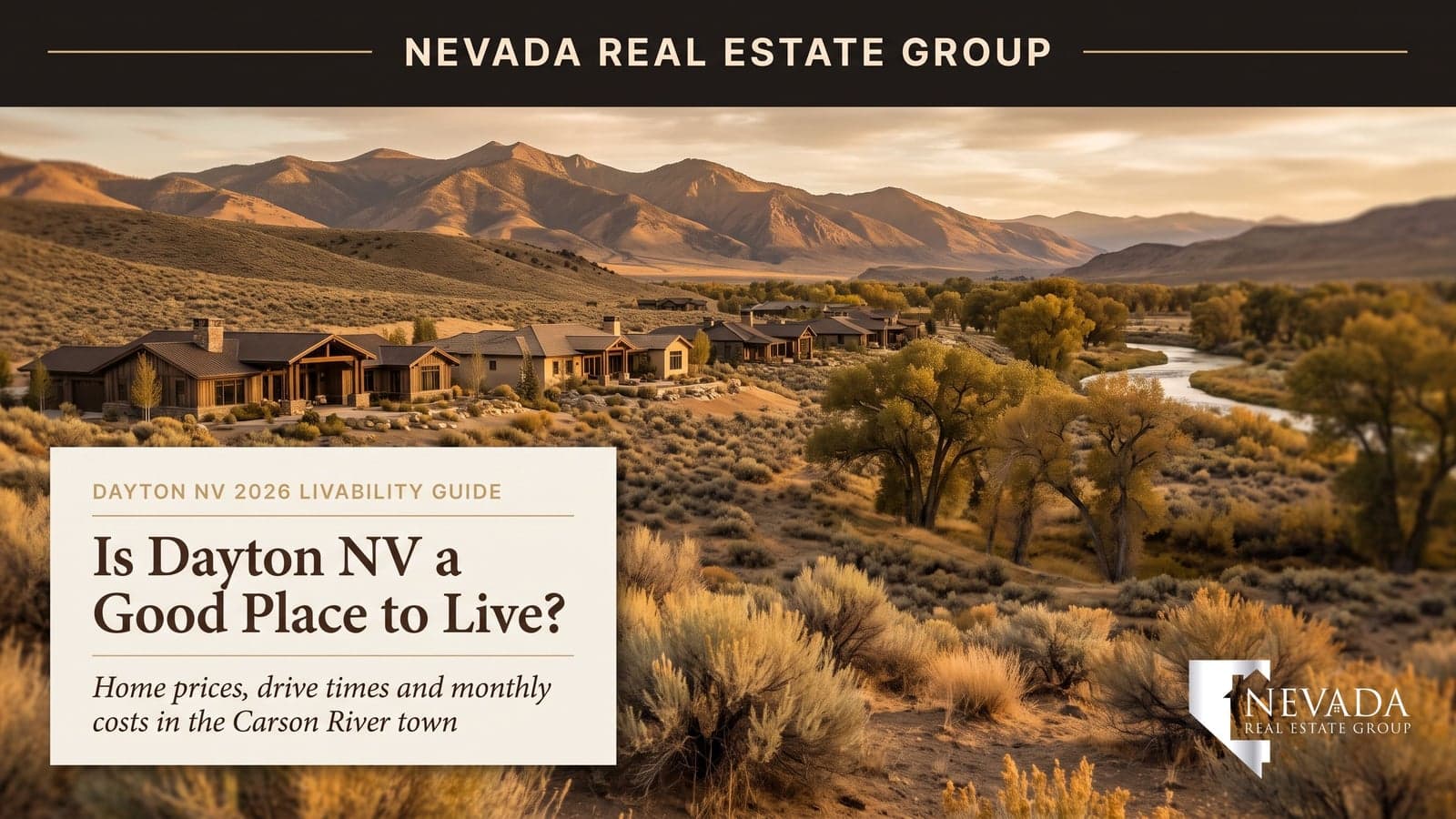

About 12 miles east of the state capital, where the Carson River leaves the Comstock foothills for open high desert, sits Dayton, one of Northern Nevada's most underestimated places to buy a house. It was a gold camp before Nevada was a state: according to Nevada State Parks' history of Dayton, Abner Blackburn found gold nearby in 1849, and the town took the name Dayton in 1861. Today the draw is arithmetic. Homes cost less than in Carson City or Reno, and the typical lot is larger.
Many of the Dayton conversations I have start in Carson City: a buyer tours the capital, runs the numbers, and asks what the same budget buys 12.5 road miles east. So when someone asks me whether Dayton is a good place to live or just a cheaper one, I answer with a scorecard rather than a pitch: prices, lots, drive times, taxes, schools and services, each with a date and a source, graded against the Northern Nevada alternatives with NNRMLS data. For neighborhoods, listings and builders, see our Dayton, Nevada homes and community guide; for utility bills and moving logistics, see my Dayton moving and cost-of-living guide.
Dayton's strengths are price and lot size; its costs are distance and services. Single-family homes in ZIP 89403 sold at a $484,950 median on 201 sales contracted March through August 2026, on a 0.25-acre median lot, against 0.17 acre in Carson City. Carson City is 20 minutes away without traffic, while Reno and the Tahoe-Reno Industrial Center are 53 to 54 minutes. Larger stores and hospital care are in Carson City.
- Dayton single-family homes sold at a $484,950 median on 201 sales contracted March through August 2026.
- Dayton's median lot was 0.25 acre, against 0.17 in Carson City and Sparks and about 0.18 in Reno.
- OSRM routes Dayton to the Tahoe-Reno Industrial Center in 53 minutes, against 26–29 from Reno City Hall.
- FY 2026-27 Dayton property tax is $3.3992 or $3.4442 per $100 of assessed value; sales tax is 7.1%.
- Dayton has no hospital; hospital care and larger stores are in Carson City, 12.5 road miles west.
What Makes Dayton, Nevada Different From Carson City and Reno?
Dayton is a different kind of place from its bigger neighbors, and the difference is the reason to consider it. Carson City is Nevada's capital and a consolidated city-county, and Reno is the largest city in Washoe County. Dayton is an unincorporated town in Lyon County. According to Census Reporter's profile of U.S. Census Bureau data for the Dayton CDP, the census-designated place had 15,781 residents in the 2020–2024 American Community Survey, spread across 34.9 square miles. It has no mayor or city council of its own. Lyon County provides local government, and according to Lyon County's Utilities Department, the county also supplies water and sewer service for the Dayton and Mound House areas. That arrangement shapes the trade: fewer services in town, more open land, and lower prices.
The town has two distinct halves. Old Town Dayton is the historic core. According to Nevada State Parks, the area was a Paiute fishing camp and winter camp on the Carson River before the 1849 gold find; Dayton was a Pony Express stop in 1861 and the Lyon County seat from 1861 until 1909, when a fire burned the courthouse and Yerington won the seat. Wrapped around the old core are the newer subdivisions: Dayton Valley, built around an Arnold Palmer–designed golf course, Santa Maria Ranch, Riverpark and Sutro, and the Carson River Estates parcels along the river. That is where most of the town's newer single-family homes sit: of the 201 single-family homes that sold in ZIP 89403 on contracts signed March through August 2026, 103 were built in 2016 or later.
Across the 9,600-plus closings (as of October 2026) Nevada Real Estate Group — the #1 real estate team in Nevada — has represented statewide and in our Northern Nevada communities, the reasons buyers give for choosing Dayton are concrete: a lower price per square foot than Carson City or Reno, larger lots, and the Carson River setting. The rest of this guide grades each of those against dated data, then lays out what the lower price costs you in drive time and services.
What Do Homes Cost in Dayton, Nevada in 2026?
I pulled every single-family sale in ZIP 89403 from our Northern Nevada Regional MLS (NNRMLS) feed on October 12, 2026, the same pull behind my Dayton moving guide. NNRMLS records a sale's date as the contract date, so the window below covers contracts signed March 1 through August 31, 2026 that had closed by October 12. July and August contracts are still closing, so their counts will rise; September, with only 8 sales posted, is left out.
| Measure | Figure |
|---|---|
| Median sale price, contracts March–August 2026 | $484,950 on 201 sales |
| Lower and upper quartile sale price | $420,000 and $560,000 |
| Sales under $400,000 / $400,000–$599,999 / $600,000 or more | 24 / 146 / 31 |
| Median home size and sold price per square foot | 1,897 sq ft; $260 |
| Median lot size and year built | 0.25 acre; 2016 |
| Manufactured homes, same window | 18 sales at a $377,500 median |
| Single-family homes for sale, October 12, 2026 | 77 at a $535,000 median asking price |
| Single-family homes under contract, October 12, 2026 | 51 |
The months line up with their neighbours. March through June each posted 36 to 38 single-family sales, with medians between $460,000 and $501,193, so the window is not leaning on one odd month. The highest single-family sale in the window was $1,630,000, and on October 12 the 77 active listings ran from $299,000 to $2,300,000. Manufactured homes, which sell under their own financing rules, are a separate market at a $377,500 median. For an independent county-level check, according to the Sierra Nevada REALTORS September 2026 market report, all residential sales in Lyon County, which also covers Fernley and Yerington, had a $435,000 median and a $254 median sold price per square foot on 68 closed sales.
Rates have moved this year, and they change the monthly math more than the price does. According to Freddie Mac's Primary Mortgage Market Survey, the 30-year fixed average has ranged from 5.98% (February 26, 2026) to 7.40% (October 8, 2026), the latest weekly reading. At 7.40%, the $484,950 median with 20% down ($96,990) carries about $2,686 a month in principal and interest before property tax, insurance and any HOA dues. A $420,000 home at the lower quartile, with the same 20% down ($84,000), runs about $2,326. Your own rate depends on credit, points and loan type, so treat these as worked examples rather than quotes. To see where your budget lands today, browse newly listed Dayton homes.
How Does Dayton Compare to Carson City, Reno, and Sparks on Price?
Comparing towns only works when the figures cover the same period, so this table pairs like with like: single-family sales on contracts signed March 1 through August 31, 2026 and closed by October 12, pulled from the same NNRMLS feed for all four markets on October 12, 2026, plus the Nevada Department of Taxation's current property and sales tax rates.
| Measure | Dayton | Carson City | Reno | Sparks |
|---|---|---|---|---|
| Median single-family sale, contracts March–August 2026 | $484,950 | $570,200 | $685,000 | $569,900 |
| Single-family sales, same window, closed by October 12 | 201 | 406 | 1,770 | 795 |
| Median sold price per square foot, same sales | $260 | $328 | $356 | $307 |
| Median lot, same sales | 0.25 acre | 0.17 acre | about 0.18 acre | 0.17 acre |
| Property tax per $100 of assessed value, FY 2026-27 | $3.3992 to $3.4442 | $3.5400 to $3.5700 | $3.6600 (City of Reno) | $3.6600 (City of Sparks) |
| Sales tax rate | 7.10% | 7.60% | 8.265% | 8.265% |
| County | Lyon | Carson City (consolidated) | Washoe | Washoe |
The headline: over the March-to-August 2026 contract window, Dayton's single-family median sat $85,250 below Carson City's, $84,950 below Sparks' and $200,050 below Reno's, and Dayton homes sold for $68 a square foot less than in Carson City, $47 less than in Sparks and $96 less than in Reno. All four markets show lower July and August counts while contracts close, so the window compares like with like. Dayton also had the largest median lot of the four, and the lowest property-tax and sales-tax rates. For month-by-month detail in the other three markets, see our Carson City September 2026 market report, Reno September 2026 market report and Sparks September 2026 market report, which use the same MLS feed.
What you give up is selection. Dayton logged 201 single-family sales in six months, against 406 in Carson City, 795 in Sparks and 1,770 in Reno, so fewer homes come up in any given month and the right one may not be listed when you are ready. The independent county figures point the same way on price: according to Sierra Nevada REALTORS, September 2026's all-residential median was $435,000 in Lyon County, $515,000 in Carson City and $595,000 in Washoe County, and the median sold price per square foot was $254, $307 and $324. One method note: Dayton's figures cover ZIP 89403, while the other three columns use the MLS city field. If you are still weighing the pricier options, our Carson City, Reno and Sparks pages cover each market in depth.
How Big Are Dayton Lots Compared With Carson City, Reno and Sparks?
The median lot is where Dayton wins. On the same March-to-August 2026 single-family sales, the median Dayton lot was 0.25 acre, against 0.17 acre in Carson City and Sparks and about 0.18 acre in Reno, and a quarter of Dayton sales sat on 0.29 acre or more. For a buyer comparing typical subdivision homes, that difference is real: a quarter-acre Dayton lot is roughly half again the size of the median Carson City or Sparks lot.
The median hides the other end, though. Large parcels are not common among Dayton sales. Only 18 of the 201 sold on a half acre or more (9.0%), and 7 on an acre or more (3.5%). Carson City sold more acreage than Dayton did, with 71 of its 406 sales on a half acre or more (17.5%) and 51 on an acre or more; Reno came in at 12.5% on a half acre or more (210 of the 1,683 Reno sales with lot data), and Sparks at 4.2% (33 of 795). The 18 larger-lot Dayton sales had a $550,000 median, and 8 of them sold under $500,000. On October 12, 2026, 6 of the 77 active single-family listings in ZIP 89403 sat on a half acre or more, and 4 on an acre or more. If acreage is the goal, search Dayton homes with land and the acreage parts of Carson City side by side.
What a larger lot allows depends on the parcel's zoning, its recorded restrictions and any HOA rules, so confirm uses such as an RV pad, a detached shop or an accessory building in writing with Lyon County planning and the association before you write an offer. Bigger lots also carry costs. According to Lyon County's Utilities Department, the county provides water and sewer for the Dayton and Mound House areas, but not every parcel is on the county system, so confirm whether a home is connected or relies on a private well and septic system. If it relies on its own, ask for a well-flow test and a septic inspection during escrow, and budget for their upkeep. Irrigation scales with the lot too. According to the Carson Water Subconservancy District's 2026 Carson River Watershed water and sewer rates report, dated March 18, 2026, a Dayton home on Lyon County water and sewer pays $122.40 a month at 5,000 gallons or less (a $30.18 water base, $91.22 for sewer and a $1.00 source water fee), plus $3.71 per 1,000 gallons above that, so outdoor watering on a larger lot is what moves the bill.
Is Dayton Part of Carson City or a Separate Town?
This is the most common point of confusion I clear up, so let me be precise: Dayton is not part of Carson City. It is a separate, unincorporated community in Lyon County, 12.5 road miles east of the Nevada State Capitol along US-50. Carson City is a consolidated city-county with its own government, while Dayton falls under Lyon County, with a different assessor, a different school district and a different property-tax rate. The Census Bureau's 2020 census table for the Dayton CDP lists it as "Dayton CDP, Nevada": a census-designated place, not an incorporated city.
Why does the distinction matter to a buyer? Because it changes your paperwork and your bills. Your property tax is set by Lyon County's tax districts, not Carson City's: according to the Nevada Department of Taxation's Property Tax Rates for Nevada Local Governments, FY 2026-27, the Dayton fire-district tax districts carry $3.3992 or $3.4442 per $100 of assessed value, against $3.5400 to $3.5700 in Carson City. Public school assignments run through the Lyon County School District, not the Carson City School District. Building permits go through Lyon County. People routinely say "Dayton, near Carson" as shorthand, which is fine in conversation, but for closing a house the county line is a hard fact, and it is part of why Dayton costs less.
The flip side of that separation is proximity. Larger stores, hospital care and state government jobs are in Carson City, about 20 minutes away without traffic, while housing costs follow Lyon County. That combination — Carson City's services at a Lyon County price — is the core of Dayton's appeal, and the drive is the cost. Smaller communities sit between and beyond the two: Mound House lies on US-50 between Dayton and Carson City, and Silver Springs and Stagecoach sit farther east, with their own price points and longer drives.
How Long Is the Commute From Dayton to Carson City and Reno?
Drive time is the price of Dayton's discount, so I measured it the same way as in my Dayton moving guide. I routed each trip on October 12, 2026 with the open-source OSRM engine on OpenStreetMap data, starting from OpenStreetMap's Dayton town point. The times assume no traffic, so add a margin for weekday rush hours and winter weather. You can rerun the Carson City route, the Reno route and the Tahoe-Reno Industrial Center route yourself.
| Destination | Road miles | Drive time, no traffic | Main route |
|---|---|---|---|
| Carson City (Nevada State Capitol) | 12.5 | 20 min | US-50 west |
| Virginia City | 11.7 | 18 min | US-50, SR-341 and SR-342 |
| Reno-Tahoe International Airport | 38.9 | 52 min | US-50 west, then I-580 north |
| Downtown Reno (Reno City Hall) | 41.4 | 54 min | US-50 west, then I-580 north |
| Tahoe-Reno Industrial Center | 38.7 | 53 min | US-50 east, then USA Parkway (SR-439) |
| Stateline, Lake Tahoe | 37.9 | 59 min | US-50 west through Carson City |
Carson City is the short drive: 12.5 miles and about 20 minutes on US-50. Almost everything else in the region is close to an hour. Reno City Hall is 41.4 miles and about 54 minutes via US-50 and I-580, the airport about 52 minutes, and the Tahoe-Reno Industrial Center about 53 minutes, east on US-50 and north on USA Parkway. Census data shows the result: according to Census Reporter's profile of the Census Bureau's 2020–2024 American Community Survey, Dayton residents' mean travel time to work is 30.8 minutes, about 1.3 times the Reno metro area's 23.3.
Fuel is the part of the commute you can price. According to AAA's Nevada gas price page, Lyon County's average for regular was $5.145 a gallon on October 12, 2026. Assume 21 workdays a month and a car that gets 25 miles per gallon: a daily round trip to the Capitol is 25 miles, or about 21 gallons a month, roughly $108. A daily round trip to downtown Reno is 82.8 miles, or about 70 gallons a month, roughly $358. A hybrid schedule changes the Reno math more than anything else, and insurance, maintenance and parking are separate costs. If downtown is your daily destination, compare the drive against Downtown Reno housing before you commit.
What Jobs Are Near Dayton at the Tahoe-Reno Industrial Center?
The Tahoe-Reno Industrial Center (TRIC) sits in neighboring Storey County along USA Parkway and I-80, and it holds several of the region's largest private employers. Tesla lists Gigafactory Nevada, in Sparks, Nevada, among its owned primary manufacturing facilities in its Form 10-K for 2025, filed January 29, 2026, and says it entered agreements with the State of Nevada and Storey County in 2014 in connection with the plant's construction. According to Switch, its Citadel Campus data center campus is in Tahoe Reno. According to Google, its Storey County data center was built in 2021. And according to Redwood Materials, its Tahoe Campus in Northern Nevada combines energy storage, recycling and refining, and materials production.
The distance is the part to price honestly. On the OSRM routing above, the drive from Dayton to TRIC is 38.7 miles and about 53 minutes. From Reno City Hall to the same point, the Reno-to-TRIC route is about 21 miles via I-80 and 26 to 29 minutes depending on direction and run; from Sparks City Hall and Fernley City Hall, it is roughly 20 to 24 minutes each. A Dayton home is not closer to the plant than a Reno home; it is about 24 to 27 minutes farther each way. What the drive buys is price: on March-to-August 2026 contracts, Dayton's single-family median was $200,050 below Reno's and $84,950 below Sparks'. Whether that trade works depends on how many days a week you make the drive, the shift times, and what your time is worth.
Carson City is the other job center within reach: the state capital, 12.5 road miles west, with state government offices and Carson Tahoe Regional Medical Center. Most working Dayton residents commute somewhere, which the 30.8-minute mean travel time reflects. For hybrid and remote schedules, the commute math changes the most, because fewer weekly trips shrink both the fuel bill and the time cost while the price gap stays the same. If TRIC is the daily destination, it is worth pricing Fernley and Sparks next to Dayton before you choose, since both cut the drive by about half an hour each way.
Which Schools Serve Dayton, and How Do You Confirm an Assignment?
Public schools in Dayton are run by the Lyon County School District, which serves the whole county; the Carson City and Washoe County districts do not serve Dayton addresses. According to the Lyon County School District's school directory, five of its schools have Dayton addresses:
- Dayton Elementary School, 285 Dayton Valley Road
- Sutro Elementary School, 190 Dayton Village Parkway
- Riverview Elementary School, 1200 Ferretto Parkway
- Dayton Intermediate School, 315 Dayton Valley Road
- Dayton High School, 335 Dayton Valley Road
Attendance zones are set by address, so confirm the assigned schools for a specific home with the district before you rely on them, and don't assume the nearest campus is the zoned one. I don't rank schools or quote ratings. Visit, ask the district about programs, enrollment and transportation, and decide for yourself. If school assignment matters to your search, put the address check on your list before you write an offer, not after.
Schools are also a line on the tax bill. According to the Nevada Department of Taxation's FY 2026-27 rate book, the Lyon County School District levies $1.3367 of every $3.3992 or $3.4442 a Dayton homeowner pays per $100 of assessed value, about 39% of the bill and the largest single share. Of that $1.3367, $0.75 is the district's operating rate and $0.5867 pays debt service. In the median-price example in the next section, the school share would be about $2,269 a year if taxable value equalled the price. Carson City's district and Washoe County's district levy their own rates, which is one more reason the county line matters when you compare homes on either side of it.
How Do Nevada and Lyon County Taxes Apply to a Dayton Home?
Nevada's biggest tax advantage is written into its constitution. Article 10, Section 1 of the Nevada Constitution says no income tax shall be levied on the wages or personal income of natural persons, so Nevada does not tax your paycheck, pension or retirement withdrawals. Federal income tax still applies, and if you are moving from a state with an income tax, have a tax adviser confirm how that state treats income you earned before the move. Our guide to Nevada's lack of a state income tax walks through the details.
Property tax is the line to price parcel by parcel, because a Dayton bill stacks several pieces:
- The tax rate. According to the Department of Taxation's FY 2026-27 rate book, Dayton's fire-district tax districts carry $3.3992 per $100 of assessed value, or $3.4442 where the parcel is also in the Central Lyon Vector Control District. The rate stacks the State of Nevada ($0.17), the school district ($1.3367), Lyon County ($0.9287), the Carson Water Subconservancy District ($0.03), the Central Lyon County Fire Protection District ($0.9338) and, where it applies, vector control ($0.045). Assessed value is 35% of taxable value, and taxable value usually runs below a resale's price.
- The cap. According to the Lyon County Assessor's tax cap page, state law caps the yearly increase in a tax bill at 3% for an owner's primary residence and at a higher rate, up to 8%, for other property. The cap is measured against the property's own prior-year tax (NRS 361.4722 and 361.4723), so a sale does not reset it. The 3% applies once the new owner claims the home as a primary residence on the affidavit the county mails; until then the higher cap applies, which the Department of Taxation's preliminary FY 2026-27 cap factors set at 8.0% for Lyon County. New parcels and new construction are not capped in their first year on the roll.
- HOA dues. Some Dayton subdivisions have an association and many older parcels do not, so get the dues, any special assessments and the CC&Rs in writing.
- Improvement districts and special assessments. The FY 2026-27 rate book lists three general improvement districts in Lyon County — Silver Springs, Stagecoach and Willowcreek — and none in the Dayton tax districts' combined rates. Ask the title officer whether any special assessment is recorded against the specific parcel.
A worked example at the median. Take the $484,950 March-to-August median. If its taxable value equalled the full price, which is the ceiling, the assessed value would be $169,733 and the bill before any cap would be $5,846 a year at $3.4442, or $5,770 at $3.3992, about $487 or $481 a month. That ceiling works out to about 1.2% of the price; most resale bills come in lower, because taxable value usually runs below price and the cap limits how fast a bill grows. Sales tax in Lyon County is 7.10%, according to the Nevada Department of Taxation's sales and use tax page, against 7.60% in Carson City and 8.265% in Washoe County. For the capital's rules side by side, see our Carson City property taxes guide.
What Is the Climate and Outdoor Lifestyle Like in Dayton?
Dayton is high desert, and that means four real seasons rather than the mild climate some newcomers expect. Summers are hot and dry with cool evenings; winters bring hard frosts, cold stretches and occasional snow; and spring wind is the most common local complaint. Budget for a furnace that works, for winter tires if you drive the passes, and for landscaping that survives both heat and frost. Heating fuel varies by address, so confirm whether a home burns natural gas, propane or electricity before you price the winter bills.
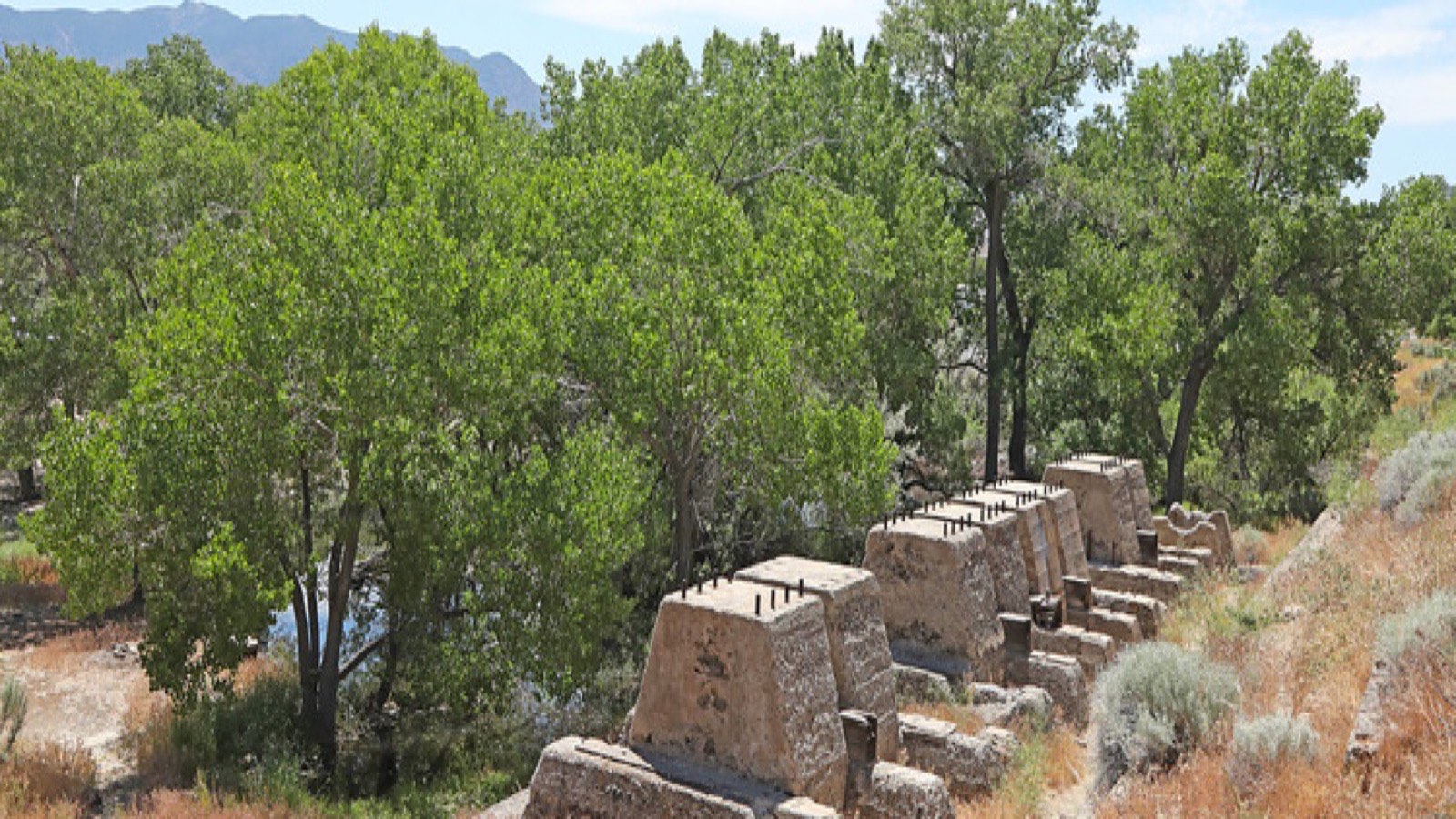
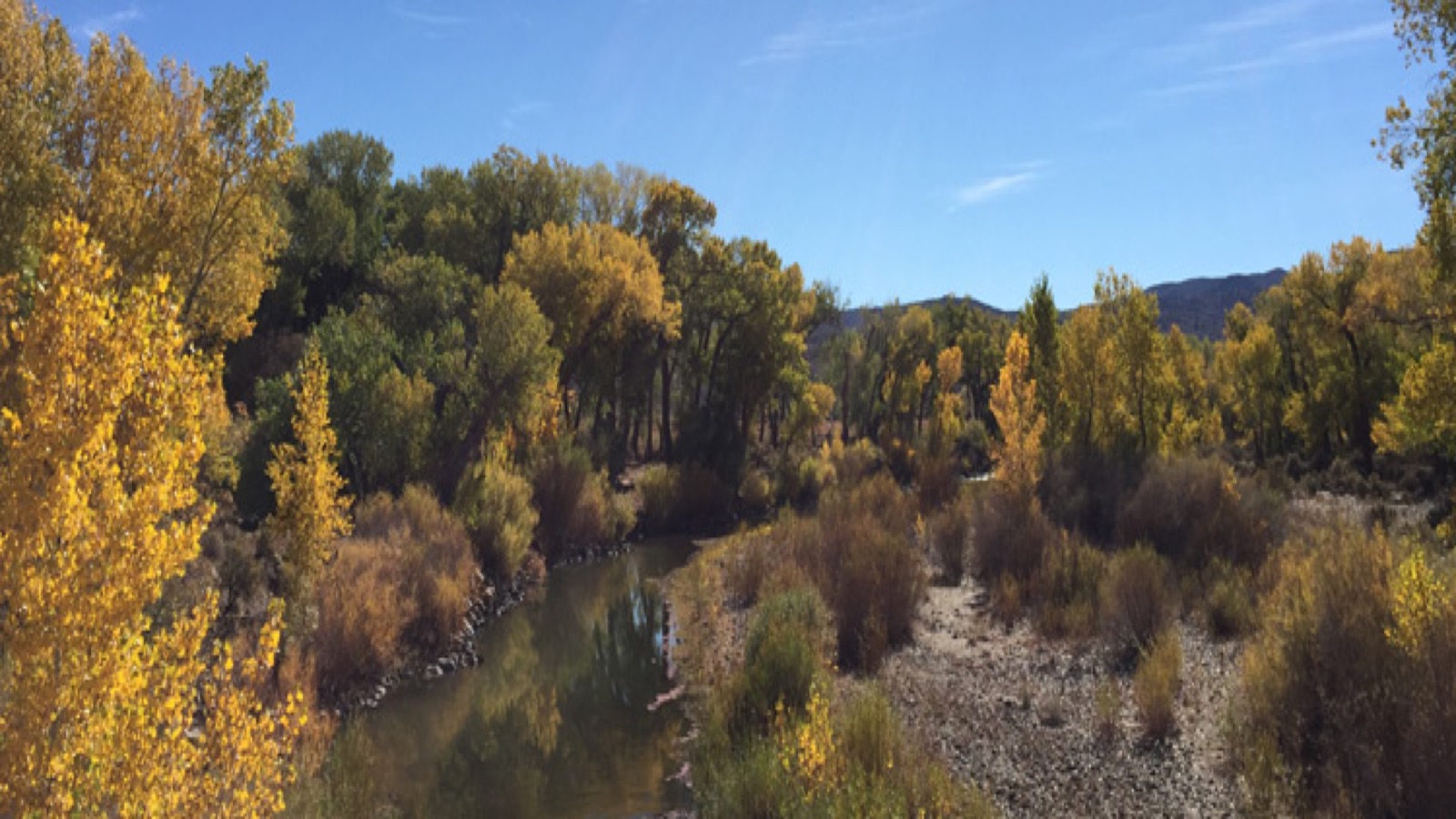
The outdoor life is where the town earns its keep, and much of it is inside the town line. According to Nevada State Parks, Dayton State Park covers 160 acres of cottonwoods, sage and willows along the Carson River, is always open, and, as of October 12, 2026, charges $5 a day per Nevada vehicle ($10 for out-of-state vehicles). The lower park borders the river, and the upper park holds the stone ruins of the Rock Point Mill, one of the early mills that processed Comstock ore. According to the Dayton Valley Golf Club's site, read October 12, 2026, its course is an Arnold Palmer design that hosts the longest-standing PGA Tour qualifying tournament in the country and has earned four and a half stars in Golf Digest's "Places to Play"; see the Dayton golf homes for sale around it.
Farther afield, according to Nevada State Parks' Lahontan State Recreation Area page, Lahontan Reservoir east of Dayton has 69 miles of shoreline and is one of the state's most popular places to boat, fish, water-ski, horseback ride and camp. Virginia City is 11.7 road miles from Dayton, about 18 minutes, and Stateline at Lake Tahoe is 37.9 miles, just under an hour without traffic. At AAA's October 12 Lyon County average of $5.145 a gallon, a 75.8-mile round trip to Stateline in a 25-mpg car uses about 3 gallons, roughly $16 in gas. The Comstock-era town of Silver City sits on the way to Virginia City.
What Are the Trade-Offs of Living in Dayton?
An honest scorecard needs the debit column, and Dayton's is real:
- Thin retail and services. Dayton covers daily errands along US-50, but larger stores and most of the region's shopping and dining are in Carson City, 12.5 road miles west, or Reno, 41.4 miles north.
- No hospital in town. According to CMS's Hospital General Information list, read October 12, 2026, none of the 46 Nevada hospitals it lists is in Dayton; it lists Carson Tahoe Regional Medical Center in Carson City and several hospitals in Reno and Sparks. Price that drive into any decision where regular medical visits matter.
- Limited inventory. On October 12, 2026, ZIP 89403 had 77 active single-family listings, and the town logged 201 single-family sales in the six months from March through August, against 1,770 in Reno. The odds that a specific combination — single-story, three-car garage, half acre, under $500,000 — is listed in any given month are lower here.
- Mixed housing stock. Dayton blends newer subdivision homes with older Old Town houses and a meaningful share of manufactured homes, which sold 18 times in the same six months at a $377,500 median. That variety is part of the affordability, but the home's age, construction type and foundation matter more here, so ask your lender early whether a specific manufactured home qualifies for the loan you plan to use.
- Real winters and wind. The high-desert climate is a feature and a cost: snow tires, a good furnace and patience with spring wind are part of the deal.
- Reno and TRIC drive times. Carson City is 20 minutes away, but Reno City Hall is about 54 minutes and the Tahoe-Reno Industrial Center about 53 without traffic, about 24 to 27 minutes farther than the drive from Reno City Hall to TRIC.
None of these is hidden. Each is a known cost of the discount, and each is easier to price before you tour than after you close. The drive, the bills and the inventory are all measurable, and the sections above give you a dated figure for each one. For a separate look at drainage records, property access and how to read sheriff crime-data boundaries before you buy, see our Dayton due-diligence guide.
How Many Dayton Homes Match Common Search Filters?
Rather than guess whether Dayton fits a wish list, it is more useful to count how many homes actually met common search filters in the March-to-August 2026 single-family sales, and how many were listed on October 12, 2026. These counts come from the same NNRMLS pull as the market table above.
- Under $400,000. 24 of the 201 single-family sales, and 6 of the 77 active listings. Manufactured homes add another price tier, at a $377,500 median on 18 sales.
- $600,000 or more. 31 sales and 15 active listings, so Dayton is not only an entry-level market.
- Built in 2020 or later. 86 of the 201 sales. Builders are still active; see new-construction homes in Dayton for current communities.
- A half acre or more. 18 sales and 6 active listings; on an acre or more, 7 sales and 4 listings.
- A short drive to Carson City. Every Dayton address qualifies at roughly 20 minutes; a short drive to Reno or TRIC does not, at 53 to 54 minutes from the town point.
When a filter comes up short in Dayton, the nearby markets fill different gaps. Carson City sold more acreage (71 half-acre-plus sales in the same window), though its overall single-family median was $85,250 higher. Sparks and Reno offer far more selection, 795 and 1,770 single-family sales, and much shorter drives to TRIC, at higher prices. Fernley City Hall is roughly 20 to 24 minutes from TRIC. For newer construction across the region, compare Reno new-construction communities with Dayton's own. My Dayton moving guide covers utilities, taxes and moving logistics in detail; treat this scorecard as the "should I?" and that guide as the "how to."
Should You Buy a Home in Dayton in 2026?
Here is the scorecard, graded against the Northern Nevada alternatives using the dated figures in this guide:
| Category | Grade | Why |
|---|---|---|
| Housing price | A | March–August 2026 single-family median $85,250 below Carson City and $200,050 below Reno |
| Lot size | A− | 0.25-acre median against 0.17–0.18 elsewhere; few acre-plus sales (3.5%) |
| Taxes | A | No state income tax; lowest property-tax and sales-tax rates of the four markets |
| Commute | B− | Carson City 20 minutes; Reno and TRIC 53–54 minutes without traffic |
| Selection | C+ | 77 active single-family listings on October 12, 2026; 201 sales in six months |
| Services and retail | C+ | Daily errands in town; larger stores and hospital care in Carson City |
| Outdoors | A− | Carson River, Dayton State Park, Dayton Valley golf and Lahontan Reservoir |
The 2026 timing question is mostly about rates. According to Freddie Mac, the 30-year average rose from 5.98% in late February to 7.40% on October 8, and at 7.40% the median Dayton home with 20% down costs about $2,686 a month in principal and interest, roughly $234 more than at 6.5%. Prices, by contrast, have held: across the March-to-August 2026 sales, the median Dayton home sold at 100.0% of its final list price, though 41.8% closed below it. According to Sierra Nevada REALTORS, Lyon County homes sold in September 2026 received 98.8% of list price at a median of 26 days to contract.
So the case for Dayton in 2026 rests on structure, not timing: a lower price than Carson City, Reno or Sparks for the same kind of home, a larger median lot, and the lowest tax rates of the four, in exchange for a longer drive to Reno and TRIC, thinner services and fewer homes to choose from. With 77 single-family listings on the market on October 12, the next comparable home may be weeks away, so decide what you will trade before you tour. If you own in Dayton and are weighing a sale, start from recent sales on your own street rather than the town median.
Why Do Dayton Buyers and Sellers Work With Nevada Real Estate Group?
Because a small market punishes casual representation. When the whole single-family inventory fits on a couple of pages, winning as a buyer means seeing listings as soon as they post and knowing, before you fall for a house, whether it is on county water and sewer or a well and septic system, whether a manufactured home will finance under your loan, which parcel's tax district and prior-year bill set your cap, and whether an HOA or special assessment applies. Winning as a seller means pricing scarcity correctly and marketing the lot, the space and the commute facts to buyers already searching for them.
Nevada Real Estate Group is the #1 real estate team in Nevada, as ranked by RealTrends Verified on 2025 production, with, as of October 2026, $4.85 billion-plus in career sales volume, 9,600-plus closed transactions, 150-plus agents and 9,146-plus five-star reviews on Google and other review platforms. In 2025 alone our team closed 789 homes and more than $361.5 million in volume. We can pull recent sales on any Dayton home you are considering, from the same MLS data this guide uses.
Call or text (775) 277-2120, tell us what you're looking for, read more about the team, or meet our Dayton real estate agents. You can search active Dayton listings, get an estimate from our home value estimator, or, if you own in Dayton, start with our Dayton home seller page. For the broader Northern Nevada picture, my Reno relocation guide sets the regional context, and if you want to know how to pick an agent, start with who the best real estate agent in Reno is in 2026.
Frequently Asked Questions
Is Dayton, Nevada a good place to live?
It depends on what you weigh most. Dayton costs less to buy into than Carson City, Reno or Sparks: on single-family contracts signed March through August 2026, its median was $484,950, against $570,200 in Carson City, $685,000 in Reno and $569,900 in Sparks. Those Dayton sales had a 0.25-acre median lot, and its FY 2026-27 property tax rate of $3.3992 to $3.4442 per $100 of assessed value is the lowest of the four. The trade-offs are distance and services: Carson City is about 20 minutes away without traffic, Reno and the Tahoe-Reno Industrial Center about 53 to 54 minutes, and there is no hospital in town.
Is Dayton part of Carson City?
No. Dayton is a separate, unincorporated community in Lyon County, 12.5 road miles east of the Nevada State Capitol along US-50. Carson City is a consolidated city-county with its own government. Dayton's property tax, public schools and building permits all run through Lyon County, which is part of why its housing costs less than the capital's, even though residents use Carson City for larger stores and hospital care.
What do homes cost in Dayton, Nevada in 2026?
On Nevada Real Estate Group's NNRMLS data pulled October 12, 2026, single-family homes in ZIP 89403 sold at a $484,950 median on 201 sales contracted March through August 2026, with a quarter at or below $420,000 and a quarter at or above $560,000. The median sold price per square foot was $260. Manufactured homes sold at a $377,500 median on 18 sales. On October 12, 77 single-family homes were for sale at a $535,000 median asking price.
How far is Dayton from Carson City and Reno?
By road, Dayton is 12.5 miles from the Nevada State Capitol in Carson City, about 20 minutes on US-50 without traffic, and 41.4 miles from Reno City Hall, about 54 minutes via US-50 and I-580. Reno-Tahoe International Airport is 38.9 miles and about 52 minutes away. Those are OSRM routing results on OpenStreetMap data from October 12, 2026, so add time for weekday traffic and winter weather.
What is the job market near Dayton?
Most working residents commute, and the Census Bureau's 2020–2024 survey puts Dayton's mean travel time to work at 30.8 minutes. Carson City, the state capital, is 12.5 road miles west. The Tahoe-Reno Industrial Center in Storey County, home to Tesla's Gigafactory Nevada, Switch's Citadel Campus, Google's Storey County data center and Redwood Materials' Tahoe Campus, is 38.7 miles and about 53 minutes away via US-50 east and USA Parkway, against about 21 miles and 26 to 29 minutes from Reno City Hall.
What schools serve Dayton, Nevada?
The Lyon County School District runs Dayton's public schools. Its directory lists five with Dayton addresses: Dayton Elementary, Sutro Elementary, Riverview Elementary, Dayton Intermediate and Dayton High School. Attendance zones follow the home's address, so confirm the zoned schools for a specific property with the district at lyoncsd.org before you buy.
Does Dayton have property taxes and HOA fees?
Yes. For FY 2026-27, Dayton's fire-district tax districts carry $3.3992 or $3.4442 per $100 of assessed value, and assessed value is 35% of taxable value. A primary residence's bill can rise no more than 3% a year once the owner claims it on the county's affidavit; until then the higher cap, 8.0% for Lyon County this year, applies, and new construction is not capped in its first year. Some subdivisions charge HOA dues and many older parcels do not, and the rate book lists no general improvement district in Dayton's tax districts.
Which Sources Inform This Dayton Livability Guide?
This guide combines Nevada Real Estate Group's own MLS analysis with public records. MLS method: on October 12, 2026, I pulled every closed single-family sale in ZIP 89403 with an NNRMLS sale date (which NNRMLS records as the contract date) from October 1, 2025 through September 30, 2026, plus every active listing, and used the March-to-August 2026 contract window for the figures above. The same day, I pulled every single-family sale in the same window for the MLS cities of Carson City, Reno and Sparks, for the median sale price and price per square foot, and the lot-size distribution of those sales; for Reno, the feed's lot-size summary covered 1,683 of 1,770 sales, and the median is about 0.18 acre whichever way the rest fall. Water and sewer rates come from the Carson Water Subconservancy District's March 18, 2026 report. Drive times are OSRM routes on OpenStreetMap data from October 12, 2026. Rates, prices and tax rules change, so confirm each with the agency before you rely on it. This is general information, not tax, legal or financial advice.
- Census Reporter — Dayton CDP, U.S. Census Bureau ACS 2020–2024
- U.S. Census Bureau — 2020 census table P1, Dayton CDP, Nevada
- CMS — Hospital General Information (Provider Data Catalog)
- Sierra Nevada REALTORS — September 2026 market report
- Freddie Mac — Primary Mortgage Market Survey
- Nevada Department of Taxation — Property Tax Rates for Nevada Local Governments, FY 2026-27
- Nevada Department of Taxation — preliminary FY 2026-27 revenue projections and tax cap factors
- Nevada Department of Taxation — sales and use tax rates by county
- Nevada Constitution — Article 10, Section 1
- Nevada Revised Statutes Chapter 361 — the partial abatement (tax cap)
- Lyon County Assessor — tax cap information
- Lyon County Utilities — water and sewer service areas
- Carson Water Subconservancy District — 2026 water and sewer rates report, March 18, 2026
- Lyon County School District — school directory
- AAA — Nevada gas prices by county
- OpenStreetMap — OSRM route from Dayton to the Tahoe-Reno Industrial Center
- OpenStreetMap — OSRM route from Reno City Hall to the Tahoe-Reno Industrial Center
- Tesla — Form 10-K for fiscal 2025, filed January 29, 2026 (SEC EDGAR)
- Switch — Tahoe Reno Citadel Campus
- Google Data Centers — Storey County, Nevada
- Redwood Materials — about the company and its campuses
- Nevada State Parks — history of Dayton State Park
- Nevada State Parks — Dayton State Park
- Nevada State Parks — Lahontan State Recreation Area
- Dayton Valley Golf Club — about the course
Ready to see the town for yourself? Call or text Nevada Real Estate Group at (775) 277-2120, and we will line up a Dayton tour that starts in Old Town and covers the lots, the drive and the numbers in this guide.