

You are moving: a new job, a bigger house, a parent's place to settle, a move out of state. The Reno or Sparks house you are leaving has equity in it and a mortgage payment that may be lower than anything you could borrow at today's rates. So the question comes up before the moving truck does. Keep it and rent it out, or sell it?
Most answers to that question are national rules of thumb. We wanted a local one. So we pulled every single-family house in Reno and Sparks that leased through the Northern Nevada Regional MLS with a lease date from October 1, 2025 through September 30, 2026, 401 of them among 599 leases of all property types, and every house that closed as a sale over the same 12 months, 4,093 of them among 5,352 sales. Then we matched rent against price by ZIP, property type and bedroom count, and added the Nevada and federal rules that change the result once a home becomes a rental.
A Reno or Sparks house leased for a median $2,750 a month and sold for a median $612,000 from October 2025 to September 2026, a 5.4% gross yield before any cost. After a 44-day vacancy (the three-bedroom median), the prior tax bill and HOA dues, a median three-bedroom kept about 4.3% of its value before insurance, repairs, management and interest. Keep it only if that return, plus expected appreciation, beats what the equity would earn elsewhere.
- Houses: $2,750 median rent against a $612,000 median sale, a 5.4% gross yield (Oct 2025 to Sep 2026).
- The median lease took 43 days to sign; 18% of house leases took more than 90.
- Only 27% of house leases with two or more bedrooms were at or below Washoe's fair market rent, the limit for keeping the 3% tax cap.
- Sell within three years of moving out to keep the home-sale exclusion; depreciation is taxed either way.
- Run the numbers on your own rent, bill and loan before listing either way.
| Measure | Reno houses | Sparks houses | Reno condos and townhouses | Sparks condos and townhouses |
|---|---|---|---|---|
| Leases / sales | 242 / 2,785 | 159 / 1,308 | 99 / 700 | 22 / 166 |
| Median monthly rent | $2,900 | $2,600 | $2,125 | $1,923 |
| Median sale price | $665,000 | $560,000 | $359,000 | $305,000 |
| Gross yield (12 months of rent over price) | 5.2% | 5.6% | 7.1% | 7.6% |
| Median days from listing to lease | 44 | 42 | 49 | 43 |
| Median days from listing to accepted sale offer | 22 | 21 | 34 | 26 |
| Share leased below the first asking rent | 22.7% | 20.8% | 32.3% | 36.4% |
| Median HOA dues where the sale listing shows one | $68 a month (57.6% of sales) | $45 a month (67.1%) | $300 a month (96.3%) | $295 a month (94.0%) |
What does a Reno or Sparks house rent for compared with what it sells for?
Across both cities, the 401 single-family houses that leased through the MLS from October 1, 2025 through September 30, 2026 rented for a median $2,750 a month. The middle half rented for $2,400 to $3,200. Over the same 12 months, the 4,093 houses that closed as sales went for a median $612,000, with the middle half between $500,000 and $805,000. Twelve months of the median rent divided by the median price is a gross yield of 5.4%. Put the other way, the median house sold for about 18.5 years of its median rent.
Reno and Sparks differ more on price than on rent. Reno houses rented for a median $2,900 and sold for $665,000, a 5.2% gross yield. Sparks houses rented for $2,600 and sold for $560,000, a 5.6% gross yield. A Reno house costs 19% more to buy at the median and rents for only 12% more, so a dollar of Sparks equity bought a little more rent over that year.
Condos and townhouses look better on the gross figure, at 7.1% in Reno and 7.6% in Sparks, because their prices are much lower than their rents would suggest. Much of that gap goes to the association. Almost every attached sale listing showed HOA dues, at a median of about $300 a month, which is $3,600 a year that a house owner usually doesn't pay. On a $2,125 Reno condo rent, the dues alone take about 14% of the gross. Our Reno HOA fees guide explains how the dues are set and what they cover.
Two cautions apply to every number in this guide. First, a rented house and a sold house are rarely the same house. The median leased house had 1,862 square feet of living area against 1,984 for the median house that sold, so a like-for-like yield is a touch higher than the raw figure. Second, MLS leases are the rentals that agents list. Owners who rent privately or through management companies that don't use the MLS are missing, and they may charge more or less. For a wider read on asking rents, see our average rent in Reno guide.
Which Reno and Sparks ZIP codes earn the most rent for the price?
Gross yield moves with the price of the ZIP more than with its rent. Rents across the 12 ZIPs with at least 10 house leases ran from a median $2,123 to $4,995, a range of about 2.4 times. Sale prices ran from $432,450 to $1,462,500, about 3.4 times. So the cheaper ZIPs pay more rent for each dollar of price, and the most expensive ones pay the least.
North Reno's 89506, which takes in Stead and Lemmon Valley, topped the list at a 6.6% gross yield: a median $2,600 rent on a $475,533 median sale. East Sparks in 89434 followed at 6.2%, then 89508 in north Reno, which includes Cold Springs, at 6.0% and 89431 in central Sparks at 5.9%. At the other end, 89511 in south Reno, home to Galena, ArrowCreek and the Mount Rose corridor, earned 4.1%, and 89523 in northwest Reno, which includes Somersett, earned 4.4%. A $675,000 house in 89523 rented for a median $2,500, $100 less than a much cheaper house drew in 89506.
The table shows each ZIP's houses. Some counts are small, so treat any ZIP with fewer than 20 leases as a range rather than a price list. A cell-by-cell match on bedrooms tells the same story. Three-bedroom houses in 89506 leased for $2,400 and sold for $450,990, a 6.4% yield, while three-bedroom houses in 89523 leased for $2,490 and sold for $645,000, a 4.6% yield. If you own in a high-priced ZIP, renting the house returns less on the equity than the city median suggests.
| ZIP (area) | House leases | Median rent | House sales | Median sale price | Gross yield | Median days to lease |
|---|---|---|---|---|---|---|
| 89506 (north Reno) | 31 | $2,600 | 420 | $475,533 | 6.6% | 44 |
| 89434 (east Sparks) | 20 | $2,563 | 222 | $500,000 | 6.2% | 53 |
| 89508 (north Reno, Cold Springs) | 15 | $2,495 | 147 | $498,000 | 6.0% | 48 |
| 89431 (central Sparks) | 30 | $2,123 | 188 | $432,450 | 5.9% | 31 |
| 89436 (north Sparks and Spanish Springs) | 103 | $2,700 | 723 | $579,000 | 5.6% | 41 |
| 89509 (southwest Reno) | 27 | $3,595 | 282 | $772,500 | 5.6% | 38 |
| 89502 (central and east Reno) | 12 | $2,273 | 170 | $517,500 | 5.3% | 53.5 |
| 89503 (west Reno) | 17 | $2,250 | 184 | $518,250 | 5.2% | 48 |
| 89521 (south Reno, Damonte Ranch) | 69 | $3,200 | 568 | $745,000 | 5.2% | 40 |
| 89519 (southwest Reno, Caughlin) | 12 | $3,350 | 131 | $875,000 | 4.6% | 29 |
| 89523 (northwest Reno, Somersett) | 31 | $2,500 | 398 | $675,000 | 4.4% | 46 |
| 89511 (south Reno, Galena) | 19 | $4,995 | 369 | $1,462,500 | 4.1% | 49 |
If your house sits in Reno's 89521 or 89506, or in Spanish Springs, you can see what competes with it for buyers today on those pages.
How long does a Reno or Sparks house take to rent?
Longer than it takes to sell. From listing to the signed-lease date the MLS records, the median house took 43 days from listing to the signed-lease date from October 2025 through September 2026, against 21 days from listing to an accepted offer for houses that sold. Only 19.0% of house leases were signed within 14 days, and 36.2% within 30. Another 32.9% took 31 to 60 days, 12.9% took 61 to 90, and 18.0% took more than 90 days. The slowest tenth took 142 days or more.
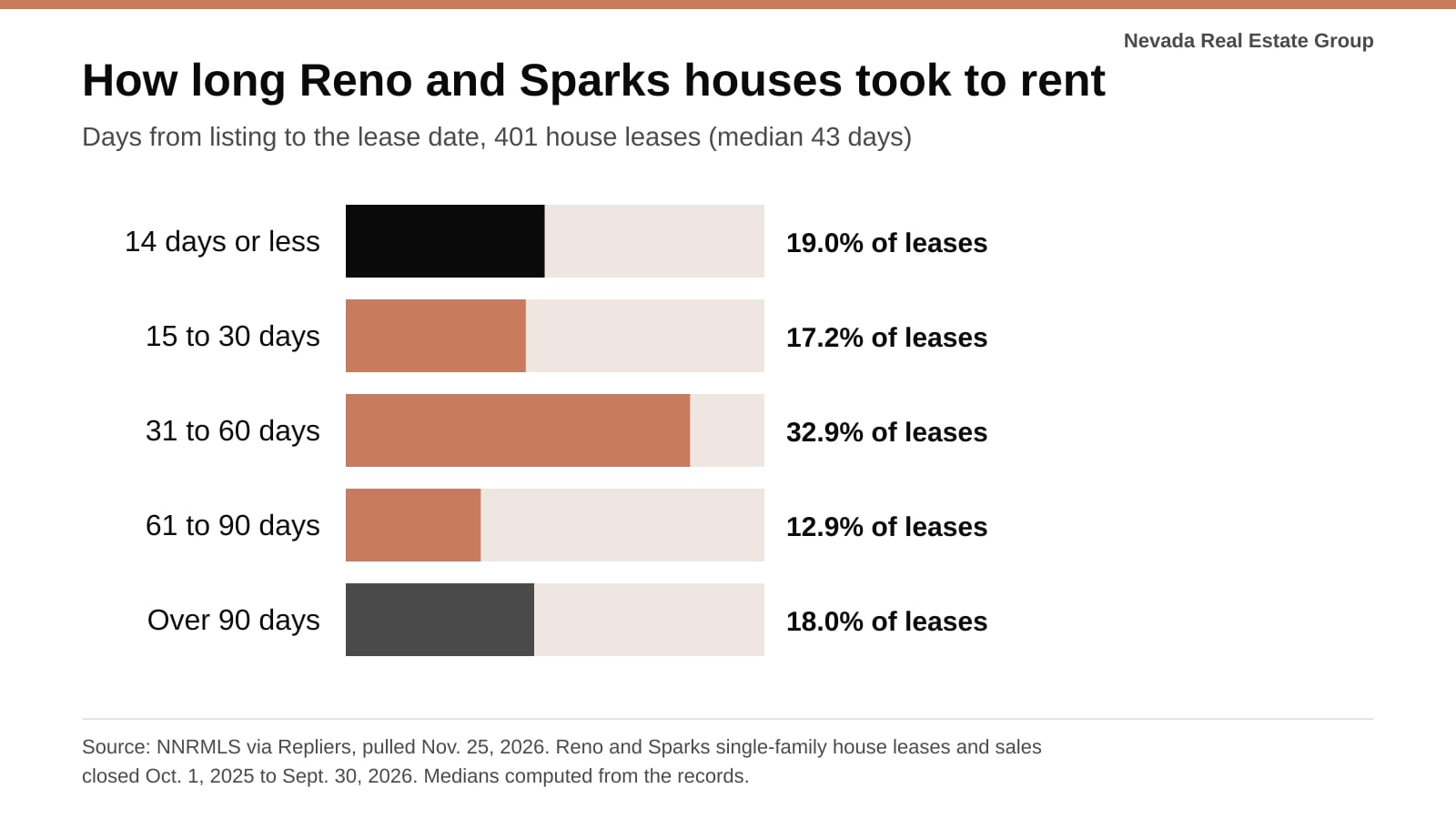
Those empty weeks are the first cost of keeping a house, and they come back every time a tenant moves out. At the median three-bedroom rent of $2,600, a 44-day gap, the median for three-bedroom houses, costs about $3,761 in lost rent. That is more than a month of rent, before any cleaning, paint or repairs between tenants. If the house is empty while you are still paying the mortgage, utilities and insurance, the gap costs more again.
Pricing matters as much as timing. About one house in five, 21.9%, leased for less than its first asking rent, and larger houses were harder: 28.8% of four-bedroom houses leased below their first asking rent and took a median 49 days. Five-bedroom houses leased faster, in a median 29.5 days, but there were only 22 of them. An owner who starts high and cuts later can lose both weeks and rent. Setting the rent from recent signed leases of the same size in the same ZIP, rather than from asking rents online, is the way to start close to the market. Our guide to how much a landlord can raise rent in Reno and Sparks covers what you can change once a tenant is in.
Does the season you move change the math?
Yes, and it matters this time of year. Houses whose leases closed from October through December 2025 took a median 51.5 days to rent and leased for a median $2,585. Those that closed from July through September 2026 took 33 days and leased for $2,895. The middle quarters fell between: 47 days and $2,650 from January through March, and 44 days and $2,795 from April through June. Each quarter held 92 to 112 house leases, so the pattern isn't one unusual month.
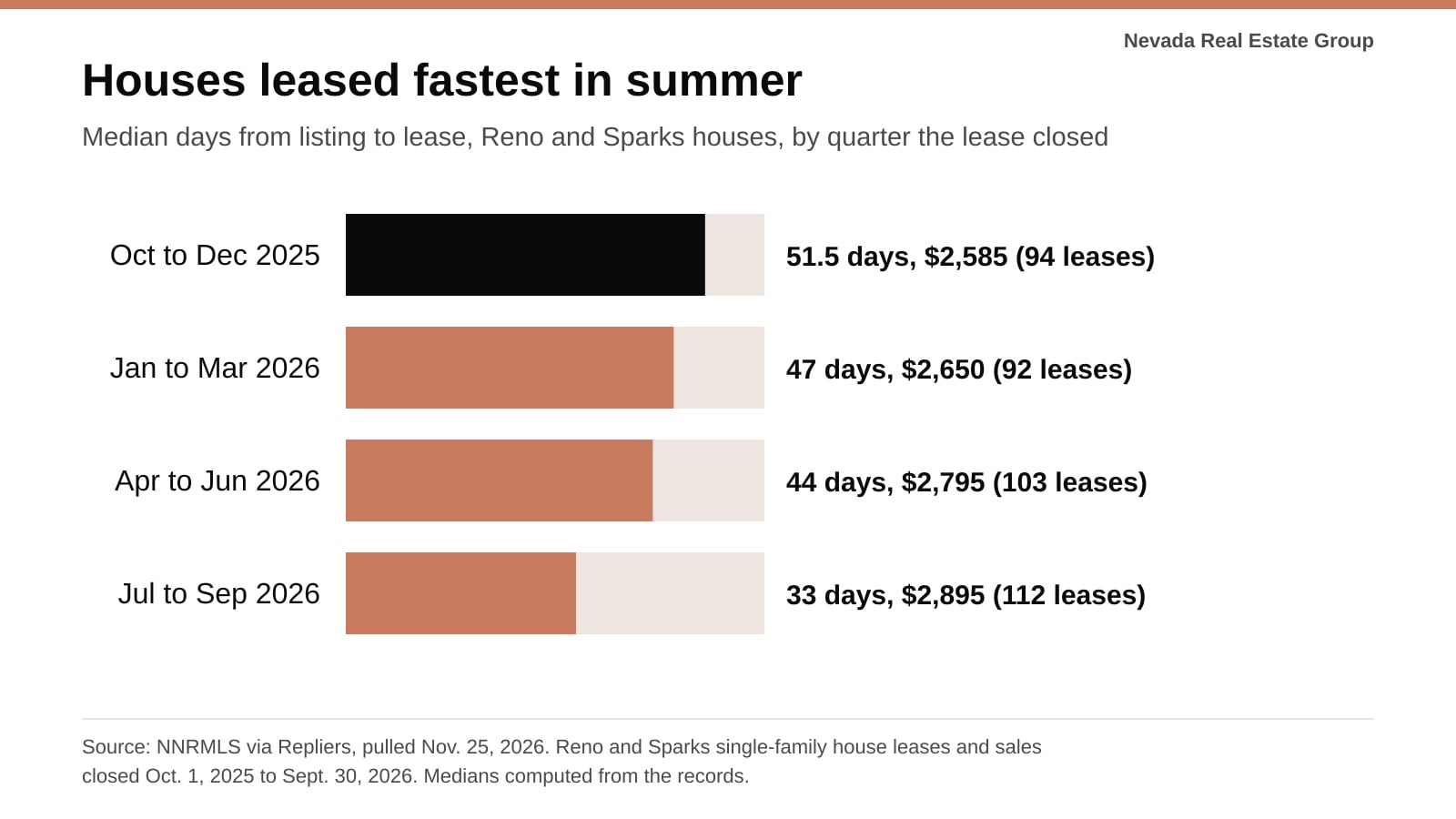
Part of the rent difference is the houses, not the season. Bedroom counts were similar in every quarter, with a median of three, but a year of rent growth and a different mix of ZIPs both sit inside these medians. The speed difference is the more useful signal. A house that goes on the rental market in late November or December is entering the slowest stretch of the year, and its owner should plan for close to two months without rent.
The rental supply today points the same way. On November 25, 2026, 113 rentals were listed on the MLS in Reno and Sparks, 61 of them houses. The houses were asking a median $3,250 a month, they had been listed for a median 38 days, and 15 of them had been listed for more than 60 days. If your move happens now, one choice is to time the vacancy: let the house sit through the winter while you finish any repairs, and list it for rent in the spring, when the data show leases sign faster. Another is to price at the recent-lease level from the start. Either way, budget for the gap.
What does the house actually earn after the costs you can measure?
Gross rent is not what you keep. The table walks a median Reno or Sparks three-bedroom house through the costs this data can measure, using the 191 three-bedroom house leases and 2,005 three-bedroom house sales from October 2025 through September 2026. It is a calculation with stated assumptions, not a forecast for your house.
| Line | Amount | Where it comes from |
|---|---|---|
| Median sale price, three-bedroom house | $560,000 | 2,005 MLS sales |
| Twelve months of median rent | $31,200 | $2,600 median rent, 191 MLS leases |
| Less one vacancy of 44 days | minus $3,761 | Median days to lease, three-bedroom houses |
| Less the property tax bill | minus $2,603 | Median annual tax shown on three-bedroom sale listings |
| Less HOA dues | minus $600 | $50 a month median where charged; assumes the house is one of the 55.9% that pay dues |
| Left before the costs below | $24,236 (4.3% of $560,000) | Calculation |
| Not included: landlord insurance, repairs and turnover work, a property manager, mortgage interest, income tax | Your quotes | Get each in writing |
The $24,236 is the number to test your own house against. Replace each line with your figures: your rent estimate, your own tax bill from the Washoe County Treasurer, your actual dues. Then subtract the lines this data can't supply. Ask your insurer for a quote on the house as a rental. If you are moving away, price a property manager, since you can't be the one who meets the plumber. Put a realistic repair budget on an older house.
What remains is the cash return on the equity you are leaving in the house, before appreciation. Compare it with what the same equity would earn if you sold and invested it, or used it as the down payment on your next home. A house with a low-rate mortgage changes the comparison: its payment may be well under the rent, which makes keeping it attractive even when the return on equity is modest. A house owned free and clear, in a high-priced ZIP like 89511, is the case where the rent earns the least on the money.
What happens to the property tax when the house becomes a rental?
Nevada limits how fast a property's tax bill can rise each year, with a higher limit for most property and a lower one for a primary residence. For fiscal year 2026-27, the Nevada Department of Taxation's tax cap table sets Washoe County's residential cap at 3.0% and its general cap at 8.0%, the statutory maximum, because the county's 10-year moving average growth in assessed value was 8.3%.
The Washoe County Assessor's tax cap page says the 3% cap applies to the owner's primary residence, that "some rental dwellings may also qualify," and that owners must tell the office when a property is no longer their primary residence. The rental test is in NRS 361.4724. A rental keeps the 3% cap only if the rent collected from each tenant does not exceed the fair market rent for the county most recently published by HUD. The Assessor's page says an affidavit must be filed every year for residential rental properties, and the rental affidavits it mails each May must be returned by June 15.
The Department of Taxation publishes the limits. Its fiscal year 2026 fair market rent tables, updated March 23, 2026 and built from HUD's fiscal year 2026 rents, set Washoe's limits with the standard utility allowance deducted (Table IV) at $1,749 for two bedrooms, $2,396 for three and $2,783 for four, with 15% added for each bedroom above four. Table I, which includes tenant-paid utilities, is higher: $2,539 for three bedrooms. The Department recommends Table IV in general.
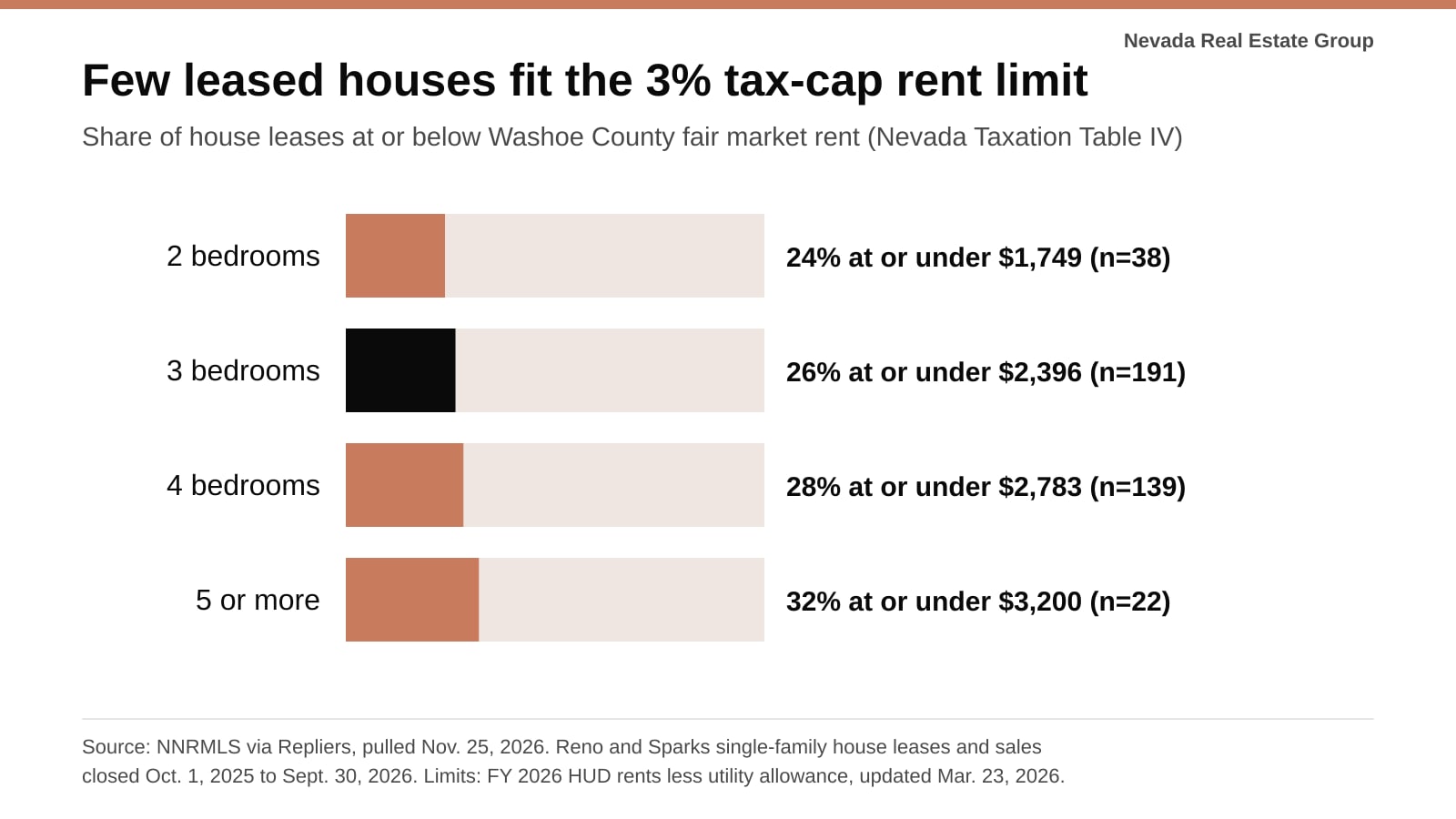
Most Reno and Sparks rentals are above that line. Of the 390 house leases with two or more bedrooms, 105, or 26.9%, were at or below the Table IV limit for their size. For three-bedroom houses it was 50 of 191, and the median three-bedroom rent of $2,600 was $204 over the $2,396 limit. So the usual outcome of renting out a Reno or Sparks house is that it moves from the 3% cap to the general cap, which for 2026-27 lets the bill rise by up to 8% a year. On the $2,603 median bill in the worked example, three years at the 3% limit come to $8,287 and three years at the 8% limit to $9,126, a difference of up to $839, depending on how much the assessed value actually rises. Our Washoe County property tax guide explains how the bill is built.
How long can you rent the house before you lose the home-sale tax exclusion?
About three years, counted carefully. IRS Publication 523 lets you exclude up to $250,000 of gain on the sale of a main home, or $500,000 for a married couple filing jointly, if you owned the home and lived in it for at least 2 of the 5 years before the sale. Move out on a given date and the clock starts: you still pass the use test if you sell before the second year of residence slips out of the five-year window. For an owner who lived in the house for exactly two years before moving out, that leaves three years of renting. An owner who lived there longer has the same outside limit: three years after moving out.
The rental years after you move out don't reduce the exclusion. Publication 523 treats any period after 2008 when the home wasn't your main home as "nonqualified use," which cuts the exclusion, but it lists as an exception "any portion of the 5-year period ending on the date of the sale or exchange after the last date you or your spouse … used the property as your main home." Renting the house after you leave, and selling within the window, is the case that exception covers.
What the exclusion never covers is depreciation. The publication says you can't exclude the part of the gain "equal to any depreciation allowed or allowable as a deduction" for periods after May 6, 1997. That matters in the next section, because the word "allowable" means the IRS counts the depreciation you were entitled to take, whether or not you took it.
The practical rule for a Reno or Sparks owner: write down the date you move out, add three years, and know that a sale after that date, unless you move back in, can lose the exclusion on the whole gain. If the house has gained more than $250,000, or $500,000 for a joint return, the excess is taxable either way. A tax professional can confirm the dates for your situation, especially if you had any earlier rental or home-office use.
What does depreciation do to the sale three years from now?
Once the house is a rental, it is depreciated. IRS Publication 527 says residential rental property is depreciated over 27.5 years under the general system, that land can't be depreciated, and that for a home converted from personal use the basis for depreciation is "the lesser of its adjusted basis or its FMV when you change it to rental use." Each year's depreciation lowers the taxable rental income, which is the benefit. When you sell, it comes back.
The IRS Topic 409 page on capital gains says unrecaptured section 1250 gain, the depreciation part of the gain on rental real estate, is "taxed at a maximum 25% rate." Here is an illustration, not a calculation for any real house. Say the building, without the land, carries a depreciable basis of $360,000. Straight-line over 27.5 years, that is about $13,091 a year, or about $39,273 over three years, ignoring the partial first and last months. At the 25% maximum rate, the tax on that portion could be as much as $9,818, even if the rest of the gain is excluded under the home-sale rule.
So depreciation turns the three-year rental into a trade. It shelters rental income while you own the house, and it creates a tax bill when you sell, at a rate that can be higher than the long-term capital gains rate on the rest. It isn't optional: the IRS counts allowable depreciation whether you claimed it or not. Owners who plan to keep the house only a year or two should weigh that recapture against the net rent they expect. Owners planning to hold for a decade face a different question, since the exclusion window will have closed anyway. Our Reno investment property guide covers the long-hold case.
What does selling now cost compared with selling later?
Some selling costs are the same now or later, and some rise with the price. Washoe County charges real property transfer tax at "$2.05 per $500 of value or fraction thereof," collected by the County Recorder at recording, according to the Washoe County Recorder. On the $560,000 median three-bedroom house, that is $2,296. Title, escrow, any agent compensation the seller agrees to pay, and any repairs or credits negotiated after inspection come on top. Agent compensation is set in the listing agreement you sign, so ask for it in writing.
Selling later adds costs that selling now avoids. A house that has been rented for three years can need more work before it lists: paint, flooring, landscaping and the repairs a tenant's wear leaves behind. If a tenant is still in place, you will be selling around a lease, which can limit showings and narrow the buyer pool to people willing to wait or to investors. Nevada's security deposit rule caps a deposit at three months' rent and requires the landlord to return any balance within 30 days after the tenancy ends, so plan for the move-out accounting before closing.
Selling now has a cost too: you give up the rent and any price growth over the holding period. In the year ending September 2026, Reno and Sparks houses went under contract in a median 21 days, so a seller listing now is not facing a slow market, though winter months closed fewer sales: 228 to 319 houses a month from November 2025 through January 2026, against 445 in June 2026. Our guide to selling a Reno home and its Sparks counterpart list every line of the closing statement.
Which houses make better rentals, by size and type?
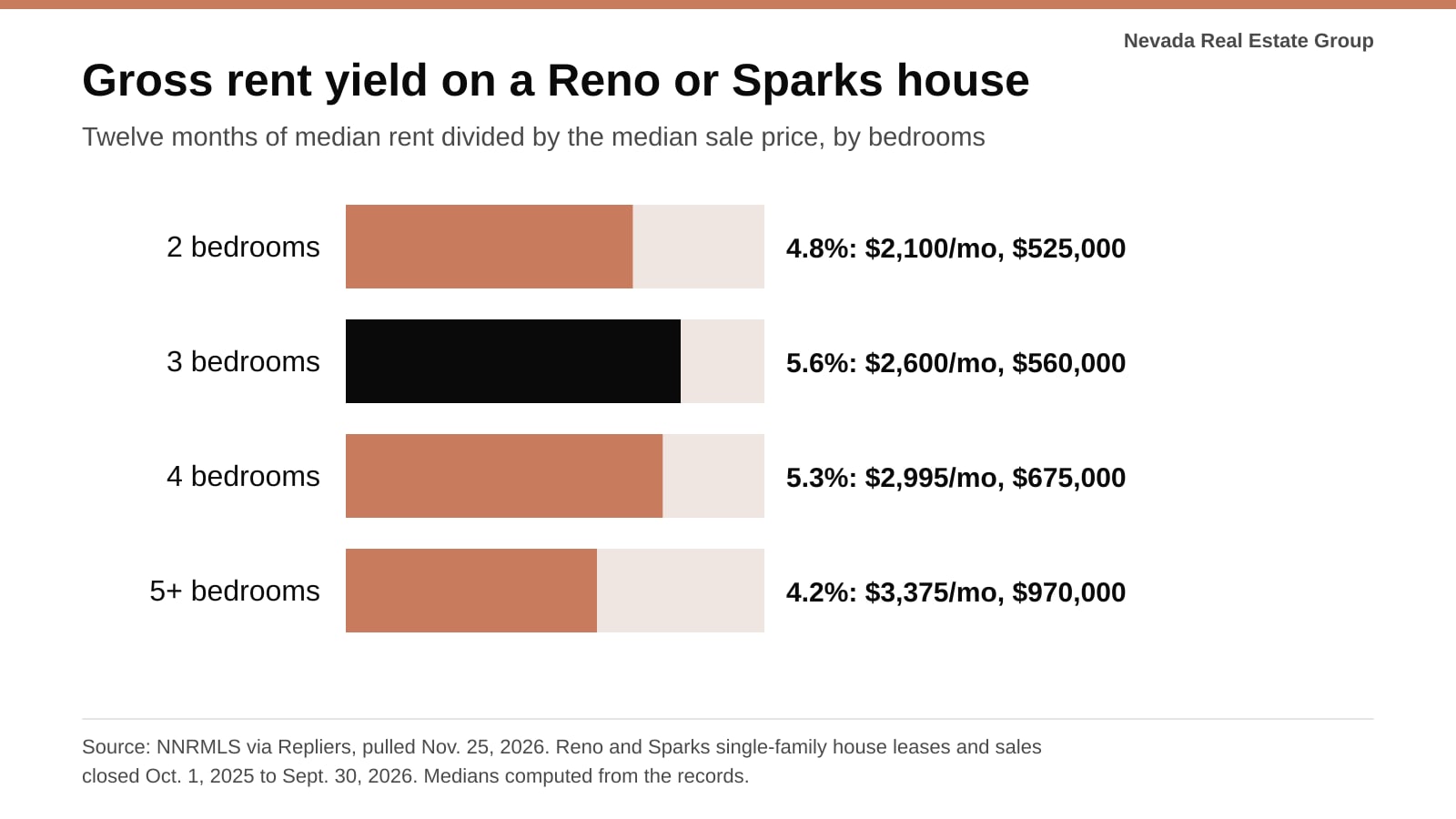
Three- and four-bedroom houses earned the most rent for the price. Three-bedroom houses leased for a median $2,600 and sold for $560,000, a 5.6% gross yield, and four-bedroom houses leased for $2,995 and sold for $675,000, 5.3%. Two-bedroom houses, at $2,100 and $525,000, earned 4.8%, because small houses in Reno and Sparks sell for a high price per square foot: $387 for two-bedroom houses against $342 for three-bedroom and $298 for four-bedroom houses.
Large houses earned the least. Five-bedroom and larger houses leased for a median $3,375 and sold for $970,000, a 4.2% yield. Over this year, rent rose with size more slowly than price did. The five-bedroom group is small, 22 leases, so read it as a direction. The same pattern shows inside ZIPs: in 89511, three-bedroom houses that leased had a median 1,498 square feet while those that sold had 2,608, so the leased and sold houses there are different products.
Condos and townhouses earn more gross rent per dollar, as the first table showed, but the HOA dues change the picture, and so do the rules. A condominium association's governing documents can limit leasing, set minimum lease terms or require registration of tenants. Read the declaration and rules before deciding to rent a condo, and ask the association for any rental cap in writing. Duplexes and small income buildings are a separate market with their own rent and price data; our duplex and fourplex investing guide covers them, and current listings are on our Reno multi-family homes page.
What should you check with your lender, insurer and HOA before renting?
Start with the mortgage. If your loan was made for a primary residence, your note and deed of trust may contain a promise about living in the house. Read the occupancy section, especially if you bought recently, and ask your servicer in writing whether renting the house now is allowed under your loan. Either way, the servicer needs your new mailing address, and a later refinance has to describe the house as what it is then: a rental, not your residence.
Then the insurance. Tell your insurer the house will be rented and ask whether your current policy still applies and, if not, what policy covers it: the building, your liability as a landlord and the loss of rent if the house can't be lived in after a covered loss. Ask whether your insurer wants the tenant to carry renter's insurance. Get the quotes before you set the rent, because the premium belongs in the worked example above.
Then the association. 55.9% of the three-bedroom houses that sold in Reno and Sparks from October 2025 through September 2026 carried HOA dues on the listing. An association's documents can set minimum lease terms, require tenant registration, ban short-term rentals or charge a fee. Short-term rentals face separate city and county rules as well; our Reno and Washoe short-term rental rules guide covers them.
Finally, the paperwork for the tax cap. When the house stops being your primary residence, notify the Washoe County Assessor, as its tax cap page asks, and watch for the rental affidavit each May. If your rent is at or under the fair market rent for the bedroom count, filing it is what keeps the 3% cap. If it isn't, expect the general cap.
What does Nevada law require of a landlord?
Nevada's landlord and tenant rules for houses and apartments are in NRS chapter 118A. One of them affects the numbers in this guide directly. Under NRS 118A.242, the total security deposit or surety bond may not exceed three months' periodic rent, and the landlord must return any remaining balance no later than 30 days after the tenancy ends. On a $2,600 rent, the deposit can be no more than $7,800.
Those rules shape the turnover gap. Between tenants you need time to inspect, document the condition, repair, clean and return the deposit on schedule, and those weeks overlap with the 43-day median time to find the next tenant. An owner moving out of the area may want to hire a property manager for that work. If you do, ask for the management agreement in writing, including the fee, the leasing fee and who approves repairs.
Rent increases have their own notice rules, and they depend on the lease type. Our guide to how much a landlord can raise rent in Reno and Sparks explains them. Selling a house with a tenant in place brings its own disclosure duties too. Nevada's seller disclosure applies to the sale whether or not the house is rented, and our Reno and Washoe seller disclosure guide explains what the form asks.
This isn't legal advice. Fair housing rules apply to rentals, including advertising and tenant screening, and a property manager or attorney can confirm what applies to your lease. The point for the keep-or-sell decision is simpler: being a landlord carries obligations with dates attached, and someone has to meet them, whether that is you or a paid manager.
When does keeping the house make sense?
The data and the rules above point to a few situations where keeping a Reno or Sparks house as a rental is the stronger choice. The first is a low-rate mortgage. If the payment, tax, insurance and dues come in well under the rent the house would draw, the house pays for itself while the loan balance falls, and that is hard to replace. The second is a house in a lower-priced ZIP. In 89506, 89434, 89508 and 89431, gross yields ran 5.9% to 6.6% over the year, well above the 4.1% to 4.4% in 89511 and 89523.
The third is a plan to return. If you expect to move back to Reno or Sparks within a few years, keeping the house avoids paying selling costs now and buying costs later. If you move back in, ask a tax professional how the nonqualified-use rules in Publication 523 apply to your dates. The fourth is a three- or four-bedroom house of ordinary size. Those earned the highest yields over the year to September 2026 and made up 330 of the 401 house leases over the year to September 2026.
Keeping also makes sense when you have a reserve. A vacancy of 44 days, a water heater, a roof patch and a quiet winter month can all arrive in the same year. An owner who can cover several months of the payment without rent can ride those out. An owner who would need the rent to make the mortgage payment is taking a risk the averages hide.
Finally, keeping makes sense when you have a plan for the work. Either you live close enough to handle repairs and showings, or you have priced a property manager and still like the numbers. The worked example earlier leaves $24,236 before insurance, repairs and management on a median three-bedroom. If a manager's fee and a realistic repair budget still leave a return you're happy with, that is the case for keeping it.
When is selling the better choice?
Selling tends to win in the opposite cases. A house in a high-priced ZIP earns the least rent per dollar of equity: 4.1% gross in 89511 and 4.4% in 89523 over the year to September 2026, before any costs. A house owned free and clear, or with a high-rate loan, gives the rent less to work with too. If the equity would make a bigger down payment on your next home, the saving on that new loan can be worth more than the rent.
Selling also wins when the home-sale exclusion is large. If you have a gain of, say, $200,000 and can exclude all of it by selling within three years of moving out, renting for three years and then selling still keeps the exclusion, but it adds depreciation recapture and the risk that the sale slips past the window. Renting for longer than three years puts the whole gain at risk, unless you move back in. For many owners, the cleanest tax outcome is to sell while the exclusion still applies in full.
Selling is often better for a large house, a condo with high dues or leasing limits, or an older house that needs work before a tenant can move in. Five-bedroom houses earned 4.2% gross over the year to September 2026, and condos paid a median of about $3,600 a year in dues. A house that needs a roof or a furnace before it can rent is a large cost up front against a modest yield.
Finally, selling wins when you don't want to be a landlord. The obligations in the Nevada rules above don't pause because you moved, and a vacancy, a deposit dispute or a repair call arrives on its own schedule. If you would rather close the chapter, the data show Reno and Sparks houses going under contract in a median 21 days over the year to September 2026, and you can see what yours might bring with our home value tool.
Should you keep or sell, and who can run the numbers with you?
Start with your own figures, not the medians. Pull your current tax bill, your loan balance and rate, your HOA dues and an insurance quote for the house as a rental. Set the rent from recent leases of the same bedroom count in your ZIP, and plan for a vacancy at least as long as the 43-day median. Write down your move-out date and the date three years later. Then compare the net rent, plus the appreciation you expect, with what selling would leave you after costs and taxes, and what that equity would do in your next home.
If you'd like help, we can pull recent leases and sales for your street and bedroom count, estimate what the house would sell for and rent for, and lay the two paths side by side, with the tax questions flagged for your CPA. You can reach our Northern Nevada team at (775) 277-2120 or through our contact page. If you have already decided to sell, our Reno home-selling page and Sparks home-selling page explain how we list and market a house. If you're shopping for the next home, current listings are on our Reno homes for sale and Sparks homes for sale pages, and the Reno condos for sale page if you're thinking smaller.
Either path can be the right one. The numbers from the past year say a typical Reno or Sparks house earns a modest return as a rental, loses its 3% tax cap more often than not, and starts a three-year clock on the home-sale exclusion. Owners with a cheap loan, a house in a lower-priced ZIP and a reserve for the bad months tend to do well keeping it. Owners in high-priced ZIPs, with large gains or no wish to manage a tenant, tend to do better selling.
Frequently Asked Questions
How much does a house rent for in Reno and Sparks?
Single-family houses that leased through the MLS in Reno and Sparks from October 1, 2025 through September 30, 2026 rented for a median $2,750 a month, with the middle half between $2,400 and $3,200. Reno houses rented for $2,900 and Sparks houses for $2,600. Three-bedroom houses rented for $2,600 and four-bedroom houses for $2,995.
Is it better to rent out or sell my house in Reno?
It depends on your loan, your ZIP and your gain. Reno and Sparks houses earned a 5.4% gross yield over the year to September 2026, and about 4.3% for a median three-bedroom after vacancy, the prior tax bill and dues, before insurance, repairs, management and interest. A low-rate loan and a lower-priced ZIP favour keeping; a high-priced ZIP, a large gain or no wish to be a landlord favour selling.
How long does it take to rent a house in Reno?
The median Reno or Sparks house took 43 days from listing to the signed-lease date the MLS records, over the year to September 2026. About 36% leased within 30 days and 18% took more than 90. Leases closing from October through December 2025 took a median 51.5 days, and those from July through September 2026 took 33.
Do I lose the 3% property tax cap if I rent out my Washoe County house?
Usually. Under NRS 361.4724 a rental keeps the 3% cap only if the rent collected from each tenant is at or below the county's HUD fair market rent, and the Washoe County Assessor asks rental owners to file an affidavit every year. Washoe's fiscal year 2026 limit for a three-bedroom house is $2,396 (Table IV). Only 26.9% of Reno and Sparks house leases with two or more bedrooms were at or under their limit over the year to September 2026. Otherwise the general cap applies, 8% for 2026-27.
Can I rent my house for three years and still avoid capital gains tax when I sell?
Under IRS Publication 523, you can exclude up to $250,000 of gain, or $500,000 married filing jointly, if you owned and lived in the home for 2 of the 5 years before the sale. Time after you move out doesn't count as nonqualified use, so selling within three years of moving out generally keeps the exclusion. Depreciation taken or allowable after May 6, 1997 is still taxable, at up to 25%.
How much can a Nevada landlord charge for a security deposit?
NRS 118A.242 limits the total security deposit or surety bond to three months' periodic rent, and requires the landlord to return any balance within 30 days after the tenancy ends. On the $2,750 median Reno and Sparks house rent for the year to September 2026, that limit is $8,250.
Which Reno ZIP codes have the best rental returns?
Over the year to September 2026, gross yields on houses were highest in 89506 in north Reno (6.6%), 89434 in east Sparks (6.2%), 89508 in north Reno (6.0%) and 89431 in central Sparks (5.9%). They were lowest in 89511 in south Reno (4.1%) and 89523 in northwest Reno (4.4%), where prices are high relative to rents. Gross yield is before every cost.
Which sources inform this keep-or-sell guide?
MLS study. Lease and sale data come from the Northern Nevada Regional MLS through Repliers, pulled November 25, 2026. We retrieved every lease and every sale with an MLS city of Reno or Sparks and an MLS closing date from October 1, 2025 through September 30, 2026, the newest 12 months that have settled, and every rental listed on November 25, 2026. A record counted only when its MLS status was Closed and its closing date fell in the window, leaving 599 leases and 5,352 sales. Houses are records with a property subtype of single-family residence (401 leases, 4,093 sales); condos and townhouses are counted separately (121 leases, 866 sales); duplexes, apartments, manufactured homes, land and commercial records are left out. Medians are computed from the records. Days to lease run from the listing contract date to the signed-lease date the MLS records. The tax bill is the annual tax shown on sale listings, which is the prior owner's bill. Monthly lease counts ran from 34 to 60 and house sale counts from 228 to 445, with no outlier month. We spot-checked three lease records by address against the MLS (on Dutch Draft Road and Roberts Street in Reno and G Street in Sparks); addresses are not saved in the output. The script is scripts/reno-sparks-keep-or-sell-rent-study.ts and the output is in reports/market/.
Limits. MLS leases are the rentals agents list; private rentals and many managed rentals are missing. A rented house and a sold house in the same group are different houses, and leased houses were slightly smaller at the median. Groups under 20 leases are shown as context. Agent-entered fields such as bedrooms and size can be wrong. Gross yield is before every cost, and the worked example uses stated assumptions, not a forecast. The depreciation figures are an illustration, not tax advice.
Other sources, all read November 25, 2026. IRS Publication 523, Selling Your Home; IRS Publication 527, Residential Rental Property; IRS Topic 409, Capital Gains and Losses; NRS 361.4722 and 361.4724 (Nevada Legislature); the Nevada Department of Taxation's fiscal 2026-27 tax cap table and fiscal year 2026 fair market rent tables; the Washoe County Assessor's tax cap page; the Washoe County Recorder's real property transfer tax page; and NRS 118A.242. Links appear in the sections above.
This guide is general information, not tax, legal or lending advice. Confirm your own dates, basis and tax position with a tax professional, your lease terms with an attorney or property manager, and your loan's occupancy terms with your servicer.