

"What does my budget actually buy at Lake Tahoe?" is the question I hear most from buyers eyeing the Nevada side of the lake. The useful answer separates the purchase budget from the property rights and responsibilities that come with a particular address. A condo, detached mountain home, view property and lakefront estate can involve very different decisions even when their asking prices overlap. This October 22, 2026 review keeps that comparison and replaces promised property packages with dated evidence and practical checks.
Lake Tahoe luxury budgets should compare property type, condition and verified access before square footage. The affiliated Incline Village report recorded a $2,275,000 single-family median across 16 August 2026 sales; that is not a price guide for every Nevada-shore property. Use the shopping bands below to organize comparisons, then check current comparable sales, financing, association costs and documented beach or pier rights for each address.
- The August 2026 Incline observation covers single-family sales, not condos or the whole lake.
- Shopping bands organize choices; they do not guarantee bedrooms, views or lakefront availability.
- Beach access, a pier and a buoy require separate document checks.
- Compare total cash and annual costs alongside the mortgage payment.
- Tax residency and closing requirements depend on facts beyond owning a Nevada home.
How we know this: Across the 9,600+ closings Nevada Real Estate Group has represented statewide — more than $4.85B in closed volume — the Nevada side of Lake Tahoe is one of our most distinctive luxury markets. In my experience, buyers who understand which tier their budget lands in, and what that tier realistically delivers, make far better decisions than buyers anchored on square footage alone. This update distinguishes those existing observations from the dated report, agency guidance and explicitly illustrative calculations below; none of the examples is a client transaction or property quote.
What Does the Available Market Evidence Tell a Tahoe Buyer?
The Incline Village city report records a $2,275,000 median sale price across 16 single-family closings in August 2026, using the Incline MLS feed through Repliers. It is an affiliated NREG report, not an independent survey. Its city and property-type boundaries matter: it does not establish a median for Crystal Bay, Zephyr Cove, Glenbrook, condominiums or the entire Nevada shoreline. A monthly midpoint also does not identify the appropriate offer for a particular home.
Use that observation to ask better questions. Which recent closed homes share the subject property's view, usable site, condition and rights? Was the comparable sale a detached residence or an attached unit? Did it include furnishings, additional land or a documented shoreline interest? A comparison that ignores these differences can appear precise while answering the wrong question. Ask for the sale dates, relevant concessions and reasons each comparison belongs in the analysis.
Current asking prices answer another question: what is being offered today? They do not show what buyers actually paid, and withdrawn or expired listings do not become closed sales. Keep those categories separate when reviewing Lake Tahoe homes. The historical Tahoe market discussion provides broader context with its own dated scope. Neither source proves that a price band always contains a particular type of property or that a view premium will persist. An address-specific comparison remains the next useful step.
How Should You Use the Four Luxury Shopping Bands?
The four bands below retain the original guide's shopping framework. They are illustrative search budgets, not measured 2026 transaction brackets or guaranteed entry prices. The gaps between bands are not missing markets. A $1.4 million property still needs comparison, and a home can fit several use categories regardless of price. Start with what the household needs to do at the lake, then see which current options fit the budget after ownership costs.
| Shopping budget | Comparison to investigate | Important trade-off |
|---|---|---|
| $800,000–$1.3 million | Attached homes and other available smaller-property options | Building obligations, condition and actual access |
| $1.5–$3 million | Detached homes versus higher-budget attached choices | Site usability, winter access and maintenance |
| $3–$8 million | View, location, privacy and renovation alternatives | Paying for a preferred feature versus total project cost |
| $8 million and above | Estate and lakefront candidates when available | Verified rights, condition and long-term operating responsibilities |
A sensible shortlist can cross two bands if a lower purchase price leaves room for work, but that room must be real. A hypothetical $1.9 million purchase plus $250,000 of specified work totals $2.15 million before financing, closing, carrying costs or overruns. A $2.1 million alternative needing $30,000 totals $2.13 million on the same limited basis. The lower sticker price is not automatically the lower project cost. These invented figures illustrate the comparison; they are not renovation estimates.
Write down which features are essential and which are optional before touring. Private outdoor space, a usable garage, accessible bedrooms and actual beach privileges may have more value to a particular household than a larger advertised floor area. Keep a separate unresolved-items column so an attractive photograph does not quietly become an assumed right or completed improvement.
What Should You Compare in a Condo or Townhome?
A condo or townhome can fit a household seeking fewer individual exterior tasks, but the phrase “lock-and-leave” does not resolve who maintains what. Read the association documents and current financial information for the specific development. Identify the unit owner's responsibilities, shared expenses, insurance arrangements, planned projects and any special assessments. Ask whether a quoted monthly amount includes the services the buyer expects or whether several charges are billed separately.
I steer first-time Tahoe buyers and lock-and-leave seekers here when they want the lake lifestyle and the Nevada tax advantages without full-estate ownership. The practical comparison still depends on the unit. A stair-heavy layout, difficult winter parking or a bedroom next to a common passage can change how useful the home feels. Visit the actual parking space, entrance and storage area; a floor plan does not show the complete arrival routine. A lower-priced unit that needs immediate work can also demand more cash than an updated alternative.
I walk buyers through the specific building's rules, dues, and rental policies before they commit, because these vary significantly across Incline's condo and townhome projects and directly affect both your carrying cost and your flexibility as an owner. Do not count rental income until the intended use has been checked with the relevant authorities and association. Compare the property with a no-rent budget first. Our Incline second-home guide addresses the ownership-use decision; the current building documents must settle the building-specific questions. No rental permit, income estimate or association account was examined for this guide.
What Changes When You Shop for a Detached Mountain Home?
A detached home can provide a different balance of privacy, storage and control, but the individual owner may also take responsibility for more of the site and exterior. Compare usable space with advertised space. Can the household reach the main living area comfortably? Where would wet boots, equipment and deliveries go? Does the driveway work for the vehicles and arrival times the buyer actually expects? These are property questions, not promises associated with the $1.5–$3 million illustrative band.
I bring this tier into the conversation for buyers who want a real home at the lake — for full-time living, a family retreat, or a long-term hold — rather than a lock-and-leave unit. Build two lists during the tour: conditions that can be changed through an approved project and conditions inherent to the site. A worn appliance and a steep access route do not have the same remedy. Before assigning a renovation allowance, obtain a defined scope and clarify required approvals, access for workers and the expected period of disruption.
I help buyers weigh these trade-offs, because two homes at the same price in the same community can offer very different experiences depending on view, grade, sun exposure, and how they live through a Sierra winter. Use Incline Village listings to establish real alternatives, then compare the specific home with those alternatives. A listing's proximity to a beach or recreation facility does not establish membership or access. Keep the evidence for that question separate from the physical-house comparison, and include foreseeable maintenance in the annual budget before choosing a larger property.
What Are You Paying for in a View or Higher-Budget Home?
At a larger budget, it becomes especially useful to name the feature receiving the premium. Is it the view from the main room, privacy from neighboring buildings, a particular layout, a finished renovation or proximity to a favored destination? The answer should survive an actual visit and a review of the relevant documents. A view photographed from one corner of a deck is not necessarily the view from the rooms where the household spends most of its time.
I position this tier for buyers who want a view retreat or a generational family home and have the budget to command a prime location. That positioning is not an appreciation forecast. Compare recent relevant transactions and current alternatives without assuming that every premium feature resells at the same premium. A buyer's willingness to pay for a design choice may differ from the next buyer's. Do not use a broad regional house-price index as proof that Tahoe view homes outperform other properties.
For an intended remodel, separate the existing lawful configuration from a desired future layout. An appealing design concept does not establish approval, cost or feasibility. Ask the appropriate professionals to identify those dependencies before treating additional space as part of the purchase. The Tahoe purchase and TRPA guide organizes process questions; it does not approve a project. The broader luxury communities directory can help households compare alternative settings, but a southern Nevada neighborhood image or price observation should not stand in for evidence about a Tahoe property.
What Must Be Verified Before Paying for Lakefront Rights?
Lakefront is a location description, not a complete statement of legal rights. Determine what the purchase includes and which documents support it. A beach, pier, buoy, access easement and boat-storage arrangement are separate items on the diligence list. Identify the owner, scope, conditions, ongoing charges and any required transfer or approval process for each claimed interest. A photograph of a boat or structure is not sufficient evidence that the buyer acquires the right to use it.
According to Nevada State Lands' Tahoe permitting guidance, public navigation on the lake does not grant access to private beaches or structures, and a State Lands permit does not replace other required approvals. Those distinctions make the specific document review central to the purchase. This guide has not reviewed any property's title or permits and cannot establish whether a particular pier or buoy is authorized or transferable.
I represent buyers and sellers at this tier with the discretion and market intelligence it demands, because these deals are as much about access and relationships as listings. For a candidate near Lakeshore Boulevard or elsewhere on the Nevada shore, ask the title, legal and permitting professionals to reconcile the advertised features with the documents. Also price maintenance and the intended operating arrangement. A large purchase budget does not remove those obligations. Compare the cost and usefulness of the rights actually offered, and keep any unresolved claimed feature out of the confirmed-benefits column until the evidence supports it.
How Do You Compare the Nevada-Shore Communities?
Community selection should begin with the household's intended routine and actual candidates. Compare Crystal Bay, Zephyr Cove, Glenbrook and Incline Village without assigning unsupported minimum prices or current inventory rankings to them. A town-level label cannot establish the privacy, access, dues or condition of an individual home. The same household may prefer a smaller home in one setting to a larger home elsewhere after considering its actual visits and responsibilities.
| Candidate area | Question to test on the visit | Documents to reconcile |
|---|---|---|
| Incline Village | Does the home fit daily errands and recreation plans? | Parcel privileges, any association obligations and building condition |
| Crystal Bay | How usable are the entrance, parking and site? | Parcel identity, access and any shared arrangements |
| Zephyr Cove | Does the location suit the household's actual lake routine? | Title, association or access terms applicable to that property |
| Glenbrook | Which advertised amenities would the household actually use? | Membership, access, fees and transfer conditions where applicable |
I match buyers to the community whose character fits how they want to use the lake, whether full-time, seasonal, or as a legacy asset. Build that match from evidence: a visit at the relevant time, a realistic arrival plan and written answers about responsibilities. Do not substitute a “quiet,” “exclusive” or “full-service” label for those checks. The Northern Nevada communities directory provides a wider set of destinations if the first shortlist does not fit. Compare the resulting trade-offs openly rather than assuming the highest-priced town must offer the best fit for every buyer.
Does Buying in Incline Automatically Include Beach Access?
No. The exact parcel and its privileges matter. IVGID's passes and punch-card guidance distinguishes properties with beach privileges from those without them. For 2026–27 it lists a $1,385 recreation facility fee and a $145 beach facility fee where applicable, totaling $1,530 when both apply. These annual parcel charges are separate from an association's dues. Verify the actual parcel's status and current account rather than assuming that an Incline mailing address answers the question.
The useful buyer exercise is to write down the intended users and activities. Will the property be used by the owners alone, extended family, guests or tenants? Which facility matters, and during what period? Then ask the district to explain the current rules and fees for that situation. Do not convert a general description of owner benefits into a promise that every visitor can enter every facility without another charge or condition. This article has not checked an individual parcel or issued any passes.
When comparing two homes, keep the benefits and charges paired. An included privilege that the household will rarely use still has a budget effect; a missing privilege central to the household's plans may be more important than a modest price difference. The Incline cost-of-living guide supplies a broader budgeting framework. Reconcile its examples with the actual property documents. Beach access, building amenities and private club membership should remain separate lines in the worksheet so none is accidentally counted twice or inferred from another.
How Do Loan Size and Down Payment Change the Comparison?
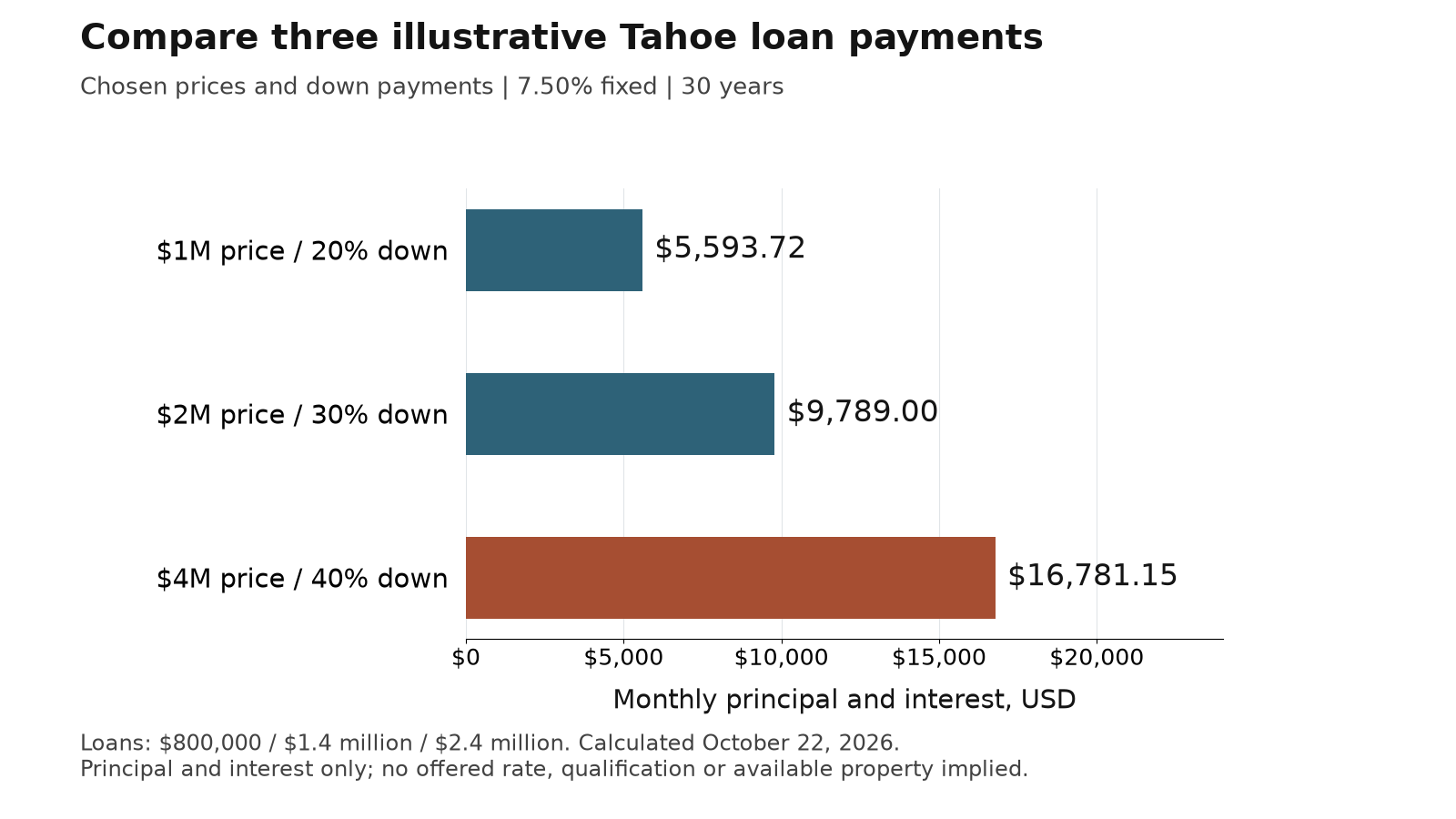
According to the FHFA 2026 county loan-limit table, the one-unit conforming limit is $832,750 in both Washoe and Douglas counties. That is a loan-amount limit, not a purchase-price ceiling or approval. For example, a $1.3 million price minus a $467,250 down payment leaves $832,750 to borrow before considering the other details of a financing proposal. Eligibility, property acceptance and loan terms still require lender review.
| Invented purchase price | Chosen down payment | Loan amount | Monthly principal and interest |
|---|---|---|---|
| $1,000,000 | 20% / $200,000 | $800,000 | $5,593.72 |
| $2,000,000 | 30% / $600,000 | $1,400,000 | $9,789.00 |
| $4,000,000 | 40% / $1,600,000 | $2,400,000 | $16,781.15 |
The percentages above are chosen for illustration, not lender minimums. Taxes, insurance, association charges, loan fees and maintenance are excluded. The CFPB Loan Estimate explainer distinguishes principal and interest from the full payment and cash to close. Use comparable written proposals to evaluate the actual loan, including any rate lock, points and required reserves. A cash purchase removes mortgage payments but leaves ownership expenses and the opportunity cost of committed funds.
I connect buyers with lenders and private banks experienced in Tahoe luxury and second-home financing, and I structure offers to compete effectively whether you are financing or paying cash. The buyer resources provide the broader purchase sequence; lender qualification and the actual property remain separate approvals. A larger down payment should be evaluated alongside the liquidity left for repairs, closing and ongoing costs.
How Much Cash Should Remain Beyond the Down Payment?
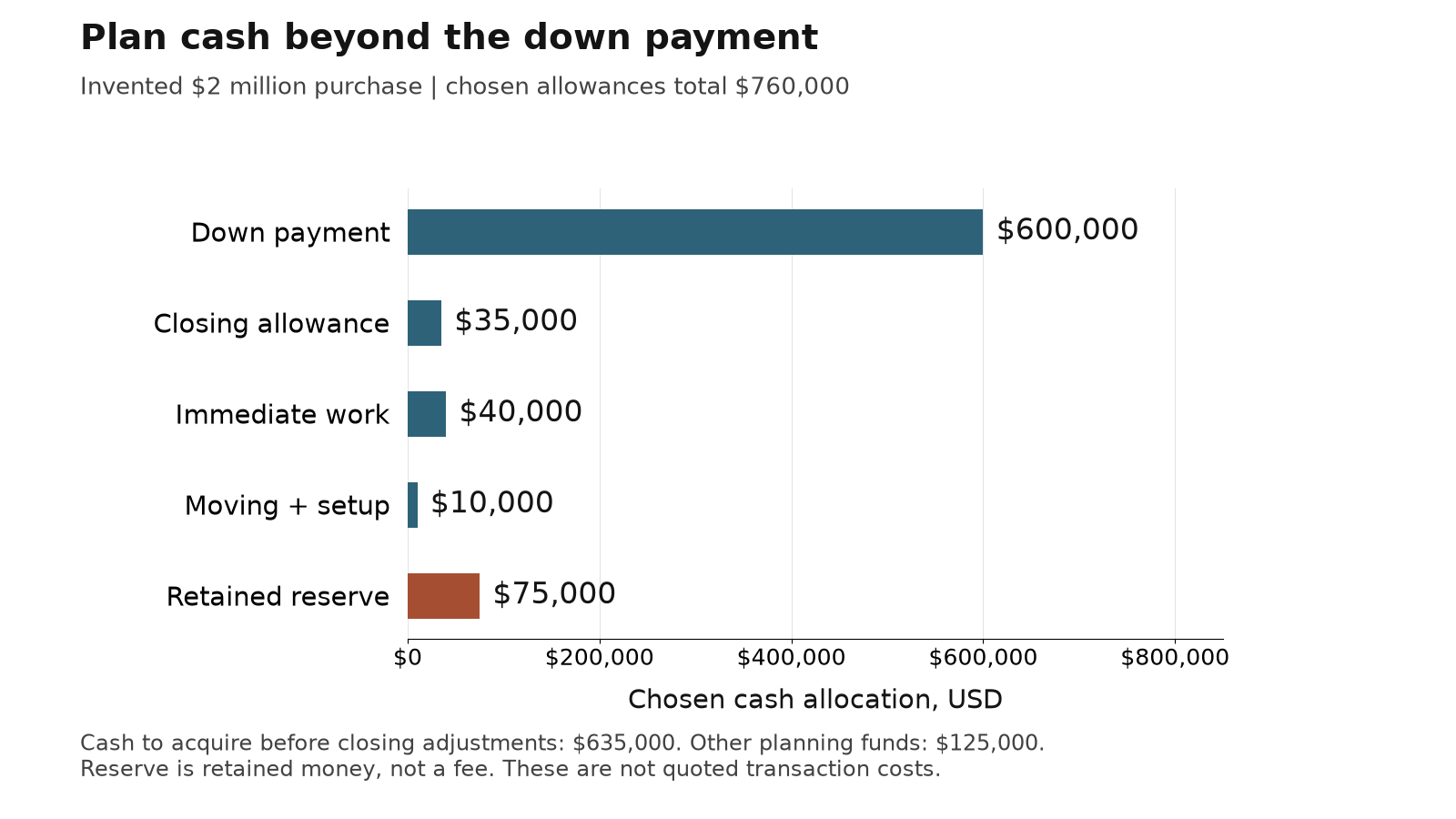
Separate the funds needed to acquire the home from funds retained after closing. The $2 million example uses a $600,000 down payment. Add an invented $35,000 closing-cost allowance, $40,000 for immediate work, $10,000 for moving and setup, and $75,000 kept available as a reserve: the combined planning requirement is $760,000. The reserve is retained money, not a fee paid to the seller. These allowances are deliberately hypothetical and do not estimate the cost of a particular Tahoe transaction.
The acquisition portion of that worksheet is $635,000 before deposit credits or other closing adjustments. The additional $125,000 covers the chosen work, setup and retained reserve. Do not label the whole $760,000 “cash to close”; that would misstate the categories. Reconcile the actual settlement figures with the lender and closing professional, then keep the post-closing plan visible. A buyer can have enough to sign and still lack enough for the first major project.
Stress the worksheet with a specific change. If immediate work rises from $40,000 to $90,000 while every other assumption stays fixed, the total planning requirement rises by $50,000 to $810,000. Decide whether that would reduce the retained reserve, require a different funding source or make the purchase unsuitable. No hypothetical future refinance or rental income is needed to show this risk. The question is whether the household is comfortable with the commitments using resources it can document now, including the time and disruption associated with the work.
What Does the Full Annual Ownership Budget Include?
I build a full annual-cost model for serious buyers, because a clear picture of taxes, insurance, utilities, caretaking, and dues is essential before committing to a mountain-lake property at any tier. Begin with documents and quotes for the address, then identify which amounts are confirmed, estimated or still missing. A tax bill, insurer proposal, association statement and service contract answer different questions. None can substitute for all the others, and the prior owner's arrangement may not match the buyer's intended use.
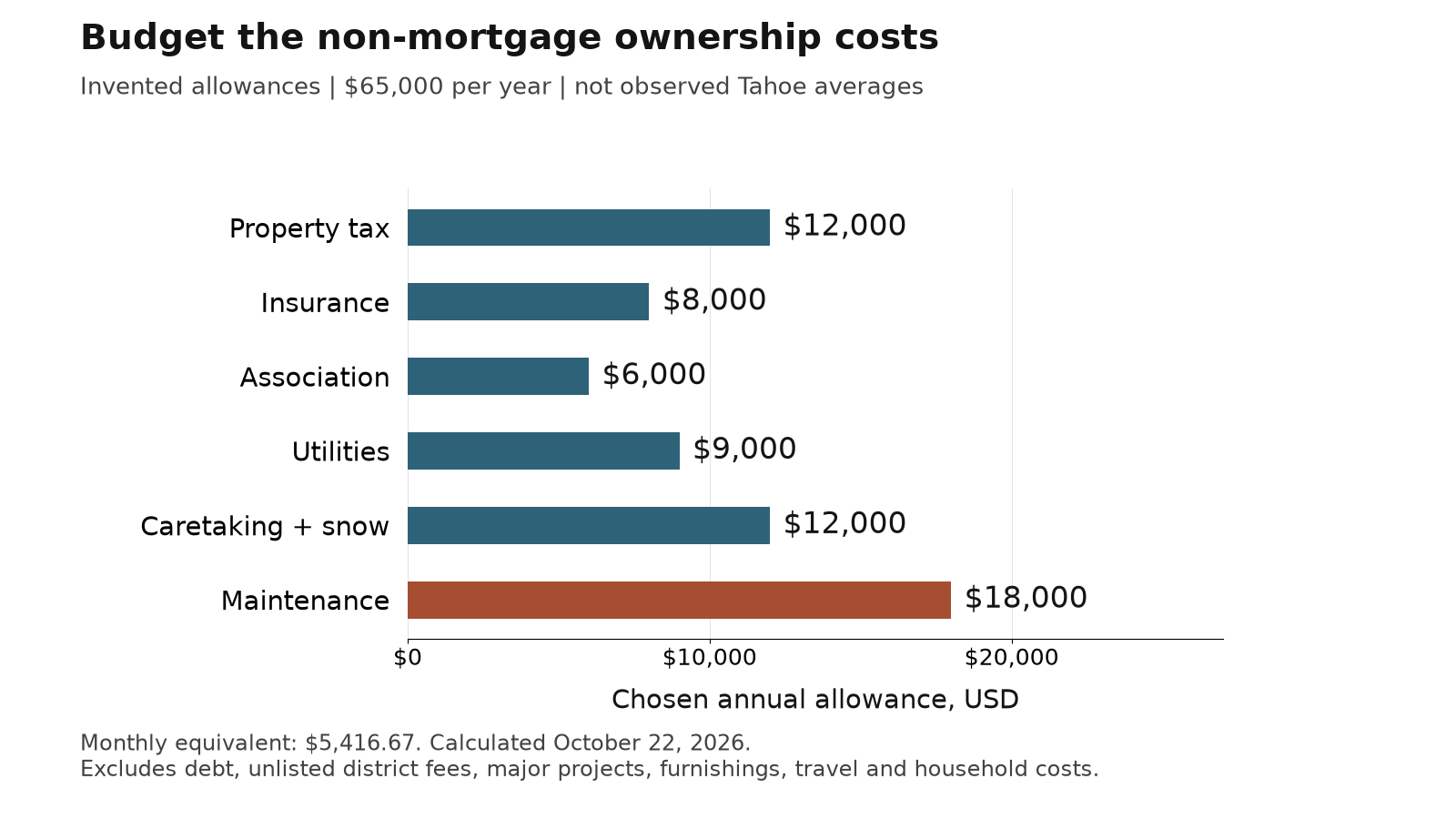
For an original illustration only, choose annual allowances of $12,000 for property tax, $8,000 for insurance, $6,000 for association charges, $9,000 for utilities, $12,000 for caretaking and snow services, and $18,000 for maintenance. They total $65,000 per year, or $5,416.67 per month rounded. These are invented planning amounts, not Tahoe averages or quotes. Where district fees apply, add them separately unless the worksheet explicitly includes them; do not silently assume that an HOA line covers them.
Adding the $2 million financing example's rounded $9,789 monthly principal and interest gives $15,205.67 per month for this limited scenario. Furnishings, travel, major renovations, tax consequences and other household obligations remain outside it. A paid-off home would still carry the chosen $65,000 annual operating allowance. That distinction is useful when comparing cash and financing: removing a loan does not make the property inexpensive to run. Replace every invented input with the actual address's evidence before using the worksheet to make an offer or set an affordability limit.
How Should Insurance, Winter Access and Use Affect the Choice?
I have buyers underwrite insurance early rather than assume it. Ask an insurer to evaluate the actual property and intended occupancy, then review the offered coverage, exclusions, deductibles and conditions with the insurance professional. A lender's estimated premium is not the same thing as a bindable policy for the buyer. Avoid promising that any price band, neighborhood label or recent renovation guarantees coverage. No insurance quote was obtained for this article.
Winter planning is similarly specific. Ask who clears the road and driveway, where snow can be placed, how deliveries arrive and who responds when the property is empty. Inspect the entry and interior circulation in relation to the household's needs. For a second home, identify who checks equipment and handles a problem between visits. A service included in an association fee should be described by its actual scope rather than assumed from the existence of an association.
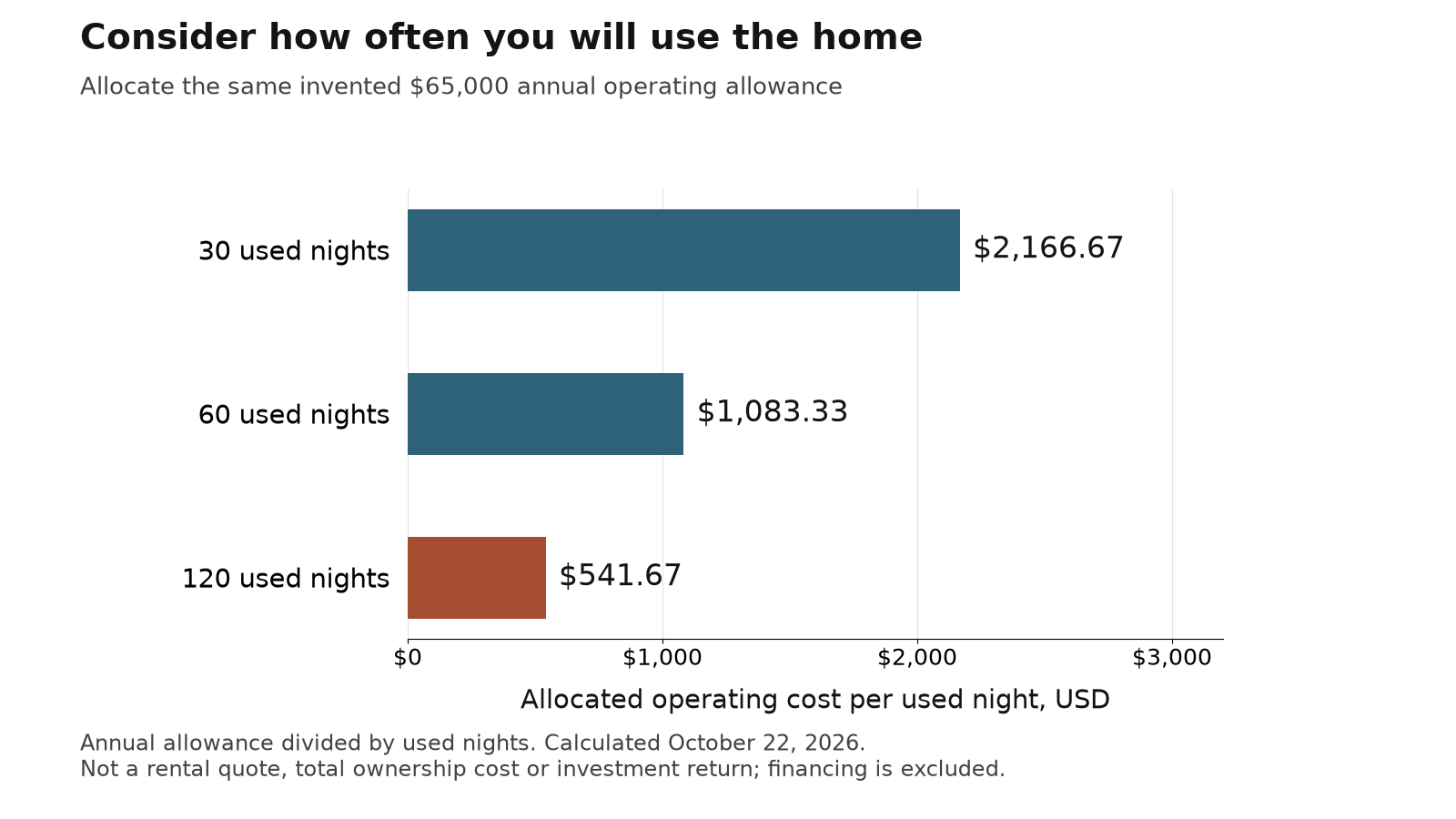
An original use comparison can reveal a different trade-off. With the illustrative $65,000 annual non-mortgage allowance, 30 nights of owner use correspond to $2,166.67 per used night; 60 nights to $1,083.33; and 120 nights to $541.67. This is simple allocation, not a rental rate or complete economic return. It excludes acquisition cost, financing and other expenses, and does not say ownership is cheaper than renting. Use it to discuss how often the household realistically expects to visit. A home selected for occasional gatherings may be valued differently from a daily residence even when the annual cost is identical.
What Should You Check About Residency and Closing Rules?
The Nevada Department of Taxation states that Nevada does not impose individual state income tax. That does not mean buying a Nevada home settles a person's tax residency or every tax obligation. The California Franchise Tax Board's residency guidance considers presence, domicile and whether a stay or absence is temporary; it states that California residents are taxed on income regardless of source. Obtain advice for the household's facts before including expected tax savings in a purchase budget.
That tax dynamic is why the Nevada shore commands a premium and why so many of my Tahoe buyers are relocating executives, business owners, and retirees moving assets and residency across the state line. I always advise buyers to work with a qualified tax and legal advisor alongside the purchase. The Reno relocation guide can help organize the wider move, while the advisers determine which records and arrangements matter for the individual household. No universal day-count shortcut or dollar saving is calculated here.
Closing rules also need a dated check. As reviewed October 22, 2026, FinCEN's Residential Real Estate Rule page states that a March 19 court order vacated the rule and that the government appealed. While the order remains in force, its alert says reporting persons need not file Real Estate Reports under that rule and face no liability for failing to do so. This is not a statement that all identity, source-of-funds or closing requirements disappear. Ask the closing professionals to confirm the then-current requirements for the specific transaction and ownership structure.
How Should You Judge Timing and Available Inventory?
Do not assume that condos are always the fastest-selling category or that winter reliably delivers a discount. Those claims require a defined dataset and comparison period. The August single-family median does not establish either conclusion. For a particular search, review current alternatives, recent relevant closings, time on market, price changes and the seller's documented response. The useful question is whether the buyer has a credible alternative if the preferred property cannot be acquired on acceptable terms.
In my experience, the defining feature of Tahoe is scarcity, not speed — the right property in the right location and tier may not come to market often, so serious buyers stay ready and move decisively when it does. Readiness can mean having funds documented, decision-makers aligned and the important diligence questions identified. It does not mean ignoring unresolved title, insurance or access concerns. Establish which unknowns must be resolved before the buyer can be comfortable proceeding under the actual contract.
I keep qualified buyers informed of quiet and coming-soon opportunities across the Nevada shore. That existing service statement does not establish how much inventory is off-market, and this guide has no measured private-inventory share. Public searches remain useful for understanding visible alternatives. The Tahoe activities guide can also help a household test whether the intended lake routine makes sense before choosing an address. Actual access arrangements, operating schedules and the property itself should determine the plan; a general seasonal narrative should not set an offer price.
How Do You Turn the Shortlist into a Decision?
Use one worksheet for every serious candidate. Record the purchase price, funds required, expected operating costs, intended use, important physical features, documented rights and unresolved questions. Put the supporting document or quote beside each consequential entry. If a claimed amenity is central to the purchase, it deserves its own line and a clear answer. Comparing completed worksheets is more useful than comparing listing adjectives or treating the shopping band as a quality rating.
In my experience, the buyers who are happiest at Tahoe are the ones who understand they are buying a mountain, lakeside lifestyle with its own rhythms and responsibilities, not just a house. I walk buyers through all of it before they commit, so the dream property does not come with unwelcome surprises. Build the final comparison around the way the household will actually live or visit. Include the inconvenience of work, the attention required between visits and the alternatives available at the same total commitment.
As the lead brokerage serving Northern Nevada, Nevada Real Estate Group represents buyers and sellers across every Tahoe tier with the discretion the market demands. To compare current properties against a defined budget and use plan, contact Nevada Real Estate Group or call (775) 277-2120. The next useful conversation is about the specific candidates, the evidence already available and the questions still needing answers. No price band or general guide can replace that property-level review, and this article does not promise appreciation, financing approval, rental income or a particular available home.
Frequently Asked Questions
How much does a Nevada-side Lake Tahoe home cost in 2026?
The affiliated Incline report recorded a $2,275,000 median across 16 single-family sales in August 2026. That is a dated city-and-property-type observation, not a whole-lake price or condo benchmark. Compare current candidates and relevant closed sales. This guide's four shopping bands organize choices; they do not guarantee an entry price, bedroom count, view or available lakefront property.
Does an $800,000–$1.3 million budget guarantee an Incline condo?
No. That is an illustrative shopping band retained from the original guide, not a verified inventory promise. Review actual listings, condition, association obligations and financing eligibility. The amount left for closing, work and reserves matters alongside the purchase limit. A building's rental or access arrangements must be checked separately rather than inferred from its location or price.
Does every Incline Village property include private-beach privileges?
No. IVGID distinguishes parcels with beach privileges from those without them. Verify the specific parcel and intended users with the district. Its published 2026–27 recreation and beach charges total $1,530 where both apply, separate from association dues. This guide has not checked an individual parcel's eligibility, account balance, passes or guest arrangements.
Does buying lakefront include a pier or buoy?
Do not assume so. Establish exactly which interests and structures are included, then have the title, legal and permitting professionals review the supporting documents and any applicable conditions. Nevada State Lands explains that navigation rights do not grant private shoreline access and that several approvals may be relevant. No property's rights or permits were verified for this article.
Do I need an all-cash purchase for a luxury Tahoe home?
Not inherently. Obtain financing proposals for the buyer, property and intended use. FHFA's 2026 one-unit conforming limit is $832,750 in Washoe and Douglas counties; that limits the loan amount, not the home price. The down payments and 7.5% rate in this article are chosen examples, not lender requirements or available offers. A cash purchase still has operating costs.
What should be included beyond the mortgage payment?
Use actual tax, insurance, association, utility and service information, plus a maintenance and project plan. Keep cash to close separate from post-closing work and retained reserves. The guide's $65,000 annual operating allowance is invented to demonstrate a worksheet, not an observed Tahoe average. Add omitted charges and household costs before using a comparison to make a decision.
Does buying a Nevada Tahoe home establish tax residency?
Ownership alone does not resolve the household's residency facts. Nevada has no individual state income tax, while California's guidance addresses presence, domicile and temporary purposes. Ask qualified tax and legal advisers to evaluate the actual move, income and records. Do not treat a general day-count rule or a hypothetical tax saving as automatic purchase-budget support.
Should a buyer wait for winter to get a better deal?
There is no demonstrated universal winter discount in the evidence reviewed for this guide. Compare actual alternatives and relevant recent transactions, then consider the property's condition, rights, costs and contractual diligence. Being prepared can help a buyer respond to a suitable opportunity; it does not justify assuming appreciation, overlooking unanswered questions or accepting an unsuitable property merely because inventory appears limited.
Which Sources and Methods Support This Comparison?
The NREG Incline Village report supplies the explicitly dated affiliated MLS/Repliers observation. IVGID's current parcel-benefit guidance and Nevada State Lands' Tahoe page support the limited access and permitting distinctions. FHFA's official 2026 county table supplies the two county loan limits. CFPB's Loan Estimate explanation supports separating payment, ownership and closing-cost categories.
Nevada Taxation, California FTB and FinCEN support the dated, limited tax and reporting discussion. These sources were reviewed October 22, 2026. No claim is made that a linked source reviewed this article or approved a particular property. The TRPA shoreline page was unavailable during review; no inaccessible wording was adopted as verified evidence.
All price-band exercises, cash allowances and ownership scenarios are original illustrations. Mortgage payments use loan principal multiplied by the monthly rate, divided by one minus the inverse of one plus that rate raised to 360 payments. Dollar amounts are rounded to cents; annual-cost allocation divides the chosen annual total by months or used nights. None is a market-rate quote, appraisal, client outcome or investment forecast. Existing company and experience statements are retained, and no new field visit or company study is represented. Confirm changing rules and the actual property evidence before relying on a comparison. Nevada Real Estate Group · Chris Nevada · License S.181401 · (775) 277-2120.