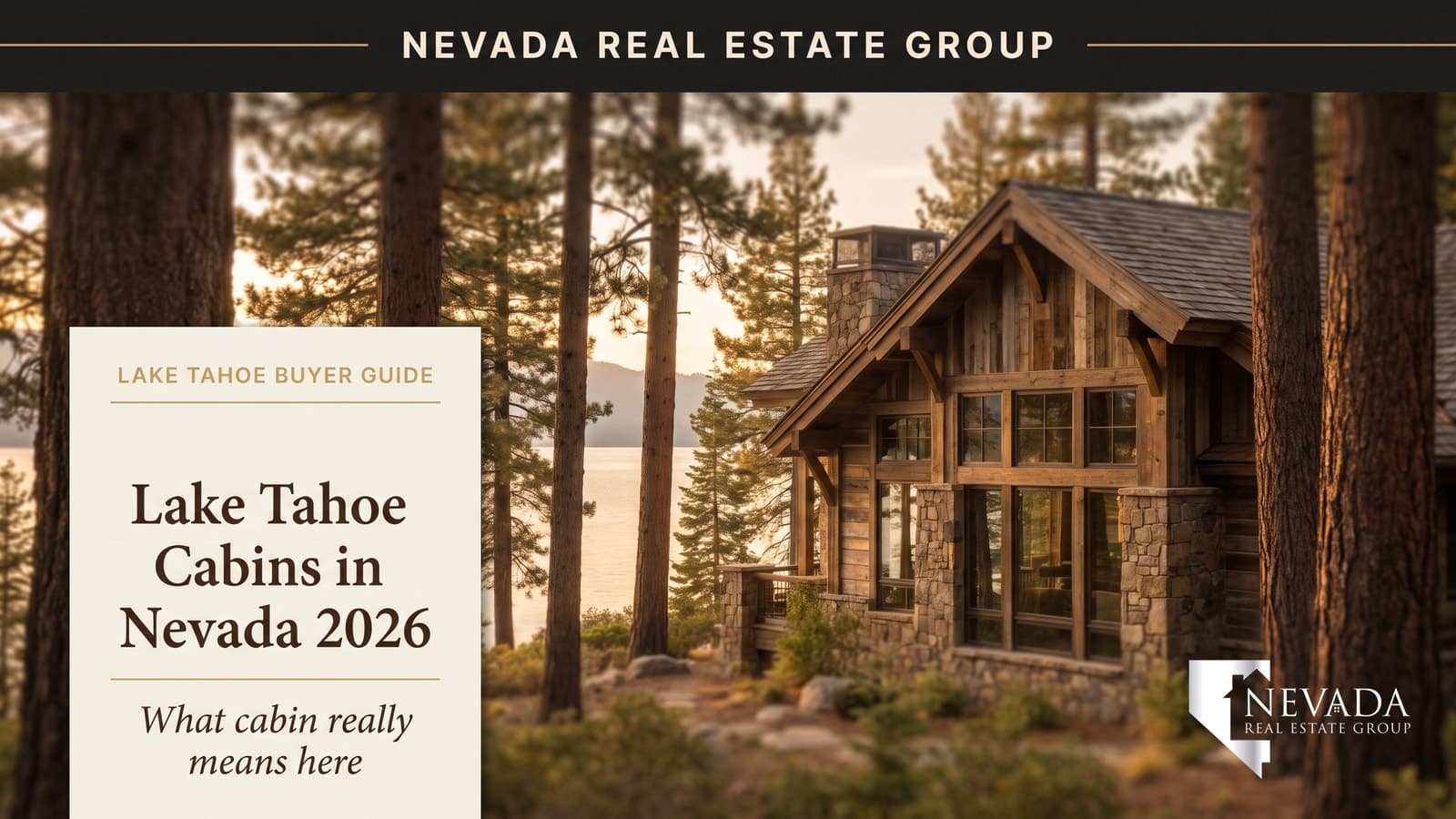

Almost every buyer who calls me about Lake Tahoe uses the same word. They want a cabin. Across the closings Nevada Real Estate Group has represented on this shore, it is the most common opening sentence and the one that most often needs unpacking.
What they picture is specific and consistent: exposed timber, a stone fireplace, pines close to the windows, something modest and old and unpretentious. What they find, when they start looking on the Nevada shore, is a 1971 four-bedroom house with a two-car garage, or a condominium in a complex built the same year, and neither one looks like the picture.
The word did not lie. It aged. Tahoe's cabin era produced a housing stock that has since been remodeled, expanded, replaced or absorbed into resort development, and what survives under the label is mostly 1960s and 1970s construction — a lot of it excellent, very little of it rustic in the way the word implies.
Here is what the Nevada shore actually holds. Of the active listings I sampled across Incline Village, Crystal Bay, Zephyr Cove, Stateline and Glenbrook, the 1970s alone accounts for the largest single share of inventory, and the median 1960s listing sits at $689,000 — the cheapest entry into the lake, and nothing like a bargain by mainland standards.
On Nevada's Tahoe shore, cabin usually describes a 1960s or 1970s house rather than a rustic one-room retreat. In our sample of active listings, 1960s homes median $689,000 and 1970s homes $1,147,000, while 1990s stock medians $2,500,000. Condominiums make up roughly 42% of inventory at a $1,050,000 median, and are the realistic entry point for most buyers. Incline Village holds 162 active listings at a $1,850,000 median.
- 1960s listings median $689,000; 1970s $1,147,000; 1990s $2,500,000 — vintage drives price.
- Condominiums are about 42% of Nevada-shore inventory at a $1,050,000 median.
- Single-family homes median $3,799,000 — a different market from condos entirely.
- Incline Village carries 162 active listings, median $1,850,000, median build year 1981.
- Older stock means older systems, and at 6,200 feet that is a real cost line.
What Does Cabin Actually Mean at Lake Tahoe Today?
Three different things, depending on who is using the word.
To a seller's agent, cabin is often a style descriptor applied to any home with timber, a pitched roof and trees — including a 3,000-square-foot house built in 1995 with a great room and radiant floors. It signals a mood, not a size.
To a buyer from out of state, cabin usually means small, old and cheap. On the Nevada shore, only the first two are reliably true, and the third is not true at all.
To the market, cabin is effectively a proxy for build decade. The homes that read as cabins are overwhelmingly the 1960s and 1970s stock, and that is where the lake's lowest price points live.
In my experience the gap between the first and second definition is where buyers lose the most time. Someone flying in for a weekend of showings expecting $600,000 rustic charm is going to see 1970s houses at seven figures and condominiums at a million, and conclude the market is broken. It is not broken. The word simply carries a promise the inventory stopped keeping around 1985.
What Does Each Decade Actually Cost on the Nevada Shore?
This is the single most useful table I can give a Tahoe buyer, because vintage predicts price here more cleanly than almost anything else.
| Decade built | Active listings | Median list price |
|---|---|---|
| 1960s | 7 | $689,000 |
| 1970s | 36 | $1,147,000 |
| 1980s | 15 | $2,188,000 |
| 1990s | 25 | $2,500,000 |
| 2000s | 8 | $4,500,000 |
| 2020s | 5 | $13,995,000 |
The curve is almost perfectly monotonic, and the steps are large. Moving from 1970s to 1980s stock roughly doubles the median. Moving from 1990s to 2000s adds another $2,000,000. Buying into the 2020s is a different activity altogether.
According to the U.S. Forest Service Lake Tahoe Basin Management Unit, a substantial share of the basin is public land. That structure exists because Tahoe's buildable land is effectively fixed. New construction is not adding supply at the bottom of the market; it is replacing older homes at the top. So the older stock is not merely cheaper — it is the only part of the market that is cheaper, and it does not get replenished.
For a buyer with a budget under $1,500,000, the practical translation is that you are shopping 1960s and 1970s homes, or condominiums. That is the inventory. Everything else is a different price conversation.
Are Condominiums the Real Entry Point?
For most buyers, yes — and the numbers say so plainly.
In the sample, condominiums accounted for roughly 42% of active inventory at a $1,050,000 median. Single-family homes medianed $3,799,000. That is not a small gap; it is two separate markets sharing a shoreline.
What the condominium buys you at Tahoe that it does not buy in most markets:
- Snow handling. Plowing, roof management and common-area maintenance are the association's problem, which at 6,200 feet is a genuine quality-of-life transfer rather than a convenience.
- Lock-and-leave. For a second home occupied a few weeks a year, a building that is monitored and maintained in your absence is worth real money.
- Amenity access. Many Nevada-shore complexes carry beach access, pools and recreation that a detached home at the same price cannot match.
What it costs you: monthly dues, association rules that may restrict rentals, and the ceiling on appreciation that comes with owning airspace rather than land. If the ownership structure itself is new to you, the mechanics of what a condo deed conveys are worth understanding before you shop.
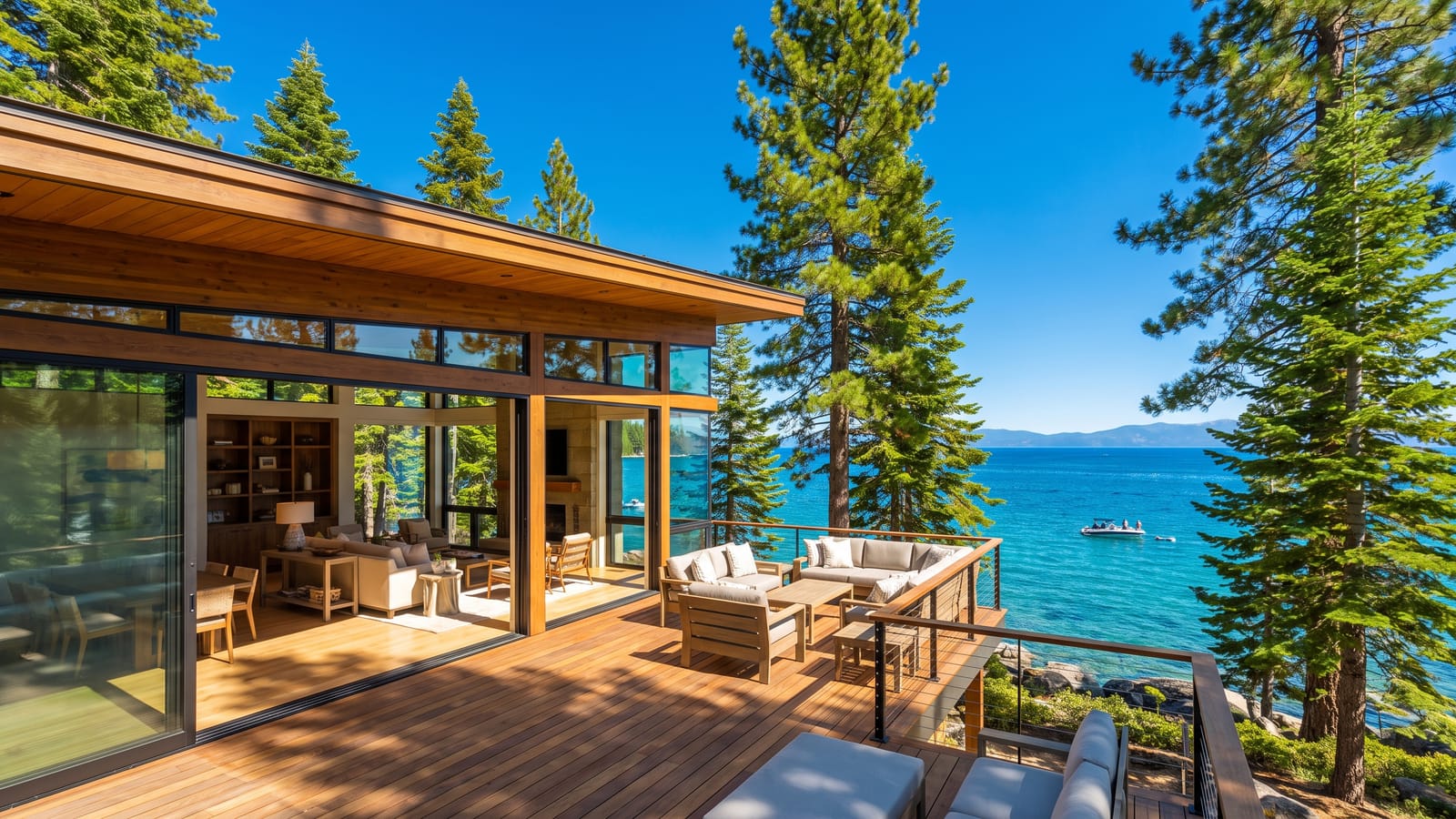
How Do Condominiums and Houses Really Compare Here?
Side by side, because the two markets behave so differently that averaging them is misleading.
| Dimension | Condominium | Single-family home |
|---|---|---|
| Median list price | $1,050,000 | $3,799,000 |
| Share of inventory | About 42% | About 55% |
| Snow and roof | Association handles it | Yours, every winter |
| Lock-and-leave | Strong — monitored in your absence | Weak — needs a caretaker or service |
| Monthly carry beyond the loan | Association dues | Maintenance, plowing, utilities |
| What you own | Airspace plus a share of common elements | Structure and land |
The row that decides it for most people is not price — it is snow. A detached home at Tahoe is a winter obligation whether or not you are there, and the owners who enjoy their second homes most are usually the ones who were honest with themselves about how much of that they wanted.
The row that decides it for the rest is land. A condominium's appreciation is tied to a building and an association; a house's is tied to a parcel in a basin where parcels are not being created. Over a long hold, that distinction is the whole investment argument.
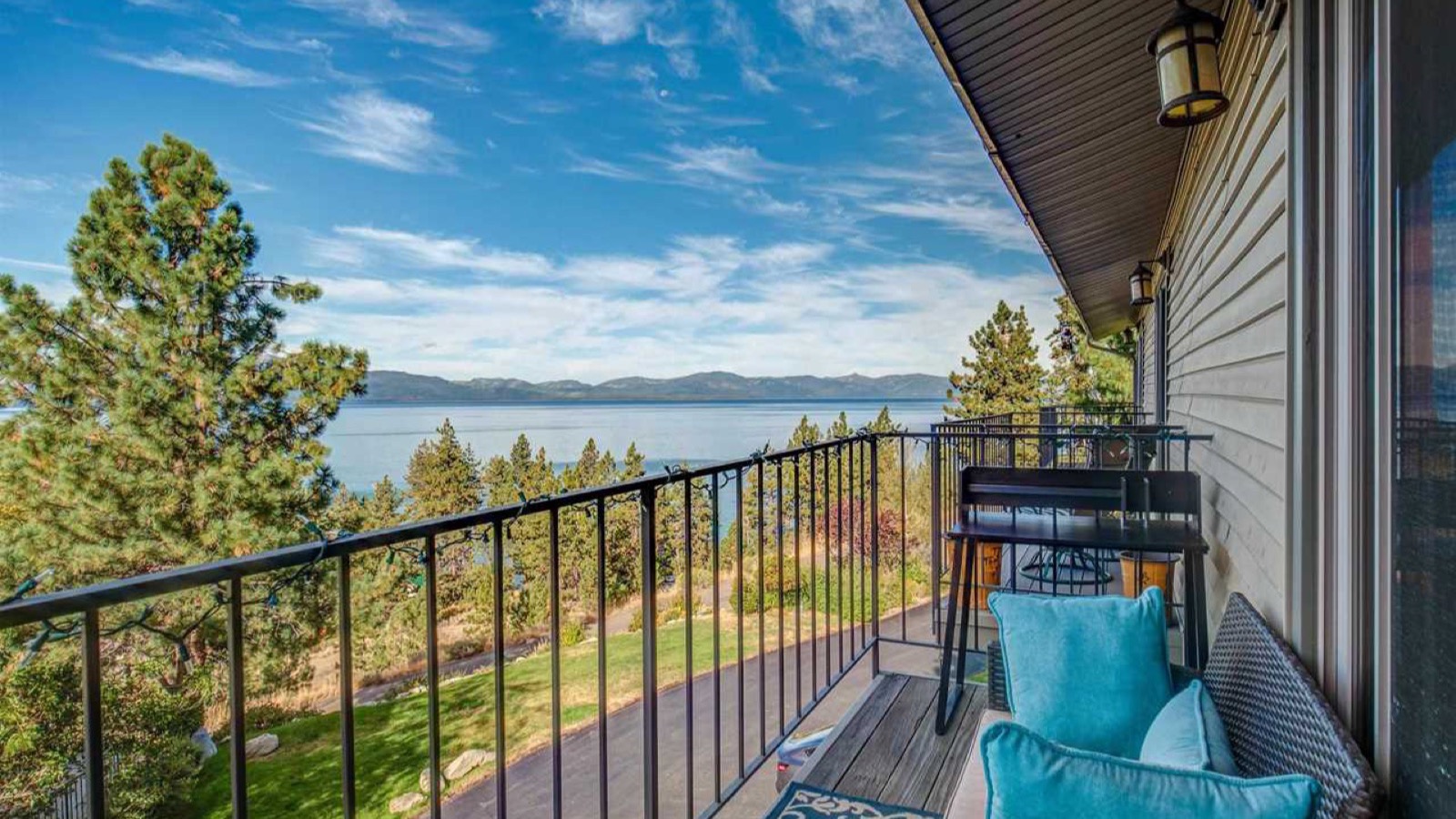
Where Is the Nevada Shore's Inventory Concentrated?
Overwhelmingly in one place, and that matters for how you shop.
Incline Village holds 162 active listings with a median of $1,850,000 and a median build year of 1981. Every other Nevada-shore community is thin by comparison — Crystal Bay showed 9 active listings at a $4,900,000 median, and Zephyr Cove, Stateline and Glenbrook were in low single digits each.
That concentration has two consequences buyers should plan around.
First, Incline Village is effectively the Nevada shore's market. If you want choice, comparison and any negotiating leverage, that is where it exists. The smaller communities are not cheaper alternatives; several are considerably more expensive, and with two or three listings at a time, they trade on scarcity.
Second, medians from the small communities are close to meaningless. A community with two active listings has a median that describes those two houses and nothing else. I pulled a $125,000,000 "median" from one of them, produced by a single trophy property, and it tells you nothing about what a normal home there costs. Treat any statistic from a two-listing market as an anecdote.
If you want to see the current spread, the Lake Tahoe and Incline Village pages carry live inventory, and Tahoe cabins filters to the older stock specifically.
What Should You Expect From a 1970s Tahoe House?
Charm, and a maintenance schedule.
The 1970s stock is the largest single block of Nevada-shore inventory — 36 active listings in the sample, medianing $1,147,000. These homes were built for a mountain climate by builders who understood snow, and many of them have been thoughtfully updated. But a house from that era carries predictable items, and at altitude they are not optional:
- Roof and snow load. Tahoe roofs work harder than almost anywhere in Nevada. Age and pitch matter, and a roof at the end of its life is a five-figure item, not a negotiating chip.
- Heating systems. Original furnaces and baseboard systems from the seventies are past service life. Replacement is expected, not a defect.
- Insulation and windows. Pre-1980 envelopes leak heat, and heating a leaky house through a Tahoe winter is a recurring cost, not a one-time fix.
- Decks and exterior wood. Snow, sun and freeze-thaw cycling are hard on exterior timber; expect maintenance on a short cycle.
- Defensible space. According to the Nevada Division of Forestry, maintaining defensible space around a structure is a live obligation in fire-prone areas, and it affects insurability.
In our experience none of that argues against buying a 1970s house. It argues for pricing it correctly. A buyer who budgets $100,000 to $200,000 of deferred work into a $1,147,000 purchase is making a sound decision. A buyer who budgets nothing is buying a surprise.
How Does Insurance Complicate a Tahoe Purchase?
More than it used to, and it belongs in your offer strategy rather than your closing checklist.
According to the Nevada Division of Insurance, wildfire exposure has reshaped availability and pricing for mountain properties statewide. For an older home in a forested basin, coverage is neither automatic nor uniformly priced, and availability can vary by parcel, by defensible-space condition and by roof material.
The practical advice I give every Tahoe buyer:
- Get an insurance quote during your contingency period, not after. A premium that is double what you assumed changes the affordability math on a $1,147,000 purchase materially.
- Ask what mitigation the carrier wants. Defensible space, roof material and vent screening frequently determine both price and availability.
- Confirm the seller's current carrier and premium. It is a data point, not a guarantee, but a policy that has been in force is informative.
Is a Tahoe Cabin a Good Investment or a Lifestyle Purchase?
Both, but the honest answer starts with the lifestyle side.
The investment case at Tahoe is unusual because supply is genuinely constrained — the basin's buildable land is limited by geography and regulation in a way that almost no other Western market matches. According to the Tahoe Regional Planning Agency, development in the basin is governed by a regional plan that caps and allocates building rights — a constraint no ordinary market faces. That is the entire long-term thesis, and it is a real one. The decade table above is what constrained supply looks like: older homes are not being replaced with cheaper ones.
The lifestyle side is where the decision actually gets made, and it deserves the same scrutiny:
- How many weeks will you genuinely use it? A second home used three weeks a year is an expensive hotel with a mortgage attached.
- What is the winter access like to the specific address? Elevation, road maintenance and grade vary enormously within a few miles.
- Do you want to rent it out? Rental rules vary by community and association, and the answer materially changes the carrying-cost math.
Buyers weighing Tahoe against the rest of the region often look at Carson City alongside Reno and Carson City as the year-round alternative, and our Reno relocation guide covers the trade between mountain second home and valley primary residence.
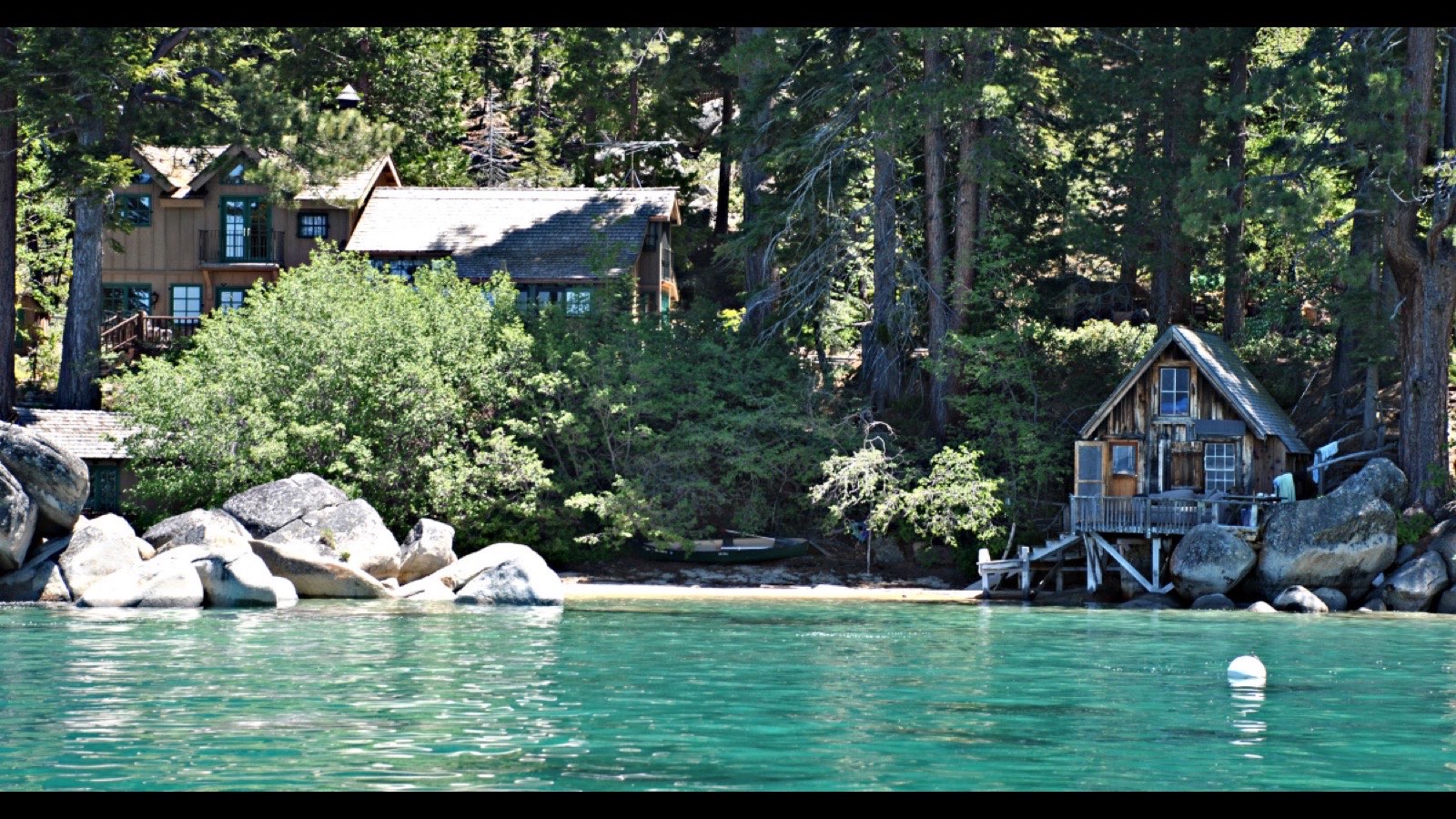
What Do the Smaller Nevada-Shore Communities Offer?
Scarcity, mostly, and it cuts both ways.
Crystal Bay showed 9 active listings at a $4,900,000 median — a small, expensive market on the north shore near the state line. Zephyr Cove, Stateline and Glenbrook each carried only a handful of listings at the time of writing, with Glenbrook in particular functioning as a trophy market where a single listing can define the entire statistical picture.
For a buyer, the implication is straightforward. If your requirement is a specific small community, you are waiting for inventory rather than choosing from it, and you should be pre-approved and ready to move when something appears. If your requirement is Tahoe, and the community is flexible, Incline Village's 162 listings give you something the others structurally cannot: options. The Lake Tahoe lakefront inventory is the one exception worth watching separately.
The mistake to avoid is treating a small community's median as a market signal. With two listings, the median is the average of two houses. It is not a price level, and it will swing wildly month to month for reasons that have nothing to do with the market.
How Should You Actually Shop the Nevada Shore?
A sequence that reflects how this inventory really behaves.
Set the budget against the decade table, not against the word cabin. Under $1,500,000 you are shopping condominiums and 1960s–1970s houses. Between $2,000,000 and $3,000,000 you move into 1980s and 1990s stock. Above that, the market changes character again.
Decide condo versus detached early. Compare against Reno and Sparks if a year-round primary residence is also on the table. These are two markets — $1,050,000 versus $3,799,000 at the median — and shopping both simultaneously wastes trips.
Budget the deferred work before you write the offer. Sellers preparing the other side of that trade can start with our seller resources. On older stock, roof, heat and envelope are where the money goes, and knowing your number lets you bid confidently rather than discovering it during inspections.
Get insurance quoted inside the contingency. In the current market this is not a formality, and our buyer resources cover how to sequence it.
Move quickly when the right one appears. Start from the live Incline Village listings and the wider Tahoe cabin inventory. With 162 listings across the shore's main market and single digits everywhere else, the specific house you want has fewer substitutes than in any valley market. That is the cost of a constrained basin, and it applies to buyers as much as to prices.
What Does a Lake View Actually Add to the Price?
More than any other single variable on this shore, and the gap is not subtle.
| Listing type | Active | Median price | Median sqft | Median $/sqft |
|---|---|---|---|---|
| Lake view | 32 | $4,400,000 | 3,442 | $1,278 |
| No lake view | 66 | $1,150,000 | 1,536 | $749 |
A lake view carries a 71% premium per square foot — $1,278 against $749 — and nearly four times the median price. Some of that is size, since view homes in the sample run more than twice as large. But the per-square-foot figure strips size out, and a 71% premium on identical square footage is the honest measure of what the water is worth here.
One caveat I want to be straight about: the MLS waterfront field on this board is not reliably populated, so this compares homes with a lake view against those without. It is not a measure of actual lake frontage, which is a smaller and even more expensive category. If frontage specifically is your requirement, that is a conversation about a handful of properties rather than a market segment.
The practical read for a buyer under $1,500,000: you are shopping the no-view side of that table, and that is where nearly two-thirds of the shore's inventory sits. A view at Tahoe is not a feature you add to a budget — it is a different budget.
How Does Tahoe Compare to Buying in the Reno Valley?
Worth answering directly, because a large share of Tahoe shoppers are also considering the valley an hour down the hill.
The two markets serve genuinely different purposes. Tahoe is a constrained-supply second-home market where the median Incline Village listing sits at $1,850,000 and the entry point for detached older stock is around $689,000. The Reno valley is a functioning primary-residence market with far more inventory across a much wider price range, year-round access, and none of the snow-load and winter-access considerations that shape a basin purchase.
Buyers who want both frequently end up doing exactly that — a primary residence in the valley and a smaller Tahoe property, often a condominium, used on weekends. The math on that combination works better than most people assume, because the Tahoe half can be a $1,050,000 condominium rather than a $3,799,000 house, and the association absorbs the winter obligations that make a detached second home demanding.
Buyers who must choose one usually find the answer in a single question: is this a place you will live, or a place you will visit? A house you visit eight weekends a year is a different financial instrument from the one you sleep in every night, and the basin's premium only makes sense if the visiting is genuinely going to happen.
Frequently Asked Questions
How much does a cabin at Lake Tahoe cost on the Nevada side?
It depends almost entirely on vintage. In our sample of active Nevada-shore listings, 1960s homes medianed $689,000 and 1970s homes $1,147,000, while 1980s stock medianed $2,188,000 and 1990s $2,500,000. Condominiums medianed $1,050,000. The word cabin is not a price tier — the decade is.
Are there still real rustic cabins for sale at Lake Tahoe?
Rarely, and they are usually either heavily updated or on land whose value exceeds the structure's. Tahoe's cabin-era stock has largely been remodeled, expanded or replaced over sixty years. What sells under the label today is mostly 1960s and 1970s construction, which is charming and well built but not primitive.
Is a condo a better buy than a cabin at Lake Tahoe?
For many second-home buyers, yes. Condominiums are about 42% of Nevada-shore inventory at a $1,050,000 median against $3,799,000 for single-family homes, and the association handles snow, roof and common-area maintenance — a meaningful transfer at 6,200 feet. The trade is monthly dues, possible rental restrictions, and owning airspace rather than land.
Which Nevada Tahoe community has the most homes for sale?
Incline Village, by a wide margin — 162 active listings at a $1,850,000 median and a 1981 median build year. Crystal Bay showed 9, and Zephyr Cove, Stateline and Glenbrook were in low single digits each. If you want choice and comparison, Incline Village is effectively the Nevada shore's market.
What should I budget for repairs on an older Tahoe home?
For 1960s and 1970s stock, plan on roof, heating system and envelope work as expected rather than exceptional. A reasonable planning range is $100,000 to $200,000 of deferred work on a home in the $1,100,000 range, verified by inspection. At altitude these are not cosmetic items, and a roof at the end of its life is a five-figure certainty.
Is wildfire insurance a problem for Lake Tahoe homes?
It has become a real variable rather than a formality. Availability and pricing can differ by parcel, defensible-space condition and roof material. Get a quote during your inspection contingency, ask what mitigation the carrier requires, and confirm the seller's existing coverage — a premium surprise materially changes the affordability of a seven-figure purchase.
Can I rent out a Lake Tahoe cabin when I'm not using it?
Sometimes, and the rules are local rather than uniform. According to Washoe County, local ordinances and, for condominiums, association rules both govern short-term rentals, and they vary across the Nevada shore. Because rental income often underpins the carrying-cost math on a second home, confirm both before your contingency expires rather than assuming.
What Do Tahoe Buyers Regret Most Often?
Three things, and each traces back to a decision made before the search started.
Underestimating the winter. A second home in the basin is a winter obligation whether you are in it or not. Snow removal, roof monitoring, freeze protection on plumbing and simple access to the front door all become recurring problems for a house that sits empty from December to March. Owners who bought detached homes assuming they would "deal with it" are the ones who end up hiring a caretaker at ongoing cost, or selling.
Buying the vintage without pricing the systems. The 1970s stock is the shore's best value and its heaviest maintenance load. A buyer who paid $1,147,000 and budgeted nothing for roof, heat and envelope is going to spend that money anyway, only under pressure and on someone else's schedule. The homes that disappoint are almost never the ones that were inspected carefully and priced accordingly.
Overestimating usage. This is the quiet one. A household that genuinely spends eight or ten weeks a year at the lake gets enormous value from ownership. A household that manages three weeks has bought a very expensive hotel room with a maintenance schedule attached. Before the search, write down the number of weeks honestly, then divide the annual carrying cost by it. The result either confirms the decision or reframes it, and both outcomes are useful.
The buyers who are happiest years later tend to share one trait: they picked the format — condominium or detached — based on how much winter responsibility they actually wanted, rather than on which one photographed better. That single decision predicts satisfaction here better than price, view or square footage.
Which Sources Inform This Lake Tahoe Cabin Guide?
Inventory counts, medians by decade, condominium share and community-level figures come from our own INCLINE-board MLS feed at the time of writing, sampling 98 of 177 active listings across Incline Village, Crystal Bay, Zephyr Cove, Stateline and Glenbrook. Regulatory and market context draws on the sources below.
- Tahoe Regional Planning Agency
- Nevada Division of Forestry — defensible space
- Nevada Division of Insurance
- Nevada Revised Statutes Chapter 116 — Common-Interest Ownership
- Nevada Real Estate Division
- Washoe County Assessor
- Douglas County, Nevada
- Nevada Department of Taxation
- U.S. Census Bureau — Washoe County QuickFacts
- U.S. Forest Service — Lake Tahoe Basin Management Unit
- Freddie Mac — Primary Mortgage Market Survey
- U.S. Bureau of Labor Statistics — Consumer Price Index
Ready to Look at Tahoe Cabins on the Nevada Shore?
The hardest part of a Tahoe purchase is not finding the house. It is calibrating the word you arrived with against the inventory that actually exists, and then pricing the older stock honestly so the offer holds up through inspections.
Call or text me at (775) 277-2120, or get in touch here. Tell me the budget and how many weeks a year you will really use it, and I will tell you which decade you are shopping — then we will look at what is active on the Nevada shore right now.