

Incline Village living costs depend heavily on the home, financing, insurance, association obligations and services needed through the year. The useful question is whether a particular property fits your recurring budget and first-year cash needs. A broad claim that Nevada tax savings will pay for a Tahoe lifestyle cannot answer that question. This October 22, 2026 review separates historical local housing evidence, current district charges and transparent budget illustrations.
I work with buyers on both ends of this spectrum — retirees right-sizing into a Tahoe condo and executives establishing Nevada residency to protect seven-figure incomes. Across the more than 9,600 transactions Nevada Real Estate Group has closed, Incline Village is where the tax math matters most. The tax projection still needs to be specific to the household, its income sources and the timing of a move. The sections below focus on the complete cost of living; our Incline Village tax and residency guide handles that related decision in more depth.
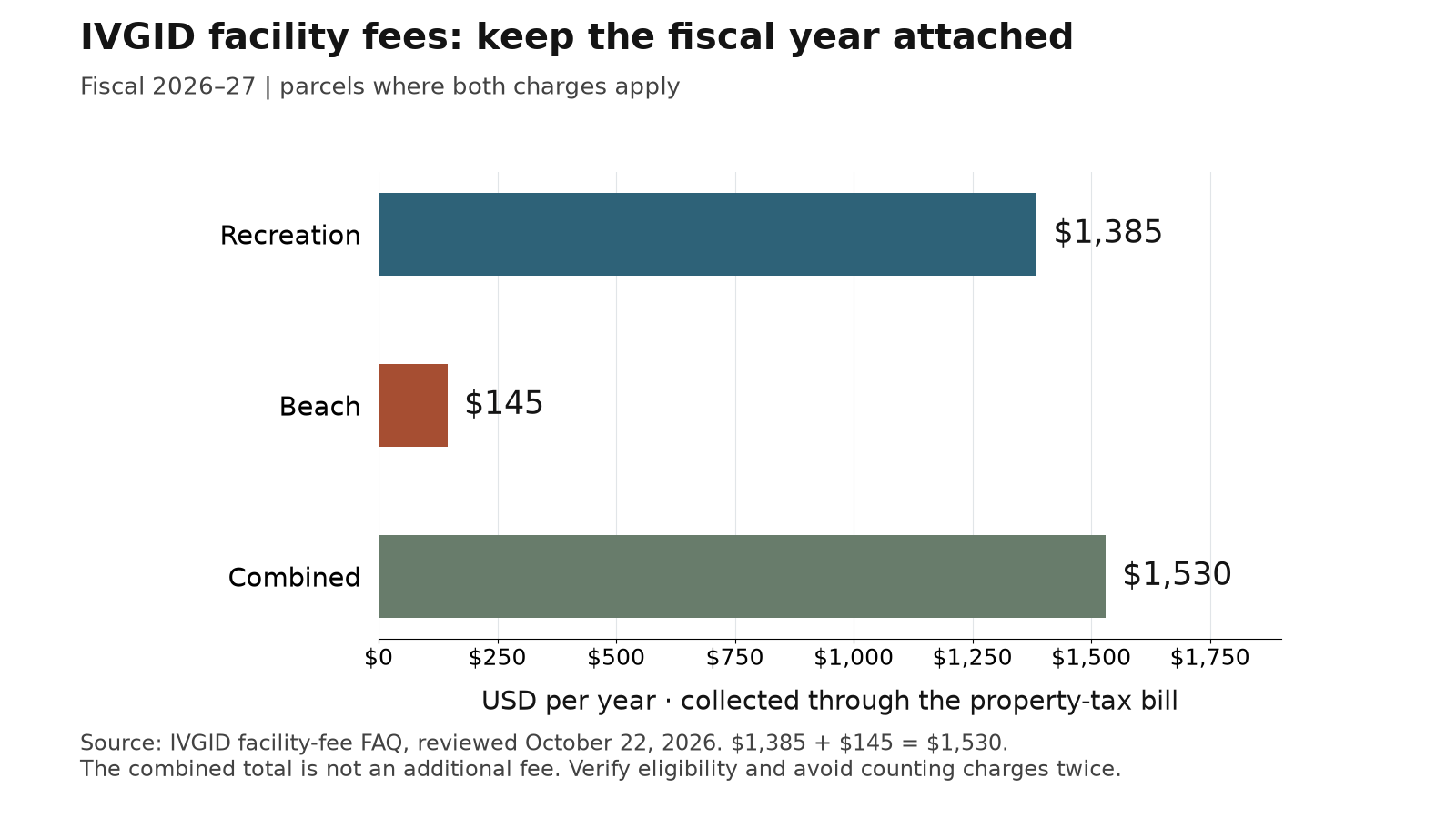
Incline Village's Census median owner-occupied home value was $1,454,600 for 2020–2024, a historical measure rather than a current sale-price quote. For fiscal 2026–27, IVGID lists $1,530 in combined annual recreation and beach fees where both apply. Build your own living-cost total from the actual home, financing, insurance, association charges, utilities, winter services and household spending.
- Census figures cover 2020–2024, so check current listings and loan quotes separately.
- Read the full tax bill so IVGID charges are counted once.
- Check insurance and association obligations before committing to a property.
- Reserve cash for annual expenses, repairs and the move itself.
- Nevada ownership does not by itself resolve California tax residency.
What does a useful Incline Village cost-of-living budget include?
Begin with the household and the property you actually intend to occupy. A renter, a financed condominium owner and a debt-free detached-home owner face different expenses and responsibilities. They also have different amounts of money tied up in the move. One citywide total cannot describe all three situations. Build a recurring monthly allocation, an annual expense calendar and a separate list of cash needed before and shortly after possession.
The local evidence in this guide serves distinct purposes. According to Census QuickFacts for Incline Village CDP, the 2020–2024 median owner-occupied value was $1,454,600 and median gross rent was $1,961. Neither identifies a home currently for sale or rent. The district's current facility fees, discussed below, are a specific public charge with a fiscal-year label. The invented household examples illustrate calculation methods rather than current property quotations.
Include the spending that continues after housing is paid: food, transport, healthcare, debts, recreation and savings. A mortgage approval answers the lender's question about the loan; it does not establish that the remaining household budget supports your preferred routine. Also identify costs that arrive unevenly, such as insurance renewal, a seasonal service contract or an association assessment. A monthly average is useful only if enough cash is available when the bill is due.
Use Incline Village listings to identify candidate properties, then attach documents to each budget. A tax bill, association statement, insurance quotation and service history are more useful than a general assertion that every cost is a fixed percentage above another city. Our broader Lake Tahoe cost guide provides a basin-wide framework; this article keeps the local district and household comparison in view.
How do Census housing costs differ from today's Incline Village prices?
The observation period and definition belong beside a housing statistic. The Census amounts above describe the Incline Village census-designated place over 2020–2024. An owner-reported value measure is different from the median price of homes that closed during a recent month. Median gross rent describes occupied rental housing and includes specified utility costs; it is different from the advertised base rent on an available unit. Do not silently substitute one measure for another.
According to the Census Bureau's explanation of gross rent, that measure combines contract rent with estimated renter-paid utility and fuel costs. The explanation is historical methodology, not a report of current rent growth. If you use a listing proposal to build a budget, identify which utilities are included before adding separate amounts. Otherwise, the same cost can be counted twice or omitted entirely.
For a current purchase decision, compare actual properties with the features you require and ask for relevant closed-sale evidence with its dates, property types and geographic scope. A condominium, a detached home and a lakefront estate should not be treated as interchangeable simply because all are marketed under the Incline Village name. A small set of transactions can also change a period's median without proving that every home changed value by the same amount.
This review does not establish a current local sale-price median, rent survey or minimum price for an available condominium. It supplies historical context and a method for evaluating actual proposals. Review the Incline Village community guide and Crystal Bay area page for location research, then make the financial comparison at the property level. Preserve the date and source of each number so the worksheet remains useful when a listing, quote or lease term changes.
What would a financed ownership example look like?
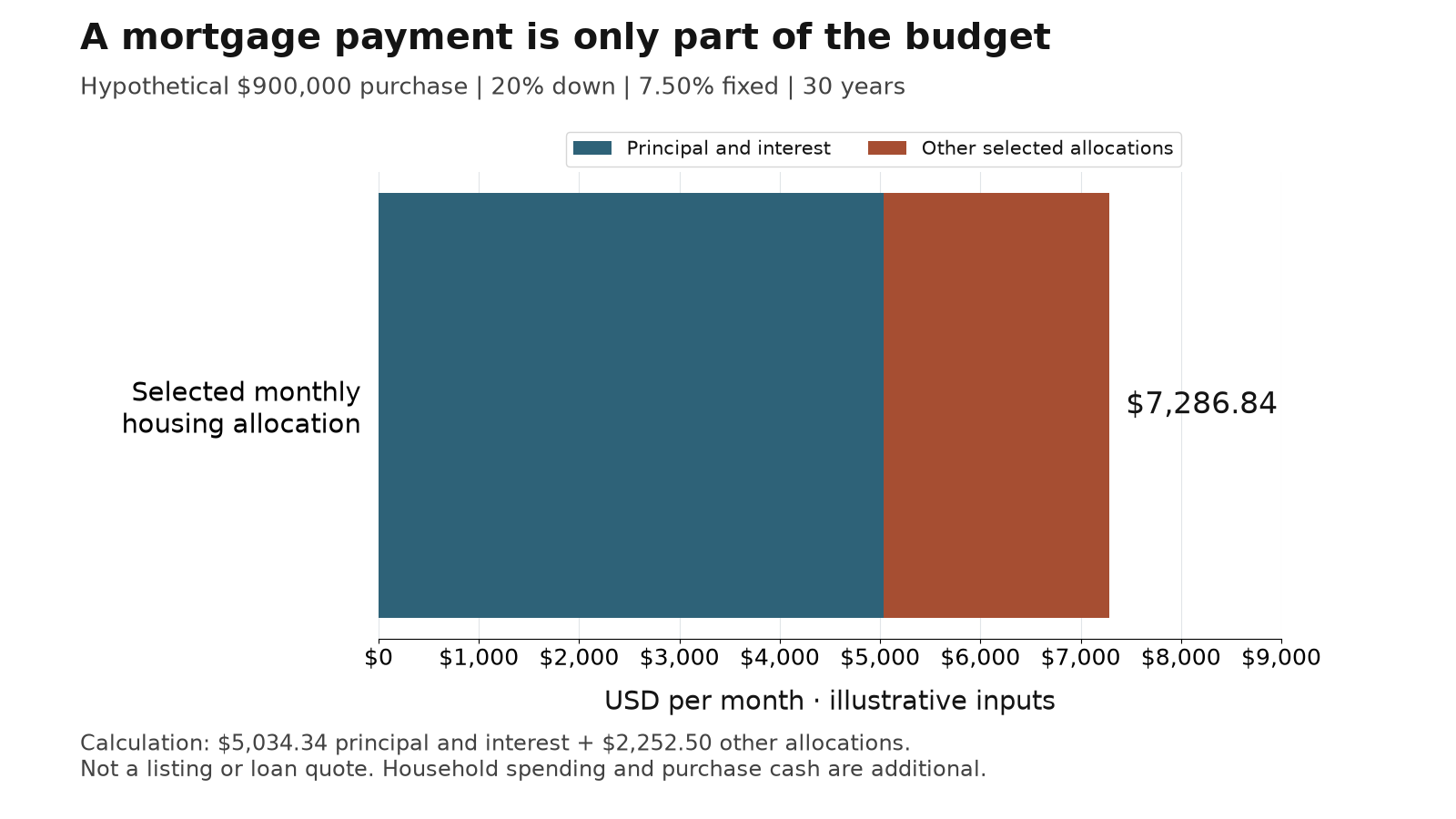
Consider a hypothetical $900,000 condominium bought with a $180,000 down payment and a $720,000 loan. These are invented purchase inputs, not a listing, minimum condominium price or representative Incline Village transaction. At an assumed fixed 7.50% annual interest rate over 30 years, the standard amortization calculation gives monthly principal and interest of $5,034.34. The loan discussion below distinguishes that assumption from the national mortgage survey.
Add operating costs rather than stopping at the loan payment. The following selected amounts are assumptions except for the identified IVGID fee where both district charges apply. The assumed property-tax amount excludes IVGID so that the fee appears once. Actual association inclusions, insurance coverage, financing conditions and the parcel's bill can change every other line. A reserve is a planned allocation; it is not an invoice or a promise that it will cover a future repair.
| Monthly item | Amount | Basis and limitation |
|---|---|---|
| Principal and interest | $5,034.34 | Calculated: $720,000, 7.50%, 30 years |
| Property tax, excluding IVGID | $450 | Assumption, replace with parcel estimate |
| IVGID allocation | $127.50 | $1,530 annual fee divided by 12, where both apply |
| Insurance | $250 | Assumption, not a coverage quotation |
| Association dues | $650 | Assumption, verify included services |
| Utilities and communications | $350 | Assumption, avoid association overlap |
| Seasonal service allocation | $75 | Assumed annual $900 spread monthly |
| Repair reserve | $350 | Assumed savings allocation |
| Selected housing total | $7,286.84 | Excludes ordinary nonhousing spending and purchase cash |
The non-loan items total $2,252.50 monthly. Owning this same hypothetical property without a mortgage would remove the illustrated principal-and-interest payment but would not remove those other allocations or the capital committed to buying the home. It would also not establish that cash ownership has no opportunity cost. Compare alternatives using consistent assumptions and your own liquidity requirements.
Before relying on the total, replace each estimate with a dated document and resolve overlaps. A condominium association might already fund some services, while other obligations may sit outside its dues. Use buyer resources to organize the purchase review and keep missing information visible. An unknown insurance cost or pending assessment should remain an unresolved item, not become zero so that the budget appears to work.
How should you choose a mortgage assumption for the comparison?
Use the rate, term and loan amount together. A payment calculated with one interest rate cannot be compared fairly with another quotation unless the principal, term, fees and included costs are understood. The example above assumes 7.50% for a 30-year fully amortizing loan. It excludes loan fees, mortgage insurance if applicable and any other charge that would be required for an actual product. It is not an approval or a promise that the property or borrower qualifies.
According to Freddie Mac's Primary Mortgage Market Survey, the national 30-year fixed average was 7.32% as of October 22, 2026. The example's 7.50% assumption is 0.18 percentage points higher. PMMS describes a defined conventional conforming application sample, not a specific Incline Village loan or a lender's current offer to you. Occupancy, credit, property type, loan size and product terms require individual evaluation.
Ask for a written estimate for the exact property and intended use. A primary residence, second home and investment property can involve different requirements. Compare the cash required at closing as well as the payment. If a lower advertised rate requires an upfront charge, evaluate that charge over the period you realistically expect to keep the loan. Do not presume a future refinance will rescue a purchase that is unaffordable under the initial terms.
Run a conservative version of the budget before making a commitment. Keep the current financing proposal attached to the worksheet, note when any rate lock expires and update the payment when the inputs change. A general online calculator is useful for arithmetic; it cannot resolve the underwriting, association or insurance questions associated with a particular home. The home search is a starting point for identifying properties, while a lender supplies the actual financing decision.
What are the current IVGID facility fees and what do they buy?
According to IVGID's facility-fee FAQ, as of October 22, 2026, fiscal 2026–27 has a $1,385 Recreation Facility Fee and a $145 Beach Facility Fee, totaling $1,530 where both apply. The district collects these annual charges through the Washoe County property-tax bill. Their monthly budgeting equivalent is $127.50, but dividing by 12 does not change the actual billing or payment arrangements. Verify the parcel's recreation-roll status before assigning the combined figure to a home.
District privileges are not a blanket promise of free use at every venue. The fee supports facilities and associated access or discounts under the applicable rules. A property without beach eligibility should not be described as receiving beach access simply because it is in the general Incline Village area. Similarly, ownership of an eligible property does not eliminate every activity charge, guest rule or documentation requirement.
Use the IVGID passes and punch-card page to check the current process for owners and tenants. Ask what is assigned to the proposed lease or purchase and how the documents will be handled. If a listing photograph features a beach, that photograph does not establish the rights conveyed by the transaction. Confirm the particular parcel and the current terms with the district.
In the budget, check whether an advertised annual tax figure already contains the district charges. Adding the combined fee again would overstate costs; assuming it is included without reading the bill could understate them. For the lifestyle side, our Nevada-side Tahoe activity guide distinguishes public parks from district privileges. Keep that access decision separate from the financial question of whether the complete home budget is manageable.
How do association dues change a condominium or neighborhood budget?
Read the association's financial and maintenance documents before comparing a condominium with a detached home. The monthly dues alone do not explain the value or the risk. Identify which building components, insurance obligations, utilities, landscape work and seasonal services the association handles and which remain the owner's responsibility. Two properties with different dues can have similar total costs once those responsibilities are accounted for.
Ask for the current budget, reserve information, relevant meeting records and disclosures of assessments or major projects. Review the condition of the shared components alongside the financial documents. A low monthly amount can be attractive, but it does not prove that all future work is funded. Conversely, a higher amount may include services that would otherwise appear elsewhere in your own budget. The comparison needs the underlying obligations rather than a general rule that one ownership form is always cheaper.
Use the hypothetical $650 association line above only as a placeholder. If the actual documents include a service already budgeted separately, adjust the worksheet to avoid counting it twice. If they exclude a significant item, add it. Keep a known special assessment separate from a general repair reserve so you can see both the required payment and the cash you still want available for other needs.
Location pages such as Mill Creek, Ponderosa and Tyrolian Village can help organize the property search. They do not establish the current obligations of a particular association or parcel. Get the documents for the actual home, review them with the appropriate professionals and resolve the items that could change your decision before relying on a monthly total.
Why should insurance be checked before the home budget is finalized?
Insurance availability, coverage and price can materially affect the decision. According to the Nevada Division of Insurance's homeowners guidance, insurers consider property risk factors and the cost to replace or rebuild a home. A sale price is not a substitute for the insurer's replacement-cost assessment. Ask for a written quotation based on the address, occupancy, property details and coverage you actually need.
Compare deductibles, limits, exclusions and temporary-living-expense protection as well as the premium. The state guidance explains that standard policies do not cover every type of loss and that risks such as flood or earthquake can require separate coverage or endorsements. A low premium attached to materially different protection is not a straightforward saving. Have a licensed insurance professional explain gaps and confirm any lender requirements.
For a condominium, coordinate the owner's coverage with the association's policy and the documents defining responsibility. Clarify how deductibles and shared-building claims could affect you. For a home that will be vacant for periods, rented or used as a second residence, disclose the intended use. Do not assume a policy designed for a different occupancy remains suitable simply because the property address is unchanged.
The $250 monthly insurance amount in the ownership illustration is an assumption, not an Incline Village average or an obtainable quote. An additional $1,800 annual premium would add $150 to the monthly allocation. Check whether the household can absorb that change while maintaining savings and other obligations. Keep the quote's date and conditions with the budget, and confirm coverage before a transaction deadline makes the unresolved issue harder to address.
How should utilities and communications be estimated for the actual home?
Ask for a full year of available utility history and the conditions behind it. The size of the building, equipment, insulation, occupancy and thermostat practices affect how useful a previous owner's bills are for your household. A lightly occupied second home may not predict the costs of full-time use. A large seasonal bill should not be hidden by looking only at a mild-weather month or assuming every home has the same heating demand.
According to IVGID's water and sewer billing page, utility bills are generated monthly, and its explanation distinguishes base, capital and water-tier charges. The page links the current rate schedule and explains account history. Review the actual service configuration and usage rather than treating water, sewer and district recreation fees as one interchangeable charge. Do not access another person's account; request appropriate bill copies or authorized service information through the transaction.
Check the provider and available service at the exact address for electricity, fuel and communications. Ask whether equipment, installation, deposits or other setup costs apply. For remote work, establish the service available to that home and how you would handle an interruption. A broad claim that connectivity is good throughout a community does not verify a particular connection, upload requirement or work arrangement.
The illustrative $350 monthly utilities-and-communications allowance is not a local tariff calculation. Replace it with a documented estimate, check association or lease inclusions and retain a margin for uncertain usage. If you plan to be away for part of the year, determine which base obligations and protective operating requirements remain. An empty home may still need services and monitoring; absence is not the same thing as zero cost.
How do winter services and irregular repairs fit the annual plan?
Build an expense calendar instead of assuming each month looks the same. Identify the services the property needs, who is responsible for arranging them and when payment is due. A seasonal contract, an equipment replacement and an unexpected repair have different cash timing. A monthly reserve can prepare for those costs, but the money must actually remain available until it is needed.
Ask for the scope of any snow-removal arrangement: the area covered, response terms, exclusions and responsibility for access. For a condominium, confirm what the association handles and what remains yours. For a detached home, evaluate the driveway, stairs and areas that need attention with the relevant service provider. The hypothetical $900 annual seasonal allowance in this guide is only a placeholder; no local service quotation supports that amount.
Inspect the home and ask qualified professionals about the condition and maintenance needs of its systems. A general percentage-of-price reserve does not establish the remaining life of a roof or heating system. List known work separately from unknown future repairs. If a significant expense is foreseeable, include its likely timing and written estimate rather than assuming a small monthly reserve will be sufficient by the due date.
For a second home, decide who would respond while you are away and include any arrangement in the budget. The National Weather Service Reno office supplies current regional weather information, but a forecast is not a maintenance plan or a service guarantee. The point of the annual calendar is to make the recurring obligations and response responsibilities visible before they compete with other household expenses.
What should you allow for food, transport, healthcare and recreation?
Use your household's actual spending as the starting point. Update it for the routines the move would change, rather than declaring that every grocery or service costs a fixed premium because the home is near Tahoe. Compare a realistic basket or written service proposal when an expense is important to your decision. Do not assume someone with a large housing budget regards everyday spending as immaterial; the household's priorities determine what needs careful attention.
For transport, identify the destinations you expect to use regularly and test the actual routes. Work, shopping, medical care and visits with family may pull in different directions. Include vehicle costs, travel, parking and the time required, using your own arrangements. An unverified “45 minutes to Reno healthcare” claim is not enough to plan access to a particular specialist, appointment or emergency service.
For healthcare, confirm the provider, network, services and ongoing costs relevant to you. A nearby facility does not prove that a particular treatment or clinician is available under your plan. This matters for any household, including people planning retirement. Keep medical decisions with qualified professionals and use the property comparison to establish practical access and budget questions, not to promise a level of care.
For recreation, distinguish district privileges from paid activities, equipment and travel. The Tahoe activity guide can help identify the separate decisions. In the ownership illustration, a hypothetical $2,000 monthly nonhousing allocation added to $7,286.84 of selected housing costs totals $9,286.84. That $2,000 is not an observed local household average and may omit substantial obligations in your case. Replace it with your own categories, including savings goals and debts.
Does Nevada's income-tax policy make Incline Village cheaper for everyone?
No. According to the Nevada Department of Taxation, the state does not impose an individual income tax. That does not eliminate federal taxes, property taxes, sales taxes or business-related obligations. The benefit to a particular household depends on the income involved, the previous tax situation and the rules that continue after the move. A top marginal rate multiplied by all income is not a reliable personal savings calculation.
According to the California Franchise Tax Board's residency explanation, residency depends on more than purchasing a Nevada home or counting a simple majority of days. Its guidance addresses presence or domicile and temporary or transitory purposes. The FTB's part-year and nonresident page explains that California-source income can remain taxable for nonresidents and that part-year residents have additional income-period considerations. A Nevada mailing address is not a tax-clearance certificate.
Get a qualified tax professional's projection for your actual income, work, business, investments and moving date. Separate a one-time tax event from recurring annual savings. Then compare the projected benefit with the incremental housing, services, travel and transition costs. Do not assume that a large benefit in one year will recur indefinitely or that every buyer receives the same result.
In my experience, the buyers happiest in Incline are the ones who ran that full calculation — the housing premium against the tax savings and the Lake Tahoe lifestyle — and found it more than worthwhile. The Incline Village tax advantages guide develops the related questions. This cost guide does not issue a tax opinion, calculate a personal liability or establish residency. Keep the professional projection with the budget and update it when the underlying facts change.
How should a renter compare the cost of living with ownership?
Start with an actual lease proposal for the dates and property you would accept. Identify base rent, included utilities, parking, insurance requirements, services and any charges that continue throughout the term. Record responsibilities for seasonal work and maintenance rather than assuming that all operating costs belong to the owner. Read the terms for renewal, early departure and any intended change in use before treating the rent as the complete cost of living.
Consider a hypothetical rental with $3,000 monthly rent, $45 renter's insurance, $250 utilities and communications, $50 parking and $75 seasonal service allocation. Those selected amounts total $3,420. Every amount in this example is invented; it is not the historical Census gross rent, a current Incline Village offer or proof that a suitable unit is available at that price. Moving costs and refundable deposits would be separate cash requirements.
| Scenario | Selected monthly allocation | What remains outside the number |
|---|---|---|
| Hypothetical rental | $3,420 | Moving cash, deposits and ordinary household spending |
| Hypothetical financed condominium | $7,286.84 | Purchase cash and ordinary household spending |
| Same condominium without a loan | $2,252.50 | Purchase capital, opportunity cost and ordinary spending |
The table is not a verdict that renting or buying is always better. The properties, use of capital, responsibilities and flexibility differ. A fair decision requires actual alternatives and a realistic time horizon. Do not subtract the two totals and call the difference a guaranteed saving without resolving those differences and the costs of entering or leaving either arrangement.
If renting first helps you test the area, verify what district privileges the owner assigns and what the lease actually allows. Use buyer resources when you are ready to compare ownership, and the home search to identify properties for further review. Keep affordability, suitability and transaction timing as separate questions so that one appealing number does not decide all three.
How much cash belongs in the first-year plan?
Separate required payments from money you intend to retain. A down payment, closing charges, prepaid expenses, moving costs and an emergency reserve serve different purposes. Some amounts are paid at closing, others afterward, and a reserve remains your cash until used. A household can afford the recurring payment yet still be stretched by the transition if these categories are not planned together.
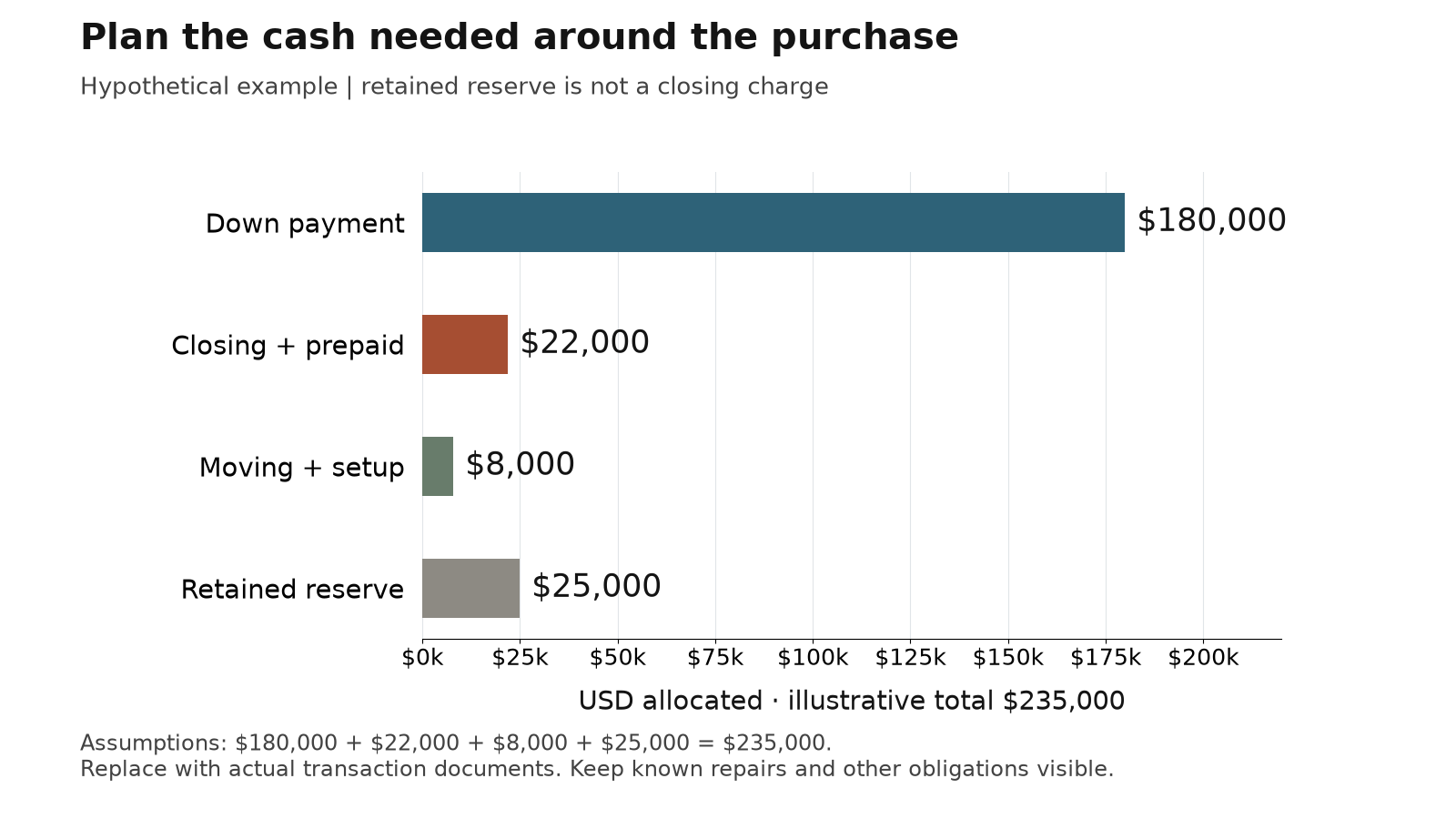
For the hypothetical $900,000 purchase, a $180,000 down payment plus an assumed $22,000 in closing and prepaid costs, $8,000 for moving and setup, and a retained $25,000 reserve totals $235,000. Only the down payment is calculated directly from the chosen purchase assumption. The other amounts are planning inputs, not estimates from a lender, title company, mover or contractor. Replace each with your own documents and avoid counting prepaid items again as an additional first-year expense.
The reserve is not a closing fee. Its purpose is to remain available for the risks and obligations you decide to cover. A known repair or assessment may require a separate allocation rather than being hidden inside a general reserve. If a sale of another property is funding the purchase, use expected net proceeds after the relevant obligations, not the sale price, when assessing available cash.
Timing also matters. Identify when deposits, inspections, insurance arrangements and final funds are required under the actual transaction. Our seller resources can help organize a sale-first move. Coordinate the budget with your lender, closing professionals and tax adviser so that the household understands both the total and the dates. This illustration is a method for collecting the information, not a prediction of your final closing statement.
How can you compare Incline Village with Reno, Sparks or Carson City?
Compare specific homes and the routine each would support. The tax treatment of a Nevada resident is not unique to an Incline Village address, while housing, services and access depend on the property. A valley location may work well for a particular household, but a blanket claim that moving there saves a fixed amount or guarantees a short trip to the lake is not a substitute for actual alternatives.
Many of my Northern Nevada clients weigh exactly this: full-time Tahoe living at Incline prices, versus a valley home with frequent Tahoe day trips. Use the same budget categories for both options, including travel that one location adds and services the other requires. A lower purchase price does not settle the comparison if the home needs significant work, the financing differs or the location creates a recurring trip you do not want to make.
Start with Reno, Sparks and Carson City as separate location choices. Then identify homes with comparable usable space and features, confirm the actual route to the destinations that matter and obtain the relevant cost documents. Our Reno new-construction guide is a Northern Nevada option to investigate when new construction fits the search. No community label determines who should live there or whether a particular house meets your needs.
For an Incline comparison, include the benefit you expect from being in the basin and the responsibilities attached to the home. In my experience, the full-time resident community is smaller and tighter than the home count suggests, and it is a genuine draw — Incline offers exceptional recreation with a small-town, uncrowded feel most of the year. Your decision should still be based on the places, services and property features you verify, not an assumed demographic profile or future resale premium.
How do you decide whether the complete budget is comfortable?
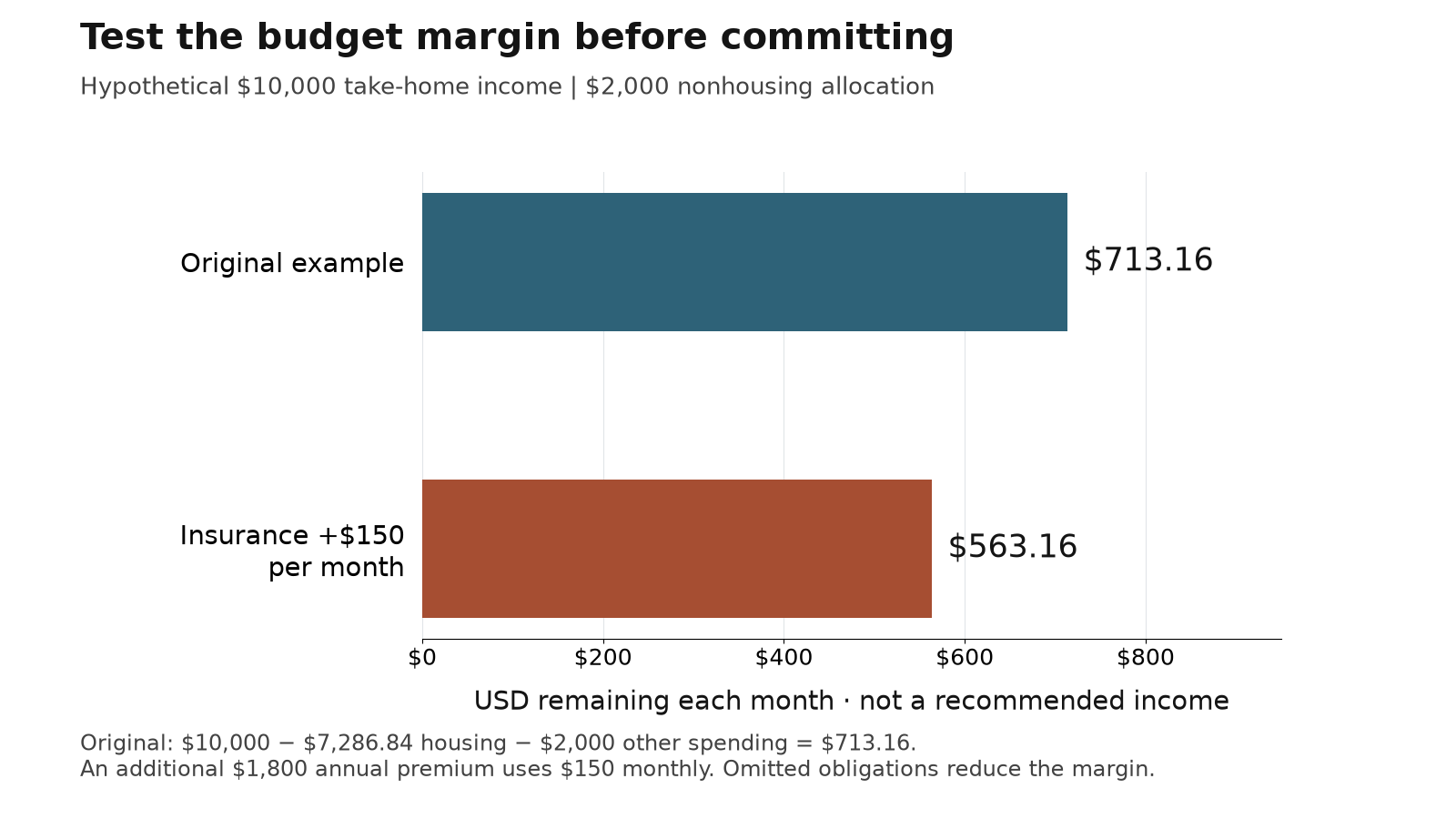
Test the proposed household plan using dependable take-home income and the obligations you expect to maintain. In the financed ownership illustration, $10,000 of assumed monthly take-home income minus $7,286.84 of selected housing costs and $2,000 of other spending leaves $713.16. These inputs are hypothetical. The result does not establish a recommended income, lending qualification or comfortable margin for your household.
Now test a change that matters. The additional $1,800 annual insurance cost discussed earlier would consume $150 monthly, reducing that illustrated remainder to $563.16. A major repair or additional healthcare obligation could use more than the remaining margin. Include savings goals, taxes not already withheld and other commitments before concluding that money is available. A worksheet should expose a fragile plan, not make it appear affordable by omitting categories.
| Requirement | Evidence to obtain | What could change the choice |
|---|---|---|
| Manageable recurring cost | Financing, tax, insurance, utility and association documents | A missing charge or revised quote that removes the budget margin |
| Desired recreation access | Parcel eligibility and current district or association terms | Privileges not included in the actual transaction |
| Practical year-round use | Property inspection, access review and service proposals | Maintenance or travel requirements the household cannot sustain |
| Expected tax benefit | Professional projection tied to income, residency and timing | Continuing obligations or a one-time benefit treated as recurring |
The honest advice I give clients is to run the full number: your income, your likely tax savings, the housing cost, and the lifestyle value, together. For many of my clients, that calculation is what makes Incline make sense; for others, a Reno or Carson City base with Tahoe day trips is the better fit. Either way, the decision should be made with the real math in front of you, which is exactly what we help buyers assemble.
For a property-specific discussion, call (775) 277-2120, browse Incline Village homes for sale or review buyer resources. If retirement is part of the decision, our Incline Village retirement guide raises additional planning questions. Bring the documents and unresolved items with you so that the next conversation can focus on the actual home and household, rather than an unsupported citywide promise.
What questions do buyers ask about Incline Village living costs?
What is the cost of living in Incline Village in 2026?
There is no single verified total for every household. Add the actual housing, insurance, taxes, district and association charges, services and ordinary spending. The historical Census housing figures provide context, while the current IVGID schedule supplies a specific public charge. The guide's ownership and rental examples are hypothetical worksheets, not current offers or representative local household budgets.
Is the historical Census value today's median sale price?
No. The 2020–2024 Census median owner-occupied value describes a different measure and period from the median price of recent closed sales. Use current, comparable transaction evidence for a purchase decision and preserve its dates and scope. Do not turn a historical value or a listing's asking price into a current community sale-price statistic.
Do IVGID facility fees include every activity?
No. Verify the parcel's eligibility and the applicable privileges, discounts, guest rules and separate charges. The combined fee applies where both recreation and beach charges are assessed. The tax bill may already include it, so check before adding it again to the budget. Owners and tenants also need to follow the current documentation and assignment rules.
Will moving to Incline Village eliminate California income tax?
Not necessarily. Residency and income sourcing require a facts-specific review, and California-source income can remain taxable after a move. Buying a Nevada property or meeting a simple day-count assumption does not answer every tax question. Get a professional projection for the household and compare it with actual incremental living and transition costs before relying on a savings estimate.
Is a debt-free home inexpensive to carry?
Removing the loan payment does not remove taxes, insurance, association obligations, district charges, utilities or maintenance. The purchase also commits capital. In this guide, the debt-free version keeps the same assumed operating allocations as the financed example. That is a calculation for the hypothetical home, not proof of the cost of another property or the best use of your cash.
How should you estimate insurance and winter costs?
Obtain written information for the actual address, occupancy, coverage and service requirements. Review exclusions, deductibles and the association's responsibilities where applicable. Use an annual calendar and retain enough cash for uneven payments. Broad local ranges cannot establish that suitable coverage or a particular service is available to you at a quoted amount.
Should you choose Reno or Carson City instead?
Compare actual homes using consistent categories, then test the travel and activities you expect to repeat. A valley home may fit one household better, while living in the basin may be central to another's plans. Neither a generic price gap nor an unverified drive time establishes the right choice. Property condition, total costs and the household's priorities determine the useful comparison.
Which evidence should you refresh before acting on this budget?
This review used primary Census, IVGID, Washoe County, Nevada tax and insurance, FTB and Freddie Mac sources on October 22, 2026. Historical Census periods, fiscal-year fees and the weekly mortgage-survey date retain their own labels. The linked source supports the specific attributed fact; it does not verify the invented prices, operating amounts or household inputs used in the examples.
Before committing, update the actual property's financing, full tax bill, association documents, insurance quote, service estimates and inspection findings. The Washoe County partial-abatement explanation describes limits on eligible tax-bill increases, not a tax rate applied to the purchase price. Its abatement review guidance also identifies value newly added to the roll as a separate issue. Confirm the parcel's treatment rather than assuming a universal tax percentage.
No local household survey, new MLS median study, current rental inventory sample or insurance-price survey was performed for this guide. No personal tax return was calculated. The purpose is to make the evidence, assumptions and unresolved costs visible so that the home decision can use current documents and appropriate professional advice. Retain copies and expiry dates so a changed quote triggers a budget revision before the transaction proceeds. Original publication remains July 1, 2026; this substantive review does not turn historical figures into October market quotes.