
Published June 14, 2026 · Updated June 14, 2026 · By Chris Nevada, Nevada Real Estate Group · NV License S.181401
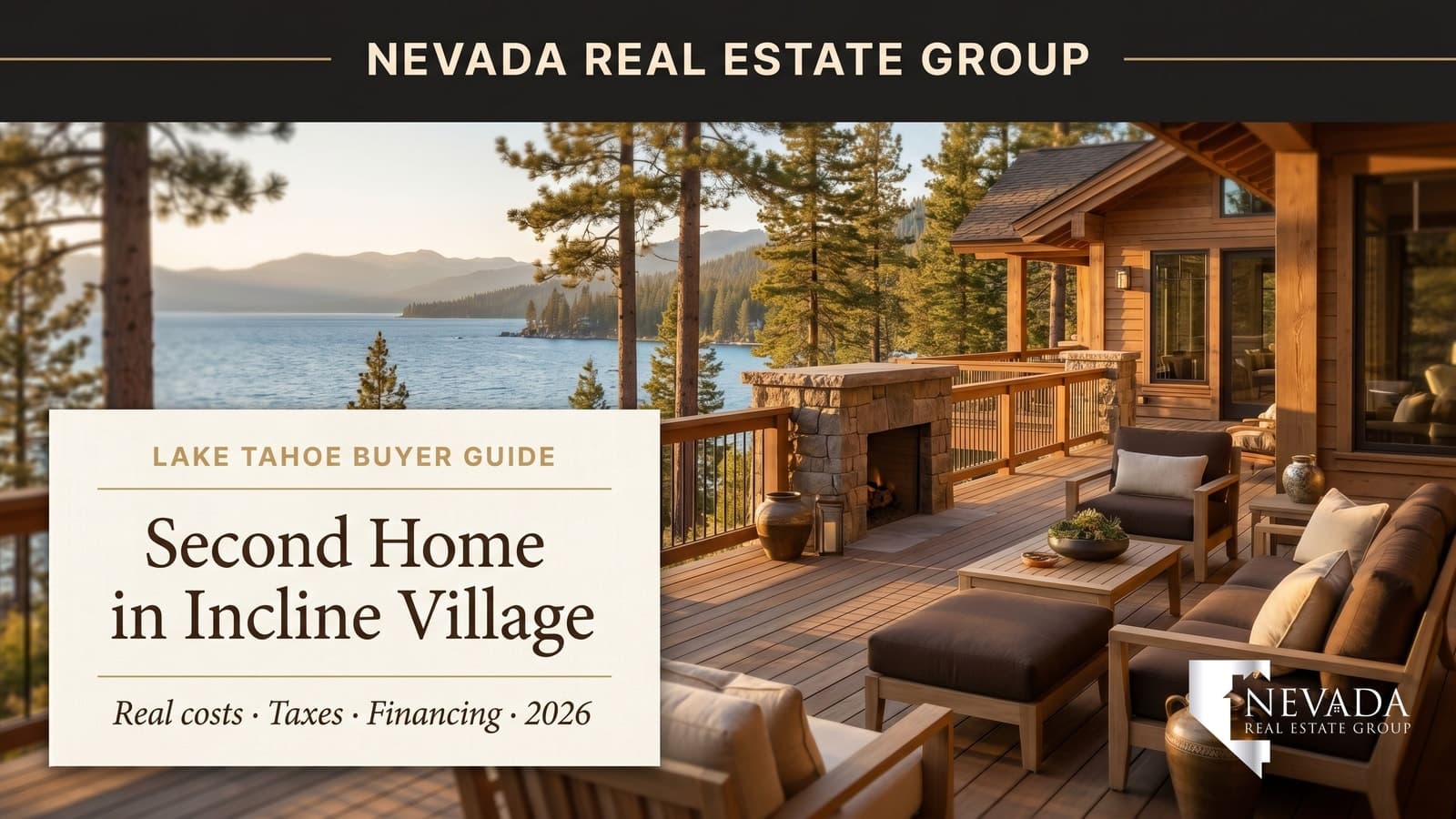
A second home in Incline Village is one of the most coveted purchases on Lake Tahoe — and one of the most misunderstood on cost. Buyers fall for the alpine lake, the Diamond Peak ski runs, and the Nevada-side tax treatment, then discover that the carrying costs, the IVGID fees, the insurance market, and the short-term rental rules all behave differently than they expected. This guide lays out the real numbers for 2026 so you go in with eyes open.
Across the 9,600-plus closings Nevada Real Estate Group — the #1 real estate team in the state — has represented, second-home buyers consistently tell us the same thing afterward: they wish they'd modeled the full cost of ownership before they fell in love with a view. So we'll do exactly that here, from purchase price to the line items most buyers forget. If the tax angle is your primary driver, read it alongside our flagship guide on Incline Village tax advantages and Nevada residency, which covers the full residency picture.
A second home in Incline Village generally starts around $800,000 for condos and runs into the millions for lakefront homes. Beyond price, budget for property taxes near 0.6% of value, IVGID recreation fees, any HOA dues, higher second-home mortgage rates, wildfire-driven insurance, and Washoe County short-term rental rules. Nevada's no-income-tax structure improves the math, but the carrying costs are real and worth modeling up front.
- Incline Village second homes start near $800,000 and reach $20 million-plus on the lakefront.
- Property taxes run roughly 0.6% of value — low for a luxury market.
- Second-home mortgages carry higher rates and larger down payments than primary loans.
- Wildfire risk has tightened the Tahoe insurance market — get quotes before you commit.
- Washoe County regulates short-term rentals, so confirm the rules before counting on rental income.
Ready to browse? Lake Tahoe homes for sale and Incline Village homes for sale lists every active MLS home with photos, prices, and map search.
What Does a Second Home in Incline Village Cost in 2026?
It depends heavily on the property type, but the floor is high because this is a scarce, luxury market on the Nevada shore of Lake Tahoe. Condominiums and smaller homes generally start around $800,000 to $1.2 million, mid-market single-family homes run from roughly $1.5 million into the several millions, and true lakefront estates command from about $5 million into the $20 million-plus tier. The lakeshore corridor anchors the top of the market.
What you're paying for is twofold: the Tahoe location and the constrained supply. Incline Village is largely built out, ringed by national forest and the lake, so there's little new construction to add inventory. That scarcity is why prices hold up even when broader markets soften, and it's why we tell second-home buyers to act decisively when the right property appears rather than waiting for a comparable to come along.
Within the community, neighborhoods offer meaningfully different price points and characters. Mill Creek and Ponderosa offer single-family living at varying elevations and views, while the alpine Tyrolian Village leans toward ski-access homes and condos. Matching the neighborhood to how you'll actually use the second home — ski weekends, summers on the water, eventual full-time living — is the first decision we work through with buyers.
| Property Type | Typical 2026 Price Range |
|---|---|
| Condominium | $800,000–$1,500,000 |
| Mid-market single-family | $1,500,000–$4,000,000 |
| View / luxury single-family | $4,000,000–$8,000,000 |
| Lakefront estate | $5,000,000–$20,000,000+ |
For perspective, a buyer who tours the market expecting a $700,000 entry point usually recalibrates quickly: even a modest condo near the village core tends to start around $850,000, and anything with a genuine lake view or beach proximity moves well past $2,000,000. The scarcity premium is real, and it's the single biggest reason we counsel second-home buyers to define their budget — and their must-haves — before the first showing rather than after they've fallen for a $6,000,000 view they didn't plan to chase.

How Much Are Property Taxes on an Incline Village Second Home?
Comparatively low, which softens the carrying cost of a luxury property. Incline Village sits in Washoe County, and according to the Washoe County Assessor, Nevada's effective property tax rates run well under 1% of value — generally around 0.6% to 0.7%. On a $2 million home, that's roughly $12,000 to $14,000 a year, materially less than the bill on a comparable property in many higher-tax states.
One important nuance for second-home buyers: Nevada's property tax abatement cap that limits annual increases is more generous for owner-occupied primary residences than for second homes and investment property. According to Nevada Revised Statutes, a non-primary residence can be subject to a higher cap on annual increases, so a property used purely as a second home won't get the same protection an owner-occupied home would. Confirm the classification and the applicable cap with the Washoe County Assessor for any specific property.
This is also one of the places where the second-home-versus-residency decision shows up in dollars. If the long-term plan is to eventually make Incline your primary home — and capture the full Nevada tax advantage covered in our tax-advantages guide — the property tax treatment improves once it's your primary residence. Many of our buyers think of the second home as a first step toward that move.
What Are IVGID Fees and How Do They Work?
This is the line item out-of-area buyers most often overlook. Incline Village is served by the Incline Village General Improvement District (IVGID), which operates the community's beaches, recreation centers, golf, ski area, and other amenities. According to the Incline Village General Improvement District, property owners pay an annual recreation facility fee, and that fee is what unlocks owner access to the private beaches and discounted amenity pricing through the IVGID "picture pass" system.
For a second-home buyer, IVGID access is a genuine value — private Tahoe beaches are rare and tightly controlled — but the annual fee is a real recurring cost to budget, separate from property taxes and any HOA dues. The beach access tied to property ownership is one of Incline's signature perks, and it's part of why homes here command a premium over otherwise-comparable Tahoe properties without that access.
Buyers should verify the current IVGID fee and exactly which amenities and beach privileges attach to a given property during due diligence, because the details matter. We walk second-home buyers through the IVGID structure as part of the cost model, since it's both a meaningful expense and a meaningful benefit that doesn't exist on most of the California side of the lake.
What About HOA Dues and Other Carrying Costs?
On top of property taxes and IVGID fees, many Incline Village properties — particularly condos and homes in planned developments — carry homeowners association dues. These vary widely by property: a luxury condo with shared amenities can carry substantial monthly dues, while a standalone single-family home may have little or no HOA. The only way to know is to review the specific property's HOA documents during escrow.
Then there are the carrying costs every mountain second home shares: utilities (heating an alpine home through a Tahoe winter is not trivial), snow removal, landscaping, and ongoing maintenance against freeze-thaw and heavy snow loads. Properties left vacant for stretches also need management — someone to check on freeze risk, clear snow, and handle issues — which is either your time or a paid property manager.
| Cost Category | Approximate Annual Range |
|---|---|
| Property taxes (0.6%–0.7%) | $12,000–$14,000 |
| IVGID recreation fee | Hundreds to low thousands |
| HOA dues (property-dependent) | $0 to $20,000+ |
| Insurance (wildfire-exposed) | Several thousand to five figures |
| Utilities + snow + maintenance | $8,000–$20,000+ |
These ranges are illustrative and vary enormously by property, so treat them as a framework for your own due diligence rather than fixed figures. The point is simply that the all-in carrying cost of an Incline second home is the sum of several line items, not just the mortgage and the tax bill.

To put the full carry in concrete terms: a $2,000,000 Incline Village second home might run roughly $13,000 in property taxes, a low-four-figure IVGID fee, anywhere from $0 to $15,000 in HOA dues depending on the property, perhaps $6,000 to $12,000 in wildfire-exposed insurance, and another $10,000-plus in utilities, snow removal, and maintenance — so total annual carry outside the mortgage can land anywhere from about $30,000 to $50,000 before financing. On a financed purchase, the mortgage stacks on top of that. None of it should deter the right buyer, but all of it belongs in the model before you write an offer, which is why our community guides and cost worksheets walk through each line item property by property.
How Does Financing a Second Home in Incline Village Work?
Differently from a primary residence, and more expensively. Lenders price second-home mortgages with higher interest rates and larger down-payment requirements than owner-occupied loans, because a second home is a higher risk to the lender — it's the property a stressed borrower stops paying first. Expect to put more down and to qualify on the basis that you'll carry both your primary housing cost and the Incline home.
In the Incline price range, many purchases also enter jumbo-loan territory, since the loan amounts exceed conforming limits. Jumbo second-home financing means stricter underwriting — larger reserves, stronger credit, fuller documentation — and rates that move with the jumbo market rather than headline conforming rates. According to the Consumer Financial Protection Bureau, shopping multiple lenders materially affects the rate and terms you're offered, which matters even more on a large second-home loan.
A practical note from our transactions: get fully underwritten pre-approval for the second-home scenario specifically before you shop, because the qualifying math is different and you don't want to find a property you love and then discover the financing doesn't pencil. Even strong, high-net-worth buyers in this market benefit from modeling the loan precisely up front. Cash buyers, common at the top of the Incline market, skip this — but should still model opportunity cost.

Can You Rent Out a Second Home in Incline Village?
Sometimes, but only within the rules — and you cannot assume rental income will cover the carry. Short-term rentals in the Incline Village and Crystal Bay area fall under Washoe County regulation, and according to Washoe County, short-term rentals in unincorporated areas require a permit and must comply with rules covering occupancy, parking, noise, and the total number of permits available. Those rules have tightened across Tahoe communities in recent years, so verify the current requirements before counting on rental revenue.
For buyers whose model depends on offsetting costs with rental income, this is a make-or-break due-diligence item. A property's eligibility for a short-term rental permit, the cap on permits, and any HOA restrictions on rentals all affect whether the income strategy is viable. We've seen buyers assume Tahoe equals easy rental income and then find the specific property or neighborhood doesn't allow it — so confirm before you buy, not after.
If a short-term rental permit isn't available or desired, longer-term seasonal rentals are another option, though the economics differ. The honest framing we give second-home buyers: buy the Incline home because you want to use it, and treat any rental income as a bonus that defrays cost rather than the foundation of the purchase. The properties that work purely as rental investments are the exception here, not the rule.
How Does Wildfire Risk Affect Insurance and Cost?
Significantly — it's one of the biggest changes in Tahoe-area ownership over the past several years. Like much of the wildland-urban interface in the West, the Lake Tahoe basin carries real wildfire exposure, and that has tightened the insurance market. According to the Insurance Information Institute, wildfire-exposed regions have seen carriers raise premiums, tighten underwriting, and in some cases decline to write or renew policies, pushing some owners toward surplus-lines or state-backed coverage.
For an Incline Village second-home buyer, this means insurance is no longer a rounding error — it's a line item to price before you commit, and in some cases a contingency to clear before closing. Get quotes early on the specific property, because cost and availability vary by location, defensible space, roofing, and construction. According to Cal Fire and Nevada fire authorities, defensible-space and home-hardening improvements can affect both safety and insurability, so a property's wildfire mitigation matters.
The practical guidance: make insurance part of your due diligence from the first showing, not an afterthought at closing. We've had buyers adjust which property they pursued based on the insurance picture alone. It's a manageable cost for most Incline buyers, but only if you price it in deliberately rather than assuming standard homeowner rates.
Why Buy on the Nevada Side Instead of California's Tahoe Shore?
Because the Nevada side changes the tax math, even on a second home. Communities like Carson City and the broader Nevada region share Nevada's no-income-tax structure, and Incline Village is the marquee Lake Tahoe expression of it. While a pure second home (where you remain a resident elsewhere) doesn't automatically capture income-tax benefits, owning on the Nevada shore positions you to eventually establish residency — which is exactly the path many Incline buyers take.
There's also the access and lifestyle case. Incline sits within Washoe County and is roughly 45 minutes from Reno-Tahoe International Airport, making it one of the more accessible parts of the Tahoe basin for a second-home owner flying in for weekends. According to the U.S. Census Bureau, the surrounding Washoe County area provides the year-round services and infrastructure that make Incline a real community rather than a seasonal outpost.
For buyers weighing the two shores, the decision often comes down to this: if there's any chance the second home becomes a primary home — or a residency play — later, the Nevada side is the only one that keeps that door open. Our tax-advantages guide walks through what that transition is worth, and our community guides cover the neighborhoods in depth.
What Should You Look for in an Incline Village Second Home?
Start with how you'll use it, because that drives everything else. A ski-focused buyer prioritizes proximity to Diamond Peak and the alpine neighborhoods; a summer-on-the-water buyer prioritizes lake access and proximity to the IVGID beaches; an eventual-full-timer weighs the things that matter for daily living — kitchen, single-level options, year-round road access. The "best" property is the one that fits your actual usage pattern, not the one with the most impressive listing photos.
Then pressure-test the practical realities: winter access and snow load, the property's wildfire mitigation and insurability, the IVGID and HOA fee picture, and whether short-term rental is allowed if that matters to you. These are the items that separate a second home you love from one that becomes a headache. We build this checklist into every Incline search, because the view sells itself — it's the operational details that determine whether you'll be happy in year three.
Finally, weigh the long game. Many of our Incline buyers start with a second home and end up establishing Nevada residency, so it's worth buying a property that would work as a primary residence if your plans evolve. That foresight costs nothing at purchase and preserves the most valuable option Incline offers: the ability to make the Nevada-side tax advantage fully yours down the road.
It's also worth comparing Incline to the other Nevada-side Tahoe options before you commit, because the right second home isn't always the first one you see. The neighboring Crystal Bay area offers a quieter, even more exclusive stretch of the North Shore, while the south-shore Zephyr Cove and broader Stateline communities trade the Incline amenity package for a different feel and, often, different pricing. A buyer set on IVGID beach access and Diamond Peak will stay in Incline; a buyer prioritizing seclusion or a particular price band may find a better fit a few miles away. We tour the full Nevada shore with second-home buyers precisely so the $1,500,000-to-$5,000,000 decision is made against the whole field, not a single listing — because at this price point, the difference between a good fit and a great one is worth the extra showings.
How Do You Actually Buy a Second Home in Incline Village?
Treat it as a deliberate, well-advised process. The sequence we run with second-home buyers:
| Step | Action | Why It Matters |
|---|---|---|
| 1. Model the full carry | Taxes + IVGID + HOA + insurance + upkeep | Avoids cost surprises later |
| 2. Get second-home pre-approval | Underwrite the second-home/jumbo scenario | Different qualifying math |
| 3. Price insurance early | Get wildfire-market quotes per property | Can change which home you pursue |
| 4. Verify rental eligibility | Confirm STR permit rules if renting | Don't assume income |
| 5. Match neighborhood to use | Ski, lake, or future primary home | Drives long-term satisfaction |
| 6. Plan the residency option | Buy a home that could become primary | Preserves the tax upside |
Work the process with an agent who knows the Incline market and a lender who underwrites second homes, and the purchase is straightforward. Skip the modeling and the due diligence, and the surprises show up after closing — which is the one outcome a luxury second home should never deliver. The buyers who enjoy their Incline home most are invariably the ones who priced every line item honestly before the offer, then bought with confidence rather than hope.
What Mistakes Do Incline Village Second-Home Buyers Make?
The most common is underestimating the all-in carrying cost — budgeting for the mortgage and property tax but forgetting IVGID fees, HOA dues, wildfire insurance, and the real cost of maintaining a mountain home through Tahoe winters. The second is assuming rental income will cover the carry without first confirming the property is even eligible for a short-term rental permit under Washoe County rules.
A third mistake is buying purely on the view without weighing the operational realities — winter access, insurability, and whether the home would work if plans change and it becomes a primary residence. And a fourth is not pricing the move toward residency: many buyers would have chosen a slightly different property had they realized at purchase that they'd want it to become their Nevada primary home, capturing the full tax advantage, within a few years.
None of these are hard to avoid — they just require modeling the purchase fully before falling for the lake. If you're considering an Incline Village second home, Nevada Real Estate Group's Northern Nevada team can build that full cost model with you, walk the neighborhoods, and connect you with second-home lenders and the right insurance and tax professionals. Call us at (775) 277-2120, and buyers also weighing Southern Nevada can compare the Las Vegas and Henderson markets.
What Are the Most Common Questions About Incline Village Second Homes?
How much does a second home in Incline Village cost?
Condos and smaller homes generally start around $800,000 to $1.2 million, mid-market single-family homes run from roughly $1.5 million into the several millions, and lakefront estates command from about $5 million into the $20 million-plus range. Incline is a scarce, largely built-out luxury market, so prices hold firm even when broader markets soften.
What are property taxes on an Incline Village second home?
Roughly 0.6% to 0.7% of value — about $12,000 to $14,000 a year on a $2 million home. Note that Nevada's annual-increase cap is more generous for owner-occupied primary residences than for second homes, so a pure second home won't get the same protection. Confirm the classification with the Washoe County Assessor.
What are IVGID fees?
IVGID is the Incline Village General Improvement District, which runs the community's beaches, recreation centers, golf, and ski area. Property owners pay an annual recreation facility fee that unlocks owner access to private Tahoe beaches and discounted amenities through the "picture pass." It's a real recurring cost — and a genuine perk most of the California shore doesn't offer.
Can I rent out my Incline Village second home short-term?
Sometimes, but only with a permit and within Washoe County's short-term rental rules, which cover occupancy, parking, noise, and permit caps. Tahoe-area STR rules have tightened, and some properties or HOAs don't allow it, so verify eligibility before counting on rental income. Treat any rental income as a bonus, not the foundation of the purchase.
How does financing a second home in Incline Village differ?
Second-home mortgages carry higher rates and larger down payments than primary-residence loans, and many Incline purchases enter jumbo territory with stricter underwriting and reserve requirements. Get fully underwritten pre-approval for the second-home scenario before you shop, and compare multiple lenders, since terms vary meaningfully on large loans.
Is wildfire insurance a problem in Incline Village?
It's a real consideration. The Tahoe basin carries wildfire exposure, and carriers have raised premiums, tightened underwriting, and in some cases declined coverage. Insurance is now a line item to price before you commit — get property-specific quotes early, since cost and availability depend on location, defensible space, and home hardening.
Should I buy a second home or establish Nevada residency?
It depends on your goals, but many Incline buyers start with a second home and later establish residency to capture Nevada's no-income-tax advantage. If there's any chance of that transition, buy a property that could become your primary home. Our companion guide on Incline Village tax advantages covers the residency path in full.
Which Sources Inform This Incline Village Second-Home Guide?
This guide combines Nevada and federal authorities with our own transaction experience. Costs, tax rules, rental regulations, and insurance markets change — confirm the specifics for any property with the relevant authority and your own professionals; this is general information, not legal, tax, or financial advice.
- Washoe County Assessor
- Washoe County (short-term rentals)
- Nevada Revised Statutes (property tax abatement)
- Nevada Department of Taxation
- Incline Village General Improvement District
- Consumer Financial Protection Bureau
- Insurance Information Institute
- Cal Fire
- U.S. Census Bureau — Washoe County QuickFacts
- Internal Revenue Service — Second Homes
- Federal Housing Finance Agency
This article is general information, not tax, legal, or financial advice. Costs, property tax classifications, short-term rental regulations, financing terms, and insurance availability are property-specific and subject to change — verify the details for any specific property with the relevant authority and a qualified professional before acting.