

The fastest way to understand Reno's attached-home market is a single price gap. As of July 12, 2026, the median list price on a Reno condo is $285,000, while the median list price across all Reno homes is $599,000 — a $314,000 spread that reshapes every conversation I have with buyers who want to be in this city without stretching to a detached house. Townhomes split the difference at a $424,999 median. That is the attainable-Reno story in three numbers, and it is why condos and townhomes deserve their own playbook rather than a footnote in a general market report.
Across the 9,600+ closings our team has represented statewide, the buyers who win in this segment are the ones who treat a condo or townhome as a specific product with its own financing rules, HOA math, and resale profile — not as a smaller, cheaper version of a single-family home. This guide walks through what these homes cost right now, where they cluster in Reno, how HOA fees and condo warrantability actually work, and why the lock-and-leave crowd heading up to Lake Tahoe keeps this segment tight.
Reno condos carry a median list price of $285,000 and townhomes $424,999, versus $599,000 for all Reno homes (live NNRMLS feed, July 12, 2026) — the most attainable way into the market. Condos cluster downtown and midtown; townhomes span midtown to south Reno. Budget for HOA fees, verify condo warrantability before you finance, and start your search at Nevada Real Estate Group by calling (775) 277-2120.
- Reno condos list at a $285,000 median — about 48% of the $599,000 all-homes median (NNRMLS, July 2026).
- 195 condos and 95 townhomes are listed in Reno now; 92 condos sold in 90 days.
- Condo warrantability decides your loan — a non-warrantable building can block conventional and FHA financing.
- Downtown high-rises like The Montage and Palladio anchor lock-and-leave second-home demand.
- HOA fees run $250 to $650 monthly on condos, covering exterior upkeep and insurance.
- Call Nevada Real Estate Group at (775) 277-2120 before you offer.
What Do Reno Condos and Townhomes Actually Cost in 2026?
Here is the live picture, pulled directly from Nevada Real Estate Group's NNRMLS feed on July 12, 2026 (methodology: median list price and active counts filtered by MLS style — Condominium and Townhouse — because a raw "condo" class field on the regional feed over-reports by sweeping in every attached and common-interest home; style filters isolate the true product):
- 195 active condos in Reno, at a median list price of $285,000
- 95 active townhomes in Reno, at a median list price of $424,999
- 1,570 active listings across all of Reno, at a median list price of $599,000
- 92 condos sold in the trailing 90 days, at a median sold price of $303,000
- Median condo days on market: 65 — a measured, negotiable pace, not a frenzy
Two figures in that list do the heavy lifting. First, the $285,000 condo median sits at roughly 48% of the citywide $599,000 median — attached ownership is the single largest affordability lever in Reno. Second, the $303,000 median sold price on condos actually runs above the $285,000 median list price, which tells you the closed pool skews toward larger, renovated, and downtown-tower units while the active list is padded with entry-level product still sitting on market. In my experience, that gap is exactly where a prepared buyer finds value — the sub-$285,000 units that need a cosmetic refresh.
Why Is Attached Housing the Most Attainable Way Into Reno?
Reno stopped being a cheap market several years ago. According to the U.S. Census Bureau, the city has grown steadily alongside an expanding logistics, advanced-manufacturing, and tech base anchored by the Tahoe-Reno Industrial Center to the east. That demand pushed the all-homes median to $599,000 — a number that prices a lot of first-time and single-income buyers out of a detached house entirely.
Attached homes are the release valve. A condo at the $285,000 median asks for roughly $57,000 down at 20%, or about $9,975 on an FHA 3.5% loan — versus roughly $120,000 down at 20% on the median house. Even a townhome at $424,999 trims the entry cost meaningfully while still delivering an attached garage and a private entrance in most cases. According to Freddie Mac's Primary Mortgage Market Survey, the rate environment through 2026 has kept monthly payments the binding constraint for most buyers, so the price you enter at matters more than ever — and $285,000 pencils where $599,000 does not.
The tradeoff is real and worth naming up front: you exchange land and full control for a lower price and shared maintenance. That is a feature, not a bug, for a huge share of Reno buyers — which is exactly why the lock-and-leave and rental segments are so active. Compare current attached inventory against detached options on our Reno homes for sale hub before you decide which side of the trade you want.
What Does Downtown Reno's High-Rise and Mid-Rise Condo Market Look Like?
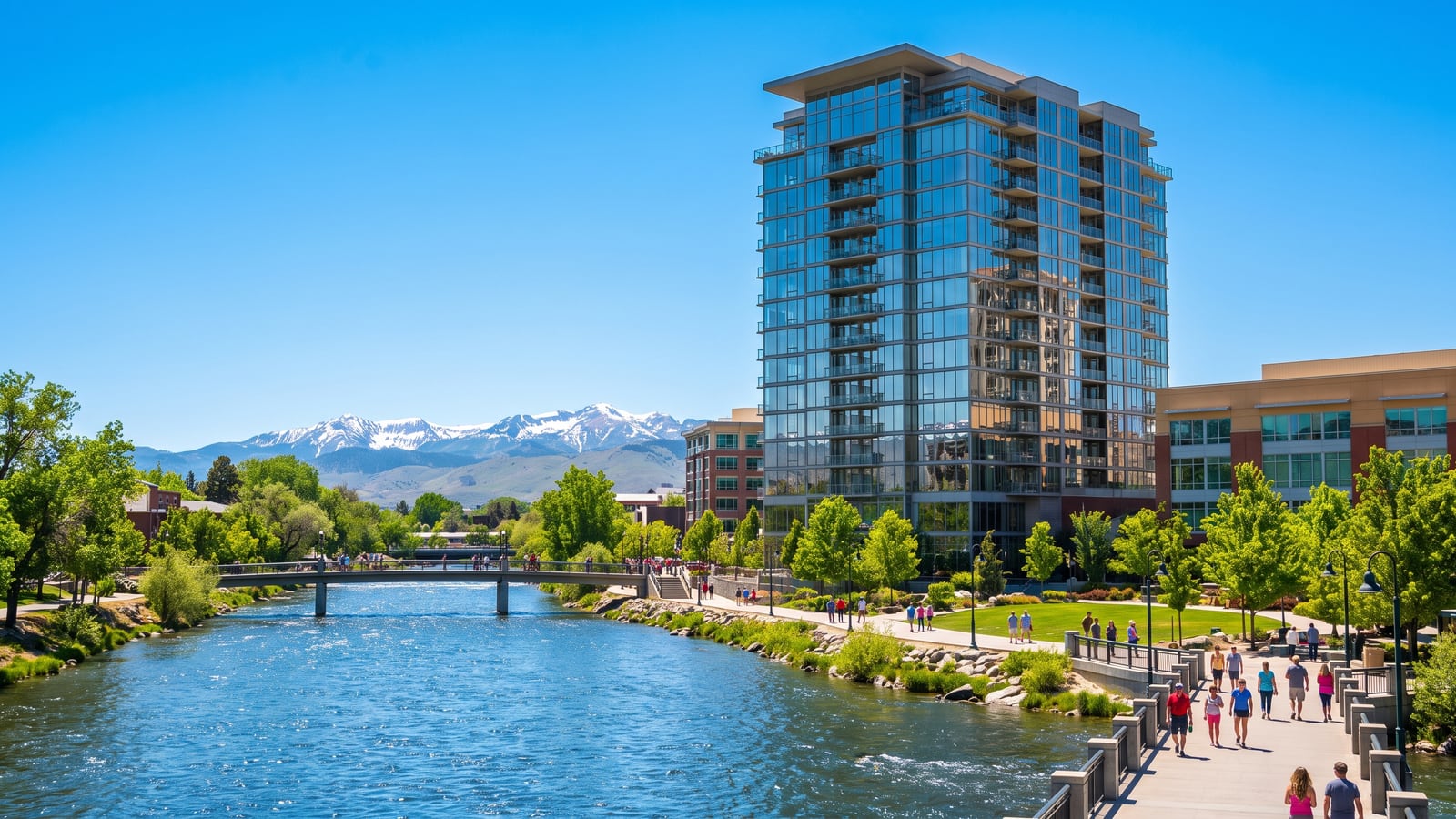
Downtown is where Reno's condo identity is clearest. The Truckee River cuts through the core, the downtown Reno district has added restaurants, a revitalized arts corridor, and walkable blocks, and the vertical residential stock — high-rise and mid-rise towers rather than garden-style walkups — gives buyers a genuinely urban, turnkey option that is rare anywhere else in Northern Nevada.
The named towers buyers ask me about most are The Montage, a full-service high-rise that is the dominant residential building over the river; The Palladio, a riverfront tower with concierge-style amenities; Riverwalk Towers; and Arlington Towers. Each carries its own HOA structure, amenity package, and — critically — its own financing profile, which I will come back to under warrantability. Pricing in these buildings runs the full spectrum: entry one-bedroom units near or below the $285,000 citywide condo median, mid-tier two-bedroom floor plans in the $400,000s to $600,000s, and penthouses that push past $1,000,000 when they trade.
What downtown sells is time and simplicity. A downtown condo means no yard, no roof to replace, secured parking, and — in the full-service buildings — a front desk and amenities. According to the Sierra Nevada REALTORS, the close-in urban core has held demand firm even as suburban inventory has loosened, precisely because that turnkey, walkable profile appeals to professionals, empty-nesters, and second-home buyers who value convenience over square footage.
Where Do Midtown Reno Townhomes Fit for Buyers?
If downtown is the condo story, midtown Reno is the townhome-and-lifestyle story. Midtown is the walkable district just south of downtown — independent restaurants, coffee shops, murals, and small retail — and its housing stock mixes early-1900s bungalows with newer infill townhomes and a handful of boutique condo projects.
Townhomes here appeal to buyers who want more space than a condo, a private entrance, and usually an attached garage, without paying the $599,000 detached median. At the $424,999 townhome median, a midtown buyer gets two or three levels, often two-car parking, and a footprint that lives like a house — while still handing exterior maintenance to the HOA. The tradeoff versus a downtown condo is fewer building amenities and, usually, a lower monthly HOA fee, since a townhome association maintains grounds and exteriors rather than an elevator, concierge, and pool deck.
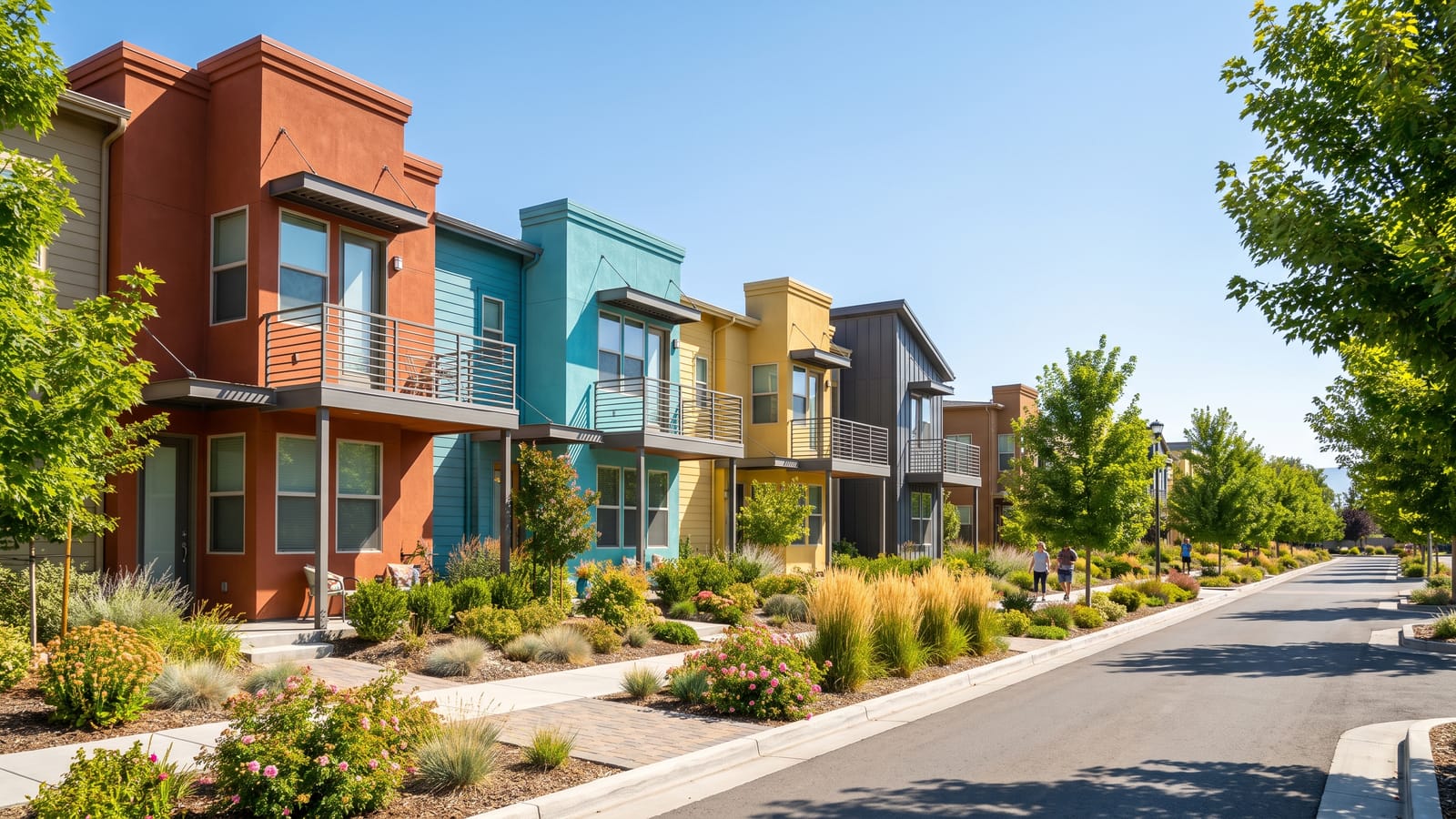
I steer walkability-first buyers toward midtown constantly, because it delivers the lifestyle people move to Reno for at a price detached homes in the same district cannot touch. For a fuller picture of how midtown prices stack up against the rest of the metro, read our Reno housing market breakdown.
What Newer Attached Product Is South Reno Building?
South Reno — the newer, master-planned side of the metro stretching toward Damonte Ranch and the south valley — is where the townhome and attached-home supply is actually being built. Where downtown and midtown offer character and location, south Reno offers new construction, HOA amenity packages, and modern floor plans.
Builders in south Reno have leaned into attached product because it lets them deliver a sub-median entry price on new inventory. A newer south-Reno townhome frequently lands between $400,000 and $525,000 — under the $599,000 detached median, with warranty coverage, current-code efficiency, and community amenities like pools and trails baked into the HOA. If a brand-new attached home is your target, our new construction guidance covers builder incentives and what to negotiate. According to the Nevada State Demographer, Washoe County's continued population growth keeps builder demand steady, and attached product is how builders answer the affordability squeeze without shrinking lots to nothing.
The buyer profile here differs from downtown. South Reno attracts families and remote workers who want a garage, a little community infrastructure, and a newer home — but still cannot, or would rather not, stretch to a detached house. Browse the newer inventory on our south Reno homes for sale page, and if you are also weighing nearby Sparks, the attached-home math there runs on similar lines.
How Do HOA Fees Really Work on Reno Condos and Townhomes?
Every attached home in Reno sits inside a common-interest community, and the HOA fee is the number that surprises first-time attached buyers most. It is not a tax and it is not optional — it funds the shared systems that make attached ownership work.
| Product type | Typical monthly HOA | What the fee usually covers |
|---|---|---|
| Garden / low-rise condo | $250 to $450 | Exterior, roof, grounds, master insurance, trash, some water |
| Full-service downtown high-rise | $450 to $900+ | All of the above plus elevator, concierge, secured parking, pool/gym, reserves |
| Townhome | $150 to $350 | Exterior, roof, grounds, master or shared insurance, sometimes trash |
| Newer south-Reno attached | $150 to $400 | Grounds, community amenities (pool, trails), exterior, reserves |
According to Nevada's Common-Interest Ownership Act, NRS Chapter 116, a seller in a common-interest community must deliver a resale package — the governing documents, current budget, reserve study summary, and fee schedule — to the buyer before closing. Read it. Two line items decide whether the fee is reasonable: reserves (the savings account that pays for the roof, elevator, and paint so you are not hit with a special assessment) and pending litigation or special assessments (the warning signs that a building is under-funded). In my experience, a fully-funded reserve study is worth paying a slightly higher monthly fee for — the alternative is a five-figure special assessment you did not budget for.
Do the math on the total carry, not just the price. A $285,000 condo with a $500 monthly HOA carries very differently than a $424,999 townhome with a $200 fee — over a year that is $6,000 versus $2,400 in dues, a $3,600 annual difference that can equal the payment gap between the two. Our Reno hub and the cost-of-living breakdown put those carrying costs in context against rents and detached ownership.
Can You Actually Finance a Reno Condo — and What Is Warrantability?
This is the section that saves deals. A condo is not just a smaller house to a lender — it is a unit inside a shared project, and the project itself has to qualify before your loan does. That concept is called warrantability, and it is the number-one reason a Reno condo purchase falls apart.
According to Fannie Mae's condo project eligibility rules, a "warrantable" condo project meets standards on owner-occupancy ratios, the share of units owned by any single entity, budget reserves (generally at least 10% of the budget), insurance, commercial-space limits, and litigation status. Hit those marks and conventional financing flows normally. Miss them and the project is non-warrantable — which does not make it unbuyable, but it changes everything about how you pay for it.
| Financing factor | Warrantable project | Non-warrantable project |
|---|---|---|
| Conventional loan available? | Yes — standard terms | No — needs a portfolio/non-QM lender |
| Typical minimum down | 3% to 5% | Often 20% to 25%+ |
| Interest rate | Market rate | Usually higher |
| FHA / VA eligible? | If on the approved list | Rarely |
Two gotchas hit Reno condos specifically. First, downtown high-rises with hotel-style amenities, short-term-rental activity, or significant commercial space are the buildings most likely to trip a warrantability flag — the very towers buyers most want. Second, FHA and VA each maintain their own approved-project lists; according to HUD's condominium approval process, a building must be individually approved for FHA financing, so a first-time buyer counting on a 3.5% FHA loan needs to confirm approval before falling in love with a unit. I've watched more condo deals wobble over a surprise warrantability finding than over price — which is why the first question our team asks on any Reno condo is "what does the project's questionnaire say?" Talk it through with our team through the buyers page before you write an offer.
Who Buys Reno Condos as a Lock-and-Leave Second Home?
Here is a buyer profile that keeps downtown Reno inventory tight: the lock-and-leave second-home owner, very often someone who also spends time at Lake Tahoe. A full-service condo an hour from the Tahoe basin is a nearly perfect base camp — you turn the key, the HOA handles the building while you are away, and there is no yard, pool, or roof to worry about from three hundred miles south.
According to Travel Nevada and the region's tourism data, the Reno-Tahoe corridor draws millions of visitors a year, and a meaningful slice of them decide they want a foothold. For those buyers, a $285,000 to $600,000 downtown condo is dramatically more attainable than a Tahoe-basin property, where the median clears well past $1,000,000, while still putting them minutes from the airport and an hour from the ski resorts. The turnkey, secured-building profile is the whole point — a house with a yard defeats the purpose.

The financing wrinkle matters for this group too: a second home is not owner-occupied, which interacts with both loan terms and a project's owner-occupancy ratio for warrantability. Investors and second-home buyers push the non-owner-occupied share up, and a building too heavy on second homes can itself tip non-warrantable. It is a good reminder that in a shared building, your neighbors' ownership choices affect your financing — one more reason to have someone read the project questionnaire before you commit.
Is a Reno Condo a Smart UNR-Proximity Rental Play?
For investors, the University of Nevada, Reno anchors a durable rental thesis. According to the University of Nevada, Reno, the campus enrolls more than 20,000 students, and the housing stock immediately around it — much of it condos, townhomes, and older attached homes near downtown and the north-of-downtown corridor — feeds a steady rental pool of students, faculty, and medical-district workers.
A $285,000 condo bought as a rental near campus can pencil where a $599,000 detached house cannot, simply because the rent-to-price ratio on attached product is friendlier and the HOA absorbs exterior maintenance that would otherwise land on the landlord. According to Nevada's landlord-tenant law, NRS Chapter 118A, Nevada gives owners a workable framework for standard leases, and Reno's no-state-income-tax backdrop improves the after-tax math versus California rentals across the Sierra.
Two cautions I always raise. First, some HOAs cap or restrict rentals — the resale package will tell you the rental ratio and any leasing restrictions, and you must confirm the building allows what you intend. Second, short-term rentals are separately regulated by the City of Reno and Washoe County; a long-term student lease is one thing, a nightly rental is another entirely. Verify the rules for the exact parcel, and treat this section as market commentary rather than legal or investment advice.
How Do Condos, Townhomes, and Single-Family Homes Compare for Reno Buyers?
When a buyer cannot decide, I put the three products side by side on the dimensions that actually drive the decision. This is the comparison that resolves most Reno attached-vs-detached debates.
| Dimension | Condo | Townhome | Single-family |
|---|---|---|---|
| Median list price | $285,000 | $424,999 | $599,000 |
| Typical monthly HOA | $250 to $900+ | $150 to $350 | $0 to $150 |
| Exterior maintenance | HOA handles all | HOA handles most | Owner handles all |
| Financing complexity | Highest — warrantability | Moderate | Lowest |
| Lock-and-leave fit | Excellent | Good | Poor |
| Private yard / land | No | Small or none | Yes |
The pattern is consistent: condos win on price and lock-and-leave convenience but carry the highest financing complexity and no land; single-family homes win on control and appreciation but demand the highest entry price and all the maintenance; townhomes sit in the middle as the compromise product. According to the Federal Housing Finance Agency's House Price Index, Nevada attached homes and detached homes have appreciated on broadly similar long-run trajectories, so the choice is really about lifestyle and budget rather than a bet that one product will dramatically outpace the other.
Are Reno Condos and Townhomes First-Timer Friendly?
Yes — attached homes are frequently the only way a first-time Reno buyer gets in the door, and that is by design. At a $285,000 condo median, an FHA 3.5% down payment is about $9,975, a figure within reach for a household that could never assemble $120,000 for 20% down on the median house. According to the Nevada Housing Division, the state runs down-payment-assistance and first-time-buyer programs that pair well with attached-home price points, further lowering the cash-to-close hurdle.
The catch is the warrantability and FHA-approval homework covered above — a first-timer counting on a low-down-payment loan has to confirm the specific project qualifies, ideally before touring. That is precisely where guidance pays for itself. Browse attainable entry-level inventory on our Reno homes for sale hub and start a conversation through contact so we can pre-screen buildings for your loan type before you fall for a unit you cannot finance.
The upside beyond price: a first attached home builds equity and credit history while the HOA absorbs the maintenance surprises — the failed water heater, the roof, the exterior paint — that catch new detached owners off guard. For many buyers, a condo or townhome is the smart three-to-five-year on-ramp to a detached home later.
What Is the Resale Outlook for Reno Attached Homes?
Attached homes have a well-earned reputation for being more cyclical than detached houses — they tend to be the first segment to soften in a downturn and can take longer to recover. That is the honest risk. But Reno's specific supply-and-demand picture cushions it more than most markets.
According to the Economic Development Authority of Western Nevada (EDAWN), the region continues to attract employers and in-migration, and Reno is not building large volumes of new downtown condo stock — the towers that exist are largely a fixed supply. Fixed urban supply plus continued in-migration plus a widening detached-affordability gap is a constructive backdrop for downtown condo resale specifically. Townhomes, with newer south-Reno supply still delivering, face more competition but also serve the deepest, most affordability-driven slice of the buyer pool.
My resale guidance is product-specific. For downtown condos, buy scarcity — a well-run, warrantable building with genuine views and amenities holds value because it cannot be easily replicated. For townhomes, buy location and HOA health — a fully-funded association in a walkable pocket resells far better than a cheaper unit in a distressed community. When you are ready to sell, our home value estimator gives a fast baseline and our sellers team prices attached homes to both the comp and the buyer pool. Track how the broader market is trending on our Reno housing market coverage and check current comparable listings anytime on our Reno search tool.
Which Reno Neighborhood Fits Your Condo or Townhome Search?
Matching product to place is the last decision. Downtown suits the turnkey, lock-and-leave, and second-home buyer who wants walkability and building amenities. Midtown suits the buyer who wants character, restaurants, and a townhome that lives like a house. South Reno suits the family or remote worker who wants new construction, a garage, and community amenities. And the near-campus corridor suits the UNR-proximity investor.
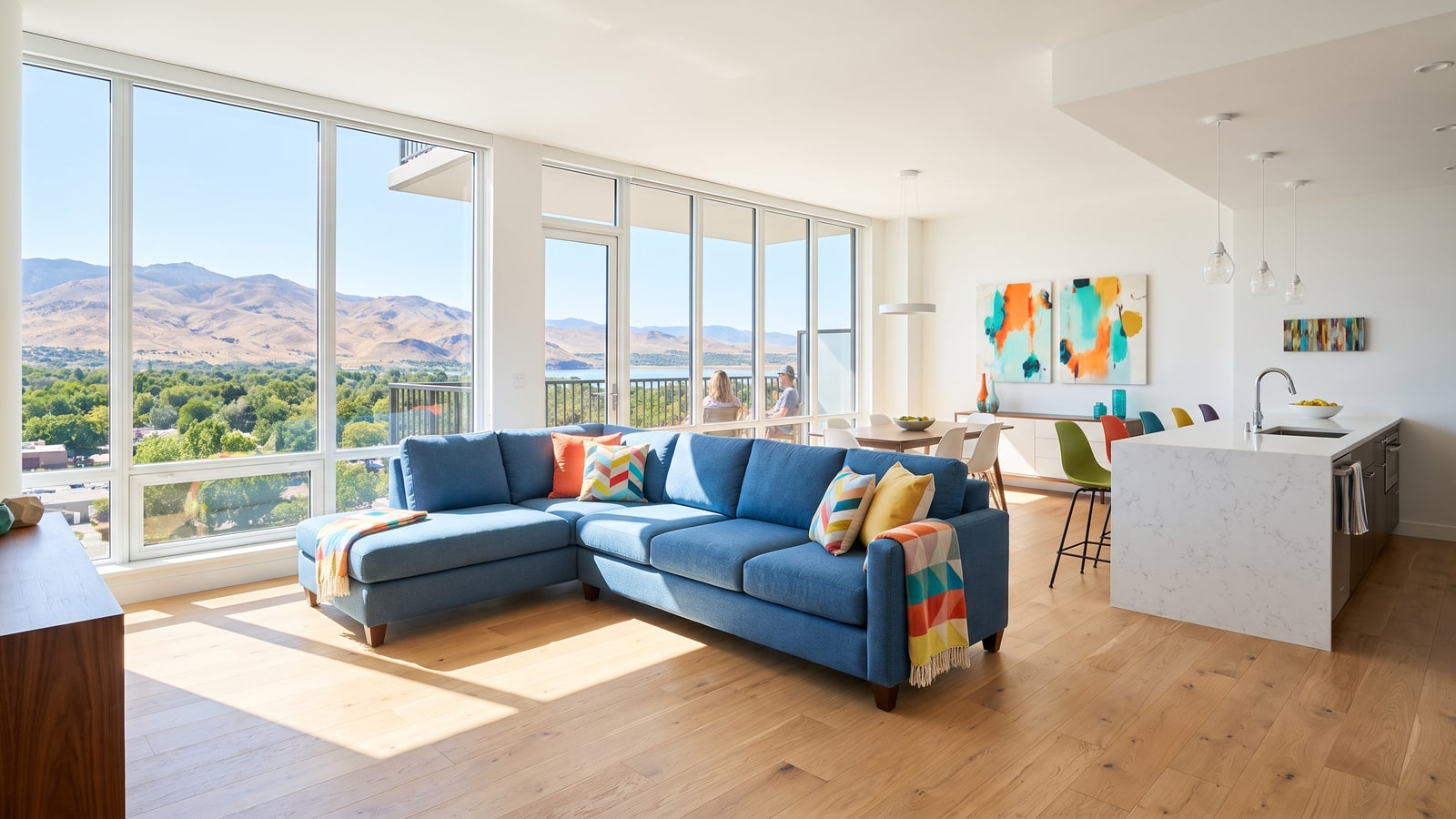
If you are relocating and still weighing the whole metro, our Reno relocation and pros-and-cons guide frames the neighborhood choices alongside the lifestyle tradeoffs, while the Sparks market next door and nearby Carson City widen the attached-home menu further. The right answer is rarely a product first — it is a neighborhood first, and then the best attached home that fits it.
Why Do Reno Condo and Townhome Buyers Call Nevada Real Estate Group?
Because attached homes punish generalists. The warrantability finding that kills a loan, the under-funded reserve study that signals a future special assessment, the rental cap buried in the CC&Rs, the FHA-approval list a first-timer never checked — each is routine for us and a landmine for an agent who closes a couple of condos a year.
Nevada Real Estate Group is the #1-ranked real estate team in Nevada, with more than $4.85 billion in career sales volume, 9,600+ closed transactions, and 789 closings in 2025 alone. Our Northern Nevada team works the Reno condo and townhome market every month — pulling the live NNRMLS data behind this guide, reading project questionnaires before our buyers offer, and matching product to neighborhood to loan type so the deal closes clean.
Buying a Reno condo or townhome? Let us pre-screen buildings for your financing and price point before you tour. Call or text our Northern Nevada team at (775) 277-2120 — reach us statewide at Las Vegas (702) 637-1759 · Reno (775) 277-2120 — browse current Reno condos for sale, or tell us what you are looking for and we will send matching inventory the moment it hits the market.
Frequently Asked Questions
What do Reno condos cost compared to houses in 2026?
As of July 12, 2026, the median list price on a Reno condo is $285,000 and a townhome is $424,999, versus $599,000 across all Reno homes (Nevada Real Estate Group's live NNRMLS feed). That makes a condo roughly 48% of the all-homes median — the single largest affordability lever in the market. Condos are the most attainable entry point, townhomes the middle-ground compromise, and detached homes the premium.
What do HOA fees run on Reno condos and townhomes, and what do they cover?
Townhomes typically run $150 to $350 a month, garden condos $250 to $450, and full-service downtown high-rises $450 to $900 or more. The fee covers exterior maintenance, roof, grounds, and master insurance, with high-rises adding elevator, concierge, secured parking, and amenities. Under Nevada's NRS Chapter 116, the seller must give you a resale package — read the reserve study and check for special assessments before you buy.
How does condo financing and warrantability work in Reno?
A lender approves both you and the condo project. A "warrantable" project meets Fannie Mae standards on owner-occupancy, reserves, insurance, and litigation, and qualifies for conventional loans at 3% to 5% down. A non-warrantable project — common in amenity-heavy downtown high-rises — usually requires a portfolio lender and 20% to 25%+ down at a higher rate. FHA and VA each maintain separate approved-project lists, so confirm approval before you offer.
What are the best areas for condos and townhomes — downtown, midtown, or south Reno?
Downtown suits lock-and-leave and second-home buyers who want high-rise towers, walkability, and amenities. Midtown suits buyers wanting character, restaurants, and townhomes that live like houses. South Reno suits families and remote workers wanting newer construction, a garage, and community amenities. Near-campus condos suit UNR-proximity investors. Pick the neighborhood first, then the best attached home that fits it.
Are Reno condos good for lock-and-leave second homes near Tahoe?
They are ideal. A full-service downtown condo an hour from the Lake Tahoe basin lets you turn the key and go — the HOA maintains the building while you are away, with no yard, pool, or roof to manage remotely. At $285,000 to $600,000, a downtown condo is far more attainable than a Tahoe-basin property clearing $1,000,000-plus, while staying minutes from the airport and an hour from the resorts.
Are Reno condos and townhomes first-timer friendly?
Yes — they are frequently the only way a first-time buyer gets in. An FHA 3.5% down payment on a $285,000 condo is about $9,975, versus roughly $120,000 for 20% down on the median house, and the Nevada Housing Division runs assistance programs that pair well with these price points. The one homework item is confirming the specific project is FHA-approved or warrantable for your loan before you tour.
What is the resale outlook for Reno attached homes?
Attached homes are more cyclical than detached houses, but Reno's fixed downtown condo supply plus continued in-migration cushions the risk for well-chosen units. For condos, buy scarcity — a warrantable building with real views and amenities. For townhomes, buy location and HOA health — a fully-funded association in a walkable pocket resells far better than a cheaper unit in a distressed community.
Which Sources Inform This Reno Condos Guide?
Live inventory, pricing, and sold figures come from Nevada Real Estate Group's NNRMLS feed, pulled July 12, 2026 (195 Reno condos at a $285,000 median list; 95 townhomes at a $424,999 median list; 1,570 all-home actives at a $599,000 median; 92 condos sold over 90 days at a $303,000 median and 65 median days on market — filtered by MLS style to isolate true condo and townhome product). Regulatory, financing, and market context draws on these authorities:
- Sierra Nevada REALTORS — Northern Nevada housing statistics
- Nevada Common-Interest Ownership Act — NRS Chapter 116 — HOA, resale-package, and reserve requirements
- Nevada Landlord-Tenant Law — NRS Chapter 118A — rental framework for investor buyers
- Fannie Mae — Condo Project Eligibility — condo warrantability standards
- HUD — Condominium Approval Process — FHA condo project approval
- Freddie Mac Primary Mortgage Market Survey — weekly mortgage-rate benchmarks
- Federal Housing Finance Agency — House Price Index — attached vs detached appreciation trends
- U.S. Census Bureau — Reno QuickFacts — population and housing baselines
- Nevada State Demographer — Washoe County population growth
- University of Nevada, Reno — enrollment and the campus rental market
- Economic Development Authority of Western Nevada (EDAWN) — employer growth and in-migration
- Nevada Housing Division — first-time-buyer and down-payment-assistance programs
Ready to find your Reno condo or townhome? Call or text Nevada Real Estate Group's Northern Nevada team at (775) 277-2120 — the attached-home specialists for Reno, downtown Reno, and Sparks.