
Buyers ask me some version of this question every month: they want to live on a golf course in Nevada, they are open on the city, and they want to know where the money goes further. Until now I have answered it with instinct. This time we measured it.
We pulled every major golf community in both markets from the live MLS — the Las Vegas board and the Northern Nevada board — and applied one method to all of them: residential only, no price floors, each community compared against its own city's baseline. That last part matters more than it sounds. Most golf-premium numbers you will read compare a gated community against a metro average that includes condos, land, and manufactured housing, which manufactures a premium out of nothing.
What came back reframed the question. The interesting difference between Las Vegas and Reno is not the trophy tier, where the two markets are nearly identical. It is what happens at the bottom.
Las Vegas buys more golf home per dollar. Reno's residential baseline is $347 per square foot against Las Vegas at $261 — 33% higher before any golf premium is applied. Las Vegas also offers something Reno does not: three golf communities priced below its own city median, including Tuscany at 14% under. Reno's cheapest golf address still costs more than Las Vegas's. Reno wins on scenery, seasons, and scarcity — not on price.
- Reno's baseline is $347 per square foot; Las Vegas is $261 — a 33% gap before golf.
- Las Vegas golf entry starts near $519,000 at Rhodes Ranch; Reno's starts near $670,000.
- Three Las Vegas golf communities sell BELOW the city median; Reno has essentially one.
- Trophy tier is a near tie: Red Rock at $707 per square foot, Montrêux at $757.
- Las Vegas homes sell in a median 28 days; Reno takes 48 — nearly twice as long.
Why Does a Golf-Course Premium Need a Same-City Baseline?
A premium is a comparison, and a comparison is only as honest as what sits on the other side of it. If you measure Red Rock Country Club against "the Las Vegas metro," you are measuring guard-gated custom estates against a pool that includes Strip-corridor studio condos. The number that falls out will be enormous and it will tell you nothing.
Every figure in this guide compares a golf community against the residential baseline of the city that contains it, computed from the same feed on the same day with the same filters. Land parcels are excluded — they carry no building square footage and would distort a per-square-foot median badly. Genoa Lakes alone carried two land listings that had to come out.
That discipline produced one immediate finding worth stating before anything else, because it governs the entire comparison.
| Measure | Las Vegas | Henderson | Reno | Sparks |
|---|---|---|---|---|
| Median active list | $468,800 | $538,390 | $649,990 | $599,500 |
| Price per square foot | $261 | $277 | $347 | $299 |
| Median closed price | $437,924 | $490,000 | $600,000 | $550,000 |
| Median days on market | 28 | 28 | 48 | 47 |
| Active listings | 8,532 | 2,389 | 1,231 | 509 |
Reno costs 33% more per square foot than Las Vegas before golf enters the conversation at all. That single fact carries most of the answer, and everything below is the texture around it.
How Much More Expensive Is Reno Before You Add Golf?
At $347 per square foot against $261, a 2,400-square-foot house costs roughly $833,000 in Reno and $626,000 in Las Vegas. That is a $207,000 difference for the same box, before anyone mentions a fairway.
The reason is supply, and it is structural rather than cyclical. Las Vegas has 8,532 active residential listings; Reno has 1,231 — about one-seventh. According to the U.S. Census Bureau, the Las Vegas-Henderson-Paradise metro is several times the population of Reno-Sparks, but the inventory gap is wider than the population gap, and Northern Nevada's buildable land is genuinely constrained by terrain and federal ownership in a way the Las Vegas valley's is not.
According to the Bureau of Land Management, the federal government controls the overwhelming majority of Nevada's land, and the release of parcels for development is a deliberate, slow process in both markets — but the Truckee Meadows runs into mountains on three sides. Las Vegas has absorbed decades of outward growth into Summerlin, the southwest, and the north valley. Reno has not had that room.
That shows up in speed too. Las Vegas moves at a 28-day median; Reno takes 48. A market with a fifth of the inventory that also takes nearly twice as long to sell is telling you that its pricing is thinner and its buyer pool is smaller — which cuts both ways for a golf buyer, as we will see.
Which Las Vegas Golf Communities Command the Biggest Premium?
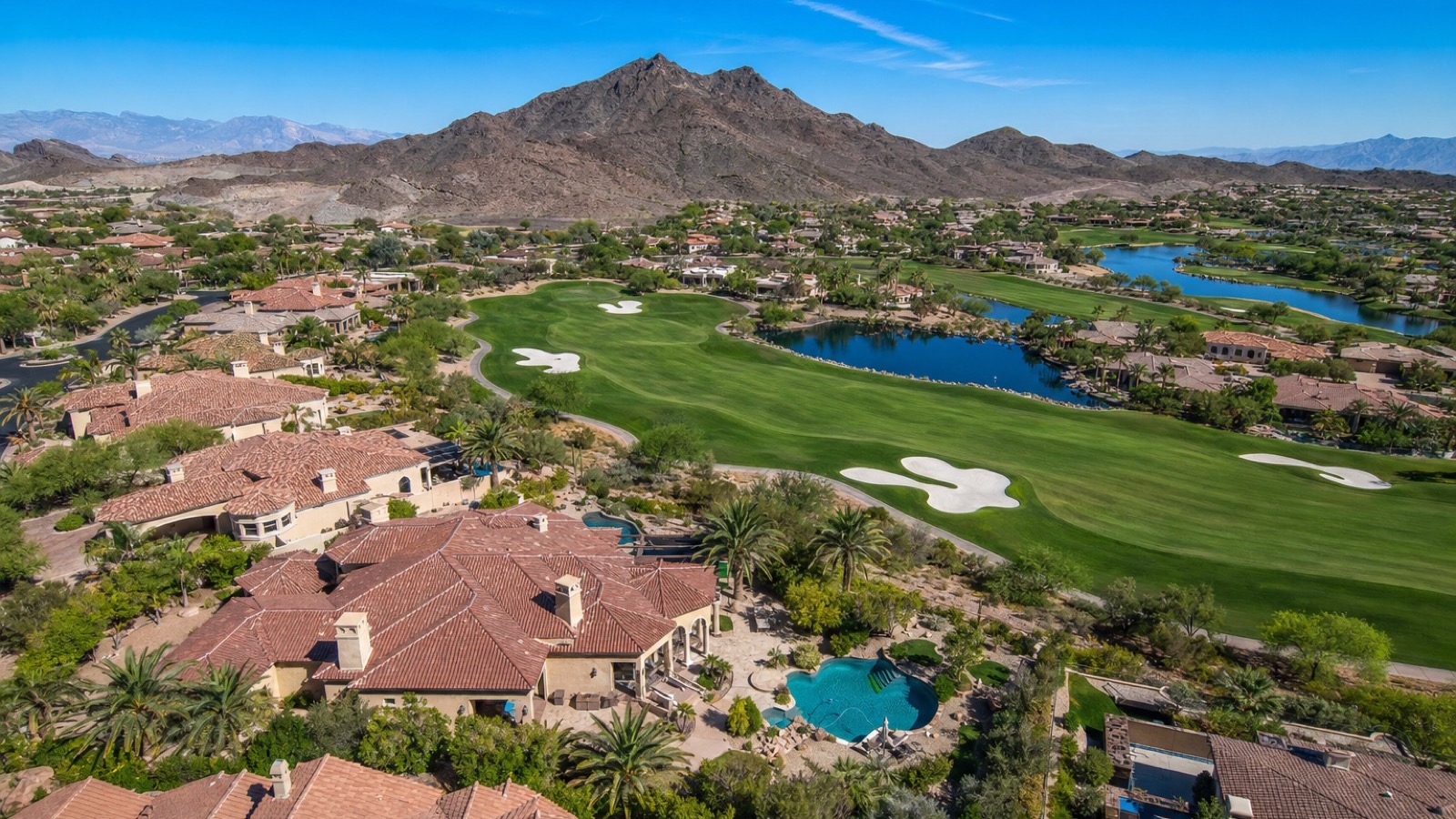
Southern Nevada's golf market is unusually wide. It runs from guard-gated custom estates at three times the city rate down to master-planned communities that trade below it.
| Community | Median list | $/sq ft | Premium vs city | Active | Median DOM |
|---|---|---|---|---|---|
| Red Rock Country Club | $2,489,500 | $707 | +171% | 26 | 38 |
| Anthem Country Club | $2,449,950 | $588 | +112% | 26 | 15 |
| Canyon Gate Country Club | $1,275,000 | $429 | +64% | 11 | 16 |
| Spanish Trail | $765,950 | $319 | +22% | 64 | 43 |
| Southern Highlands | $848,888 | $291 | +11% | 139 | 26 |
| Rhodes Ranch | $519,000 | $246 | −6% | 85 | 38 |
| Silverstone Ranch (course closed since 2015) | $684,500 | $244 | −7% | 18 | 44 |
| Tuscany | $598,888 | $239 | −14% | 45 | 35 |
Read the bottom three rows again. Rhodes Ranch, Silverstone Ranch, and Tuscany all trade at a discount to their city's per-square-foot median. That is not a data error and it is not a distressed market. It is what happens when a golf course is an amenity inside a large master plan rather than the point of an exclusive club — the course is a landscaped edge that a few hundred homes back onto, and the community's pricing is set by the houses, not the membership.
Silverstone Ranch belongs in that row with an asterisk I am not willing to leave off. Its 27-hole course has been closed since 2015, and the shuttered property sold at a Clark County trustee auction in May 2025 with no redevelopment application filed since. Homes there still back onto the old corridor, but nobody has played it in a decade, and the $244 per square foot reflects that. If you are shown a Silverstone listing described as a golf-course home, that is a description of the view, not of an amenity you will use.
In my experience the bottom three rows are also where buyers argue with me hardest, because a fairway address at a discount sounds like it must come with a catch. It usually comes with a specific one: the course is not private, the clubhouse is modest, and the membership everyone imagines is not part of the purchase. For a buyer who wants to look at grass rather than play it every morning, that is not a catch at all — it is the whole arbitrage. For a buyer who wants a club, it is a dealbreaker, and finding that out at the walkthrough rather than the offer saves a lot of grief.
Anthem Country Club's 15-day median market time deserves a note of its own. It is the fastest number in either table, at the second-highest price point, which is the signature of scarce inventory meeting real demand rather than a soft market. Our Anthem Country Club guide covers that community in depth.
Which Reno Golf Communities Command the Biggest Premium?
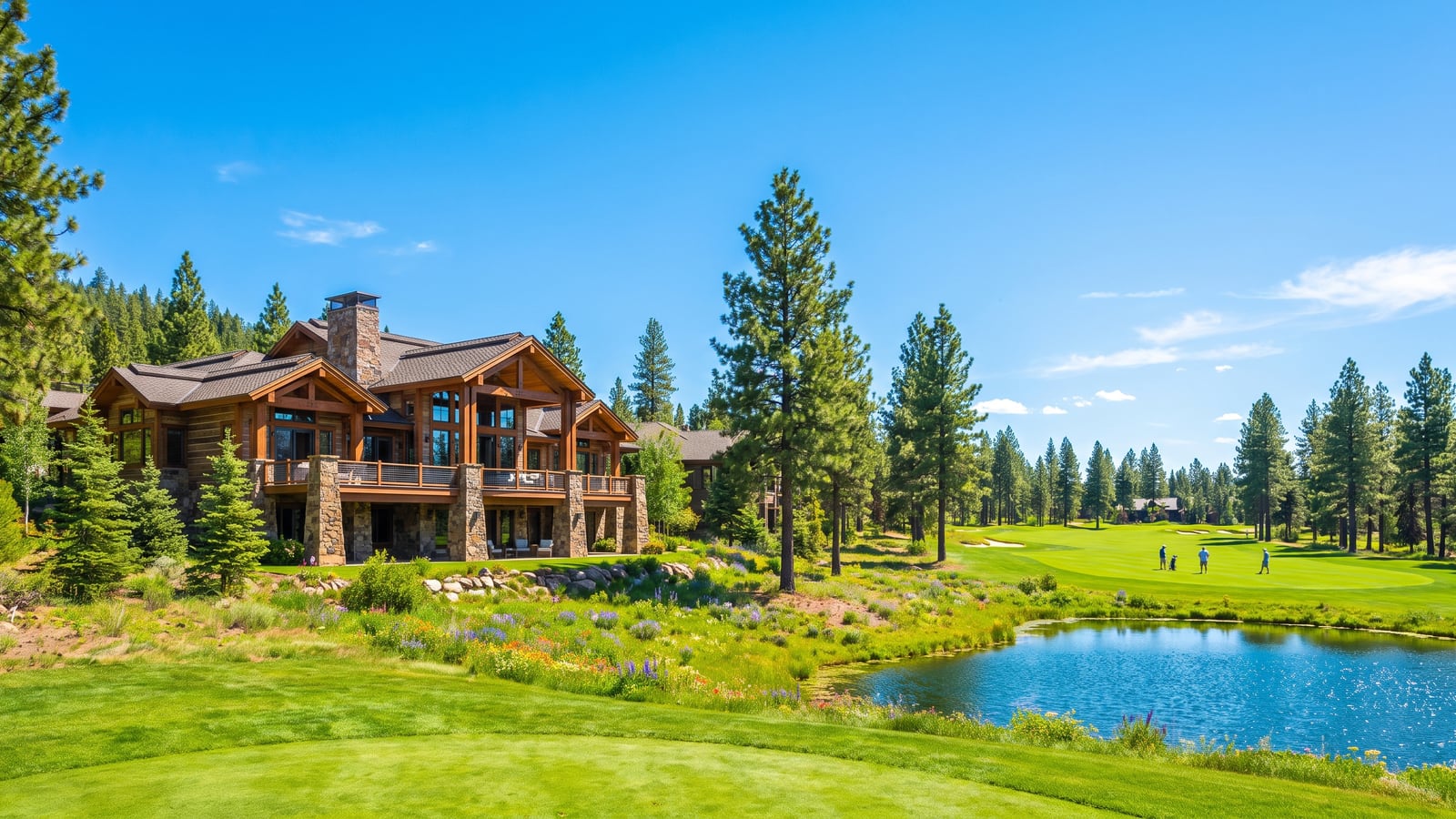
Northern Nevada's golf market is narrower at both ends. The trophy tier reaches just as high, but the floor sits much higher.
| Community | Median list | $/sq ft | Premium vs city | Active | Median DOM |
|---|---|---|---|---|---|
| Montrêux | $2,875,000 | $757 | +118% | 24 | 54 |
| ArrowCreek | $1,850,000 | $539 | +55% | 31 | 41 |
| Genoa Lakes | $867,450 | $417 | +20% | 8 | 50 |
| Somersett | $1,050,000 | $380 | +10% | 57 | 47 |
| Lakeridge | $889,000 | $361 | +4% | 9 | 71 |
| D'Andrea (Sparks) | $739,900 | $289 | −3% | 9 | 36 |
| Wingfield Springs (Sparks) | $670,000 | $274 | −8% | 103 | 55 |
Montrêux at $757 per square foot is the most expensive golf address in either market — narrowly ahead of Red Rock Country Club's $707. According to Las Vegas REALTORS and the Northern Nevada boards, both communities sit at the top of their respective luxury markets, and a buyer at that level is choosing between a Red Rock Canyon backdrop and a Mount Rose one rather than choosing on price.
The two Sparks communities are the North's value tier, and they are the closest thing Reno-Sparks has to what Las Vegas offers at the bottom. Wingfield Springs at $670,000 and a 8% discount to the Sparks baseline is a genuine golf-course value — it is simply that $670,000 is where Northern Nevada's value tier starts, and in Las Vegas $670,000 is already above the golf entry point.
Where Does Golf-Course Living Actually Start in Each Market?
This is the number most buyers should anchor on, because very few are shopping the trophy tier.
In Las Vegas, the practical entry to golf-course living is Rhodes Ranch at a $519,000 median list, with 85 active listings — a real, liquid pool, not a handful of holdouts. Silverstone Ranch at $684,500 and Tuscany at $598,888 sit alongside it.
In Reno-Sparks, the entry is Wingfield Springs at $670,000, with 103 active listings, or D'Andrea at $739,900 with only 9.
That is a $151,000 gap at the entry point — and the Las Vegas entry buys more house per dollar on top of it, because Rhodes Ranch runs $246 per square foot against Wingfield's $274. A buyer with $650,000 is shopping comfortably inside the Las Vegas golf market and shopping at the absolute floor of the Reno one.
Translate the two entry points into square footage, because that is where the gap widens further. At Rhodes Ranch's $246 a foot, $650,000 buys roughly 2,640 square feet; at Wingfield Springs' $274, the same money buys about 2,370 — the difference of a bedroom and a bathroom. The products differ too. Rhodes Ranch is a guard-gated master plan in the southwest valley built around a public course, Silverstone Ranch is its northwest counterpart in layout though not in amenity, since its course has sat closed since 2015, and Wingfield Springs wraps the Red Hawk courses in the Spanish Springs valley with 103 active listings — the deepest golf board in Northern Nevada. Entry-tier fairway living is a real, liquid product in both regions; it simply costs $151,000 more to enter in the north, and the house you enter with is smaller.
Is the Trophy Tier Actually Cheaper in Either Market?
No — and this surprises people who assume Las Vegas is categorically cheaper.
Red Rock Country Club runs $707 per square foot and a $2,489,500 median list. Montrêux runs $757 and $2,875,000. Anthem Country Club at $588 and ArrowCreek at $539 bracket each other similarly one tier down. At the top of both markets, a buyer is paying roughly the same rate for roughly the same product.
What differs is liquidity. Anthem Country Club's median 15 days and Canyon Gate's 16 against Montrêux's 54 and ArrowCreek's 41 say that Southern Nevada's luxury golf inventory turns over meaningfully faster. For a buyer that means less negotiating room in Las Vegas and more in Reno. For a future seller it means the opposite, and that is the trade to think about at this price point — you are choosing which side of that you would rather be on in five years.
Depth is similar too — 26 active listings at Red Rock and 26 at Anthem against 24 at Montrêux and 31 at ArrowCreek — so the difference in days on market is not a supply story. It is a buyer-pool story: Southern Nevada's luxury pool is simply larger, and a seller at the top of the Las Vegas market can expect a bid inside a month more often than one above Reno can. For a buyer that liquidity is the price of admission; for a seller it is the exit.
Our Red Rock Country Club guide and the Reno-Tahoe golf communities guide go community-by-community if you are shopping a specific address rather than choosing a market.
What Does the Golf Season Actually Look Like in Each Market?
Price is only half the comparison. The other half is how many months the amenity you are paying for is usable.
Las Vegas golf is effectively year-round. According to the National Weather Service, the Las Vegas valley sits near 2,000 feet with mild winters, and courses operate through every month — with the trade being July and August, when play shifts to early mornings and late afternoons and the middle of the day is genuinely punishing.
Northern Nevada is seasonal, and the elevation is why. Reno sits near 4,500 feet, and the mountain courses above it climb from there. According to NOAA climate records, the Truckee Meadows sees real winter, and most Reno-area courses run roughly April through October, with the highest-elevation and Tahoe-adjacent courses on a shorter window still.
Across the closings our team has represented in both markets, this is the single factor that changes people's minds most often — and it changes them in both directions. Buyers who came for the Las Vegas price sometimes discover they are outdoor people who would rather have four seasons than four extra months of golf. Buyers who assumed they wanted Tahoe sometimes realise they will play twice a week for thirty years and want a course that never closes. Neither reaction is wrong; both are expensive to discover after closing.
That is not a mark against Reno so much as a different product. A Reno golf home is a four-season property where golf is the summer use and skiing is the winter one — Mount Rose is minutes from Montrêux and ArrowCreek. A Las Vegas golf home is a golf home twelve months a year. Which is worth more depends entirely on whether you ski.
How Do HOA Dues and Club Memberships Compare?
The listing price is the smaller half of a golf-community decision, and the recurring costs diverge more than the purchase prices do.
Two separate charges are involved and buyers routinely conflate them. The HOA maintains the community — gates, streets, landscaping, common areas — and is mandatory. The club membership buys access to the course, and in most Nevada golf communities it is optional and separate. Owning a home on a fairway does not include the right to play it.
That distinction is where the real money sits. A guard-gated community's HOA covers staffed gates and extensive common-area landscaping, and runs materially higher than a master-plan HOA where the course is privately operated and the association maintains streets only. Equity memberships at the top clubs in both markets carry initiation fees that can exceed six figures, while master-plan courses like Rhodes Ranch and Wingfield Springs are generally daily-fee or offer far lower-cost membership.
According to the Nevada Real Estate Division, buyers in a common-interest community are entitled to the association's governing documents, budget, and reserve study during the resale-package review period. On a golf-community purchase that package is not paperwork — it is where a pending assessment for course drainage or clubhouse work becomes visible before you own a share of it.
Do Golf-Course Homes Hold Value Better in Vegas or Reno?
The honest answer is that our data measures today's prices, not a decade of appreciation, and I will not dress up a snapshot as a forecast.
What the snapshot does say is worth something. In both markets the trophy communities command large, stable premiums over their city baselines — 171% at Red Rock, 118% at Montrêux — which reflects genuinely scarce product on a finite number of fairway lots. Course frontage cannot be built more of.
The value-tier communities are the more interesting case, and here the two markets differ in kind. A Las Vegas buyer at Tuscany or Rhodes Ranch is paying at or below the city rate, so their downside is the city's downside — they are not carrying a premium that can compress. A Reno buyer at Somersett is carrying a 10% premium and a Reno-level base price, which is more to give back if Northern Nevada's supply constraint ever eases.
According to the Federal Housing Finance Agency House Price Index, both Nevada metros have tracked well above national appreciation over the long run, with Reno more volatile through cycles — a smaller market with less inventory moves further in both directions. The number to watch in either market is the community's own active count against its clock: 139 listings at Southern Highlands clearing in 26 days is a liquid premium, while 9 listings at Lakeridge taking 71 days is a thin one — and thin premiums are the ones that move when the market does.
Which Market Is Better for a Second Home or Investment?
These are different questions and the answer splits.
For a second home, Reno-Tahoe has the stronger case on non-price grounds. The four-season use is real, Lake Tahoe is inside an hour, and according to the Nevada Department of Taxation the state's absence of personal income tax applies statewide — so the tax argument that draws California buyers works identically in either market, and proximity decides it. A Bay Area owner reaches Reno in about four hours by car; Las Vegas is a flight.
For rental investment, Las Vegas is the more straightforward market. It has seven times the inventory, half the days on market, and a visitor economy that supports demand year-round. Reno's shorter season concentrates demand into fewer months, which is workable but is a materially different underwriting model — and short-term rental rules vary sharply by jurisdiction in both regions and must be verified for the specific address, not the city.
For a primary residence bought on price, Las Vegas wins on the numbers in this guide, and it is not close at the entry and mid tiers.
One tax detail that applies to both markets and catches second-home buyers. According to the Nevada Department of Taxation, Nevada's partial property-tax abatement caps annual bill increases at 3% for an owner-occupied primary residence but allows up to 8% for other property — so a second home or rental on a fairway in either city can see its tax bill climb faster than the neighbor's, and the difference compounds over a decade of ownership. The state rules are identical in Reno and Las Vegas; the cap you qualify for depends on how you use the house, which is worth settling before you choose it.
What Should You Actually Compare Before Choosing a Market?
If you are genuinely open between the two, these are the comparisons that decide it in practice.
Total monthly cost, not list price. A $519,000 Rhodes Ranch home with a modest master-plan HOA and no mandatory membership can carry less monthly than an $670,000 Wingfield Springs home even before the price gap is financed.
Whether you want the course or the view of it. Fairway frontage costs a premium in both markets. If what you actually want is open space behind the house and no rear neighbor, a greenbelt or park-backing lot delivers most of that at a fraction of the cost.
Season against use. If you will play 80 rounds a year, twelve months of access is worth real money. If you will play 20 and ski 20, Reno's calendar may be the better fit at any price.
Liquidity when you sell. A 15-day median in Anthem Country Club and a 54-day median in Montrêux describe very different exits.
The association's reserve study. In both markets, on every golf community, before the inspection contingency expires.
One more thing I tell every buyer weighing these two markets: go in both seasons if you can. Las Vegas in February and Reno in July each show you the version of themselves that sells the house. Las Vegas in late July and Reno in January show you the version you will actually live with, and those two visits will tell you more than any table on this page. The numbers here can tell you where the money goes further — they cannot tell you which of two genuinely good Nevada markets you will be happier waking up in, and buyers who make that call from photographs are the ones who move again in three years.
Frequently Asked Questions
Is it cheaper to buy a golf course home in Las Vegas or Reno?
Las Vegas, clearly. Reno's residential baseline is $347 per square foot against Las Vegas at $261 — 33% higher before any golf premium. Las Vegas golf entry starts near $519,000 at Rhodes Ranch; Reno-Sparks starts near $670,000 at Wingfield Springs, a $151,000 gap at the floor.
Can you buy a home on a golf course for less than the city median?
In Las Vegas, yes — three communities do it. Tuscany trades 14% below the Las Vegas per-square-foot median, Silverstone Ranch 7% below, and Rhodes Ranch 6% below. Reno-Sparks has essentially one such community, Wingfield Springs at 8% below the Sparks baseline, and its $670,000 median is above where Las Vegas golf living begins.
What is the most expensive golf community in Nevada?
Montrêux in south Reno, at $757 per square foot and a $2,875,000 median list price, narrowly ahead of Red Rock Country Club in Las Vegas at $707 and $2,489,500. The two trophy tiers are far closer than the two entry tiers.
Does buying a home on a golf course include club membership?
Almost never. The HOA maintains the community and is mandatory; the club membership buys course access and is usually separate and optional. At the top clubs in both markets, equity initiation fees can run well into six figures, while master-plan courses are often daily-fee. Confirm which structure applies before you write an offer.
How long is the golf season in Reno compared to Las Vegas?
Las Vegas plays effectively year-round at roughly 2,000 feet, with midsummer play shifting to mornings and evenings. Reno sits near 4,500 feet and most area courses run roughly April through October, with higher-elevation and Tahoe-adjacent courses shorter still. A Reno golf home is a four-season property; a Las Vegas one is a twelve-month golf property.
Do golf-course homes sell faster in Las Vegas or Reno?
Las Vegas, substantially. The Las Vegas citywide median is 28 days against Reno's 48, and the pattern holds inside golf communities — Anthem Country Club sells in a median 15 days and Canyon Gate in 16, while Montrêux takes 54 and Lakeridge 71. That means less negotiating room in Las Vegas and more in Reno.
Is a fairway lot worth the premium?
It depends on what you are buying it for. Frontage is genuinely scarce and holds its premium in both markets. But if the appeal is open space and no rear neighbor rather than the golf itself, a greenbelt or park-backing lot delivers most of that benefit without the frontage premium, the errant-ball exposure, or the early-morning maintenance crews.
Which Sources Inform This Nevada Golf Homes Guide?
The community and market figures in this guide are original NREG analysis. We queried the live GLVAR (Southern Nevada) and NNRMLS (Northern Nevada) MLS feeds in August 2026, restricted every query to residential property, applied no price floors, and scoped each community by keyword and ZIP. Each community's per-square-foot figure is compared against the residential baseline of its own city computed the same way on the same day — not against a metro average, which would inflate every premium shown. Land parcels were excluded because they carry no building square footage and distort a per-square-foot median. Closed-price and days-on-market figures use a 120-day window. Small communities carry small sample sizes, noted in the active-listing column; treat single-digit counts as directional. Verify any specific address with us before making an offer.
- Las Vegas REALTORS — Southern Nevada MLS statistics and monthly median reporting.
- U.S. Census Bureau — Metro population, housing stock, and owner-occupancy data for both regions.
- Nevada Department of Taxation — State tax structure and property tax abatement rules.
- Nevada Real Estate Division — Common-interest community resale package and HOA disclosure requirements.
- Bureau of Land Management — Federal land ownership and disposal affecting Nevada development supply.
- National Weather Service — Las Vegas valley and Truckee Meadows climate normals.
- NOAA — Elevation-linked seasonal climate records for Northern Nevada.
- Federal Housing Finance Agency House Price Index — Long-run appreciation benchmarks for both Nevada metros.
- U.S. Bureau of Labor Statistics — Employment and wage data for Las Vegas and Reno-Sparks.
- Consumer Financial Protection Bureau — Closing cost and loan disclosure guidance.
- Freddie Mac Primary Mortgage Market Survey — Weekly national mortgage rate benchmarks.
- Las Vegas Review-Journal — Silverstone Ranch course closure since 2015 and the May 2025 trustee auction.
- GreatSchools — School attendance-zone ratings in both metros.
All market data reflects live GLVAR and NNRMLS MLS information as of August 2026. Median prices, inventory, and days on market change continuously; contact Nevada Real Estate Group at (702) 637-1759 for current figures before making any buying decision. Information is believed accurate but not guaranteed — verify all figures with a licensed Nevada real estate professional. Nevada Real Estate Group | LPT Realty | License S.181401 | 8945 W Russell Rd, Suite 170, Las Vegas, NV 89148.
Shopping golf-course homes in either Nevada market? Nevada Real Estate Group is Nevada's #1 real estate team with 150-plus agents across Las Vegas and Reno, $4.85B-plus in closed sales volume, and 9,061-plus five-star reviews. We can pull the current fairway-frontage inventory in any community in this guide, in either market, with the same numbers behind it.
Call or text (702) 637-1759 | Email info@nevadagroup.com | Search Nevada homes | Talk to an agent