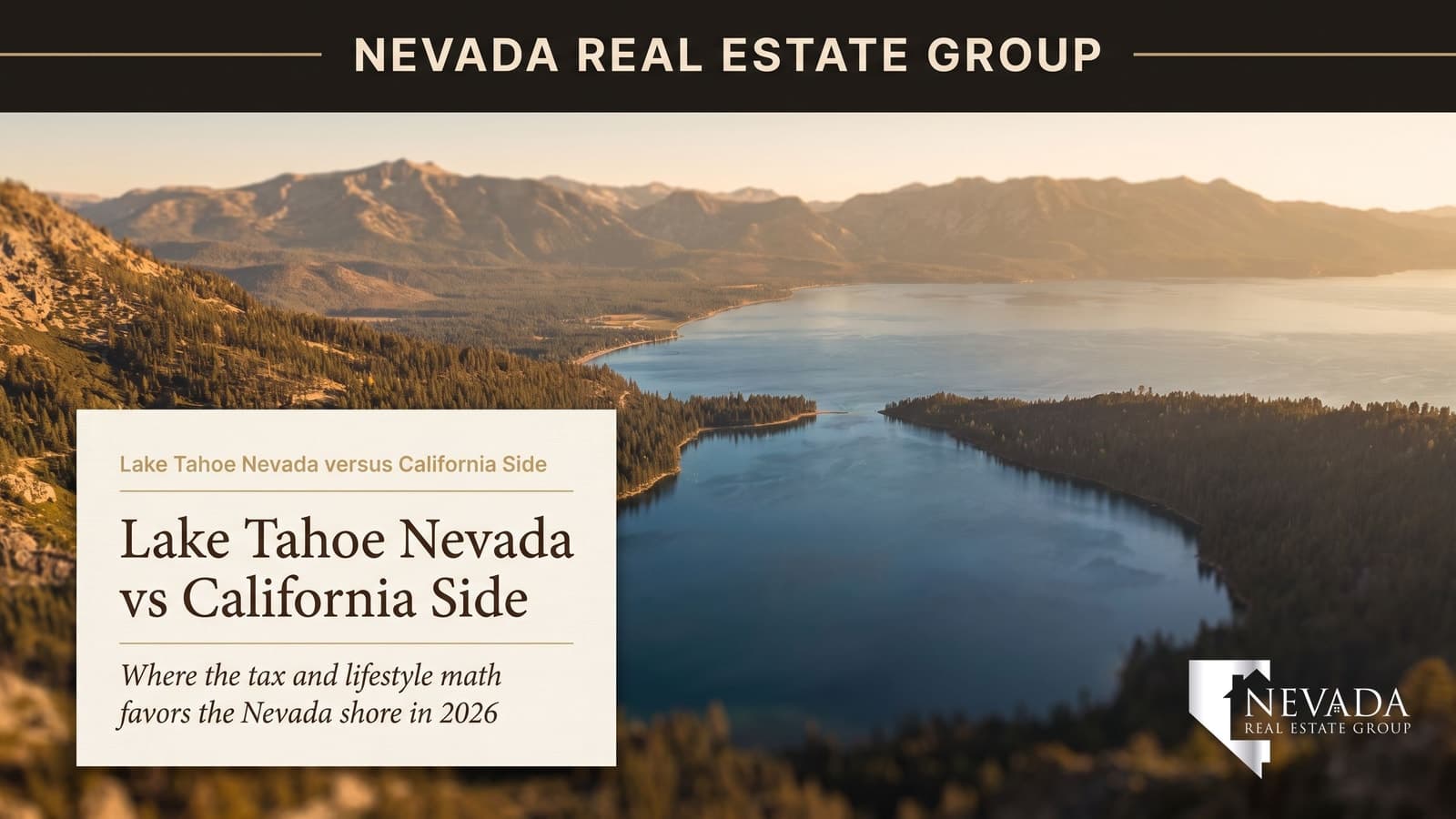

Lake Tahoe is one lake with two very different price tags, and the state line running down the middle of it is worth more money than almost any other border in the country. On the Nevada side — Incline Village, Crystal Bay, Zephyr Cove, Glenbrook, and Stateline — buyers get the same alpine water, the same granite peaks, and the same ski access as the California shore, but with a tax structure that can save a high-income household well into six figures a year. That single fact reshapes everything: who buys where, what a lakefront estate really costs to own, and why so many high earners domicile on the Nevada shore. This is the honest 2026 guide to the Nevada-versus-California decision at Tahoe — where the arbitrage is real, where it is oversold, and how the two shores actually compare on price, schools, and daily life.
The Nevada side of Lake Tahoe — Incline Village, Crystal Bay, Zephyr Cove, and Stateline — wins on taxes, and that is the whole story. Nevada has no state income tax; California's top rate is 13.3%, the nation's highest. A high-earning household can save six figures a year by domiciling in Nevada. The California shore, from Tahoe City to South Lake Tahoe, offers more towns and price points but a heavier tax load. Same lake, very different math.
- Nevada charges no state income tax; California's top marginal rate hits 13.3%, the highest in the U.S.
- Incline Village single-family closings had a $2.69 million median in January–September 2026 MLS data; lakefront runs far higher.
- The Nevada shore is quiet and low-density under basin development caps; South Lake Tahoe, California is denser and tourist-driven.
- Nevada has no state estate or inheritance tax, a major factor for wealth transfer at the high end.
- Claiming Nevada residency requires genuinely living there — consult a qualified tax advisor before you plan around it.
What Defines the Nevada Side Versus the California Side of Lake Tahoe?
Lake Tahoe sits astride the Nevada-California border, and roughly one-third of the shoreline is in Nevada while the rest is in California. The Nevada side is compact and concentrated: Incline Village and Crystal Bay anchor the north shore in Washoe County, while Zephyr Cove, Glenbrook, and Stateline run down the east shore in Douglas County. The California side is far larger and more spread out — Tahoe City, Kings Beach, Tahoe Vista, and Carnelian Bay on the north and west in Placer County, and the region's biggest town, South Lake Tahoe, in El Dorado County.
That geographic split matters because it is also a jurisdictional split. Which state your front door sits in determines your income tax, your estate tax exposure, your property-tax methodology, and which school district your children attend. According to the Tahoe Regional Planning Agency, the entire basin is governed by a bi-state compact that keeps development tightly capped on both shores — so the lake, the water clarity rules, and the building limits are shared, but almost everything about the financial and civic experience of ownership changes at the state line. In my experience walking buyers through this decision, the mistake is treating Tahoe as one market. It is two.
Why Does the Nevada Side Have Such a Tax Advantage?
The advantage comes down to one word: income. According to the Nevada Department of Taxation, Nevada levies no state personal income tax at all — not on wages, not on capital gains, not on business or investment income. According to the California Franchise Tax Board, California's personal income tax is graduated up to a top marginal rate of 13.3%, the highest of any state in the nation, and that top bracket bites hard on high earners and on large one-time capital gains from selling a business or a concentrated stock position.
For a Tahoe buyer, the state line is therefore not a line on a map — it is a line on a tax return. A household earning $2 million a year that establishes genuine Nevada residency avoids a California tax bill that could run several hundred thousand dollars annually. Nevada also has no state estate or inheritance tax, which is why the arbitrage compounds over a lifetime and across generations of wealth transfer. According to the Nevada Department of Taxation, the state funds itself primarily through sales and gaming revenue rather than income, which is the structural reason the shore on the east side of the lake has become a magnet for entrepreneurs, retirees sitting on large gains, and remote executives who can domicile anywhere. This is not a loophole — it is two states making different choices, and the lake happens to sit on the seam.
How Much Can You Actually Save on Taxes on the Nevada Side?
The honest answer is: it depends entirely on your income, and the savings scale directly with it. A retired couple living on Social Security and modest withdrawals will see a small difference between the shores. A founder selling a company for $50 million, or an executive with $3 million in annual income, is looking at a difference that can pay for the house. Because California's top rate is 13.3% and Nevada's is zero, the gap on high incomes is enormous — and there is no state capital-gains carve-out in California, so a large liquidity event is taxed as ordinary income at that top rate.
Here is the directional picture across income levels. These are illustrative, not tax advice — everyone's situation differs, so consult a qualified tax advisor before you plan around any of it.
| Household taxable income | Nevada state income tax | California top-rate exposure |
|---|---|---|
| $250,000 | $0 | Tens of thousands |
| $1,000,000 | $0 | Roughly $100,000+ |
| $3,000,000 | $0 | Well into six figures |
| $10,000,000 (liquidity event) | $0 | Over $1 million |
The catch — and it is a real one — is that the savings only materialize if you genuinely become a Nevada resident. According to the California Franchise Tax Board, California scrutinizes residency claims closely, and simply owning a second home on the Nevada shore does not change your domicile. Claiming Nevada residency means actually making it your primary home: where you spend the most time, register to vote, hold your driver's license, and center your life. Across our 9,600 closings, we've represented plenty of buyers who bought on the Nevada side specifically to relocate their domicile — and the ones who did it cleanly worked with a tax attorney from day one. Do not treat this as a DIY move. If the numbers are large enough to matter, they are large enough to warrant professional advice.
What Does It Cost to Buy on the Nevada Side of Lake Tahoe?
The Nevada shore, and Incline Village in particular, is a luxury market — arguably the most expensive residential real estate in the entire state. Sierra Nevada REALTORS' monthly reports track whole counties rather than the shore: its September 2026 market report put Washoe County's median sales price across all residential property types at $595,000. Incline Village trades far above that. In the Incline Village board's MLS records for January through September 2026, which we pulled on October 10, the 103 single-family closings in ZIP 89451 had a median of about $2.69 million, the middle half ran from roughly $1.88 million to $4.9 million, and the top sale was $46 million; condominiums had a median near $920,000. Even non-lakefront homes with a lake view or deeded beach access carry a substantial premium over comparable inland Northern Nevada markets, because supply on the shore is fixed and demand is national.
That premium buys scarcity. The basin's development caps mean no one is building a new master plan on the shoreline, so the existing inventory is effectively all there will ever be. Condominiums and townhomes offer the lower rungs of the ladder — you can find attached product below the single-family bands — while custom homes on larger lots in the pine forest command the top of the market. Here is how the Nevada-side price ladder generally stacks up in 2026.
| Housing type | Directional 2026 range | What you get |
|---|---|---|
| Incline Village condo / townhome | $600,000 – $1,200,000 | Lock-and-leave, amenities, HOA dues |
| Incline / Crystal Bay single-family | $1,500,000 – $5,000,000+ | Forested lots, mountain or filtered lake views |
| Zephyr Cove / Stateline home | $900,000 – $2,500,000+ | East-shore access, Douglas County tax base |
| Lake-view custom estate | $3,000,000 – $8,000,000 | Big lots, panoramic views, high-end finishes |
| True lakefront | $8,000,000 – $40,000,000+ | Private frontage, pier/buoy rights, trophy status |
We've toured enough of these homes to know the value is never in the sticker alone — deeded beach rights, buoy permits, and view corridors can swing two otherwise-similar homes by seven figures. If you want to see live inventory on the Nevada shore, browse Incline Village homes for sale and then call Nevada Real Estate Group at (775) 277-2120 to run the all-in ownership math on any specific address.
How Do Property Taxes Compare Across the State Line?
Income tax is the headline, but property tax is the quiet annual difference, and here again Nevada generally comes out ahead. According to the Washoe County Assessor, Nevada assesses property using a partial-value methodology with statutory caps on how fast a primary residence's tax bill can rise year to year, which tends to keep effective property-tax rates on the Nevada shore modest relative to many California jurisdictions. According to the Douglas County Assessor, the east-shore communities of Zephyr Cove, Glenbrook, and Stateline fall under Douglas County's tax base, which is likewise among the lower-burden jurisdictions in the region.
I want to be careful here, because exact rates change every fiscal year and vary by parcel — so I will not quote a precise millage. The qualitative reality, which holds year over year, is that on a multimillion-dollar Tahoe home the annual property-tax difference between the Nevada and California sides can itself run into five figures, on top of the income-tax gap. For a $2 million home, that annual delta is not trivial — it is another line item that compounds over a long hold. Always verify the current-year assessment and tax bill for any specific address with the relevant county assessor before you buy; do not rely on a listing's estimate.
What Are the Nevada-Side Communities Like?
The Nevada shore is small, and each community has a distinct personality. Incline Village, on the north shore in Washoe County, is the flagship — a tightly zoned, low-density community with a 2020 Census population of 9,462 (U.S. Census Bureau, Table P1), wrapped in pine forest, with private amenities including golf, beaches, and a recreation center funded by resident fees. It is quiet and walkable in pockets, and second homes make up a large share of the housing: the same census counted 7,367 housing units, 2,671 of them held for seasonal, recreational or occasional use (Tables H1 and H5). Crystal Bay, its immediate neighbor at the state line, blends residential estates with a cluster of historic casinos right at the border.
Down the east shore in Douglas County, Zephyr Cove and Glenbrook are smaller and more rural in feel — Glenbrook in particular is a historic, gated enclave that is among the most exclusive addresses on the entire lake. Stateline, at the south end of the Nevada shore, is the lively counterpoint: it sits directly across the border from South Lake Tahoe and hosts the east-shore casino corridor and Heavenly's Nevada base. According to the U.S. Census Bureau's 2020–2024 American Community Survey, median owner-occupied home values run about $1.45 million in Incline Village and $1.75 million in Zephyr Cove and exceed the survey's $2 million reporting cap in Crystal Bay and Glenbrook, against $435,400 statewide. If you want the broader relocation picture for Northern Nevada — commute patterns, seasons, and how the shore connects to the Reno valley below — our Reno relocation guide is the companion read, and our Incline Village community page goes deep on the flagship market.
What Are the California-Side Towns Like?
The California shore offers more variety, more towns, and more price points — at the cost of the California tax load. On the north and west shores in Placer County, Tahoe City is the historic hub, with a walkable downtown, marina, and a mix of cabins and lakefront estates. Kings Beach, Tahoe Vista, and Carnelian Bay run along the north shore as smaller, more casual beach communities, some with more attainable cabin stock than anything on the Nevada side. These towns share the same north-shore ski access and lake as Incline Village, just a few minutes west across the line.
South Lake Tahoe, in El Dorado County, is the region's largest and most urban town — denser, more tourist-driven, and more affordable at the entry level than the Nevada shore, with a large stock of condos, cabins, and vacation rentals feeding the Heavenly ski crowd. It is the practical, high-energy end of the lake, and it lives very differently from the hushed forest of Incline Village. You can name these California towns in any Tahoe search — I mention them constantly with clients — but the buying decision for a tax-motivated purchaser almost always circles back to the state line. The California shore is wonderful; it is simply taxed as California.
How Do the Two Shores Compare on Lifestyle and Amenities?
Both shores share the essentials — the same alpine lake, the same summer boating and beach season, the same winter snowpack, and mutual access to the basin's ski resorts. Where they diverge is density and vibe. The Nevada side, led by Incline Village, is quieter, more residential, higher-priced, and more oriented toward owners than tourists. The California side, especially South Lake Tahoe, is livelier, more commercial, and more geared to visitors, with the deeper bench of restaurants, rentals, and nightlife that comes with a bigger tourist economy.
Here is the head-to-head on the factors buyers weigh most when choosing a shore.
| Factor | Nevada side (Incline, Stateline) | California side (Tahoe City, South Lake) |
|---|---|---|
| State income tax | None | Up to 13.3% |
| Estate / inheritance tax | None | No separate state estate tax, higher income load |
| Entry price | Higher — luxury-skewed | Broader — cabins to estates |
| Density / vibe | Quiet, low-density, development capped | Denser, more tourist-driven |
| Best for | High earners, domicile changers | Value seekers, town-life buyers |
Which Side Has Better Schools?
Schools split cleanly by state and district, and this is a real factor for full-time families rather than second-home buyers. On the Nevada north shore, Incline Village and Crystal Bay are served by the Washoe County School District — the same large district that covers Reno and Sparks — with local Incline elementary, middle, and high schools right in the community. On the California side, South Lake Tahoe families are served by the Lake Tahoe Unified School District, while the north and west shore towns fall under the Tahoe-Truckee Unified School District.
Because the two shores sit in different states, direct apples-to-apples comparison is tricky — the states test and rate differently. The practical guidance I give families is the same on either side: pull the current ratings for the specific schools your address would feed into, tour them, and weigh the small local enrollment that comes with a mountain community against the top magnet and private options down in the Reno valley. According to the U.S. Census Bureau, the Nevada-shore communities are small, so school cohorts are intimate — a plus for some families, a limitation for others who want big-program breadth. Verify current-year boundaries before you buy, because mountain-district lines can be counterintuitive.
How Does Skiing and Recreation Differ Between the Shores?
Ski access is one thing the state line does not really divide — the whole basin is a shared playground. On the Nevada side, Diamond Peak is Incline Village's own community ski resort, a mountain with some of the best lake views of any run in North America, and Heavenly's Nevada base sits at Stateline. From either shore you are within easy reach of the marquee California resorts too: Palisades Tahoe and Northstar on the north and west, and Heavenly straddling the south. According to the Tahoe Regional Planning Agency, the basin's recreation infrastructure — trails, beaches, and marinas — is managed region-wide, so a Nevada-side owner enjoys the same lake access as a California-side one.
Summer is where the shores feel most equal and most spectacular. Boating, paddleboarding, and beach days are universal, and the east-shore Nevada beaches — Sand Harbor chief among them — are widely considered the most beautiful on the lake. In our experience, buyers who prioritize a quiet forest-and-water lifestyle gravitate to the Nevada shore, while those who want walk-to-town energy and a deeper nightlife often lean California. Neither is wrong; they are different products. Our Lake Tahoe hub covers the recreation and seasonal picture across both shores in more depth.

Which Side of Lake Tahoe Is Friendlier to Short-Term Rental Buyers?
If part of your plan is renting the place out when you are not in it, the state line matters more here than any other question in this guide — and it matters in a way most buyers discover after they have already written the offer.
Start with the fact that surprises nearly everyone: on the Nevada shore, a short-term rental permit does not convey with the property. Both Washoe and Douglas counties treat permits as non-transferable. They die at the closing table, and the buyer applies from zero. A listing advertised as a "turnkey vacation rental with rental history" is selling you a house and a spreadsheet, not the right to keep renting it. That distinction has cost buyers real money.
On the south shore that risk has a number attached. Douglas County caps its entire Tahoe Township at 600 Vacation Home Rental permits, and 556 were issued as of May 2026 — roughly 44 left across Stateline, Zephyr Cove, and Glenbrook combined. Buy a Douglas County home whose permit dies at your closing, and you are re-applying into a queue that is 93% full. On the north shore, Washoe County runs Incline Village and Crystal Bay under an occupancy-tier ordinance rather than a hard cap — a permit is required before you advertise or rent any stay under 28 days, with the fee scaling to occupancy. Both Nevada shores levy roughly 13% transient lodging tax, collected from the guest but registered and remitted by you.
The California side is not simply "stricter" — it is unsettled, which is a different and arguably worse problem for a buyer. Measure T, the 2018 ballot initiative that phased out vacation rentals in South Lake Tahoe's residential zones after December 31, 2021, was overturned by the El Dorado County Superior Court in March 2025, which found its permanent-resident exception unconstitutional. The city declined to appeal, paused permit issuance, and adopted a replacement ordinance on June 17, 2025. North of there, Placer County allows rentals across North Lake Tahoe and part of the West Shore under a program capped at 3,900 permits.
| Question a buyer asks | Washoe Co. (NV — Incline, Crystal Bay) | Douglas Co. (NV — Stateline, Zephyr Cove) | California shore |
|---|---|---|---|
| Program type | Occupancy-tier permit | Hard-capped VHR permit | Varies by jurisdiction |
| Is there a cap? | No fixed basin cap | Yes — 600 township-wide | Placer Co. capped at 3,900 |
| Permits remaining | Tier-dependent | About 44 (556 of 600 issued, May 2026) | Jurisdiction-dependent |
| Transfers to the buyer at sale? | No | No | No — re-apply under current rules |
| Lodging tax | About 13% | About 13% | Set locally, plus California income tax on the income |
| Regulatory stability | Settled ordinance | Settled, but supply-constrained | In flux — 2025 court ruling and new ordinance |
So the honest comparison is this: Nevada gives you clearer rules and no state income tax on the rental income, but on the Douglas side the permit supply is nearly exhausted, and on both Nevada shores your ability to rent restarts at closing. California gives you more inventory and, in Placer County, more permit headroom — at the cost of a regulatory picture that has changed twice since 2024 and income that California will tax.
None of this is a reason to avoid either shore. It is a reason to verify the specific parcel's county, permit status, and current queue before you remove your contingencies, because "the neighbors rent theirs" is not evidence that you will be allowed to. Our Lake Tahoe Nevada short-term rental guide walks the Nevada-side rules county by county, including fire and parking inspections, neighbor-notice requirements, and what happens if you operate without a permit. If you are weighing a specific address, call our Northern Nevada team at (775) 277-2120 and we will check the parcel's jurisdiction and permit availability before you write.
Who Should Buy on the Nevada Side Versus the California Side?
This is a fit decision, and income is the deciding variable. The Nevada side is the clear choice for high earners and anyone facing a large liquidity event — a business sale, a big stock vest, a concentrated position — because the income-tax and estate-tax savings can dwarf the price premium. It also fits retirees sitting on large gains who want to protect distributions, and remote executives who can genuinely domicile anywhere and want the quiet, forested, luxury lifestyle Incline Village is built around. If you are moving your whole life and your tax home, the Nevada shore is usually the answer.
The California side fits a different buyer. If your income is modest, or if the property will remain a second home while you keep your primary residence and tax domicile elsewhere, the Nevada tax advantage may not move the needle — and the California shore offers a wider range of towns, more attainable cabin stock, and more walk-to-town village life, especially in Tahoe City and South Lake Tahoe. The honest test I give clients: if the tax savings would meaningfully change your life, buy Nevada and move your domicile; if they would not, buy the shore and town you love most. Our buyers resources walk through the full decision, and you can always reach the Northern Nevada team at (775) 277-2120 to talk it through.
What Are the Risks and Tradeoffs of Buying at Lake Tahoe?
Every Tahoe purchase carries mountain-specific realities that a valley buyer never thinks about, and honesty about them helps you buy smart. First, the residency trap: the tax savings are real only if you genuinely make Nevada your domicile, and a botched residency claim can trigger a California audit — so if the numbers are large, hire a tax attorney, not just an accountant. Second, insurance and wildfire risk: the basin is a high-elevation forest, and according to the Nevada Division of Insurance, coverage in wildfire-exposed areas has grown more expensive and harder to place, so budget for premiums and verify insurability before you remove contingencies.
Third, the basin's development rules. According to the Tahoe Regional Planning Agency, building, remodeling, and even tree removal on lake-basin parcels are governed by strict bi-state regulations, so what you can do to a property is more limited than off the lake — a renovation you would breeze through in Reno can require a lengthy TRPA review at Tahoe. Fourth, seasonality and access: winters are real, some roads and homes are snow-country properties, and the rental and resale seasons are compressed. And fifth, buoy and beach rights are their own micro-market — deeded lake access or a permitted buoy can add six or seven figures of value and does not transfer automatically, so verify every access right in writing. None of these are dealbreakers; they are reasons to buy with an agent who knows the basin, not a generalist.
How Is the Lake Tahoe Market Trending in 2026?
The Tahoe market moves differently from the Reno valley below it, and understanding why helps you time a purchase. According to Nevada REALTORS, the Northern Nevada market broadly cooled from the pandemic-era frenzy into a more balanced footing, with inventory rebuilding and price growth moderating. The Tahoe shore, though, trades on its own logic: supply is permanently capped by the basin compact, buyers are national and often cash, and the high end is driven more by wealth events and tax planning than by mortgage rates. That decoupling means the shore can hold value even when the broader market softens, because you cannot build more lakefront.
Sierra Nevada REALTORS' September 2026 market report shows the county-level backdrop: Washoe County's median sales price was $595,000, up 9.7% from September 2025, with 1,196 active listings (down 19.9% year over year) and 2.5 months of supply. In my experience, the spread between a well-priced Tahoe listing and an overpriced one is wider than almost anywhere I work — a realistically priced $1.5 million lake-view home can move quickly while an aspirational $2.5 million one sits for a full season, because the buyer pool at these price points is small and sophisticated.
For buyers concentrating on the shoreline, our guide to Nevada-side Lake Tahoe waterfront homes adds property-specific questions to the state-line comparison.

For sellers, the 2026 playbook is precise pricing against genuine comps plus honest presentation of the access rights, view corridor, and tax story that make the Nevada shore distinctive. If you are weighing the shore against a base in Reno or Carson City, the framing is that Tahoe is not competing on price per square foot — it is competing on a scarcity and a tax structure nothing else in the region can match.
What Should Tahoe Buyers Do Next?
Start with the tax question, because it determines everything else. Sit down with a qualified tax advisor and model your specific income and any coming liquidity event under both states — if the Nevada savings are large enough to matter, that alone can justify the price premium and point you to the east shore. Then decide whether this is a primary domicile move or a second home, because a genuine domicile change is what unlocks the savings and a second home does not.
From there, get your financing or proof of funds in order, and lean hard on local, basin-level expertise. Tahoe rewards granular knowledge — buoy rights, view corridors, TRPA constraints, insurability, and micro-neighborhood pricing that a portal estimate cannot touch — more than almost any market in Nevada. Browse current Incline Village homes for sale, read up on the flagship community at our Incline Village page, and when you find a shore, a town, and an address worth pursuing, reach Nevada Real Estate Group at (775) 277-2120 or through our contact page for the all-in ownership math and an honest read on that specific property. If you are ready to list on the Nevada shore, our sellers team knows how to price and position it.
Frequently Asked Questions
Is the Nevada or California side of Lake Tahoe cheaper?
It depends on what you are measuring. On sticker price, the California side is generally cheaper at the entry level — South Lake Tahoe and the north-shore towns have more attainable cabin and condo stock than the luxury-skewed Nevada shore, where Incline Village single-family homes commonly start around $1 million. But on total cost of ownership for a high earner, the Nevada side is often far cheaper once you factor in zero state income tax versus California's 13.3% top rate. A modest-income second-home buyer may find California cheaper overall; a high-income domicile changer almost always finds Nevada cheaper.
How much can you save on taxes buying on the Nevada side of Lake Tahoe?
The savings scale with your income and are only realized if you genuinely change your domicile to Nevada. Nevada has no state income tax; California's top marginal rate is 13.3%. A household with a few hundred thousand in income might save tens of thousands a year, while one with multimillion-dollar annual income — or a large one-time liquidity event — can save well into six figures, or over $1 million on a very large gain. Nevada also has no state estate or inheritance tax. Because California scrutinizes residency claims, work with a qualified tax advisor before planning around any of this.
Do I have to actually live in Nevada to get the tax benefit?
Yes. Owning a second home on the Nevada shore does not by itself change your tax domicile. To claim Nevada residency you must genuinely make it your primary home — spend the majority of your time there, register to vote, hold a Nevada driver's license, and center your life in the state. California audits residency claims closely, so a half-hearted move can be challenged. If the potential savings are significant, engage a tax attorney from the start; this is not a do-it-yourself planning move.
Is Incline Village the best place to buy on the Nevada side?
For most buyers seeking the classic Nevada-shore experience, yes — Incline Village is the flagship: quiet, forested, and rich with private amenities. But it is not the only option. Crystal Bay offers estates at the state line, while Zephyr Cove, Glenbrook, and Stateline on the east shore in Douglas County offer a more rural feel and a different county tax base. The best fit depends on whether you want north-shore community amenities or east-shore privacy, and on your budget within the luxury tier.
What are property taxes like on the Nevada side of Lake Tahoe?
Nevada generally has a lighter property-tax burden than many California jurisdictions, thanks to a partial-value assessment methodology and statutory caps on how fast a primary residence's bill can rise. On a multimillion-dollar Tahoe home, the annual property-tax difference between the shores can run into five figures, on top of the income-tax gap. Rates change every fiscal year and vary by parcel, so verify the current assessment and bill with the Washoe or Douglas County Assessor for any specific address before you buy.
Can you ski from both the Nevada and California sides of Lake Tahoe?
Yes — ski access is basin-wide and does not follow the state line. On the Nevada side, Diamond Peak is Incline Village's own resort and Heavenly's Nevada base sits at Stateline. From either shore you can reach the big California mountains — Palisades Tahoe and Northstar on the north and west, and Heavenly at the south. Wherever you buy on the lake, you have access to top-tier skiing within a reasonable drive.
Is buying at Lake Tahoe a good investment in 2026?
For the right property, it can be — with eyes open. The basin's development caps permanently limit supply, and the Nevada shore adds a tax advantage that keeps drawing national, high-income buyers, both of which support value even when the broader market softens. The risks are real: wildfire insurance costs, strict TRPA building rules, seasonality, and buoy or beach rights that must be verified in writing. Tahoe rewards a conviction buyer who wants the lifestyle and the tax structure, not a passive investor chasing quick appreciation.
If a Lake Tahoe home is already a vacation rental, do I inherit the permit when I buy it?
No — and this is the most expensive assumption buyers make at Tahoe. On the Nevada shore, both Washoe and Douglas counties treat short-term rental permits as non-transferable: the permit ends at the closing table and the buyer applies again from zero, under whatever rules are current. That matters most in Douglas County, where the Tahoe Township is capped at 600 Vacation Home Rental permits and 556 had been issued as of May 2026 — roughly 44 left. A listing marketed as a turnkey rental with strong income history is selling you the house and the history, not the right to keep operating. Verify the parcel's county, permit status, and queue before your contingencies expire.
Which Sources Inform This Lake Tahoe Comparison?
This guide draws on state tax agencies, county assessors, regional REALTOR associations, the bi-state planning authority, and federal population data. According to the sources below, every figure cited is directional as of mid-2026; confirm current tax rates, assessments, and residency rules with a qualified professional before any transaction.
- Nevada Department of Taxation — state tax structure
- California Franchise Tax Board — personal income tax rates
- Nevada REALTORS — statewide market data
- Sierra Nevada REALTORS — September 2026 market report (county-level NNRMLS data; all monthly reports)
- U.S. Census Bureau — 2020 Census and 2020–2024 ACS tables for Incline Village and the Nevada shore
- Washoe County Assessor — north-shore property data
- Douglas County Assessor — east-shore property data
- U.S. Census Bureau — Nevada QuickFacts
- Bureau of Labor Statistics — Nevada economic data
- Nevada Division of Insurance — wildfire coverage
- Tahoe Regional Planning Agency — basin regulations
- University of Nevada, Reno — regional research