

Reno home staging costs depend on whether you need advice, furniture rearrangement, a vacant-home installation, or digitally furnished photographs. NAR's 2025 national survey reported a $1,500 median for a staging service, but that is not a Reno quote or a full-house rental price. Compare written local scopes, including installation, rental term, extensions, removal, and photography, before setting your budget.
- Get an address-specific quote; national medians do not price your home.
- Occupied, vacant, and virtual staging purchase different services.
- Ask what happens if the home needs another rental period.
- Finish repairs and cleaning before furniture installation and photography.
- Clearly identify virtual staging and preserve truthful property details.
The useful staging question is not “What does it cost per square foot?” It is “What does this home need buyers to understand, and what is the least complicated way to show it?” An occupied bungalow with a crowded living room needs a different service from an empty house with an unusual great-room layout. Buying the same package for both would miss the point.
This guide focuses on Reno and Sparks sellers who want a usable budget. Public prices and research were checked September 24, 2026. We have not obtained private vendor quotes for your property. The worked rental example below is invented to explain contract math; it is not a local price survey. If the sale is part of a housing transition, start with our Reno aging-in-place versus downsizing guide before choosing how much furniture to keep. For the wider sale timeline, use our Reno selling process and costs guide.
What Do Published Staging Prices Actually Tell Reno Sellers?
Published figures can help you ask better questions, but they do not establish what a particular Reno property will cost to stage. The size of the installation, available furniture, access, service area, minimum rental period, and preparation already completed all affect the scope. Ask whether the quoted figure describes a consultation, a styling visit, a room package, or a complete vacant-home installation.
According to the National Association of REALTORS' 2025 staging report release, the national median was $1,500 using a staging service and $500 when the seller's agent handled staging. Those are survey results, not current Reno vendor bids. A median also does not tell you which services, rooms, or rental duration were included in an individual project.
According to Diaz Design's own website, the Reno-area business offers real estate staging and invites customers to request a quote. That is a useful local starting point, not evidence that one published national number will cover its work. Compare providers using the same address, room list, timing, access details, and photographs. This guide does not imply a preferred-vendor agreement or an included NREG staging package.
Avoid comparing only the first line of a proposal. One company may include delivery and removal while another lists them separately. One may use your furniture and bring accessories, while another supplies everything. Ask for a total through a clearly stated date, then the cost of extending through a second date. That gives you a decision you can use even when the house takes longer to sell than you initially expect.
How Are Occupied, Vacant, and Virtual Staging Different?
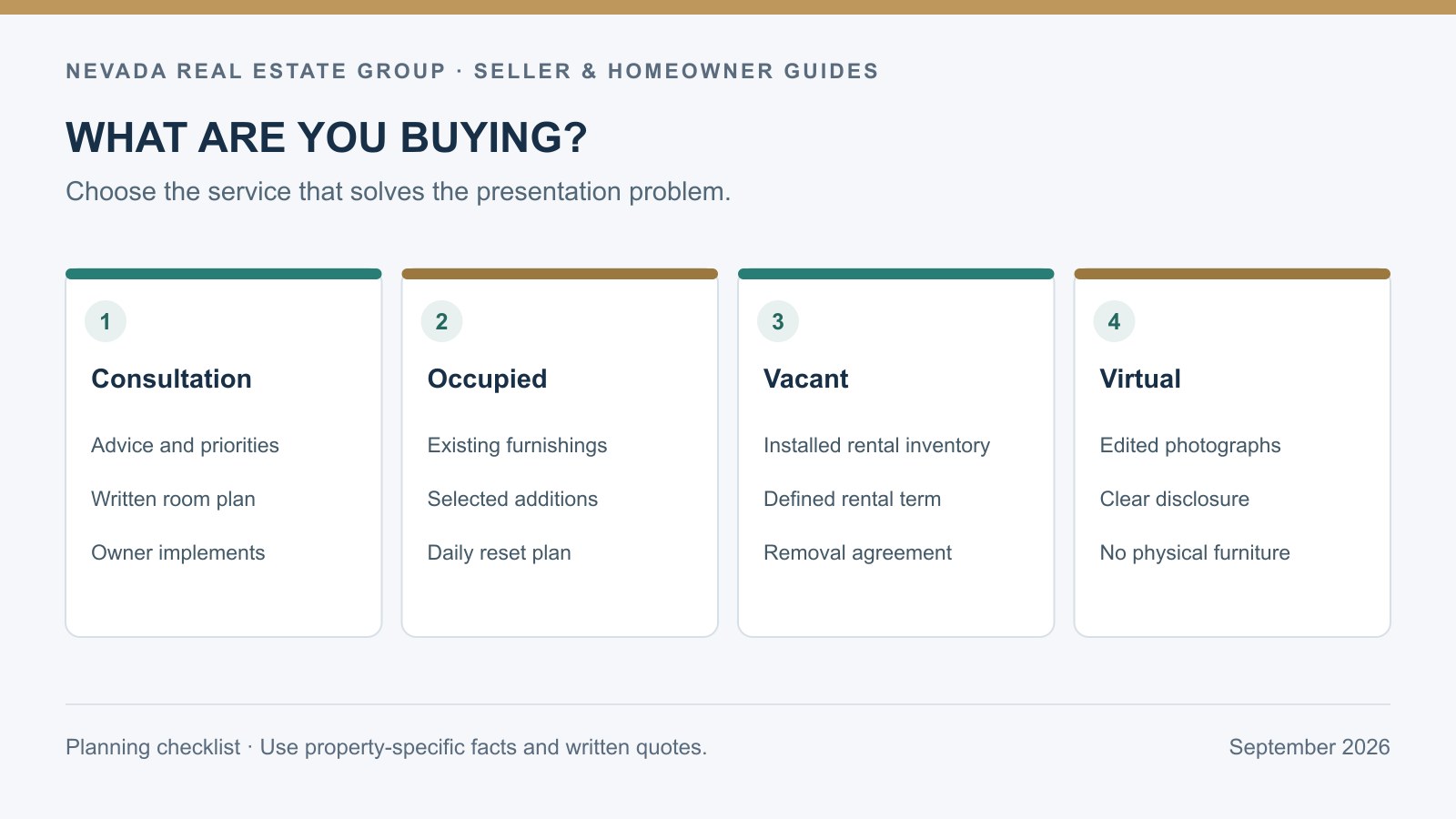
Occupied staging works with a home people still use. It may involve advice, rearranging existing furniture, removing excess pieces, and adding selected accessories or furnishings. Vacant staging installs furniture in an otherwise empty property, usually under a rental agreement. Virtual staging changes photographs by adding digital furnishings; it does not change what a buyer experiences inside the property.
| Approach | What you purchase | Main budget questions |
|---|---|---|
| Consultation | A walkthrough and preparation recommendations | Written plan? Follow-up? Who performs the work? |
| Occupied styling | Arrangement using existing items plus agreed additions | Labor, storage, rentals, and reset expectations |
| Vacant staging | Delivered furniture and accessories for specified rooms | Minimum term, extension charges, removal, damage terms |
| Virtual staging | Digitally furnished photographs | Image count, revisions, disclosure, and photography |
Choose the approach that solves the presentation problem. If buyers cannot understand where a dining table fits, a room layout may matter more than decorative accessories. If the house is already furnished coherently, a consultation and editing pass may be enough. If it is vacant, decide whether selected rooms can explain the home without furnishing every bedroom.
Hybrid plans are possible, but define them carefully. A physically staged living area paired with virtually furnished secondary bedrooms creates different in-person conditions. Label the photographs appropriately and prepare the agent to explain which furnishings are present. Do not assume every provider offers every combination or that combining services always costs less.
The best starting document is a room-by-room scope with one sentence explaining the purpose of each intervention. “Make the living room's circulation obvious” is a clearer goal than “make it luxurious.” It also gives you a way to evaluate whether the final result delivers the service you purchased.
What Should an Occupied-Home Staging Plan Include?
An occupied-home plan needs to work on an ordinary weekday, not just for a photograph. Identify which furnishings stay, which leave, where removed items go, and who does the lifting. Set expectations for beds, desks, pets, toys, and daily storage. A plan that prevents the household from functioning will be difficult to maintain through showings.
Start with the largest visual and circulation problems. A room may have enough space but contain too many pieces, or furniture may make the route between doors look awkward. Measure before renting replacements. If you remove a desk, decide where work happens during the marketing period. If you pack kitchen items, keep a practical set available. The goal is clear presentation with a manageable daily reset.
Separate labor from purchases. A written consultation can leave the owner responsible for shopping, rearranging, packing, hanging artwork, and disposing of unwanted items. If you want the provider to complete those tasks, include them in the quote. Ask whether accessory rentals are optional, whether fragile items must be removed, and who is responsible for returning borrowed pieces.
According to NAR's 2025 staging research, decluttering and cleaning were among agents' most common seller recommendations. Use that as a reason to evaluate basic preparation before paying for more inventory. It is not a promise that an occupied home will need no professional work.
Take a test photograph of each priority room after the first pass. It can reveal distracting items that are easy to overlook in person. Keep the final arrangement simple enough that the household can reproduce it for showings without a professional returning every time.
When Does Vacant Staging Deserve the Larger Commitment?
Vacant staging is worth considering when furniture helps explain proportions, function, or a challenging floor plan. Empty spaces can leave buyers guessing about how a room works. But an empty home is not automatically a full-house staging project. Identify the rooms where an installation is most likely to improve understanding, then obtain both a focused-room quote and a broader alternative.
Ask the stager to identify the proposed furniture scale and style. Oversized pieces can make a room difficult to navigate; very small pieces can give a misleading impression of usable space. The plan should show reasonable pathways and believable everyday use. Request recent examples of comparable work, while recognizing that photographs of another project do not specify the inventory available for yours.
Access affects the job. Tell the provider about stairs, elevators, narrow driveways, loading restrictions, gated access, and any association scheduling requirements. Confirm that utilities will be active and cleaning complete before installation. Ask how the company handles unexpected access problems, delayed keys, or a property that is not ready on the agreed date.
Before signing, understand minimum rental commitments, cancellation terms, damage responsibility, permitted use, and removal scheduling. If the home goes under contract quickly, the contract may still require the minimum charge. If closing is delayed, furniture may need to remain longer than expected. A purchase contract's dates do not automatically modify a staging agreement.
Also decide whether furniture stays through inspections and final walkthroughs. Buyers should understand which items are excluded from the sale. Put the removal plan on the transaction calendar and coordinate it with the listing agent, stager, and household. The installation is only one part of the commitment; the exit needs a plan too.
How Do Rental Extensions Change the Total Staging Bill?
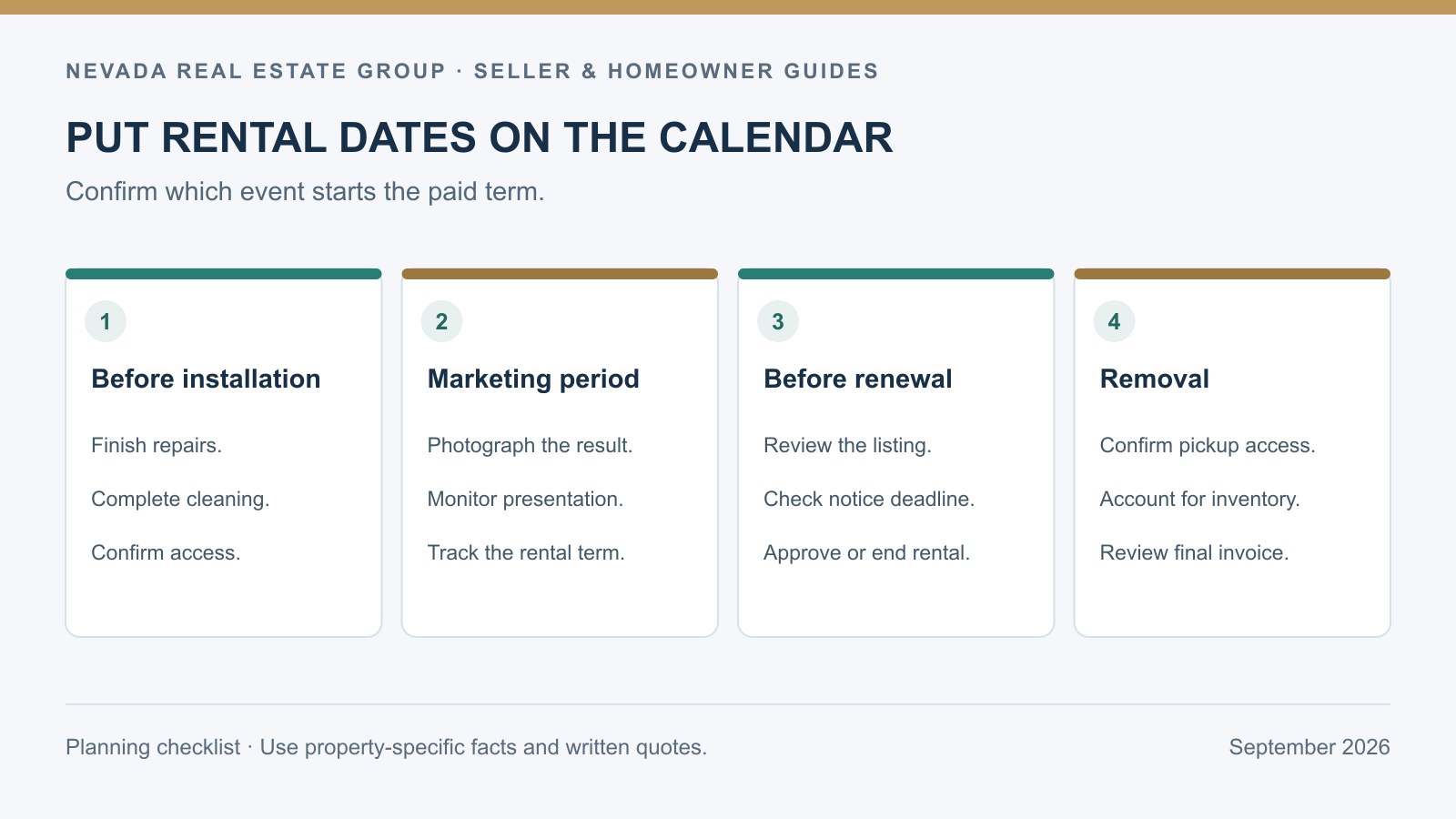
Calculate the full initial term and at least one extension before approving vacant staging. Ask whether the term begins when you sign, when furniture arrives, or when the listing launches. A delayed photo appointment or unfinished repair can consume part of a paid period before buyers see the property. Confirm whether extensions are automatic and how much notice is required to stop them.
The following numbers are an illustrative September 2026 contract exercise, not observed Reno prices. Imagine a proposal with a $2,400 initial installation and rental package, $300 removal charge, and $600 for each additional 30-day rental period. It would total $2,700 within the initial term, $3,300 after one extension, and $3,900 after two. Taxes, damage charges, insurance, and other items are excluded unless the hypothetical agreement says otherwise.
| Timing | Calculation | Illustrative total |
|---|---|---|
| Within initial term | $2,400 package + $300 removal | $2,700 |
| One extension | $2,700 + $600 | $3,300 |
| Two extensions | $2,700 + $1,200 | $3,900 |
Read the notice requirement alongside the price. A seller can intend to remove furnishings before a renewal and still incur another charge if the required notice or access was not provided. Ask whether a partial additional period is prorated; do not assume it is. Identify who tracks the renewal date and who has authority to extend the agreement.
Set a review before that date. Compare the listing's activity, likely closing schedule, and remaining marketing needs. The choice may be to renew, reduce the installation, or remove it, depending on the contract and available alternatives. Treat the extension as a fresh budget decision rather than an expense that quietly continues because nobody checked the calendar.
Which Rooms Should Get Attention First?
Prioritize the rooms that explain how the home lives. The main gathering area, primary bedroom, kitchen, and any confusing flex space are useful starting points. Your property's layout matters more than a universal checklist. A small home with an obvious floor plan may need less furniture than a larger home whose connected spaces are difficult to distinguish in photographs.
According to NAR's 2025 staging survey, buyer agents ranked the living room, primary bedroom, and kitchen as the most important rooms to stage. That national ranking can help begin a discussion. It does not mean every Reno seller should buy the same package or leave another important room untreated.
Look at the first set of listing photographs as a sequence. Does it establish the entry, main living space, kitchen connection, bedroom arrangement, and useful outdoor area? If an image raises a question about function, address that question with a sensible arrangement, a truthful caption, or a floor plan. More accessories are not always the answer.
For secondary bedrooms, decide whether furniture adds necessary information. A plainly presented room with accurate dimensions can sometimes be enough. If it will be virtually staged, show an appropriate scale and retain the actual room image. Do not turn a small room into a digital office, gym, and guest suite simultaneously if that arrangement would not work in person.
Use a priority order when comparing bids: essential rooms, useful additions, and optional decoration. That lets you reduce scope without dismantling the purpose of the plan. It also keeps a limited preparation budget available for repairs, cleaning, photography, and the other work buyers will notice once they arrive.
What Should Be Finished Before the Stager and Photographer Arrive?
Complete messy work before furnishings are installed. Paint, flooring work, dusty repairs, and substantial cleaning can damage rented pieces or force the stager to return. Create one schedule that identifies the repair completion date, cleaning date, staging installation, photography, and listing launch. Leave room for a delay rather than booking each step so tightly that one late delivery disrupts everything.
According to the Nevada State Contractors Board, consumers should check contractor licensing and obtain written bids. When pre-listing work requires a contractor, confirm qualifications and the scope before scheduling staging around a promised completion date. A furniture installation does not substitute for addressing a property problem or obtaining any required approval for the work.
Prepare the home for photography with a specific room checklist. Replace failed bulbs, clear counters appropriately, tidy visible cords, clean windows where practical, and remove personal documents and valuables. Avoid heavy fragrances that merely mask an unresolved odor. If there is a known defect, handle it and the required disclosure with the appropriate professionals; do not use styling to conceal it.
Tell the photographer which features matter and which items are temporary. Confirm whether floor plans, exterior images, twilight photography, or additional editing are included or separately priced. If weather or unfinished exterior work could affect the shoot, agree on a rescheduling plan. Verify usage rights and delivery arrangements before assuming the images can be reused across every channel.
After the shoot, review the actual images with the listing agent. Look for inaccurate color, misleading wide-angle effects, visible private information, and a mismatch between the photograph and the property. A polished presentation should make the home easier to understand, not create a surprise at the showing.
How Much Does Virtual Staging Cost, and What Does It Leave Out?
Virtual staging can be a lower-cost way to explain an empty room in photographs, but it purchases an image service. You still need suitable original photographs and a property that is ready for in-person visits. It does not provide furnishings, improve the building, eliminate cleaning, or resolve a floor-plan limitation. Evaluate the digital service separately from those other preparation costs.
According to BoxBrownie's published virtual-staging page, its price checked September 24, 2026 was US$30 per image. At that published rate, four images would be $120 before any separately ordered services. This is an online provider's advertised price, not a Reno photographer's bundled fee or an endorsement. Confirm current pricing, revisions, turnaround, licensing, and any additional editing before ordering.
Make the brief precise. Identify the intended room use, request plausible furniture scale, and specify that permanent property features must remain accurate. Review windows, walls, flooring, fixtures, exterior views, and room proportions in the returned image. Ask for correction if the editing changes something that is not actually part of the proposed service or makes the room misleading.
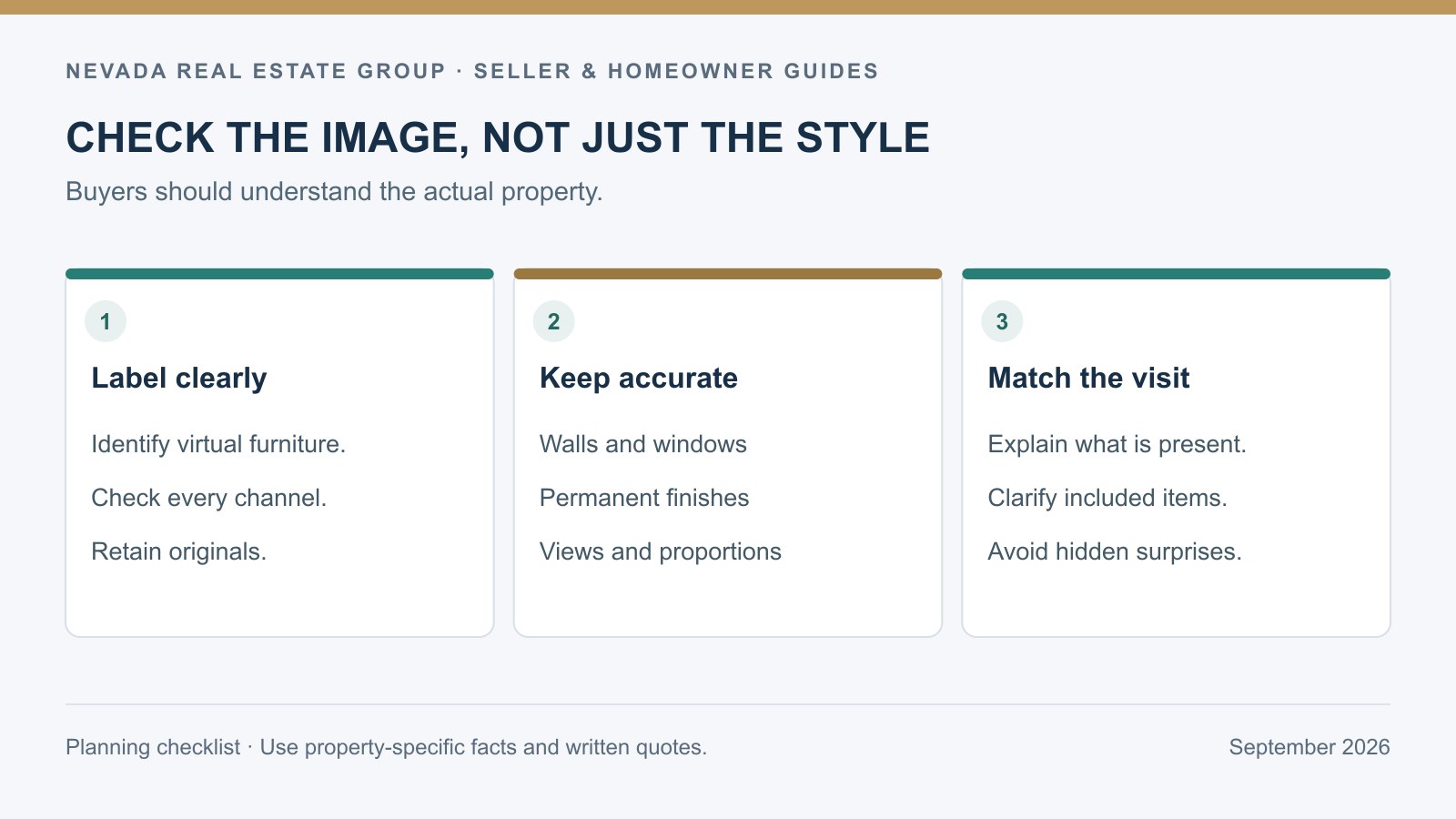
Keep the original images alongside the finished files, with a naming system that prevents an edited version from being mistaken for an unaltered photograph. The listing agent should confirm current MLS and advertising requirements before upload. Add clear virtual-staging disclosure and an unaltered comparison image as a practical transparency standard; the exact required placement and presentation should follow the rules applicable to the listing.
Finally, prepare buyers for the in-person condition. If a virtually furnished room is empty, make that clear in the marketing. Digital styling works best when it helps someone imagine a reasonable use of a real space and leaves no uncertainty about what exists today.
How Do You Keep Staging Photos Honest?
Separate temporary furnishings from proposed renovations and from existing property features. A digitally added sofa communicates an arrangement. A digitally removed wall or repaired roof communicates a different property. Do not present those images as equivalent. If a renovation concept is used at all, it needs clear labeling and professional review appropriate to the listing, rather than being mixed casually into ordinary property photographs.
According to Article 12 of NAR's 2026 Code of Ethics, REALTORS must communicate truthfully and present an accurate picture in marketing. For a seller, that means reviewing the final image package for what it implies, not only whether it looks attractive. The agent also needs to apply current MLS requirements; this guide does not replace those rules.
A useful review asks three questions. Can a buyer tell which furnishings are virtual? Do permanent features match the property? Can the original condition be understood without guesswork? Check the image captions and listing description together. A small disclosure in one location may not travel with a photograph when it appears elsewhere, so discuss how the marketing channels handle it.
Physical staging needs clear expectations too. Tell buyers whether furniture, light fixtures, appliances, or decorative items are included, excluded, or negotiable. Temporary arrangements should not block access to areas an inspector or buyer needs to see. If staging pieces are removed during the sale, coordinate the change so nobody mistakes it for removal of an included item.
Trust is part of presentation. A showing that matches the online story gives buyers a clear basis for judging the home. A beautiful image that conceals a material difference can create friction at precisely the moment the seller wants a straightforward decision.
What Questions Make Two Staging Quotes Comparable?
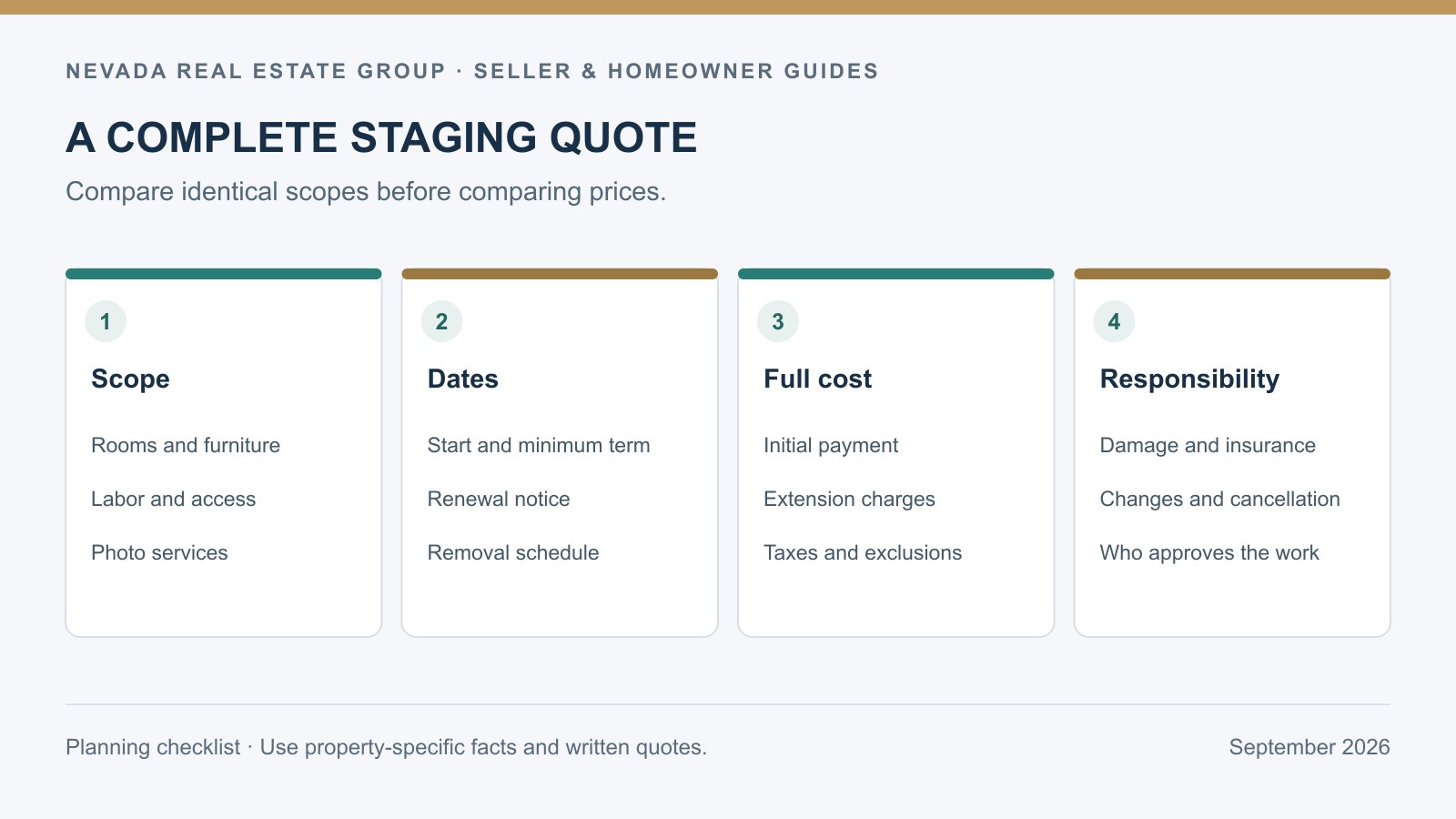
Give each provider the same brief. Include the address, occupancy, room list, approximate desired start date, expected marketing plan, access restrictions, and photographs. Ask the provider to separate required work from optional additions. If one quote includes a much larger scope, request a version that matches the other before deciding that the company is simply more expensive.
| Item | What to confirm | Why it affects the budget |
|---|---|---|
| Rooms and inventory | Specific rooms, major pieces, accessories, substitutions | Defines the actual installation |
| Labor and access | Delivery, setup, stairs, loading, and removal | Prevents incomplete comparisons |
| Rental term | Start date, minimum term, renewal, notice, proration | Controls the cost if timing changes |
| Photography | Included services, image rights, digital editing | A staging quote may exclude the photo package |
| Responsibility | Damage, permitted use, insurance, cancellation | Identifies costs outside the headline price |
| Payment | Deposit, balance, taxes, refund terms | Shows when cash is required |
Ask who will be present for installation and who approves the completed arrangement. Identify how disagreements, missing pieces, or changes are handled. A written room list and a few approved reference examples can reduce uncertainty without pretending you are purchasing every object shown in a portfolio image.
Keep an agreed change process. If the stager recommends another room after arrival, ask for the added cost and term before approving it. If the seller changes the listing date, notify the provider promptly and obtain updated dates in writing. Informal assumptions can become expensive when furniture and labor have already been reserved.
The least expensive quote is not necessarily the best value, and the most elaborate package is not necessarily the right fit. Choose the proposal that addresses your property's presentation needs with understandable obligations and a total your selling plan can support. Keep the signed agreement somewhere the person managing the listing calendar can find it.
Can Staging Replace Repairs or an Appropriate Asking Price?
No. Staging can clarify the home's presentation; it cannot establish a value unsupported by comparable properties or remove a building problem. An attractive living room will not make a difficult showing schedule, an unresolved repair, or an unrealistic asking price disappear. Evaluate these issues separately so a staging expense is not asked to solve the wrong problem.
Distinguish a cosmetic distraction from a condition concern. Excess furniture, an unclear room purpose, or poorly chosen accessories are presentation issues. Water intrusion, a failing system, or an unsafe feature requires appropriate assessment and handling. Fixing or disclosing a problem and negotiating the transaction is different from styling around it. Ask your agent how the proposed preparation fits with the property's condition and competition.
Do not budget a guaranteed sale-price premium from staging. Published survey responses describe reported experiences, not a controlled experiment establishing what your home will sell for. The sensible budget question is whether the presentation improvement is worth the documented expense within the whole sale plan. Consider the property, buyer alternatives, and the amount of cash you can comfortably commit.
If the home is already listed, review the feedback before ordering more furniture. Are buyers confused about layout, or are they comparing the price unfavorably with similar homes? Are photographs weak, or are people unable to obtain convenient showings? A focused correction is more useful than a general instruction to spend more.
Discuss these distinctions with a local listing professional using current competing properties in Reno or Sparks. The right preparation supports a credible asking price and an honest showing experience. It is one part of that work, alongside condition, access, marketing, and negotiation. Our home value estimator provides an initial reference for the pricing discussion, not an appraisal or a staging-return calculation.
How Should You Plan Photo Day, Showings, and Furniture Removal?
Work backward from a realistic listing launch. Confirm when the home will be ready, when the stager can install, and when the photographer can capture the finished arrangement. Then allow time for image delivery and review before publication. An announced launch date is not a reason to photograph unfinished work or accept inaccurate edits.
Create a short reset checklist for showings. Keep it focused on tasks the household can repeat: clear key surfaces, tidy bedding, restore furniture positions, manage pets, and secure private items. For a vacant home, identify who checks lights, temperature, cleanliness, and access. The provider's installation may be a one-time service rather than ongoing property management.
Review activity before the rental-renewal deadline and again when the home goes under contract. Decide when furnishings can be removed without undermining remaining marketing or interfering with inspections and the final walkthrough. Confirm access and pickup dates with the provider. Do not promise included furniture to a buyer when it belongs to the staging company.
At removal, document the property's condition, ensure all rented items are accounted for, and reconcile the final invoice against the agreement. If there are damage or additional-term charges, ask for the supporting detail. Keep records with the other sale expenses rather than trying to reconstruct them later.
Nevada Real Estate Group can help you decide what your home needs before you spend. Call (775) 277-2120 or contact us with the address, occupancy, and preferred timing. We can discuss the preparation and listing sequence; any staging services, vendor arrangements, or costs should be agreed in writing for your specific property. If you are also purchasing, use our buyer resources and mortgage calculator to keep the next-home budget separate from preparation spending. Discuss the service terms with our team, including the 7-day listing agreement, and read the actual agreement. Start with a clear scope and a complete budget, then use the presentation to help buyers understand the home you are actually selling.
Frequently Asked Questions
What is the average cost of home staging in Reno?
This guide does not have a verified Reno-wide average. NAR's national 2025 survey reported a $1,500 median for professional staging services, but scopes and rental terms vary. Obtain written local proposals for your address and room list, including delivery, removal, extensions, photography, and any separately charged items before deciding what to budget.
Can I stage a Reno home while living in it?
Yes, occupied staging can work with your existing furniture and selected additions. Agree on what is removed, who moves it, where it is stored, and how the home will function between showings. Ask whether the quote covers advice only or hands-on implementation. The arrangement needs to be practical enough to maintain throughout the marketing period.
Do I need to stage every room of a vacant home?
Not necessarily. Request a focused-room proposal that explains the main living spaces and any confusing layout, then compare the incremental cost of additional rooms. Furniture should help buyers understand use and scale. The right scope depends on the property, photographs, competing listings, and budget rather than a fixed rule to furnish everything.
What happens to staging costs if my home does not sell quickly?
The contract determines whether the rental renews, what another period costs, and how much notice removal requires. Calculate at least one extension before signing and put a review date ahead of the notice deadline. A delayed closing can also affect the schedule. Do not assume unused days are refunded or partial periods are prorated.
Is virtual staging cheaper than renting furniture?
It can have a much smaller image-service charge, but it provides something different. The house remains unfurnished during visits, and you still need photography, cleaning, and appropriate preparation. Compare the total package and the problem you want to solve. Label the digital work clearly and confirm current MLS and advertising requirements before publication.
Does the real estate agent always pay for staging?
No. Arrangements vary by agent, provider, property, and agreement. Ask what the listing service includes, what the seller pays separately, and whether any payment is due upfront or subject to repayment. Do not infer that furniture rental or a photography package is included because another seller received it. Put the agreed scope and responsibility in writing.
Will staging guarantee a higher sale price?
No. Staging may improve how buyers understand the home, but its outcome depends on the property and market. It does not replace appropriate pricing, necessary repairs, or truthful marketing. Evaluate the expense as part of the overall selling plan and avoid relying on an assumed percentage premium to justify a package you cannot otherwise afford.
Which Sources Inform This Reno Staging Budget Guide?
Reviewed September 24, 2026. National survey results, a published online image-service price, and a local provider's service description are identified separately. No private vendor quote or Reno-wide staging-price study is claimed.
- NAR: 2025 Profile of Home Staging release and methodology
- Diaz Design: Reno-area staging services and quote request
- BoxBrownie: virtual-staging service and published pricing
- NAR: 2026 Code of Ethics, Article 12
- Nevada State Contractors Board: working with contractors
Chris Nevada · Nevada Real Estate License S.181401 · Nevada Real Estate Group · LPT Realty · (775) 277-2120.