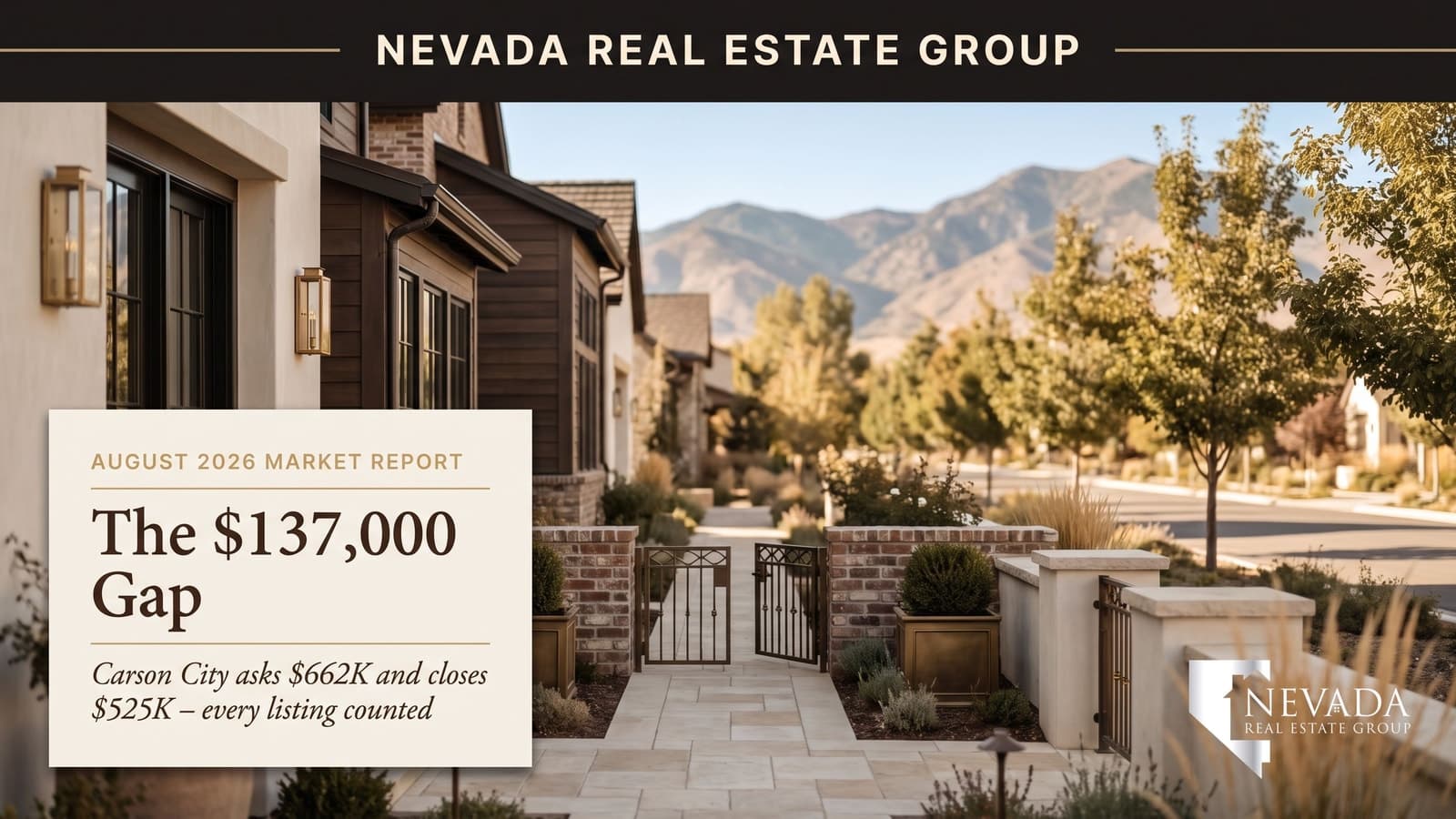

Every market has a gap between what sellers ask and what buyers pay. Carson City's is the widest in Nevada, and it isn't close: the median active listing asks $662,000 while July's median closing settled at $525,000 — a $137,000 spread that explains the state-leading $39,900 price cuts, the 56-day clock, and nearly everything else about how the capital's market actually works in August 2026.
Every figure below comes from a complete sweep our team ran on August 23, 2026 — all 272 active Carson City listings on the NNRMLS board, examined individually, plus the 59 July closings that had posted by that date; July settled at 86 once the month finished posting (see the restatement below). A mid-size market, fully counted, with sample sizes stated where they matter.
Carson City in August 2026 runs Nevada's widest ask-to-close gap: a $662,000 median asking price against July's settled $510,000 median closing ($602,500 single-family; 86 sales counted September 15), at $314 per square foot. 33.5% of the 272 active listings have cut price at a state-leading $39,900 median, sales run a 55-day clock, and 52.3% of July's 86 closings settled below asking. Buyers who price to the closings, not the asks, hold the leverage.
Restated September 15, 2026. The July closing figures in this report were counted on August 23, when about 70% of July's sales had posted to the MLS feed; closings keep posting for five to six weeks after a month ends. Fully posted, July shows 86 closings, not the 59 this report originally counted, at a $510,000 median ($602,500 single-family), 98.8% of list, 52.3% below asking, $314 per square foot and a 55-day median clock. The medians moved within a few percent and the conclusions stand; the active-listing figures, counted the same day, are unaffected. The Direct Answer and snapshot table above carry the settled figures; percentages elsewhere in the body reflect the August 23 count. The September 2026 edition carries the settled month in full, and this series now waits for a month to settle before counting it.
- Median ask $662,000 vs median July close $525,000 — Nevada's widest listing gap at $137,000.
- State's largest median price cut: $39,900, across 33.5% of the 272-listing board.
- July: 59 closings at $525,000 all-types / $595,000 single-family and $314 per square foot.
- 56-day median market time — Nevada's longest, the cost of aspirational anchoring.
- Buyer rule for the capital: negotiate from the closing bench, never from the asking board.
What Are Carson City's Numbers for August 2026?
| Metric | Value | Sample / context |
|---|---|---|
| Active listings | 272 | The complete capital board |
| Listings with a price cut | 33.5% | 91 of 272 — Nevada's lowest big-board share |
| Median price cut | $39,900 | Nevada's largest, by a wide margin |
| Median active list price | $662,000 | The aspirational anchor |
| July closings | 86 (59 posted by Aug 23) | Read July stats with this n |
| July median sale — all types | $525,000 | $137,000 under the asking median |
| July median sale — single-family | $595,000 | 47-day median |
| Median sale-to-list | 98.7% | 54% below ask, 12% above |
| Median price per square foot | $314 | Between Reno's $339 and the southern benches |
| Median days on market | 56 | Nevada's longest big-board clock |
The pairing to study: the lowest cut share in the state (33.5%) next to the largest cuts ($39,900). Carson City sellers resist the market longer than anyone in Nevada — and then concede more than anyone when they finally do. That is the statistical signature of anchoring, and it is the whole report in two numbers.
Two framing notes before the sections below lean on these figures. First, the windows: the active board, its 33.5% cut share, and the $662,000 asking median are as of the August 23, 2026 sweep; every closing statistic — $525,000, $314 a foot, 98.7% of list, 56 days — comes from the 59 sales recorded in July 2026, and a 90-day ZIP-level window further down checks them against a larger sample. Second, the scale of the gap in context: $137,000 is 26% above where the market actually clears. Reno's July closing median sat above its asking median; Sparks closed within $500 of its list median; Henderson's gap was $64,560 and the Summerlin corridor's $114,000. Carson City's spread beats the next-widest in the state by $23,000. A buyer who negotiates from the asking board here starts a quarter too high before the first counter, and a seller who prices to the asking board is pricing to a number July's buyers did not pay — which is the cleanest one-sentence explanation of the 56-day clock this report can offer.
Why Is Carson City's Ask-to-Close Gap the Widest in Nevada?
Three ingredients, each structural:
The board skews aspirational by composition. Carson City's active inventory is heavy with the properties that always anchor high: view homes in the western foothills, acreage on the valley edges, and estate properties priced to their owners' decades rather than their comps. According to U.S. Census Bureau housing data, the capital's housing stock runs older and larger-lot than any Nevada metro — and older, larger, view-adjacent stock is precisely where sentiment pricing lives.
The closings skew practical. What actually sold in July — 59 transactions — concentrated in the livable middle: $450,000–$650,000 single-family homes near the schools and the state-employment core. The buyers are state workers, Reno spillover priced out of Washoe's $668,500 single-family bench, and retirees trading coastal equity for capital quiet. They buy the middle; the board lists the dream.
Thin volume slows truth-finding. With five dozen closings a month, an overpriced Carson City listing can wait a long time before the market's verdict arrives — and the $39,900 median cut measures exactly how much verdict accumulates while it waits. According to the Sierra Nevada REALTORS, the broader Northern Nevada correction has been gradual all year; Carson City's version is the same correction arriving in fewer, larger installments.
What Did Carson City Homes Actually Sell For in July?
All 59 closings — with the small-market caveat that a $525,000 median built on 59 sales moves with mix, so read the distribution alongside it:
- All-types median: $525,000; single-family: $595,000 in a 47-day median. The single-family figure sits $73,500 under Reno's equivalent — the capital discount that keeps pulling Washoe spillover south.
- $314 per square foot — the honest bench, and the number that survives the small-sample noise better than the price median. A 1,800-square-foot Carson home benches at about $565,000.
- 54% closed below asking, 12% above, at a 98.7% median ratio. The at-the-table concession is ordinary; the pre-offer concession — that $39,900 cut — is where Carson City's real discounting happens.
- The 56-day overall clock hides the same two-lane structure as Reno's: the practical middle closed in five to six weeks; the aspirational tail either cut its way to a sale or is still on the board, aging into next month's statistics.
The bench turns into a price test with one multiplication, and in a 59-closing market it is the only test with enough data behind it. At July's $314 a foot, a 1,400-square-foot North Carson ranch benches at about $439,600, a 1,800-square-foot core two-story at roughly $565,200, and a 2,600-square-foot west-side view home near $816,400 — before the adjustments for view, acreage, and vintage that, in our experience, move a specific Carson City house 10% or more to either side of the bench, the widest band in Northern Nevada because the capital's stock ranges from 1880s brick to last year's stucco. The 34% of July's closings that settled exactly at list are the practical middle in its purest form: sellers who opened at the comp and got the comp, without a cut and without a counter. Add the 12% that closed over ask and nearly half of Carson City's July sellers collected at least their full asking price — a figure that sits oddly beside the state's largest median cut until you remember that the two groups are different sellers with different anchors.
How Do Carson City's Areas Compare?
| Dimension | Central / historic core | West side / foothills | North Carson / new growth | Valley edges / acreage |
|---|---|---|---|---|
| Typical band | $400K–$600K | $600K–$1.2M+ | $450K–$700K | $550K–$1M+ |
| August speed | The volume core — steadiest | Slow — view pricing negotiates | Fastest for newer stock | Slowest — acreage waits for its buyer |
| Cut behavior | Small, infrequent | Large — the $39,900 median lives here | Moderate | Largest and latest |
| Buyer profile | State workers, first-timers | View buyers, Reno equity | Families, commuters | Retirees, horse property, privacy |
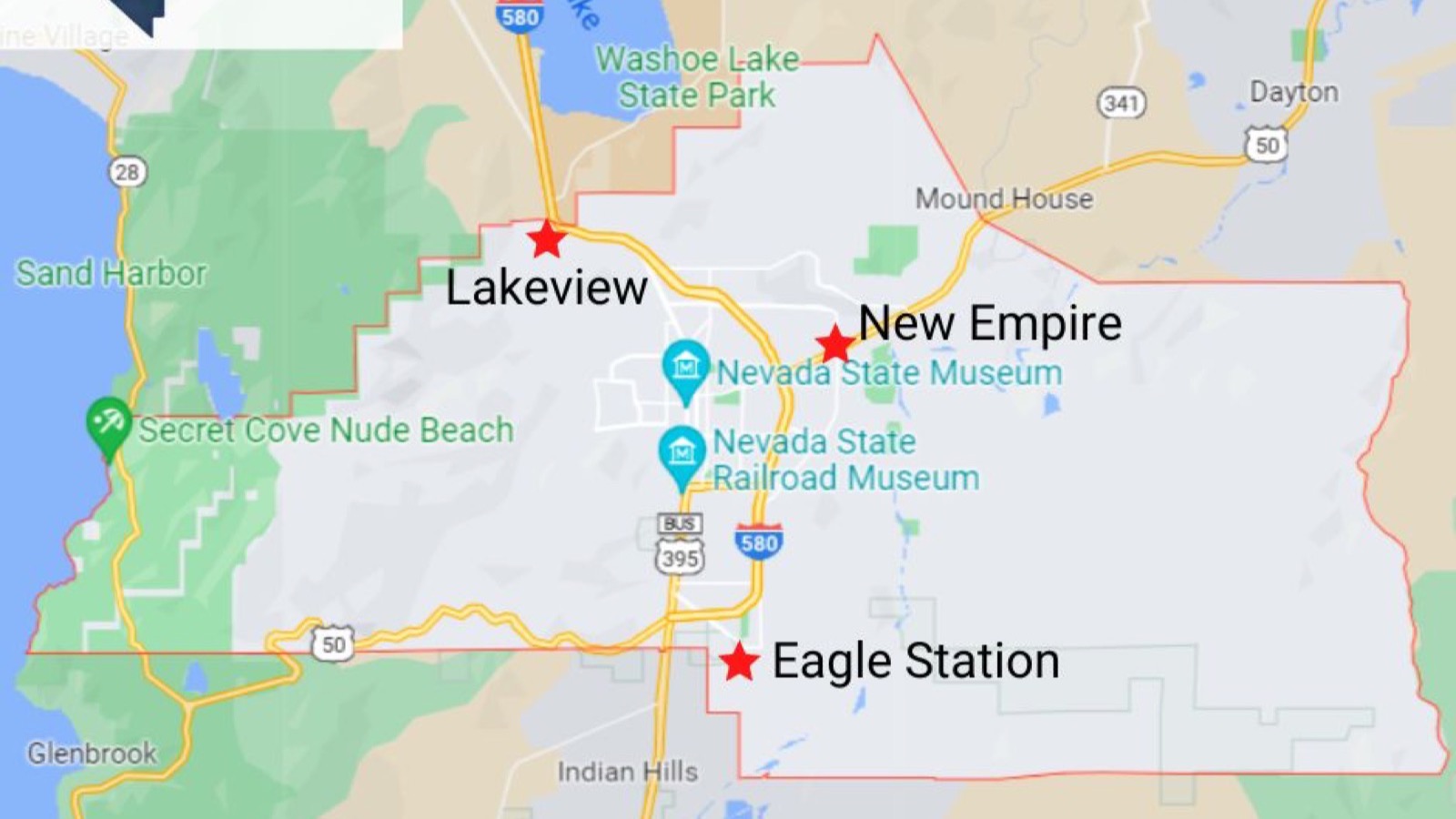
The historic core is the capital's honest market — walkable blocks near downtown where pricing stays close to the bench and the 12% over-ask sales concentrate. The west-side foothills and the acreage edges are where the $137,000 gap is manufactured: properties genuinely unlike their neighbors, priced by owners who know it, meeting buyers who agree in principle and disagree by $80,000.
The 90-day ZIP record further down puts numbers under each column. In the 90 days ending September 6, 2026, according to our analysis of Northern Nevada Regional MLS data via Repliers, 89703 — the west side and the foothills below Lakeview — carried a $694,500 median ask against a $612,500 median closing, an $82,000 gap, on the fastest clock in the city at 41 days. 89701, the core and the east side around Empire Ranch, closed 73 sales at $482,000 against a $519,538 ask — the narrowest gap of the four ZIPs. And 89705, the south end through Indian Hills and Jacks Valley, carried an $836,250 median ask against a $544,000 median closing: a $292,250 gap on 32 closings and a 61-day clock. The area table's "valley edges" column is not a figure of speech; it is a ZIP code, and it is where the capital's ask-to-close gap is manufactured.
Who Is Buying in Carson City Right Now?
The demand base is the steadiest in Northern Nevada, because most of it doesn't cycle with rates. State employment anchors the middle — according to the State of Nevada, the capital's government core provides the payroll stability that keeps the $450,000–$650,000 band absorbing through every rate environment. Reno spillover feeds the top: households priced out of Washoe's $668,500 single-family bench find the same Sierra-adjacent life thirty minutes south at a $73,500 discount. Retirees anchor the edges — the acreage and single-story stock, the Carson Tahoe Health system's draw, and Nevada's tax posture keep the equity-buyer stream steady; according to the Nevada Department of Taxation, the state's absence of income tax remains the single most cited relocation driver among the retiree cohort, and the capital collects more than its share of them.
What Carson City lacks, almost completely, is speculative demand — no short-term-rental economy of scale, no investor churn. Like Boulder City in the south, it is bought to be lived in, and its values behave accordingly: slow to spike, slow to crack, stubborn in the middle.
The ZIP record puts a number on the spillover discount. In the 90 days ending September 6, 2026, Reno's 89521 — Damonte Ranch and South Reno, the relocation corridor — closed at a $697,000 median, while Carson City's west-side 89703 closed at $612,500 and its core 89701 at $482,000, according to our analysis of Northern Nevada Regional MLS data via Repliers. A household that cannot clear South Reno's bench finds the same Sierra-adjacent life $85,000 to $215,000 cheaper thirty minutes south, and that arithmetic — not marketing — is what keeps the second buyer stream flowing into the capital every quarter.
What Should Carson City Buyers Do With This Market?
The gap is your instruction manual:
- Negotiate from the closing bench, never the asking board. The board says $662,000; the closings say $525,000. Every offer conversation in Carson City should begin with the last 90 days of closed comps for that specific product — and with $314 a foot as the sanity line.
- Target the pre-capitulation tail. Listings at 45–70 days that haven't yet cut are sellers mid-education; a well-evidenced offer 6–9% under ask frequently lands there, saving both sides the public $39,900 step.
- Respect the honest middle. Bench-priced central-core homes still draw the 12% over-ask competition — the gap play doesn't work on accurately priced stock, and lowballing it just loses you the house.
- Price the well-and-septic reality on the edges. Much of the acreage stock runs private systems; according to Nevada Division of Environmental Protection guidance, inspections and certifications there are their own workstream — budget the time and the $1,500–$3,000 of diligence.
- Model Carson against both neighbors. Thirty minutes north, Reno's single-family bench runs $73,500 higher; twenty minutes east, the Dayton corridor runs meaningfully cheaper. The capital's value case is strongest for buyers who price all three — our Carson City vs Reno comparison runs the full trade.
What Should Carson City Sellers Do in September?
The market's message to sellers is unusually specific here:
- Price to the closings and skip the $39,900 lesson. The capital's data says sellers who anchor eventually concede more than anywhere in Nevada — the longer resistance simply compounds the eventual cut. The 66.5% who haven't cut include both the accurately priced and the not-yet-educated; decide which you are before the market decides for you.
- If you own the view or the acreage, bring evidence, not adjectives. Unique properties still sell here — but July's closings show they sell to buyers who were shown a defensible number: an appraisal-grade comp set, documented improvements, water rights papers in order.
- Use the fall window. According to SNR's seasonal patterns, Northern Nevada's buyer pool thins sharply after October; with a 56-day median clock, a September listing priced right closes before winter — a September listing priced hopefully becomes a February cut.
- Pre-inspect the vintage stock. The capital's older housing rewards the seller who documents systems up front; every furnace surprise found after the price cut is a second negotiation you fund.
Put numbers on the anchoring tax, because it is the state's most expensive. On the $525,000 median, the 98.7% at-table ratio is a concession of about $6,800; the listing that anchors instead takes the $39,900 median public cut first and then gives the same $6,800 at the table — roughly $46,700 against the correctly priced neighbor's $6,800, plus the weeks between a five-week sale and a fifty-six-day one. The 90-day ZIP record shows what the far end of that road looks like: in 89705, the median ask sits $292,250 above the median closing, on a board where only 32 homes closed in three months. A seller there who prices to the neighbors' asking prices is pricing to a number the market has not paid all summer, and the neighbors' listings are the proof. Start the pricing conversation with the closings, not the board.
How Does Carson City Compare Across Nevada This Month?
On the statewide August scoreboard the capital is the outlier on both ends: the widest ask-to-close gap ($137,000) and largest cuts ($39,900) — but also the lowest cut share (33.5%) and among the steadiest closing benches. Reno runs faster and prices higher; Sparks undercuts both as the Truckee Meadows' entry market; and the southern metros run entirely different physics — deeper boards, faster clocks, smaller gaps. Carson City's distinction is temperament: Nevada's most patient sellers meeting Nevada's most patient buyers, with the state's payroll underneath as ballast. Corrections here are slow negotiations, not repricings.
The rest of the statewide scoreboard, from the same-day sweeps across this series, puts the capital's numbers in order. Reno carried 1,125 active listings with 43.2% cut at a $29,100 median, and its 245 July closings ran $591,250 at a full 100% of list in 49 days at $339 a foot. Sparks carried 512 with 47.5% cut at $20,000, closing at $549,000 — 99.9% of a $549,448 list median — at $304 a foot. In the south, Las Vegas proper's 991 July closings ran $430,000 at 98.8% with 43% of its 8,170 listings cut; Henderson's 334 ran $480,000 at 98.9% in 35 days; North Las Vegas's 173 ran $419,900 at 100% in 18 days; and Boulder City's twelve ran $425,000 at $325 a foot. Carson City's $314 bench sits fourth in the state, its $525,000 median fourth, its 33.5% cut share the lowest, and its $39,900 median cut the highest — the outlier on both ends, in a single column. According to the Sierra Nevada REALTORS, the association's headline statistics describe the Reno-Sparks market, which is exactly why a Carson City decision needs the capital's own count: nothing in a Truckee Meadows median describes a 59-closing market with a $137,000 gap between what is asked and what is paid.
How Do the ZIP Codes Inside Carson City Compare?
The capital has four residential ZIP codes, and the $137,000 city-wide gap is not spread evenly across them. To locate it, we pulled each ZIP's active board and its closings for the 90 days ending September 6, 2026, according to our analysis of Northern Nevada Regional MLS data via Repliers. All property types are included, the window is a rolling 90 days rather than July alone, and one boundary caveat matters: 89705 runs south from the city through Indian Hills and Jacks Valley and straddles the Douglas County line, so its row includes some addresses outside the capital proper.
| ZIP | Area | Active listings | Median ask | Closed (90 days) | Median closed | Median DOM |
|---|---|---|---|---|---|---|
| 89703 | West side / foothills (Silver Oak, Lakeview) | 90 | $694,500 | 34 | $612,500 | 41 |
| 89705 | South Carson / Indian Hills / Jacks Valley (straddles the Douglas County line) | 126 | $836,250 | 32 | $544,000 | 61 |
| 89701 | Central / historic core / east side | 139 | $519,538 | 73 | $482,000 | 49 |
| 89706 | North Carson | 59 | $440,000 | 35 | $379,900 | 50 |
Three readings. First, the gap is manufactured almost entirely in one ZIP. 89705 carried an $836,250 median ask against a $544,000 median closing — a $292,250 spread, more than double the city's — on a board of 126 listings that produced only 32 closings in 90 days and the slowest clock in the capital at 61 days. That is the acreage-and-view tail from the area table, located: the luxury and acreage listings that anchor the city-wide asking median sit here, and so does most of the $39,900 median cut. Second, the practical middle is exactly where this report says it is: 89701 closed 73 sales — more than two-fifths of the four-ZIP total — at a $482,000 median in 49 days, with a $37,538 gap between ask and close that is the narrowest in the city. Third, the west side confirms the premium is real but negotiable: 89703 closed at $612,500 in 41 days, the fastest clock of the four, against a $694,500 ask — an $82,000 gap that is the median cut, twice. And 89706, North Carson, is the entry bench at $379,900, a full $102,000 under the core, on a 50-day clock. For a buyer, the table says where the gap lives and where it does not; for a seller in 89705, it says what the market has decided about the neighbors' asking prices, and how long it is willing to wait for them to notice.
What Does the Median Carson City Home Cost Per Month?
The $525,000 July median at the current 6.65% thirty-year rate (Freddie Mac PMMS, August 21):
| Down payment | Loan amount | P&I / month | With a seller-funded buydown to 5.9% |
|---|---|---|---|
| 10% ($52,500) | $472,500 | $3,033 | $2,803 |
| 20% ($105,000) | $420,000 | $2,696 | $2,492 |
| 40% ($210,000) | $315,000 | $2,022 | $1,869 |
The 40% row is there because it describes this market's actual buyers: the equity-mover share — Reno sellers, coastal retirees — runs higher in Carson City than anywhere in Northern Nevada except the Tahoe basin. And the buydown column has a capital-specific edge: with the state's largest median cuts already on the table, converting $15,000 of an aged listing's concession appetite into rate instead of price moves the monthly payment roughly twice as far. On a market whose sellers eventually concede $39,900 at the median, the buyer who asks for the concession in the right currency wins twice.
Two ownership-cost facts belong beside the table. According to the Nevada Department of Taxation, the property-tax bill on an owner-occupied primary residence cannot rise more than 3% a year under the state's partial abatement — and for a market whose buyers are disproportionately relocating stored equity, that cap is the fiscal counterpart to the zero income tax that drew them here: the two costs a retiree most needs to be predictable are the two Nevada fixes. The 40% row makes the same point from the other side. At $2,022 a month, a $315,000 loan on the median house is a payment a state salary or a pension carries comfortably, which is why the practical middle keeps absorbing in any rate environment; the buyers who need the 10% row are the ones for whom the buydown column — $230 a month on that row — is the difference between the core and North Carson. Acreage buyers should add one more line that the table cannot: a private well and septic system carry their own inspection, certification, and maintenance costs, and on the valley edges those are part of the monthly reality, not a closing-day formality.
How Has Carson City Shifted Since the June Report?
Our June Carson City report flagged the widening gap between the board and the closings; August's sweep shows the gap institutionalized rather than resolved. Through the summer, the asking median drifted up on new aspirational inventory while the closing bench held its band — the spread grew, and the market's answer grew with it: cuts at the state-leading $39,900 median, arriving later and larger than anywhere else in Nevada.
The June figures make that drift concrete. June's report printed a $607,495 median list price, a $500,000 median sold price, 386 active listings, a 48-day median market time, and $306 per square foot. August's sweep prints a $662,000 ask, a $525,000 July closing median, 272 actives, 56 days, and $314 a foot. The gap between the board and the closings widened from $107,495 to $137,000 — the asking median rose $54,505 while the closing median rose $25,000 — the clock stretched eight days, and the board thinned by nearly 30% as summer absorbed the practical middle and left the aspirational tail behind. The per-foot bench moved $8, within noise. Every one of those movements points the same way: the record is steady, the board is drifting away from it, and the distance between the two is what a Carson City buyer negotiates into and a Carson City seller eventually pays.
According to the Sierra Nevada REALTORS, the broader Northern Nevada market spent the summer settling rather than sliding — and Carson City's version of settling is distinctive: fewer sellers capitulate, but each capitulation is bigger. According to the U.S. Census Bureau, the capital's demographics — older, more equity-rich, less mortgage-dependent than any Nevada metro — explain both halves: sellers who can afford to wait, buying from buyers who can afford to be right.
What September should tell us: where the gap closes from. Watch two numbers against this report — the $662,000 asking median and the $525,000 closing median. Ask-side narrowing (new listings pricing closer to the bench) means the education is spreading and fall belongs to realistic sellers. Close-side narrowing (buyers stretching upward) would signal genuine demand pressure — and nothing in July suggested it. A third possibility is the one July actually delivered: neither side moves, the standoff ages another month, and the 56-day clock quietly becomes 60. In a market this patient, even the stalemate is information — and September's sweep will count it the same way this one did, listing by listing.
How Was This Report Built?
Counted, not sampled, with the samples printed. All 272 active listings were swept individually — original asking price against current — which is where 33.5% and the $39,900 median cut come from. The 59 July closings posted by August 23 (86 once the month settled) were ratioed sale-against-final-list, producing the 98.7% median and the 54%-below-ask figure. The mid-size n is exactly why this report leans on the $314-per-foot bench and the ask-to-close gap over the raw price median: across 2026's monthly samples, the bench has held a tight band while the monthly median bounced with mix, and a statistic that bounces is a statistic that misleads. One more disclosure that matters in the capital specifically: NNRMLS display rules keep sold records out of public-facing feeds, so portal-derived "Carson City sold data" is built from a partial picture — these figures come from the analytical access agents hold. When the portals and this report disagree, that gap is the reason.
The ZIP-level table is this month's one addition to the method, and it deliberately uses a different window: active counts as of September 6, 2026, and closings for the 90 days ending that date, pulled ZIP by ZIP through the same analytical Repliers access to the Northern Nevada Regional MLS and including every property type. A rolling 90 days gives each ZIP enough closings — 32 to 73 — to print a median worth reading, which a single month in a 59-closing city could not; even so, the 89705 and 89703 rows at 32 and 34 closings deserve the same caution as July's city-wide figures, and 89705's Douglas County spillover is stated rather than hidden. Where the ZIP figures and the July city-wide figures disagree, the window and the boundary are the reasons, and both are labeled.
What Does This Mean for Your Carson City Move?
Buying: the gap is the opportunity — negotiate from closings, hunt the pre-capitulation tail, respect the honest middle. Selling: the data's message is blunt and kind at once — price to the bench now, because the capital's anchoring tax is the state's most expensive. Watching: track the gap itself. If the $137,000 spread starts narrowing from the ask side (sellers repricing), the correction is maturing; from the close side (buyers stretching), the market is turning. July moved neither — which is Carson City in one line.
In our experience across Northern Nevada closings, the capital's buyers are the most comp-literate in the state — they arrive knowing the Reno bench and price every Carson City listing against it — the same discipline that plays out down the valley in Dayton and Genoa. One closing calibration for the out-of-state readers this market increasingly draws: the capital's $595,000 single-family median buys a Sierra-adjacent life that would command seven figures across the California line, with no state income tax and a fifteen-minute drive to Tahoe's east shore. That arbitrage — not local dynamics — is what quietly refills Carson City's equity-buyer stream every quarter, and it is why the practical middle of this market has absorbed steadily through a rate environment that froze family markets elsewhere. The capital's buyers are largely done borrowing; they are relocating stored value, and stored value doesn't wait for the Fed. Sellers in the practical middle should read that as their demand floor; sellers on the aspirational edges should read it as their ceiling's explanation — the equity buyer who can pay any price is also the buyer least inclined to overpay one, because nobody audits a purchase like someone spending a lifetime's proceeds.
Capital-market specifics, parcel by parcel: (775) 277-2120 · current Carson City inventory · what your home would bring.
Frequently Asked Questions
What is the median home price in Carson City in August 2026?
July's 59 closings ran a $525,000 median across all property types and $595,000 for single-family homes, at $314 per square foot. The median active listing asks $662,000 — a $137,000 gap to closings that is the widest in Nevada and the defining fact of this market.
Why do Carson City homes take so long to sell?
The 56-day median — Nevada's longest — is mostly an anchoring cost. The board carries heavy view, acreage, and estate stock priced to sentiment; those listings wait, cut a state-leading $39,900 at the median, and then sell. The practical middle near the bench closes in five to six weeks, right alongside Reno.
Is Carson City cheaper than Reno?
Meaningfully: the single-family medians run $595,000 vs $668,500 — a $73,500 capital discount for the same Sierra-adjacent region, thirty minutes apart. That spread, plus state-payroll stability, is why Reno spillover has become one of Carson City's three main buyer streams.
Are Carson City sellers negotiating in 2026?
In two installments. Publicly: 33.5% of the board has cut, at Nevada's largest median of $39,900. At the table: 54% of July sales closed below ask at a 98.7% ratio. The combined message — sellers resist longest and concede most — makes the pre-cut window (days 45–70) the buyer's best negotiating moment.
Is Carson City a good place for retirees to buy?
It draws exactly that buyer for concrete reasons: single-story and acreage stock, the Carson Tahoe medical system, Nevada's zero income tax on retirement income, and small-capital pace fifteen minutes from Tahoe's east shore. The market mechanics reward retiree buyers specifically — equity purchases sidestep the rate environment, and patient timelines fit a 56-day market.
What should I offer on a Carson City home?
Build it from the last 90 days of closed comps for that product type and the $314-a-foot bench — not from the asking price, which sits a median $137,000 above where the market actually clears. On fresh, bench-priced core listings, offer close to ask; on 45-plus-day view or acreage stock, evidence-backed offers 6–9% under have been landing all summer.
How many homes actually sell in Carson City each month?
July closed 59 — a mid-size sample worth keeping in mind whenever you read a capital "median." One month of unusual mix can move the headline number $25,000; the per-foot bench and the ask-to-close gap are the sturdier signals, which is why this report leads with them.
Which Sources Inform This Carson City Market Report?
- Full NNRMLS feed sweep, August 23, 2026 — all 272 active Carson City listings and all 59 July closings, examined individually via NREG's Repliers MLS access
- ZIP-level pull, September 6, 2026 — active counts and 90-day closings for Carson City ZIPs 89701, 89703, 89705, and 89706, via NREG's Repliers access to Northern Nevada Regional MLS data
- Sierra Nevada REALTORS — regional statistics and seasonal context
- U.S. Census Bureau — Carson City profile — housing-stock and parcel composition
- State of Nevada — the employment anchor
- Carson Tahoe Health — the medical draw behind retiree demand
- Nevada Department of Taxation — the tax posture behind relocation
- Nevada Division of Environmental Protection — well and septic frameworks
- Freddie Mac PMMS — the 6.65% rate environment
- U.S. Census Bureau — demographics
- FHFA — price-trend context
Methodology: cut share measured on the complete 272-listing board (original vs current list price); sales measured on all 59 NNRMLS-recorded July closings. Sample sizes are printed beside small-market statistics deliberately — a 59-closing median deserves different confidence than a 991-closing one, and reports that hide the n are asking you not to notice. Not an appraisal of any individual home.